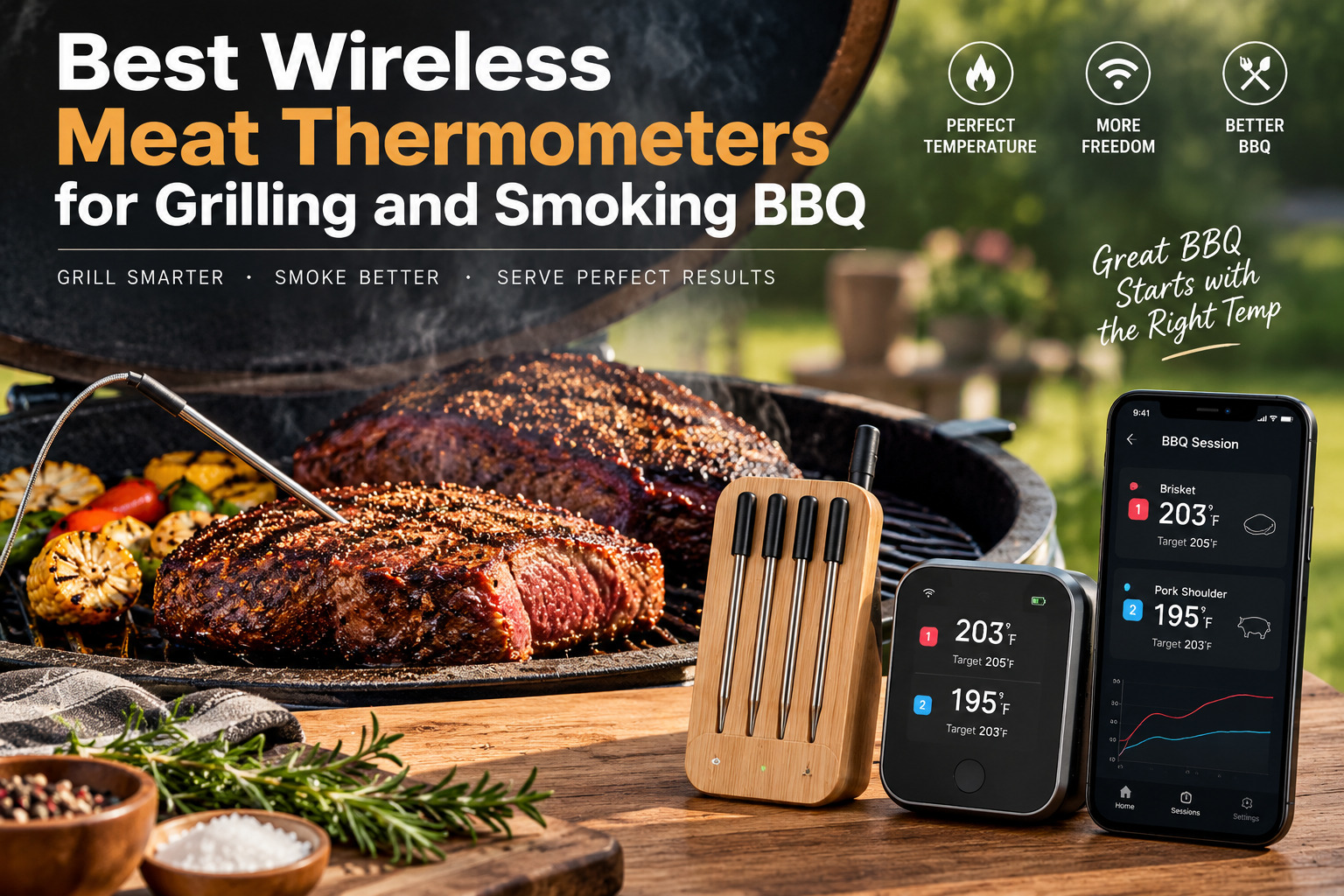
Perfect barbecue depends on much more than simply putting meat over heat and waiting. Whether you are smoking a brisket overnight, slow-cooking pork shoulder, reverse-searing thick steaks, roasting a whole chicken, or preparing several racks of ribs for a backyard gathering, temperature is one of the most important variables you can control.
That is why a good meat thermometer is one of the most useful tools a backyard cook can own.
Traditional instant-read thermometers are excellent for checking food quickly, but they require you to open the grill or smoker and physically insert the thermometer every time you want a reading. Wired leave-in probes solve part of that problem, although their cables can become inconvenient around grill lids, rotisserie equipment, foil, and multiple pieces of meat.
Wireless meat thermometers take another approach.
A wireless probe stays inside the meat while transmitting temperature information to a base station, receiver, smartphone, or cloud service. You can monitor the cook without repeatedly opening your smoker. Some systems also estimate remaining cooking time, monitor ambient pit temperature, warn about temperature changes, and track several pieces of meat simultaneously.
Modern wireless thermometers have become especially useful for low-and-slow barbecue because smoking a brisket or pork shoulder may take many hours. Instead of standing beside the smoker throughout the cook, you can monitor temperatures while preparing side dishes, spending time with guests, watching television, sleeping during an overnight cook, or simply relaxing elsewhere in the house.
However, wireless thermometers are not all the same.
Some rely primarily on Bluetooth. Others combine Bluetooth with Wi-Fi. Newer premium systems may use dedicated sub-GHz radio communication between the probe and base station, allowing better penetration through thick smoker walls and significantly greater range.
Probe count also varies. One cook may need only a single probe for a steak, while someone running a large smoker might want four or more independent probes.
Then there are differences in temperature accuracy, probe thickness, battery life, high-heat resistance, waterproofing, apps, prediction algorithms, alarms, displays, charging systems, and ambient-temperature monitoring.
This guide examines the best wireless meat thermometers for grilling and smoking BBQ and explains which type is best for different cooking styles.
Best Wireless Meat Thermometers at a Glance
For most BBQ cooks, these are some of the strongest options to consider:
| Wireless Meat Thermometer | Best For | Main Advantage |
|---|---|---|
| ThermoWorks RFX | Best overall for serious BBQ | Long-range radio connection and dedicated pit monitoring |
| MEATER Pro Duo | Best smart thermometer for most home cooks | Excellent app and two fully wireless probes |
| Combustion Predictive Thermometer Gen 2 | Best predictive thermometer | Advanced multi-sensor temperature analysis |
| Typhur Sync Gold Quad | Best for multiple meats | Four probes and very long-range communication |
| CHEF iQ iQ Sense | Best guided cooking experience | Smart presets, app guidance, and multiple probe options |
| Typhur Sync One Pro | Best single-probe value | Strong long-range connection and dedicated display |
| ThermoPro TempSpike | Best budget-friendly choice | Simple wireless monitoring at a lower cost |
| MEATER Pro | Best for steak and everyday grilling | Compact single-probe convenience and high-heat capability |
There is no single thermometer that is automatically best for every cook.
Someone smoking four pork shoulders has completely different needs from someone grilling two steaks. Likewise, a competition pitmaster may prioritize connection reliability while a beginner might prefer guided cooking instructions and automatic temperature recommendations.
The best wireless thermometer is therefore the one that matches how you actually cook.
1. ThermoWorks RFX – Best Overall Wireless Meat Thermometer for Serious BBQ
The ThermoWorks RFX is one of the strongest choices for cooks who take smoking seriously and prioritize reliability above everything else.
Many older wireless meat thermometers depend heavily on Bluetooth. Bluetooth works well under ideal conditions, but barbecue smokers create difficult wireless environments. Steel walls, thick insulation, water inside the meat, distance, buildings, and household walls can all reduce signal strength.
ThermoWorks designed the RFX differently.
Instead of depending only on a traditional short-range Bluetooth connection between the probe and your phone, the RFX uses dedicated radio communication between the meat probe and its gateway.
ThermoWorks rates the wireless connection at up to approximately 1,500 feet under line-of-sight conditions. The probe can tolerate external temperatures up to about 1,000°F and is designed with four internal temperature sensors.
That makes the RFX particularly attractive for smokers located away from the house.
Why the ThermoWorks RFX Is Excellent for Smoking
Smoking creates several conditions that can expose weaknesses in cheaper wireless thermometers.
First, a smoker may run continuously for 8, 12, 16, or even more hours.
Second, the thick steel body of many smokers can weaken wireless transmissions.
Third, serious barbecue often requires monitoring two different temperatures:
- Internal meat temperature
- Actual smoker or grill temperature
Many wireless probes put an ambient sensor at the exposed end of the same probe inserted into the meat.
That sounds convenient, but there is a limitation.
The air immediately surrounding a large piece of cold or evaporating meat may not have exactly the same temperature as the air elsewhere inside your smoker. Evaporative cooling around the meat can influence the local reading.
ThermoWorks takes a different approach with RFX.
The RFX system can use a separate wired air probe connected to the gateway for measuring cooking-chamber temperature away from the meat. This makes it particularly useful for pitmasters who care about accurately tracking smoker temperature rather than simply estimating the environment immediately beside the food.
Excellent for Brisket and Pork Shoulder
Imagine smoking a 14-pound brisket overnight.
You might begin at 9:00 PM with the smoker stabilized around your preferred cooking temperature. The brisket may not be ready until late morning or afternoon the following day.
With a reliable remote thermometer, you can monitor:
- Internal brisket temperature
- Smoker temperature
- Sudden pit temperature drops
- Excessive smoker temperature
- Progress through the stall
- Temperature after wrapping
- Final finishing temperature
Instead of walking outside repeatedly during the night, you can receive temperature information remotely.
That is where a system such as the RFX makes sense.
RFX Advantages
The biggest strengths include:
- Excellent wireless range
- Strong signal reliability
- High-temperature resistance
- Waterproof construction
- Multiple internal sensors
- Expandability
- Dedicated ambient-temperature measurement
- Long battery life
- Cloud-connected monitoring
- Strong accuracy reputation
Independent testing published in 2026 also selected RFX as a leading leave-in thermometer, particularly highlighting its signal reliability and separate air-temperature measurement.
RFX Disadvantages
The RFX may be more equipment than a casual griller actually needs.
If you grill burgers once every few weekends, buying a premium radio-based thermometer system may be unnecessary.
It also depends heavily on its digital ecosystem for displaying information. Some cooks prefer a large standalone base display positioned directly beside the grill rather than checking a smartphone.
Best For
Choose the ThermoWorks RFX if you:
- Smoke brisket regularly
- Cook overnight
- Own an offset smoker
- Have your grill far from your house
- Want reliable long-distance monitoring
- Need accurate pit-temperature monitoring
- Cook several meats simultaneously
- Prefer BBQ-focused equipment over beginner-oriented cooking guidance
For dedicated barbecue enthusiasts, it is one of the most complete wireless monitoring solutions available.
2. MEATER Pro Duo – Best Wireless Meat Thermometer for Most Home Cooks
MEATER helped popularize the completely wireless meat-probe concept.
The MEATER Pro Duo improves that concept by combining two probes with Wi-Fi connectivity through its charging dock, making it a particularly convenient choice for home grilling, roasting, and smoking.
Each probe contains multiple sensors, allowing the system to monitor internal temperatures at several points along the probe while also measuring surrounding cooking temperature.
The Pro Duo supports two probes, uses five internal sensors plus an ambient sensor per probe, and is designed for internal temperatures up to 221°F and ambient environments up to 1,000°F. Its Wi-Fi-capable dock can extend monitoring beyond direct Bluetooth range.
Why Two Probes Are So Useful
For many households, two probes represent the ideal compromise.
One probe can be limiting.
Suppose you are grilling two steaks:
- One guest wants medium-rare.
- Another wants medium-well.
A single probe cannot properly monitor both steaks.
Likewise, if you are smoking two pork shoulders, you should not assume both pieces of meat will cook at the same rate.
Differences in:
- Weight
- Thickness
- Fat distribution
- Location inside the smoker
- Starting temperature
can cause significant differences in finishing time.
With two probes, you can independently monitor both pieces.
Great for Reverse-Searing Steak
Wireless probes are especially useful for reverse-seared steaks.
The process typically involves cooking thick steaks slowly until they approach your desired internal temperature, then finishing them quickly over intense heat.
A high-temperature-resistant wireless probe allows you to monitor internal temperature without constantly opening the cooker.
The MEATER Pro line is particularly well suited to this style because of its improved high-heat resistance compared with earlier generations.
User-Friendly Cooking Guidance
Another major reason to choose MEATER is the software experience.
Not everybody wants to memorize finishing temperatures for every type of meat.
A good smart thermometer can help beginners choose:
- Meat type
- Cut
- Desired doneness
- Target temperature
and then monitor cooking progress.
MEATER also provides estimated cooking and resting information through its app.
This makes the Pro Duo especially attractive for people who want something that feels more like a smart cooking assistant than industrial BBQ equipment.
MEATER Pro Duo Advantages
Important strengths include:
- Two completely wireless probes
- Wi-Fi connectivity
- High-heat capability
- Clean probe design
- Multiple sensors per probe
- Guided cooking
- Estimated completion times
- Rechargeable system
- Dishwasher-safe probes
- Strong ecosystem
- Convenient storage
MEATER Pro Duo Disadvantages
Even though the charger provides Wi-Fi connectivity, the probes themselves still need to communicate with the nearby dock.
That means correct dock placement matters.
Metal cookers can interfere with the connection, so placing the charging dock near the grill or smoker is generally important.
The Pro Duo also provides only two probes. If you frequently cook four briskets, ribs, chickens, or steaks simultaneously, a four-probe system may suit you better.
Best For
The MEATER Pro Duo is ideal for:
- Backyard grilling
- Pellet grills
- Kamado grills
- Gas grills
- Steak
- Chicken
- Turkey
- Pork
- Two-meat cooks
- Home smoking
- Beginners wanting guided cooking
It is one of the easiest premium wireless meat thermometers to recommend to a typical home cook.
3. Combustion Predictive Thermometer Gen 2 – Best for Temperature Prediction
The Combustion Predictive Thermometer takes a more analytical approach to cooking.
Instead of treating the probe as a simple temperature sensor, Combustion uses several temperature sensors positioned along the probe to understand what is happening at different depths in and around the food.
The second-generation Predictive Thermometer uses eight sensors, supports high-temperature cooking environments, and incorporates prediction software designed to estimate when food will reach its target temperature. Combustion says the Gen 2 probe can operate for up to approximately 92 hours on a charge depending on use and configuration.
Why Multiple Sensors Matter
Consider a thick steak.
Temperature does not change uniformly throughout the steak.
The outer layers heat much faster than the center.
Traditional meat thermometers measure temperature at one specific point. If the probe tip is positioned slightly away from the actual thermal center, your reading can be misleading.
A multi-sensor probe can gather more information along its length.
That gives the software a more complete temperature profile.
For technically minded cooks, this can be extremely interesting.
Predicting Cooking Time
One of the hardest questions in barbecue is:
“When will the meat actually be ready?”
Temperature is relatively easy to measure.
Time is much harder to predict.
Several factors affect cooking speed:
- Meat thickness
- Initial meat temperature
- Cooking temperature
- Air movement
- Humidity
- Bone structure
- Fat
- Surface evaporation
- Wrapping
- Cooker design
The Combustion system uses temperature behavior to estimate completion time dynamically.
This can be especially useful when roasting poultry, reverse-searing meat, or preparing dinner for a specific serving time.
Why Prediction Can Never Be Perfect
Prediction should still be treated as an estimate.
Brisket is a perfect example.
Large cuts often experience a stall during smoking when evaporative cooling slows the internal temperature increase dramatically.
The duration and severity of that stall can vary.
Wrapping the brisket can change the cooking rate again.
Therefore, even the most sophisticated algorithm cannot guarantee an exact finishing time.
Think of prediction as a planning tool rather than a promise.
Excellent for Cooking Enthusiasts
The Combustion thermometer is especially appealing to people who enjoy understanding the science behind cooking.
You can observe how heat travels through food rather than simply waiting for one number to reach your target.
That makes the system interesting for:
- Steak
- Roast beef
- Poultry
- Pork loin
- Lamb
- Reverse searing
- Oven roasting
- Smoking
- Sous vide workflows
- High-temperature finishing
Combustion Advantages
Its major strengths include:
- Eight temperature sensors
- Advanced cooking prediction
- Excellent temperature visibility
- High-temperature capability
- Long probe battery life
- Strong waterproofing
- Fast temperature response
- Food-safety analysis features
- Expandable Wi-Fi ecosystem
Combustion Disadvantages
The additional data may be unnecessary for cooks who simply want to know whether their brisket is 165°F or 200°F.
The ecosystem can also become more expensive once displays, Wi-Fi accessories, and multiple probes are added.
Best For
Choose Combustion if you:
- Enjoy cooking science
- Want sophisticated temperature data
- Care about estimated finishing times
- Reverse-sear steaks frequently
- Want more information than a basic thermometer provides
It is one of the most technologically ambitious wireless thermometers available.
4. Typhur Sync Gold Quad – Best Four-Probe Wireless Thermometer
Sometimes two probes are not enough.
If you regularly cook for large groups, having four independent wireless probes can dramatically simplify barbecue management.
The Typhur Sync Gold Quad is built for that situation.
The system includes four wireless probes and a dedicated base station, allowing several pieces of meat to be monitored simultaneously.
Typhur specifies five internal sensors and one ambient sensor per probe. The Sync Gold Quad also combines Bluetooth, Wi-Fi, and sub-1GHz communication, with the manufacturer claiming distances up to 3,000 feet in ideal open conditions and up to 700 feet in enclosed conditions.
Real-world range will naturally depend on walls, the smoker, buildings, interference, and placement.
Four Probes Change How You Manage Large BBQ Cooks
Imagine preparing:
- Two pork shoulders
- One brisket
- One turkey
With a single-probe thermometer, you would have to move the probe around or use additional equipment.
With four probes, each meat can have its own temperature channel.
This becomes even more useful when preparing steaks for several guests.
Probe one could monitor medium-rare.
Probe two could monitor medium.
Probe three could monitor medium-well.
Probe four could monitor chicken or another protein.
Dedicated Display
One feature that many pitmasters appreciate is the dedicated base display.
Smartphone apps are useful, but pulling out a phone every time you want to check temperature can become annoying.
Phones also:
- Run out of battery
- Receive distracting notifications
- Get dirty during cooking
- May be inside the house
- Are difficult to operate with greasy hands
A dedicated display allows you to glance at the cook without opening an app.
Long-Range Communication
The Sync Gold generation adds dedicated long-range radio communication rather than depending entirely on conventional Bluetooth.
This can make a meaningful difference around heavy metal smokers.
In open air, Bluetooth can perform impressively.
Put the transmitter inside a thick steel smoking chamber, however, and conditions change dramatically.
For pitmasters who have experienced dropped signals, stronger radio communication can be a major advantage.
Typhur Sync Gold Quad Advantages
Key advantages include:
- Four included probes
- Six sensors per probe
- Dedicated display
- Long-distance radio communication
- Wi-Fi monitoring
- High-temperature capability
- Waterproof probes
- Independent meat monitoring
- Good option for large BBQ cooks
Disadvantages
A four-probe system is naturally larger and more expensive than a simple single-probe thermometer.
The base station also occupies more space.
If you normally cook only one steak or chicken, much of this capacity would go unused.
Best For
The Sync Gold Quad makes the most sense for:
- Large families
- BBQ parties
- Competition-style cooking
- Multiple pork shoulders
- Multiple briskets
- Several steaks
- Holiday cooking
- Large smokers
- People who want a physical display
For cooks who regularly need more than two probes, it is one of the strongest options.
5. CHEF iQ iQ Sense – Best Wireless Thermometer for Guided Cooking
The CHEF iQ iQ Sense is another smart thermometer designed around convenience and app-assisted cooking.
The system combines wireless probes with a Smart Hub that communicates with your phone.
Current versions are available with several probe-count configurations, allowing users to choose one, two, three, or four probes depending on their cooking needs.
CHEF iQ’s current iQ Sense platform combines Wi-Fi and Bluetooth connectivity with multiple internal temperature sensors, an ambient sensor, estimated cooking times, cooking presets, and high-temperature capability up to approximately 1,000°F in supported conditions.
Beginner-Friendly Design
Experienced pitmasters often know their target temperatures from memory.
Beginners usually do not.
For example, a new cook may wonder:
- What temperature should I cook chicken to?
- What temperature produces medium steak?
- When should I remove the meat?
- How long should the meat rest?
- Should I flip it?
- How much carryover cooking should I expect?
Smart cooking systems help reduce this uncertainty.
Useful for More Than Traditional BBQ
The iQ Sense can be useful across several cooking appliances.
Examples include:
- Gas grills
- Pellet grills
- Charcoal grills
- Smokers
- Ovens
- Air fryers
- Stovetop cooking
- Roasting
- Sous vide
That versatility makes it suitable for households that want one thermometer for indoor and outdoor cooking.
CHEF iQ Advantages
Notable strengths include:
- Multiple probe configurations
- Wi-Fi monitoring
- Bluetooth connectivity
- Guided cooking
- Temperature presets
- Estimated completion time
- Smart alerts
- Useful for beginners
- Versatile cooking applications
Disadvantages
Experienced cooks may find some of the app-focused guidance unnecessary.
If you already know exactly what temperatures you want and simply require a durable, long-range probe for a smoker, a BBQ-oriented radio system may be more straightforward.
Best For
CHEF iQ is particularly suitable for:
- Beginners
- Families
- Indoor and outdoor cooking
- People who like app guidance
- Users preparing multiple proteins
- People who want presets and reminders
6. Typhur Sync One Pro – Best Single-Probe Long-Range Thermometer
Not everybody needs four probes.
A single high-quality probe may be all you need for:
- One brisket
- One roast
- One pork shoulder
- One chicken
- One steak
The Typhur Sync One Pro focuses on that simpler use case while retaining the long-distance radio technology found in more expensive multi-probe systems.
The model includes five internal sensors and an ambient sensor, a dedicated base display, Wi-Fi connectivity, and sub-1GHz radio communication. Current specifications list long-distance communication up to 3,000 feet in ideal open environments and around 700 feet under specified enclosed conditions.
Why a Single Probe Can Be the Better Purchase
More probes are not automatically better.
Four probes usually mean:
- Higher cost
- Larger charger
- More equipment
- More cleaning
- More storage requirements
If 90 percent of your cooking involves one piece of meat, buy the best single-probe system you can justify rather than paying for unused capacity.
Physical Display Is a Major Advantage
The base display makes the Sync One Pro particularly convenient.
You can monitor temperature without unlocking your phone.
This is useful when:
- Cooking outside
- Wearing gloves
- Handling raw meat
- Using your phone for music
- Hosting guests
- Trying to conserve phone battery
Best For
The Sync One Pro is especially appealing for people who want:
- One probe
- Strong connection reliability
- Long-distance monitoring
- A standalone display
- Wi-Fi access
- Modern multi-sensor technology
It provides many premium features without forcing you to purchase a multi-probe system.
7. ThermoPro TempSpike – Best Budget Wireless Meat Thermometer
Premium wireless meat thermometers can become expensive.
Not everyone needs predictive algorithms, sub-GHz radio systems, four probes, cloud cooking histories, or sophisticated displays.
Sometimes you simply want a thermometer that:
- Goes inside the meat.
- Sends temperature to your phone.
- Alerts you when dinner is ready.
The ThermoPro TempSpike fills that role.
It is considerably more straightforward than premium systems such as ThermoWorks RFX or Combustion.
Independent 2026 testing still regarded TempSpike as a useful lower-cost wireless option, while noting that its real-world connection range is more dependent on conditions than premium long-range radio systems.
Why Budget Thermometers Still Make Sense
A beginner buying a first pellet grill may already be spending hundreds of dollars on:
- Grill
- Pellets
- Cover
- Tools
- Meat
- Rubs
- Cutting board
- Knives
- Gloves
Spending several hundred dollars more on a thermometer system may not make sense immediately.
A budget wireless thermometer lets you experience remote monitoring before deciding whether premium features are valuable to you.
Best Uses
TempSpike is suitable for:
- Chicken
- Steak
- Pork loin
- Roasts
- Shorter smoking sessions
- Pellet grills
- Gas grills
- Beginners
Where Premium Models Are Better
For serious overnight brisket smoking, stronger wireless systems may justify their higher cost.
Bluetooth range can be affected by:
- Thick smoker walls
- Distance
- Concrete
- Brick
- Multiple household walls
- Wireless interference
If your smoker is 100 feet away behind several walls, prioritize connection strength.
If your grill is 15 feet from your kitchen door, you may not need expensive long-range technology.
8. MEATER Pro – Best Single Wireless Probe for Everyday Grilling
If you like the MEATER ecosystem but do not need two probes, the MEATER Pro is a natural alternative to the Pro Duo.
It combines a compact wireless probe with multiple temperature sensors and high-heat resistance.
MEATER lists a typical Bluetooth range around 250 feet for the Pro under suitable conditions, although actual cooking range can vary considerably depending on obstructions and the cooker itself.
Excellent for Steak
Steak is arguably one of the best uses for a wireless thermometer.
A difference of only a few degrees can noticeably affect doneness.
When cooking without a thermometer, many people rely on:
- Cooking time
- Appearance
- Touch
- Guesswork
Those techniques can work with experience, but internal temperature provides far more consistent information.
For a thick ribeye, strip steak, or filet, you can monitor the temperature continuously and remove the steak before it overshoots your preferred doneness.
Useful for Rotisserie Cooking
Wireless probes are also extremely useful for rotisserie.
Traditional wired probes can be difficult to use because the rotating meat twists the cable.
A completely wireless probe eliminates that problem.
This makes products such as MEATER Pro particularly attractive for:
- Rotisserie chicken
- Rotisserie pork
- Prime rib
- Lamb
- Whole poultry
Wireless Meat Thermometer vs Wired Meat Thermometer
Both technologies have advantages.
Wireless Probe Advantages
Wireless probes offer:
- No cables
- Easy lid closure
- Better rotisserie compatibility
- Easier food movement
- Cleaner setup
- Remote monitoring
- Smartphone connectivity
Wired Probe Advantages
Wired systems can offer:
- Lower prices
- Replaceable probes
- Reliable direct communication
- No internal wireless battery
- Thin probe designs
- Simple standalone displays
A wired thermometer remains perfectly adequate for many BBQ setups.
Wireless becomes most valuable when convenience and freedom of movement matter.
Bluetooth vs Wi-Fi vs Radio Wireless Meat Thermometers
Understanding wireless technology is one of the most important parts of choosing the right thermometer.
Bluetooth
Bluetooth allows the probe or base station to communicate directly with your smartphone.
Advantages:
- Simple
- Low power consumption
- No Wi-Fi required
- Easy setup
Disadvantages:
- Limited range
- Walls reduce signal
- Metal smokers can interfere
- Connection may drop when you move around the house
Bluetooth is usually sufficient when your grill is close to where you spend your time.
Wi-Fi
Wi-Fi systems connect the thermometer base to your home network.
Advantages:
- Much greater practical monitoring distance
- Can often monitor away from home
- Works throughout Wi-Fi coverage area
- Good for long cooks
Disadvantages:
- Requires Wi-Fi setup
- Grill location needs network coverage
- Some products support only certain Wi-Fi bands
- Router problems can interrupt monitoring
Wi-Fi is excellent for overnight smoking.
Dedicated Radio Communication
Premium BBQ thermometers increasingly use dedicated radio frequencies between the probe and receiver or gateway.
Advantages:
- Excellent range
- Better penetration through obstacles
- Reliable smoker communication
- Less dependent on your phone’s Bluetooth
This category is particularly attractive for serious pitmasters.
ThermoWorks RFX and newer Typhur Sync Gold systems demonstrate why long-range radio communication is becoming increasingly important in premium wireless thermometers.
How Many Wireless Probes Do You Need?
Choosing probe count is easier when you think about what you normally cook.
One Probe
Best for:
- Steak
- Chicken
- Pork shoulder
- Brisket
- Roast
- Small households
One probe is enough if you normally cook one large item at a time.
Two Probes
Best for:
- Two steaks
- Two pork shoulders
- Brisket plus another meat
- Turkey breast and thigh monitoring
- Couples with different steak preferences
Two probes are ideal for many home BBQ enthusiasts.
Four Probes
Best for:
- Parties
- Large smokers
- Multiple briskets
- Multiple pork shoulders
- Several steaks
- Competition cooking
If you regularly fill your smoker, four probes are worth considering.
What Accuracy Should You Look For?
Temperature accuracy matters, but small specification differences are not always meaningful in real-world barbecue.
Suppose one thermometer is accurate within approximately half a degree while another is accurate within approximately one degree.
For brisket, that difference is unlikely to determine whether the meat is tender.
Other factors often matter more:
- Probe placement
- Calibration
- Meat variation
- Carryover cooking
- Pit temperature
- Resting time
- Tenderness
For most grilling and smoking, accuracy within roughly 1°F is excellent.
Consistency is equally important.
Probe Placement Matters More Than Many People Realize
Even the best thermometer gives poor information if the probe is inserted incorrectly.
For large cuts, place the sensor in the thickest part of the meat.
Avoid:
- Bone
- Large fat pockets
- Open cavities
- Extremely thin sections
Brisket
Insert the probe into a thick portion of the flat.
Avoid placing it entirely inside the fattier point because the reading may not represent the leaner flat.
Temperature tells you when to begin checking tenderness, but brisket should ultimately be judged by feel.
Steak
Aim for the thermal center of the thickest section.
Avoid placing the sensor too close to the surface.
Chicken
When monitoring the breast, place the probe into the thickest part without touching bone.
If using multiple probes, you can monitor the breast and thigh separately.
Pork Shoulder
Insert the probe deeply into a thick section away from the bone.
Internal Temperature vs Ambient Temperature
Wireless probes often advertise both internal and ambient temperature monitoring.
These are different measurements.
Internal Temperature
This tells you the temperature inside the food.
Examples:
- Steak center
- Brisket flat
- Chicken breast
- Pork shoulder
Ambient Temperature
This estimates the cooking temperature surrounding the food.
For example:
- Smoker chamber temperature
- Grill temperature
- Oven environment
Ambient measurement can be useful, but probe location matters.
A sensor located directly beside cold, evaporating meat may read differently from a dedicated pit probe positioned several inches away.
If accurate smoker temperature is extremely important to you, consider a system with a separate dedicated ambient probe.
This is one of the notable design advantages of ThermoWorks RFX.
Why Wireless Thermometers Are Excellent for Pellet Grills
Pellet grills already automate fire management.
Adding a wireless thermometer makes the cooking process even more convenient.
You can monitor food while the pellet grill manages:
- Fuel delivery
- Combustion
- Airflow
- Cooking temperature
This combination is especially useful for:
- Brisket
- Pulled pork
- Turkey
- Ribs
- Roast beef
However, do not assume the pellet grill’s built-in meat probe is always enough.
A premium wireless probe may provide:
- Better app experience
- Multiple sensors
- Better accuracy
- Better alerts
- More convenient placement
- Independent monitoring
Why Wireless Thermometers Are Excellent for Offset Smokers
Offset smokers require more attention than pellet grills.
Fire temperature can fluctuate depending on:
- Log size
- Wood moisture
- Ventilation
- Coal bed
- Weather
- Wind
- Firebox management
A wireless thermometer can warn you when smoker temperature moves outside your preferred range.
For offset-smoker owners, connection reliability is particularly important because heavy steel can interfere with weaker wireless transmissions.
That makes radio-based systems especially attractive.
Wireless Thermometers for Kamado Grills
Ceramic kamado grills such as egg-shaped charcoal cookers are extremely efficient but can also interfere with wireless transmission.
The cooker includes:
- Thick ceramic
- Metal components
- Charcoal
- Moist food
All of these can influence signal performance.
Keep the thermometer’s receiver or charging base reasonably close to the cooker.
For very long cooks, Wi-Fi or dedicated radio communication is preferable to relying exclusively on direct Bluetooth communication.
Wireless Thermometers for Gas Grills
Gas grills are relatively easy environments for wireless thermometers.
Common uses include:
- Thick steak
- Pork chops
- Chicken breast
- Whole chicken
- Prime rib
- Roast beef
Because gas grills can produce intense direct heat, always check your thermometer’s maximum ambient temperature.
Do not expose a probe to temperatures exceeding its rating.
High-Heat Resistance Is Important
There is a major difference between smoking and searing.
A smoker might operate around a few hundred degrees Fahrenheit.
A searing zone can become dramatically hotter.
If you plan to leave the probe inside the meat during:
- Direct flame cooking
- Steak searing
- Pizza ovens
- High-temperature charcoal grilling
choose a thermometer designed for those temperatures.
Several modern premium probes, including ThermoWorks RFX and the MEATER Pro family, are rated for environments around 1,000°F under their specified operating conditions.
Always follow the manufacturer’s temperature limits.
Exceeding those limits can permanently damage the probe.
Battery Life Matters for Overnight Smoking
Battery life may seem unimportant when grilling a steak for 20 minutes.
It becomes extremely important during an 18-hour brisket cook.
Imagine losing your thermometer connection at 4:00 AM because the probe battery dies.
For long smoking sessions, choose a system with enough battery capacity for:
- Cooking
- Stall
- Wrapping
- Finishing
- Resting
Charge your probes before major cooks even if the battery indicator suggests they still have capacity.
Waterproofing and Cleaning
Barbecue equipment gets dirty.
Wireless probes may encounter:
- Grease
- Meat juice
- Marinades
- Water
- Smoke
- Sauce
- Dishwasher cycles
Water-resistant or waterproof construction makes maintenance significantly easier.
Some premium probes carry high ingress-protection ratings and can be washed or placed in a dishwasher according to manufacturer instructions.
Always verify whether both the probe and base station are waterproof.
Often the probe is highly water-resistant while the charger or display is not.
Do You Need a Smartphone App?
Not necessarily.
Some cooks love smartphone integration.
Others dislike it.
App Advantages
Apps can provide:
- Graphs
- Alerts
- Presets
- Temperature history
- Cooking estimates
- Remote monitoring
- Multiple probe management
App Disadvantages
Apps also introduce dependence on:
- Phone battery
- Software updates
- Account services
- Wi-Fi
- Notifications
- Smartphone availability
If you prefer simplicity, choose a thermometer with a standalone display.
Typhur’s Sync systems are particularly appealing to users who want both a display and smartphone monitoring.
Do Wireless Meat Thermometers Work Through Smoker Walls?
Yes, but performance varies.
A probe inside a steel smoker is a difficult wireless environment.
Factors affecting signal include:
- Smoker wall thickness
- Insulation
- Distance
- Building materials
- Receiver position
- Probe orientation
- Other wireless devices
Keep the base station close to the smoker whenever possible.
Then allow the base to relay information through Wi-Fi or a longer-range radio connection.
Best Wireless Meat Thermometer for Brisket
For serious brisket smoking, the ThermoWorks RFX is one of the strongest choices.
Brisket requires:
- Long battery life
- Reliable communication
- Accurate internal monitoring
- Stable pit monitoring
- Long-distance alerts
The separate ambient probe is particularly useful for pitmasters who want to know the actual smoker temperature rather than only the temperature immediately around the brisket.
The Typhur Sync Gold line is another excellent option for cooks who want several fully wireless probes.
Best Wireless Thermometer for Steak
The MEATER Pro is one of the best options for steak.
Its completely wireless design makes it particularly convenient for:
- Reverse searing
- Charcoal grilling
- Gas grilling
- Cast-iron finishing
- Thick ribeyes
- Filet mignon
- Strip steak
Combustion’s Predictive Thermometer is another outstanding choice if you want detailed information about how heat moves through the steak.
Best Wireless Thermometer for Multiple Meats
For four independent meats, the Typhur Sync Gold Quad stands out.
Four probes allow you to monitor:
- Four steaks
- Four pork shoulders
- Several chickens
- Brisket plus pork
- Mixed meats
Large families and party hosts will benefit far more from four probes than casual cooks.
Best Wireless Thermometer for Beginners
The MEATER Pro Duo and CHEF iQ iQ Sense are both excellent beginner options.
Their smart features help remove guesswork by providing:
- Temperature targets
- Cooking guidance
- Alerts
- Estimated cooking progress
- Resting information
This is useful when you are still learning how different meats respond to heat.
Best Wireless Thermometer for Long Range
If maximum practical range and connection reliability are priorities, focus on thermometers using dedicated radio communication rather than basic Bluetooth alone.
Strong choices include:
- ThermoWorks RFX
- Typhur Sync Gold
- Typhur Sync One Pro
The actual distance you achieve will still depend heavily on your property and cooking equipment.
Best Budget Wireless Thermometer
ThermoPro TempSpike remains a reasonable entry-level choice.
It lacks some sophisticated features found in premium models, but it can provide the main benefit most people want:
remote internal-temperature monitoring without a cable running from the meat.
For occasional grilling, that may be enough.
How to Use a Wireless Meat Thermometer Correctly
Buying an expensive thermometer does not guarantee perfect barbecue.
Correct technique still matters.
Step 1: Charge the Probe
Fully charge the thermometer before a long cook.
Step 2: Insert It Deep Enough
Most wireless probes have minimum insertion requirements.
The internal electronics and temperature-sensitive portions may need to remain inside the meat.
Step 3: Avoid Bone
Bone can affect temperature readings.
Step 4: Keep the Base Near the Cooker
This improves probe communication.
Step 5: Set Alerts
Configure:
- Target meat temperature
- High pit temperature
- Low pit temperature
when supported.
Step 6: Watch the Trend
Do not obsess over every single degree.
Focus on the overall cooking trend.
Step 7: Verify Tenderness
For barbecue such as brisket and pork shoulder, temperature alone does not determine readiness.
Check texture and tenderness.
Step 8: Rest the Meat
Monitor temperature during resting if desired.
Carryover cooking can continue to raise internal temperature after the meat leaves the grill.
Common Wireless Thermometer Mistakes
Mistake 1: Putting the Probe Too Close to the Surface
This causes the thermometer to measure a hotter area than the center.
Mistake 2: Touching Bone
Bone contact can distort readings.
Mistake 3: Ignoring Maximum Temperature
High direct heat can damage probes that are not designed for searing.
Mistake 4: Leaving the Receiver Too Far Away
The receiver should generally remain close enough to maintain a strong probe connection.
Mistake 5: Trusting Cooking-Time Predictions Completely
Predictions are estimates.
Barbecue is unpredictable.
Mistake 6: Cooking Only to a Number
Brisket may reach a commonly recommended finishing temperature and still feel tight.
Tenderness matters.
Mistake 7: Forgetting to Charge
Always charge before overnight smoking.
Is an Expensive Wireless Meat Thermometer Worth It?
For frequent BBQ cooks, usually yes.
Consider the price of the meat itself.
A high-quality brisket can be expensive.
So can:
- Prime rib
- Large turkey
- Premium steaks
- Beef tenderloin
- Pork ribs
Ruining only a few expensive cooks through overcooking can cost more than a good thermometer.
A premium thermometer also provides convenience.
Instead of constantly checking your smoker, you can focus on other tasks.
For someone who BBQs regularly, that convenience has real value.
Can You Leave a Wireless Meat Thermometer in the Meat While Cooking?
Yes, leave-in wireless probes are specifically designed for this purpose.
However, always respect:
- Maximum internal temperature
- Maximum ambient temperature
- Minimum insertion depth
- Waterproofing limits
- Direct-flame restrictions
Not every wireless thermometer is designed for every cooking environment.
Can You Use a Wireless Thermometer in a Smoker Overnight?
Yes.
This is one of their best uses.
For overnight smoking, prioritize:
- Battery life
- Reliable signal
- High and low alarms
- Wi-Fi or long-range radio
- Strong probe construction
Always make sure your smoker itself is operating safely before leaving it unattended.
Can You Use a Wireless Meat Thermometer in an Oven?
Yes.
Most wireless meat thermometers work well in ovens.
Keep the charger, receiver, or base station outside the oven unless the manufacturer explicitly states otherwise.
Only the probe is normally designed for the cooking chamber.
Can You Use a Wireless Thermometer in a Rotisserie?
A completely wireless probe is ideal for rotisserie cooking because there is no cable to wrap around the rotating spit.
Check probe clearance carefully so it does not strike:
- Grill walls
- Burners
- Rotisserie hardware
- Drip pans
Can You Use a Wireless Thermometer for Sous Vide?
Some wireless probes support sous vide use when properly sealed and waterproof.
Check the manufacturer’s instructions before vacuum-sealing any wireless thermometer.
Waterproofing alone does not automatically mean the manufacturer approves vacuum sealing.
Are Wireless Meat Thermometers Accurate?
High-quality wireless thermometers can be extremely accurate.
The biggest source of error is often not the thermometer.
It is probe placement.
A perfectly calibrated probe positioned one inch away from the thermal center can provide less useful information than a slightly less accurate thermometer positioned correctly.
Technique matters.
How Often Should You Check Calibration?
You do not necessarily need to calibrate a quality thermometer before every cook.
However, periodically comparing it with known temperature references can help identify major problems.
If readings suddenly seem unrealistic, verify the thermometer before relying on it during an expensive cook.
What Features Matter Most When Buying a Wireless Meat Thermometer?
Prioritize these features in approximately this order:
1. Accuracy
Temperature measurement is the core purpose of the device.
2. Connection Reliability
A thermometer that constantly disconnects becomes frustrating.
3. Probe Temperature Rating
Match it to your cooking style.
4. Battery Life
Important for long smoking sessions.
5. Probe Count
Buy enough for your normal cooking routine.
6. Display
Decide whether you want a standalone screen.
7. Wi-Fi
Highly useful for long-distance monitoring.
8. Waterproofing
Makes cleaning easier.
9. App Quality
Important if you depend heavily on smartphone monitoring.
10. Prediction Features
Useful, but secondary to accuracy and reliability.
Which Wireless Meat Thermometer Should You Buy?
For serious smoking and maximum confidence in connectivity, the ThermoWorks RFX is an outstanding overall choice.
Its radio-based architecture, excellent range, high-temperature probe design, and dedicated pit-temperature option make it particularly suitable for brisket, pork shoulder, offset smokers, and overnight barbecue.
For most home cooks who want convenience and a polished smart-cooking experience, the MEATER Pro Duo is extremely attractive.
Two probes cover a large percentage of typical household cooking situations without requiring a bulky four-probe system.
If technology and cooking science interest you, the Combustion Predictive Thermometer Gen 2 offers some of the most sophisticated temperature analysis available.
For large BBQ cooks, the Typhur Sync Gold Quad provides four independent wireless probes and long-range communication.
For beginners wanting guidance, the CHEF iQ iQ Sense provides an accessible smart-cooking environment.
If you need only one probe but still want premium long-range communication and a standalone display, the Typhur Sync One Pro deserves serious consideration.
And for budget-conscious buyers, the ThermoPro TempSpike provides the basic convenience of wireless cooking without the premium price of more advanced systems.
Frequently Asked Questions
What is the best wireless meat thermometer for grilling?
For typical home grilling, the MEATER Pro or MEATER Pro Duo offers an excellent combination of wireless convenience, smart monitoring, high-temperature capability, and ease of use. Serious grillers who prioritize maximum connection reliability may prefer ThermoWorks RFX.
What is the best wireless meat thermometer for a smoker?
ThermoWorks RFX is one of the strongest options for dedicated smokers because of its long-range radio connection and ability to use a separate pit-temperature probe.
What is the best wireless meat thermometer for brisket?
ThermoWorks RFX is particularly well suited to brisket because long cooks benefit from excellent battery life, strong connectivity, reliable internal-temperature tracking, and independent smoker-temperature monitoring.
What wireless thermometer is best for four pieces of meat?
Typhur Sync Gold Quad is designed specifically for multi-meat cooking and includes four probes.
Is Wi-Fi better than Bluetooth for a meat thermometer?
Wi-Fi is generally better when you want to monitor your cook from a greater distance. Bluetooth is simpler and works well when you remain relatively close to the grill. The strongest modern systems may combine Bluetooth, Wi-Fi, and dedicated radio communication.
How many probes should a BBQ thermometer have?
One probe is enough for a single large piece of meat. Two probes are ideal for many households. Four probes are useful for large smokers, parties, competitions, or several steaks with different target temperatures.
Can a wireless thermometer stay in a brisket for the entire cook?
Yes, provided the thermometer is designed as a leave-in probe and remains within its specified temperature limits.
Should I use the thermometer’s ambient sensor to control my smoker?
It can provide useful information, but remember that an ambient sensor attached directly to the meat probe measures the environment near the meat. For highly accurate smoker-temperature measurement, a dedicated chamber probe positioned away from the food can be preferable.
Why does my thermometer show a different temperature from my grill?
Built-in grill thermometers measure temperature at their own physical location, which may be significantly different from grate temperature beside the meat.
Temperature can vary throughout a grill or smoker.
Is a wireless thermometer better than an instant-read thermometer?
They perform different jobs.
A wireless thermometer provides continuous monitoring.
An instant-read thermometer provides fast spot checks.
Serious BBQ cooks benefit from owning both.
Can wireless meat thermometers survive direct flame?
Only if the specific probe is rated for the temperatures involved.
Never assume that waterproof construction means high-heat resistance.
Do wireless thermometers need internet access?
Bluetooth-only monitoring does not necessarily require internet access.
Wi-Fi and cloud-based remote monitoring typically require a network connection.
Can one wireless probe monitor two steaks?
Not accurately.
Each steak may cook at a different rate.
Use one probe per steak when precise individual doneness is important.
Do I need four probes for smoking ribs?
Usually not.
Ribs are typically judged more by tenderness, bend, bone exposure, and cooking technique than by internal temperature alone.
Wireless probes are more useful for thick meats such as brisket, pork shoulder, turkey, and large roasts.
Is a wireless thermometer useful on a pellet grill with built-in probes?
Yes.
A separate premium thermometer can provide independent verification and may offer better accuracy, connectivity, software, multiple sensors, or alerts.
What temperature range should a wireless thermometer support?
For low-and-slow barbecue, extreme heat resistance is less important. If you grill and sear frequently, look for a probe designed to tolerate much higher ambient temperatures.
Final Verdict
The modern wireless meat thermometer has evolved from a convenient grilling gadget into one of the most valuable tools in serious backyard BBQ.
A good thermometer does more than tell you whether meat is hot.
It helps you understand how your cook is progressing.
It can alert you when your smoker loses heat.
It can warn you before food becomes overcooked.
It can monitor several pieces of meat simultaneously.
It can allow you to sleep during an overnight brisket cook without walking outside every 30 minutes.
And in the most advanced systems, it can analyze temperature at several points inside the food and estimate how much cooking time remains.
For the dedicated smoker who values long-range reliability and accurate pit monitoring, ThermoWorks RFX is the strongest overall recommendation.
For the typical backyard cook who wants a premium wireless experience that is easy to understand, MEATER Pro Duo provides an excellent balance of convenience, smart features, and two-probe flexibility.
For technology enthusiasts, Combustion Predictive Thermometer Gen 2 provides exceptional temperature data and predictive capabilities.
For cooks handling several meats at once, Typhur Sync Gold Quad offers the flexibility of four wireless probes combined with long-range communication.
For beginners, CHEF iQ iQ Sense provides useful guidance and smart cooking assistance.
For someone who needs only one probe, Typhur Sync One Pro and MEATER Pro are both strong choices, depending on whether you value dedicated long-range communication and a base display or prefer a compact app-centered experience.
And for buyers trying wireless temperature monitoring for the first time, ThermoPro TempSpike offers an approachable entry point without requiring the investment of a premium BBQ monitoring system.
Whichever model you choose, concentrate on the fundamentals first: accuracy, connection reliability, sufficient temperature resistance, battery life, and the correct number of probes.
Smart predictions and advanced apps are useful additions, but they cannot replace good probe placement or proper barbecue technique.
When temperature information is combined with experience—watching bark development, understanding the stall, recognizing carryover cooking, and learning how properly tender meat feels—a wireless thermometer becomes much more than another grill accessory.
It becomes one of the most effective tools for producing consistently better barbecue.