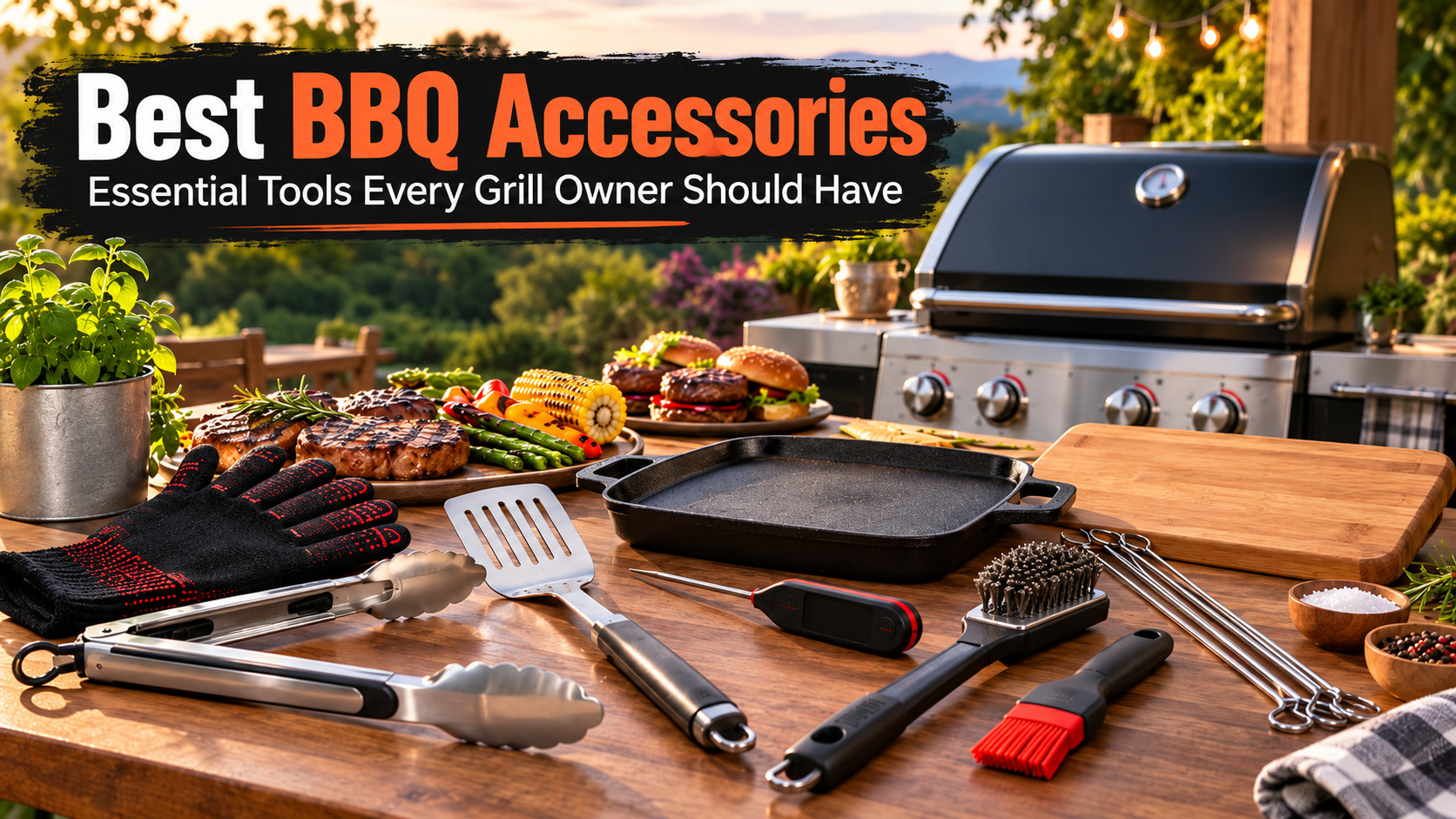
A great grill can produce incredible food, but the grill itself is only part of the equation. The right BBQ accessories can make grilling easier, safer, more consistent, and much more enjoyable. Whether you cook burgers on a gas grill, smoke brisket overnight, sear steaks over charcoal, or prepare complete meals in an outdoor kitchen, having the right tools beside you can dramatically improve the entire cooking experience.
Many new grill owners start with little more than a spatula and a pair of tongs. That may be enough to flip a burger, but serious outdoor cooking quickly reveals how useful specialized BBQ equipment can be. A reliable meat thermometer helps prevent overcooked steaks and undercooked chicken. Heat-resistant gloves protect your hands when handling hot grates and charcoal. A chimney starter makes charcoal lighting faster and more predictable. Grill baskets keep vegetables from falling through the grates. Cleaning tools preserve cooking performance and extend the life of the grill.
Some BBQ accessories are essential, while others are convenience upgrades. The goal is not to fill your patio with gadgets. The goal is to build a practical collection of tools that solve real grilling problems.
This guide covers the best BBQ accessories for gas, charcoal, pellet, electric, and smoker cooking. It explains what each accessory does, why it matters, which features are worth paying for, and how to decide whether a tool deserves a place beside your grill.
Why Good BBQ Accessories Matter
Grilling may look simple from the outside. Light the fire, place food on the grates, and wait until it is done. In practice, successful BBQ depends on temperature control, timing, preparation, food handling, fire management, and safety.
Accessories help you manage these variables.
A quality thermometer tells you what is happening inside the meat instead of forcing you to guess. Long tongs allow you to move food without putting your hands close to the fire. A charcoal chimney gives you evenly lit coals instead of partially burned briquettes soaked in lighter fluid. A grill cover reduces exposure to rain, dust, sunlight, and debris.
The best BBQ tools also improve consistency. Cooking the perfect steak once may be luck. Cooking it correctly every weekend requires control and repeatable techniques.
Good tools contribute to that consistency.
They can also help reduce waste. Overcooking an expensive brisket, prime rib, rack of ribs, or thick steak can cost far more than buying a good thermometer in the first place.
For frequent grill owners, accessories should be viewed as part of the cooking system rather than optional decorations.
The Most Essential BBQ Accessories
If you are building a BBQ tool collection from scratch, start with the accessories that provide the biggest improvements in cooking control, safety, and convenience.
The core accessories most grill owners should consider include:
- Instant-read meat thermometer
- Wireless or leave-in temperature thermometer
- Long stainless-steel grilling tongs
- Heavy-duty grill spatula
- Heat-resistant BBQ gloves
- Grill cleaning brush or scraper
- Grill cover
- Cutting board
- Sharp slicing knife
- Basting brush
- Charcoal chimney starter for charcoal grills
- Drip pans
- Grill basket
- Meat claws or shredding tools
- BBQ storage containers
- Proper lighting for nighttime grilling
You do not necessarily need all of these on your first day. However, most regular BBQ cooks eventually find that these tools solve common problems.
1. Instant-Read Meat Thermometer
An instant-read thermometer is arguably the most important BBQ accessory a grill owner can buy.
Visual appearance is not a reliable indicator of internal doneness. Chicken may look browned on the outside while still being undercooked inside. A thick steak may develop a perfect crust long before the center reaches the desired temperature.
An instant-read thermometer removes much of the guesswork.
The thermometer is inserted into the thickest part of the meat for a quick reading. High-quality models typically display temperatures within a few seconds.
This is useful for:
- Steaks
- Burgers
- Chicken breasts
- Chicken thighs
- Pork chops
- Sausages
- Fish
- Lamb
- Turkey
- Roasts
A thermometer also helps you learn how your grill behaves. Over time, you begin to understand how long different foods require under specific cooking conditions.
Features to Look For
Choose a thermometer with a fast response time. Waiting ten or fifteen seconds while your hand is over a hot grill becomes uncomfortable quickly.
Accuracy is equally important. A thermometer that consistently reads several degrees incorrectly can cause cooking problems.
Useful features include:
- Fast temperature readings
- Bright digital display
- Backlit screen
- Foldable probe
- Waterproof or water-resistant design
- Automatic sleep mode
- Wide temperature range
- Calibration capability
A rotating display can also be surprisingly useful because it allows the screen to remain readable regardless of which direction you insert the thermometer.
2. Wireless Meat Thermometer
An instant-read thermometer tells you the temperature when you manually check the food. A wireless thermometer allows you to monitor temperature continuously.
This can be especially valuable when smoking large cuts of meat.
Brisket, pork shoulder, turkey, and ribs may cook for many hours. Opening the grill or smoker repeatedly releases heat and slows the cooking process.
A wireless thermometer allows you to track temperatures without opening the lid.
Depending on the model, it may monitor:
- Internal meat temperature
- Grill temperature
- Smoker temperature
- Multiple pieces of meat
- Several cooking zones
Some systems use dedicated wireless receivers, while others communicate with a smartphone.
Why Wireless Monitoring Helps
Long BBQ sessions involve significant temperature changes.
A smoker may run hotter than expected. Pellet grills can sometimes experience temperature fluctuations. Charcoal fires may gradually weaken. Large cuts of meat can enter a temperature stall where internal temperature rises very slowly.
Continuous monitoring makes these changes easier to recognize.
For serious smoking enthusiasts, a multi-probe thermometer can be one of the most useful BBQ investments.
3. Long BBQ Tongs
Good grilling tongs are simple but essential.
The ideal pair should be long enough to keep your hands away from high heat but responsive enough to provide good control.
Short kitchen tongs are often uncomfortable for grilling because your hands remain too close to the fire.
A length of approximately 16 inches is comfortable for many grilling situations.
What Makes Good Grill Tongs
Look for:
- Stainless-steel construction
- Comfortable grip
- Strong spring tension
- Scalloped gripping edges
- Locking mechanism
- Heat-resistant handles
- Dishwasher-safe construction when possible
Avoid overly flexible tongs. If the arms bend when lifting a heavy steak or chicken breast, control becomes difficult.
The gripping ends should also meet evenly.
A reliable pair of tongs may become the tool you use more than any other grill accessory.
4. Heavy-Duty Grill Spatula
A grilling spatula is essential for foods that need support underneath.
Examples include:
- Burgers
- Fish fillets
- Smash burgers
- Grilled sandwiches
- Pancakes on a griddle
- Delicate vegetables
A standard kitchen spatula can work, but BBQ spatulas are generally longer and stronger.
For burgers and steaks, a wide stainless-steel blade is useful. If you cook on a flat-top griddle, a shorter professional-style turner may provide better leverage.
Useful Spatula Features
Consider:
- Wide stainless-steel blade
- Comfortable handle
- Long reach
- Thin front edge
- Strong connection between blade and handle
- Hanging loop
- Slightly angled handle
Avoid spatulas with very thick front edges because they can be difficult to slide underneath delicate food.
5. Heat-Resistant BBQ Gloves
Grilling involves extremely hot surfaces.
Standard kitchen oven mitts can help, but specialized BBQ gloves usually provide better flexibility and grip.
Heat-resistant gloves are useful when:
- Moving grill grates
- Handling hot cast iron
- Adjusting charcoal
- Moving smoker components
- Handling hot meat
- Removing rotisserie equipment
- Managing firewood
- Opening hot grill lids
Different glove materials offer different benefits.
Silicone gloves resist moisture and grease well. Aramid-fiber gloves provide excellent heat protection while maintaining flexibility. Leather gloves work especially well when managing charcoal, firewood, or offset smokers.
For maximum protection, look for gloves that extend past the wrist.
6. Grill Cleaning Brush and Scraper
A dirty grill can affect both cooking performance and food quality.
Grease, carbonized food, sauces, and debris accumulate on cooking grates over time.
Regular cleaning helps maintain a consistent cooking surface.
Traditional wire brushes have been widely used for years, although some grill owners prefer alternatives because loose wire bristles can occasionally detach.
Alternatives include:
- Coil-style cleaning brushes
- Wooden grill scrapers
- Stainless-steel scrapers
- Nylon brushes for cool grates
- Grill cleaning stones
- Steam-based cleaning tools
Whichever method you choose, inspect your grill grates before cooking.
Cleaning is easiest when the grates are warm rather than completely cold, although you should always follow the cleaning tool manufacturer’s intended temperature range.
7. Grill Cover
A grill spends much of its life sitting outdoors.
Sunlight, rain, moisture, dust, pollen, insects, leaves, and snow can all contribute to wear.
A grill cover helps protect the exterior and internal components when the grill is not being used.
What to Look For in a Grill Cover
Choose a cover that fits closely without being excessively tight.
Important features include:
- Water-resistant or waterproof material
- UV resistance
- Reinforced seams
- Ventilation openings
- Secure straps
- Tear-resistant fabric
- Handles for easy removal
Ventilation can help prevent moisture from becoming trapped underneath the cover.
The grill should also be cool before covering it.
8. Large Cutting Board
BBQ often involves much larger pieces of meat than normal indoor cooking.
A small kitchen cutting board becomes frustrating when slicing brisket, ribs, pork shoulder, turkey, or large steaks.
A large cutting board provides more working space and helps contain juices.
Ideal Features
Look for:
- Large surface area
- Juice groove
- Non-slip feet
- Thick construction
- Easy cleaning
- Resistance to warping
Wooden cutting boards can be beautiful and durable when properly maintained. Plastic boards are lighter and generally easier to sanitize.
Some BBQ enthusiasts use separate boards for raw meat and cooked food to reduce cross-contamination.
9. Sharp BBQ Slicing Knife
A perfectly smoked brisket can still look disappointing if it is cut with a dull knife.
Long slicing knives allow clean strokes through large cuts of meat.
They are particularly useful for:
- Brisket
- Turkey breast
- Prime rib
- Pork loin
- Tri-tip
- Ham
- Large steaks
A blade around 10 to 12 inches works well for many BBQ applications.
Grantons or small indentations along the blade can reduce friction when slicing.
A sharp knife is safer and easier to control than a dull knife because it requires less force.
10. Boning Knife
A slicing knife handles finished meat. A boning knife helps with preparation.
It can be used for:
- Trimming brisket fat
- Removing silver skin
- Trimming ribs
- Cleaning pork shoulder
- Preparing poultry
- Removing unwanted tissue
A narrow blade provides better control around bones and irregular shapes.
Many BBQ cooks prefer a semi-flexible boning knife because it offers a balance between precision and strength.
11. Basting Brush
Sauces, marinades, melted butter, oils, and glazes are frequently applied during grilling.
A basting brush allows these ingredients to be distributed evenly.
Silicone brushes are often easier to clean than natural-bristle brushes and do not shed fibers.
Look for a long handle if you frequently apply sauces over direct heat.
Keep in mind that sugar-heavy sauces can burn quickly over high temperatures. Applying them late in the cooking process often produces better results.
12. Charcoal Chimney Starter
For charcoal grill owners, a chimney starter is one of the most practical BBQ accessories available.
It allows charcoal to ignite quickly and evenly without requiring lighter fluid.
The process is simple.
Charcoal goes into the upper chamber while fire starters or paper are placed underneath. Hot air rises through the chimney, causing the coals to ignite from bottom to top.
Once the charcoal develops a layer of ash and is fully burning, it can be poured into the grill.
Benefits of a Chimney Starter
Advantages include:
- Faster charcoal ignition
- More evenly lit coals
- No lighter-fluid flavor
- Simple operation
- Low cost
- Reliable results
Heavy-duty chimneys with heat shields and secondary handles can make pouring safer.
13. Fire Starters
Even with a chimney starter, you need something to ignite the charcoal.
Purpose-made fire starters offer a clean and convenient solution.
Common options include:
- Wax-based cubes
- Wood fiber starters
- Compressed sawdust starters
- Natural tumbleweed-style starters
A good starter should light easily and burn long enough to ignite the surrounding charcoal.
Avoid products that produce strong chemical smells.
14. Grill Basket
Vegetables taste excellent over an open flame, but small pieces can fall through standard grill grates.
A grill basket solves that problem.
It works especially well with:
- Peppers
- Onions
- Mushrooms
- Zucchini
- Asparagus
- Green beans
- Shrimp
- Diced potatoes
- Small pieces of meat
Perforations allow heat and smoke to contact the food while preventing pieces from falling into the fire.
Stainless-steel baskets are durable and easy to clean.
15. Vegetable Grill Tray
A flat grilling tray performs a similar role to a basket but provides a broader cooking surface.
It can be useful for vegetables that benefit from frequent turning.
Some trays feature raised edges, while others resemble perforated griddles.
Choose one large enough for your typical portion sizes without covering the entire grill surface.
Leaving room around the tray allows heat to circulate more effectively.
16. Cast-Iron Griddle
A cast-iron griddle dramatically expands what you can cook on your grill.
Instead of only using traditional grates, you can prepare:
- Smash burgers
- Bacon
- Eggs
- Pancakes
- Fried onions
- Cheesesteaks
- Shrimp
- Breakfast foods
- Grilled sandwiches
- Stir-fried vegetables
Cast iron retains heat exceptionally well, making it ideal for developing strong browning.
Preheating is important because thick cast iron takes time to reach cooking temperature.
Regular seasoning also helps protect the surface and improve its nonstick characteristics.
17. Cast-Iron Skillet
A cast-iron skillet is one of the most versatile accessories for outdoor cooking.
It can move directly from the grill to the table and handles extremely high temperatures.
Use it for:
- Sautéed vegetables
- Cornbread
- Baked beans
- Skillet desserts
- Deep-dish dishes
- Sauces
- Breakfast foods
- Reverse-seared steaks
Cooking in cast iron also allows you to capture drippings and cook ingredients that would otherwise fall through grill grates.
18. Grill Press
A grill press is a weighted piece of cast iron or steel used to press food against a cooking surface.
It is popular for:
- Smash burgers
- Bacon
- Sandwiches
- Steaks
- Chicken
- Sausages
A press can improve contact with a flat griddle and encourage browning.
However, pressing regular burgers aggressively can squeeze out valuable juices, so technique matters.
For smash burgers, the initial pressing stage is intentional. For thicker burgers, constant pressing is generally unnecessary.
19. BBQ Skewers
Skewers make it possible to cook small pieces of food together.
Common choices include:
- Chicken
- Beef
- Shrimp
- Peppers
- Onions
- Mushrooms
- Pineapple
- Sausage
Metal skewers are reusable and transfer heat into food from the center.
Flat skewers are generally easier to use than round skewers because food is less likely to rotate when you turn them.
If using wooden skewers, soaking them beforehand may reduce burning.
20. Rib Rack
Ribs can occupy a large amount of grill space when they lie flat.
A rib rack holds several racks vertically.
This can significantly increase cooking capacity.
Rib racks are especially useful when preparing food for groups or parties.
Spacing matters. Leave enough room between each rack for heat and smoke to circulate.
A rib rack can also be used for some other foods, depending on the design.
21. Chicken Roaster
Vertical poultry roasters allow whole chickens to cook upright.
This positioning exposes more of the skin to circulating heat.
Some designs include a central container that can hold liquid or aromatics.
While liquid inside the cooker may contribute aroma, the most important benefits often come from stable positioning and increased airflow around the bird.
Look for a sturdy base that will not tip over easily.
22. Rotisserie Kit
A rotisserie continuously rotates food above the heat.
This promotes even cooking and self-basting as juices travel around the surface.
Popular rotisserie foods include:
- Whole chicken
- Turkey
- Pork loin
- Prime rib
- Leg of lamb
- Roast beef
Many grills offer dedicated rotisserie attachments.
Before purchasing one, confirm that it fits your specific grill dimensions and motor mounting system.
23. Meat Claws
Pulled pork can be shredded with forks, but meat claws make the process faster.
They feature several pointed prongs that pull cooked meat apart.
They can also help lift large pieces of meat.
Use them for:
- Pork shoulder
- Chicken
- Beef roasts
- Turkey
Choose strong, heat-resistant models with comfortable handles.
24. Butcher Paper
Butcher paper is popular among BBQ smokers, particularly for brisket.
Wrapping meat during part of the cooking process can help manage moisture loss and reduce cooking time.
Pink or unwaxed food-grade butcher paper allows some airflow compared with completely sealed aluminum foil.
That can help maintain bark texture.
Butcher paper is commonly used for:
- Brisket
- Beef ribs
- Pork shoulder
It can also be used when resting finished meat.
25. Heavy-Duty Aluminum Foil
Foil remains one of the most versatile BBQ supplies.
It can be used to:
- Wrap ribs
- Wrap pork shoulder
- Cover pans
- Protect food from excessive browning
- Create packets for vegetables
- Line drip trays
- Rest meat
- Protect delicate areas from heat
Heavy-duty foil is preferable for BBQ because thin household foil tears easily around bones and large cuts of meat.
26. Drip Pans
Drip pans help manage grease and make cleanup easier.
They can be placed beneath meat to collect rendered fat.
On charcoal grills, drip pans are often used between zones of charcoal during indirect cooking.
They can also hold water in some smoker setups.
Advantages include:
- Reduced grease buildup
- Easier cleanup
- Better control of flare-ups
- Cleaner grill interior
Disposable aluminum pans are convenient, while reusable stainless-steel pans reduce waste.
27. Water Pan
Some smokers benefit from additional moisture inside the cooking chamber.
A water pan may help stabilize temperature and increase humidity.
It is commonly used in:
- Bullet smokers
- Charcoal smokers
- Some offset smokers
- Indirect charcoal setups
The effect varies depending on cooker design, climate, and cooking method.
Water pans should be positioned securely because spilling hot water around burning charcoal can be dangerous.
28. Spray Bottle
A simple food-safe spray bottle is common equipment for low-and-slow BBQ.
Pitmasters may spray or spritz meat during long smoking sessions.
Typical liquids include combinations of:
- Water
- Apple juice
- Apple cider vinegar
- Broth
- Other mild liquids
The goal is generally to prevent the surface from drying excessively and influence bark development.
Avoid opening the smoker too frequently just to spray the meat. Every lid opening affects temperature stability.
29. Sauce Mop
For large cuts of meat, a traditional BBQ mop can apply more liquid than a small silicone brush.
It works well for:
- Pork shoulder
- Whole hog
- Ribs
- Large roasts
Mops are typically used with thin sauces rather than thick finishing sauces.
Clean them thoroughly after use because meat juices and sauce residues can remain deep within the fibers.
30. Marinade Injector
A marinade injector delivers seasoned liquid directly inside thick pieces of meat.
It is popular for:
- Turkey
- Pork shoulder
- Brisket
- Chicken
- Large roasts
Injection can distribute flavor deeper than surface seasoning alone.
Some injectors include multiple needle sizes for thin liquids and thicker marinades.
Stainless-steel models are generally more durable than inexpensive plastic versions.
31. Spice Shakers
Consistent seasoning matters in BBQ.
Large spice shakers allow rubs to be applied evenly across meat surfaces.
They are useful if you prepare your own seasoning blends or buy rubs in bulk.
Look for adjustable openings or shaker lids that distribute spices evenly.
Having several labeled shakers also makes it easier to organize salt, pepper, garlic, paprika, and signature BBQ blends.
32. BBQ Prep Trays
One of the most overlooked accessories is a set of dedicated prep trays.
Transporting raw meat from the kitchen to the grill and cooked meat back inside can create cross-contamination if the same tray is reused.
Using separate trays solves this problem.
One tray can carry raw food while another stays clean for finished food.
Some grilling systems use color-coded trays to make the distinction obvious.
33. Stainless-Steel Mixing Bowls
Large mixing bowls are useful for:
- Marinating meat
- Tossing wings
- Mixing vegetables
- Preparing sauces
- Holding seasoned potatoes
- Combining rub ingredients
Stainless steel is durable, lightweight, and resistant to staining.
Bowls with lids are particularly useful for outdoor cooking because they protect food from insects and debris.
34. Food Storage Containers
Organized BBQ preparation becomes easier with proper containers.
Use them for:
- Chopped vegetables
- Rubs
- Sauces
- Marinades
- Cooked meat
- Leftovers
- Pre-portioned ingredients
Clear containers help identify ingredients quickly.
Stackable designs save space in refrigerators and outdoor kitchens.
35. Burger Press
If you frequently make homemade burgers, a burger press creates consistent patties.
Consistent thickness helps burgers cook at similar rates.
Presses can also create stuffed burgers, depending on the design.
However, a burger press is not essential for everyone. Many cooks prefer forming patties by hand.
It becomes most useful when preparing large batches.
36. Meat Tenderizer
A meat tenderizer can help flatten and soften certain cuts.
Common designs include:
- Flat mallets
- Textured mallets
- Blade tenderizers
They are useful for specific preparations such as:
- Chicken cutlets
- Pork cutlets
- Thin steaks
- Schnitzel-style dishes
Blade tenderizers should be used carefully because they can push surface bacteria deeper into meat. Proper cooking becomes particularly important.
37. BBQ Timer
Phones include timers, but a dedicated kitchen timer still has advantages.
It can remain outside near the grill without exposing an expensive phone to grease or weather.
Multiple-channel timers allow you to track several tasks at once.
This is useful when cooking:
- Ribs
- Corn
- Potatoes
- Chicken
- Side dishes
- Multiple steaks
BBQ often involves managing several cooking times simultaneously.
38. Grill Light
Outdoor grilling does not stop when the sun goes down.
A dedicated grill light illuminates the cooking surface.
Common designs attach to:
- Grill handles
- Side shelves
- Nearby surfaces
Useful features include:
- Bright LED output
- Adjustable beam
- Weather resistance
- Heat resistance
- Strong mounting mechanism
Good lighting helps you inspect browning, move food accurately, and read thermometer displays.
39. Headlamp
A headlamp may look less sophisticated than a grill-mounted light, but it is incredibly practical.
The light automatically points wherever you look.
It is useful for:
- Checking smokers overnight
- Managing charcoal
- Reading thermometers
- Cleaning grills
- Handling firewood
- Moving around dark patios
For overnight smoking sessions, a comfortable rechargeable headlamp can be one of the most valuable accessories you own.
40. Outdoor Work Table
Grills rarely provide enough preparation space.
An outdoor work table gives you room for:
- Cutting boards
- Trays
- Seasonings
- Thermometers
- Sauces
- Tools
- Finished food
Stainless-steel tables are durable and easy to clean.
Portable folding tables are cheaper and easier to store.
If you grill frequently, additional workspace can dramatically improve efficiency.
41. BBQ Tool Hooks
Tongs, spatulas, brushes, and gloves need somewhere to go.
Tool hooks keep accessories organized and prevent them from occupying valuable work surfaces.
Many grills include hooks already.
If yours does not, magnetic hooks or aftermarket side hooks may work.
Just ensure that magnets are appropriate for the grill surface and remain away from areas that become excessively hot.
42. Magnetic Paper Towel Holder
Paper towels are constantly useful during BBQ.
They help with:
- Wiping grease
- Cleaning spills
- Drying meat surfaces
- Cleaning thermometers
- Holding hot items briefly when appropriate
- General cleanup
A magnetic holder keeps the roll available without taking up table space.
Position it away from flames and extreme heat.
43. Outdoor Trash Can
A nearby trash container makes grilling much more efficient.
Without one, empty packaging, paper towels, vegetable scraps, and used foil quickly accumulate around the cooking area.
Choose a container with a secure lid to discourage insects and animals.
44. Ash Bucket
Charcoal grills and wood-burning smokers produce ash.
A metal ash bucket provides a safer place to collect it.
Never assume ash is completely cold immediately after cooking. Hidden embers can remain hot for hours.
Use a metal container and allow ash to cool completely before disposal.
45. Charcoal Storage Container
Charcoal absorbs moisture.
Damp charcoal becomes harder to ignite and may burn inconsistently.
A sealed storage container helps keep briquettes or lump charcoal dry.
Large containers with wheels are convenient if you regularly buy big bags.
Make sure the container is stored away from ignition sources.
46. Pellet Storage Container
Wood pellets should also be protected from moisture.
Wet pellets can swell, crumble, and cause problems inside pellet grill feed systems.
A sealed container helps preserve them.
Some grill owners keep different wood species in separate labeled containers.
That makes switching between oak, hickory, cherry, apple, pecan, and other flavors easier.
47. Wood Chunk Storage
Wood chunks and smoking wood benefit from dry storage.
Moisture can affect ignition characteristics.
Simple sealed bins or dry shelving can keep smoking woods organized.
Labels are useful if several wood species look similar.
48. Smoke Tube
A smoke tube is commonly used to increase smoke production in pellet grills or other cookers.
It is filled with wood pellets or small wood products and ignited separately.
Once established, the material smolders slowly and creates additional smoke.
Smoke tubes can be used for:
- Meat
- Cheese
- Nuts
- Vegetables
Cold-smoking applications require careful temperature management because some foods are highly perishable.
49. Smoker Box
Gas grills do not naturally produce wood smoke.
A smoker box gives gas-grill owners a simple way to add smoky flavor.
Wood chips are placed inside the box, which sits near the heat source.
As the box heats, the wood begins to smolder.
Stainless-steel smoker boxes are reusable and more durable than improvised foil packets.
50. Grill Grate Lifter
Some grills include removable grates that need to be moved during cooking.
A grate lifter allows you to handle them without grabbing the hot metal directly.
This can be particularly useful for charcoal grills when adding fuel during a long cook.
Always combine a grate lifter with proper heat-resistant gloves.
51. Charcoal Rake
A charcoal rake allows you to move hot coals around the grill.
It is useful for creating:
- Direct heat zones
- Indirect heat zones
- Two-zone cooking
- Snake configurations
- Banked charcoal arrangements
A long handle keeps your hands away from the heat.
This simple tool is especially valuable for kettle grill enthusiasts.
52. Grill Grate Thermometer
The thermometer built into a grill lid does not always represent the temperature where the food is actually cooking.
A grate-level thermometer can provide more relevant information.
This is particularly important for smoking because temperatures may vary between the lid and the cooking grate.
Digital probe systems are generally more useful than small analog grate thermometers because they can be monitored without opening the cooker.
53. Infrared Thermometer
An infrared thermometer measures surface temperature without touching the cooking surface.
It is excellent for checking:
- Cast-iron skillets
- Griddles
- Pizza stones
- Grill grates
- Plancha surfaces
It does not measure the internal temperature of meat.
Therefore, an infrared thermometer does not replace an instant-read food thermometer.
The two tools measure different things.
54. Pizza Stone
A pizza stone allows a grill to function more like a high-temperature outdoor oven.
The stone stores heat and helps create a crisp pizza crust.
It can also be used for some types of bread and flatbread.
Preheating is essential.
Rapid temperature changes can crack some stones, so follow the material’s heating and cooling requirements.
55. Pizza Steel
Pizza steel performs a similar function to a pizza stone but transfers heat more aggressively.
It can create excellent crust browning.
Steel is generally more durable than ceramic stone but much heavier.
A pizza steel can also be used as a griddle depending on its design and finish.
56. Pizza Peel
If you cook pizza on your grill, a pizza peel makes transferring dough much easier.
Wooden peels are often good for launching uncooked pizza.
Metal peels can be excellent for turning and retrieving finished pizza.
Using a small amount of flour or another appropriate release material prevents dough from sticking.
57. Grill Wok
A grill wok allows high-heat cooking of small ingredients outdoors.
It works well for:
- Stir-fries
- Seafood
- Vegetables
- Fried rice
- Small meat pieces
Perforated grill woks allow smoke exposure, while solid woks retain sauces and cooking liquids.
58. Dutch Oven
A cast-iron Dutch oven adds another level of versatility to outdoor cooking.
You can make:
- Chili
- Stews
- Braised meat
- Beans
- Bread
- Desserts
- Soups
Some Dutch ovens can be used directly over charcoal or fire, while others are designed primarily for grill grates.
Choose the style that fits your cooking method.
59. BBQ Apron
A dedicated BBQ apron protects clothing from grease, smoke, sauce, and charcoal dust.
Useful features include:
- Large front pockets
- Adjustable neck strap
- Durable fabric
- Towel loop
- Tool pockets
Avoid overly loose fabric around open flames.
An apron will not replace heat-resistant safety equipment, but it keeps outdoor cooking cleaner.
60. Protective Grill Mat
Grease and food debris can stain decks and patios.
A grill mat placed underneath the cooker can help protect the surface.
Choose a mat made for high-temperature outdoor cooking environments.
It should extend beyond the areas where grease is likely to drip.
A mat is particularly useful underneath flat-top griddles and smokers because these cookers may produce significant grease and ash.
Accessories for Gas Grill Owners
Gas grills are convenient, clean, and easy to control.
The most useful accessories for gas grilling typically focus on expanding cooking possibilities.
A strong basic setup includes:
- Instant-read thermometer
- Long tongs
- Spatula
- Grill basket
- Cast-iron griddle
- Smoker box
- Rotisserie
- Grill light
- Cleaning tool
- Grill cover
A smoker box is especially useful because it can introduce wood smoke into a cooking environment that otherwise produces very little smoke flavor.
A griddle is another valuable upgrade because it transforms part of the grill into a flat cooking surface.
Accessories for Charcoal Grill Owners
Charcoal grilling requires more fire management.
Useful accessories include:
- Chimney starter
- Fire starters
- Heat-resistant gloves
- Charcoal rake
- Ash bucket
- Charcoal storage bin
- Wireless thermometer
- Drip pans
- Grill grate thermometer
A chimney starter should be near the top of the list.
Two-zone fire management is also important.
By positioning charcoal on one side and leaving the other side relatively cool, you create both direct and indirect cooking zones.
That allows you to sear food over the charcoal and finish cooking more gently away from the hottest heat.
Accessories for Pellet Grill Owners
Pellet grills automate much of the temperature control process, but accessories can still improve results.
Useful additions include:
- Wireless thermometer
- Instant-read thermometer
- Pellet storage container
- Smoke tube
- Grill cover
- Large cutting board
- Butcher paper
- Drip pan liners
- Heat-resistant gloves
Keeping pellets dry is particularly important.
Moist pellets can break down into sawdust and interfere with the auger system.
Accessories for Offset Smoker Owners
Offset smokers require active fire management.
Useful accessories include:
- High-temperature gloves
- Firewood storage
- Charcoal chimney
- Ash bucket
- Wireless thermometer
- Multiple temperature probes
- Charcoal rake
- Water pan
- Butcher paper
- Spray bottle
- Headlamp
- Long-handled tools
Because offset smokers can develop temperature differences across the cooking chamber, multiple probes can help identify hot and cool zones.
Accessories for Electric Smoker Owners
Electric smokers are easy to operate, but good temperature monitoring remains important.
Useful tools include:
- Digital thermometer
- Extra meat probes
- Drip pans
- Wood chip storage
- Heat-resistant gloves
- Cleaning tools
- Grill cover
Even if the smoker has a built-in temperature display, verifying internal meat temperature with an independent thermometer is still valuable.
BBQ Accessories for Steak Lovers
If steak is your main priority, spend money on tools that improve temperature precision and searing.
A strong steak setup includes:
- Instant-read thermometer
- Cast-iron skillet
- Infrared thermometer
- Long tongs
- Grill press for specific techniques
- Sharp steak or slicing knife
For thick steaks, temperature control is more important than simply cooking over the hottest possible fire.
Reverse searing is one popular technique.
The steak cooks gently at a lower temperature before being finished over intense heat.
A thermometer is essential for controlling this process.
BBQ Accessories for Brisket
Brisket cooking benefits from a somewhat different tool set.
Useful brisket accessories include:
- Sharp boning knife
- Large cutting board
- Wireless thermometer
- Butcher paper
- Long slicing knife
- Heat-resistant gloves
- Spray bottle
- Large storage container
- Insulated resting container
Brisket preparation begins long before it reaches the smoker.
A boning knife helps remove excess hard fat and shape the brisket.
After cooking, a long slicing knife allows smooth slices across the flat.
BBQ Accessories for Ribs
Rib cooks benefit from:
- Rib rack
- Basting brush
- Heavy-duty foil
- Butcher paper
- Meat thermometer
- Sauce containers
- Sharp knife
A rib rack becomes particularly helpful when cooking multiple slabs.
Because ribs are thin compared with brisket, temperature probes can sometimes be difficult to position accurately. Tenderness testing and visual cues are often used alongside temperature measurements.
BBQ Accessories for Chicken
Chicken demands careful internal-temperature control.
Useful tools include:
- Instant-read thermometer
- Poultry shears
- Vertical chicken roaster
- Rotisserie kit
- Basting brush
- Heat-resistant gloves
- Clean prep trays
Cross-contamination is particularly important when working with raw poultry.
Keep raw chicken tools and surfaces away from cooked food.
Wash hands and equipment thoroughly after contact.
BBQ Accessories for Burgers
Burger lovers may benefit from:
- Wide spatula
- Griddle
- Burger press
- Instant-read thermometer
- Grill press for smash burgers
- Cheese melting dome
- Prep trays
For traditional burgers on grates, strong spatulas and accurate temperature measurement are the main priorities.
For smash burgers, a flat griddle and rigid pressing tool become much more important.
BBQ Accessories for Vegetables
Vegetables become significantly easier to grill with the right tools.
Useful accessories include:
- Grill basket
- Perforated tray
- Skewers
- Silicone brush
- Cast-iron skillet
- Grill wok
Different vegetables require different approaches.
Large vegetables such as corn, peppers, and zucchini can often cook directly on the grate.
Small vegetables need baskets or trays to prevent them from falling into the fire.
BBQ Accessories for Seafood
Seafood can be delicate.
Useful tools include:
- Fish spatula
- Grill basket
- Grill mat designed for cooking
- Skewers
- Cedar or grilling planks
- Instant-read thermometer
- Silicone brush
A thin spatula is particularly useful because it slides underneath delicate fish more easily than a thick burger spatula.
BBQ Accessories for Outdoor Kitchens
A permanent outdoor kitchen creates opportunities for more advanced accessories.
Consider:
- Stainless-steel prep table
- Outdoor refrigerator
- Storage drawers
- Paper towel holder
- Sink
- Trash drawer
- Weatherproof storage
- Grill lighting
- Outdoor thermometer
- Cutting board station
- Beverage cooler
Organization becomes increasingly valuable as the number of tools increases.
A cluttered outdoor kitchen can be less efficient than a simple grill setup with good storage.
How to Choose Quality BBQ Accessories
Not every grilling accessory deserves a place in your collection.
Before buying something, ask whether it solves a real problem.
Material Quality
Stainless steel is popular because it resists corrosion and tolerates high temperatures.
Cast iron offers excellent heat retention but requires more maintenance.
Silicone works well for grips, brushes, and heat protection.
Plastic can be appropriate for certain tools but should remain away from high-temperature areas unless it is specifically rated for heat.
Handle Length
Long handles protect your hands from heat.
However, extremely long handles can reduce control.
The ideal length depends on the grill.
Large charcoal and offset smokers generally benefit from longer tools.
Small tabletop grills may work better with shorter accessories.
Cleaning
BBQ equipment gets greasy quickly.
Tools that can be disassembled or washed easily are more convenient.
Check whether accessories are dishwasher safe.
Complex tools with small openings can trap grease and food residue.
Storage
Consider where accessories will be stored.
Large collections of BBQ tools can quickly overwhelm outdoor cabinets.
Choose multipurpose tools when possible.
A high-quality pair of tongs used every cook is more valuable than ten specialized gadgets used once a year.
Durability
Cheap BBQ accessories may bend, warp, melt, crack, or rust.
Pay particular attention to:
- Handle attachments
- Hinges
- Welding
- Metal thickness
- Temperature ratings
- Weather resistance
Outdoor cooking equipment experiences harsher conditions than most indoor kitchen tools.
BBQ Accessories You Can Skip
Not every gadget improves grilling.
Some accessories are highly specialized and may only be worthwhile for certain cooks.
Examples include extremely complex burger molds, novelty branding irons, highly specialized meat holders, and single-purpose tools that duplicate equipment you already own.
Before buying something, ask three questions.
Will I use this regularly?
Does it solve a problem my current tools cannot solve?
Is there a simpler multipurpose tool that can accomplish the same job?
If the answers are no, the accessory may become clutter.
How Much Should You Spend on BBQ Accessories?
You do not need to spend a fortune.
A beginner can build a very capable BBQ toolkit by prioritizing essentials first.
A practical starter collection might include:
- Thermometer
- Tongs
- Spatula
- Gloves
- Cleaning tool
- Cutting board
- Grill cover
From there, add accessories based on the food you cook.
Charcoal users can buy a chimney starter.
Brisket enthusiasts may add a slicing knife, butcher paper, and multi-probe thermometer.
Vegetable lovers may purchase a basket.
People who cook breakfast outdoors may invest in a cast-iron griddle.
This approach prevents unnecessary purchases.
Best BBQ Accessories for Beginners
Beginners should focus on tools that improve control and safety.
The most useful starter accessories are:
- Instant-read thermometer
- Long tongs
- Strong spatula
- Heat-resistant gloves
- Grill cleaning tool
- Cutting board
- Grill cover
- Chimney starter if using charcoal
These tools address the most common challenges new grillers encounter.
Once you understand your cooking habits, specialty tools become easier to choose.
Best BBQ Accessories for Experienced Grillers
Experienced cooks often benefit from tools that increase precision and capacity.
Consider:
- Multi-probe thermometer system
- Infrared thermometer
- High-quality slicing knife
- Boning knife
- Rotisserie kit
- Cast-iron griddle
- Pizza stone or steel
- Smoke tube
- Rib rack
- Outdoor prep station
Experienced grill owners usually know which accessories match their preferred cooking style.
At that stage, buying higher-quality specialized equipment makes more sense.
How to Store BBQ Accessories
Proper storage protects your investment.
Keep cooking tools dry whenever possible.
Metal tools can eventually corrode if they remain exposed to moisture.
Thermometers should be kept away from extreme heat when not in use.
Wooden cutting boards should dry completely before storage.
Cast iron should be cleaned, dried, and lightly protected with oil when appropriate.
Charcoal and pellets should remain in sealed containers.
Store chemicals, cleaning products, and fire starters separately from food preparation equipment.
How to Clean BBQ Tools
Clean tools after every major grilling session.
Tongs and spatulas should be washed to remove grease and food residue.
Cutting boards used for raw meat require especially careful cleaning.
Thermometer probes should be wiped and sanitized between different foods.
Do not immerse electronic thermometer bodies unless the manufacturer specifically says the unit is waterproof.
Cast iron should be cleaned using methods appropriate for seasoned cookware.
Grill baskets and trays are easiest to clean before burned residue becomes completely hardened.
BBQ Safety Accessories Worth Having
Some accessories are not cooking tools but should still be kept near the grill.
Fire Extinguisher
Outdoor cooking involves open flame, hot grease, charcoal, propane, or wood.
A suitable fire extinguisher should be accessible.
Never position it somewhere that would require walking through a fire to retrieve it.
Heat-Resistant Gloves
Keep gloves dry and in good condition.
Damaged or wet gloves may offer less protection.
First-Aid Kit
Minor cuts and burns can happen during food preparation.
Keeping basic first-aid supplies nearby is sensible.
Grill Light
Good visibility reduces mistakes during nighttime cooking.
Long-Handled Tools
Long tools increase the distance between your hands and hot surfaces.
Common BBQ Accessory Mistakes
Even good accessories can be used incorrectly.
Buying Too Many Gadgets
More equipment does not automatically improve cooking.
Master essential tools before adding specialized items.
Depending Only on the Grill’s Built-In Thermometer
Built-in lid thermometers measure a different location than where food sits.
Use a grate-level probe when precise temperature control matters.
Cutting Meat Immediately
A good slicing knife cannot compensate for poor resting technique.
Large cuts often benefit from resting before slicing.
Using Dull Knives
Dull knives crush meat instead of slicing it cleanly.
Keep BBQ knives sharp.
Using the Same Tray for Raw and Cooked Meat
This creates unnecessary food-safety risks.
Use separate trays.
Ignoring Tool Maintenance
Rusty tongs, damaged brushes, inaccurate thermometers, and cracked gloves should be replaced.
Accessories are only useful when they function correctly.
Building the Perfect BBQ Accessory Kit
The ideal BBQ toolkit depends on how you cook.
For a basic gas grill setup, prioritize a thermometer, tongs, spatula, basket, cleaning tool, and cover.
For charcoal cooking, add a chimney starter, fire starters, charcoal rake, and ash bucket.
For smoking, add multiple temperature probes, butcher paper, long gloves, spray bottles, and slicing knives.
For outdoor entertaining, add prep tables, storage containers, serving trays, lighting, and dedicated trash management.
Build your collection gradually.
Every accessory should earn its space.
Frequently Asked Questions About BBQ Accessories
What BBQ accessories are absolutely essential?
The most important accessories for most grill owners are an instant-read meat thermometer, long tongs, strong spatula, heat-resistant gloves, grill cleaning tool, cutting board, and grill cover.
Charcoal grill owners should also strongly consider a chimney starter.
What is the most important BBQ accessory?
For cooking accuracy, an instant-read meat thermometer is arguably the most important.
It provides objective information about internal food temperature and helps prevent both undercooking and overcooking.
Do I need a wireless BBQ thermometer?
You do not necessarily need one for quick grilling.
However, wireless thermometers are extremely useful for long smoking sessions, large roasts, turkey, pork shoulder, and brisket.
Are expensive grilling tools worth it?
Higher-priced tools can be worthwhile when they offer better construction, durability, accuracy, or heat resistance.
However, price alone does not guarantee quality.
Simple accessories such as tongs and spatulas do not need luxury features.
What accessories should I buy with a new charcoal grill?
Start with a chimney starter, heat-resistant gloves, long tongs, thermometer, cleaning tool, ash container, and grill cover.
What accessories should I buy with a pellet grill?
A good thermometer, dry pellet storage container, grill cover, heat-resistant gloves, butcher paper, and possibly a smoke tube are useful additions.
What accessories make grilling easier?
Thermometers, prep trays, grill baskets, work tables, good lighting, storage containers, and long-handled tools make outdoor cooking more organized and predictable.
Is a grill basket worth buying?
Yes, especially if you frequently grill vegetables, shrimp, or small pieces of food.
It reduces food loss through the grates and makes turning ingredients easier.
Is a cast-iron griddle worth having?
For many grill owners, yes.
It adds the ability to cook breakfast, smash burgers, sandwiches, onions, seafood, and other foods that are difficult on standard grill grates.
Do I need both an instant-read and wireless thermometer?
They serve different purposes.
A wireless thermometer monitors food throughout the cook.
An instant-read thermometer provides fast spot checks in different locations.
Serious BBQ cooks often use both.
Is a grill cover necessary?
A grill can function without a cover, but a quality cover helps protect it from weather, sunlight, moisture, dust, and debris.
It can be particularly useful for grills that remain outdoors year-round.
How often should grill accessories be replaced?
Replacement depends on condition rather than a fixed schedule.
Replace accessories when they become unsafe, inaccurate, cracked, rusted, warped, or difficult to clean.
Thermometers should occasionally be checked for accuracy.
What is the best BBQ gift for a grill owner?
A high-quality thermometer is one of the safest choices because nearly every grill owner can use one.
Other useful gifts include heat-resistant gloves, grilling tools, cutting boards, carving knives, grill baskets, and BBQ prep equipment.
Are BBQ tool sets worth buying?
They can be convenient, but quality varies.
Some kits include many low-quality tools that rarely get used.
Buying several high-quality individual tools is often a better long-term strategy.
What BBQ accessories help with smoking meat?
Useful smoker accessories include wireless thermometers, butcher paper, spray bottles, heat-resistant gloves, large cutting boards, slicing knives, boning knives, water pans, and fuel storage containers.
What accessories improve grill safety?
Important safety accessories include heat-resistant gloves, long-handled utensils, reliable lighting, a proper ash container, and an appropriate fire extinguisher.
Final Thoughts
The best BBQ accessories are not necessarily the most expensive or complicated. They are the tools that make outdoor cooking safer, easier, more precise, and more enjoyable.
Every grill owner should begin with the fundamentals.
A reliable instant-read thermometer provides accurate information about doneness. Long tongs and a sturdy spatula improve control over the fire. Heat-resistant gloves protect your hands. A proper grill cleaning tool keeps cooking surfaces ready for the next meal. A large cutting board creates a safer preparation and slicing area.
After the essentials are covered, accessories should reflect the way you cook.
Charcoal enthusiasts benefit enormously from chimney starters, charcoal rakes, ash buckets, and fuel storage containers. Pellet grill owners can improve their setup with dry pellet storage, wireless temperature monitoring, and smoke tubes. Brisket enthusiasts may invest in butcher paper, trimming knives, long slicing knives, and multi-probe thermometers. Vegetable lovers can dramatically expand their menus with grill baskets, skewers, cast-iron cookware, and perforated trays.
Outdoor cooking is ultimately about controlling heat, timing, smoke, and food temperature. Good accessories give you better control over all four.
There is no need to buy every grilling gadget available. A carefully selected collection of durable, practical tools is far more useful than a cabinet full of accessories that rarely leave the shelf.
Start with equipment that solves the biggest problems. Add specialized accessories as your grilling skills and cooking style develop. Maintain the tools properly, replace damaged equipment when necessary, and organize the cooking area so everything you need is within reach.
With a solid BBQ accessory kit beside the grill, preparing steaks, burgers, chicken, vegetables, ribs, brisket, seafood, and complete outdoor meals becomes more efficient and predictable.
A great grill provides the heat. The right accessories give you the control needed to turn that heat into consistently great BBQ.