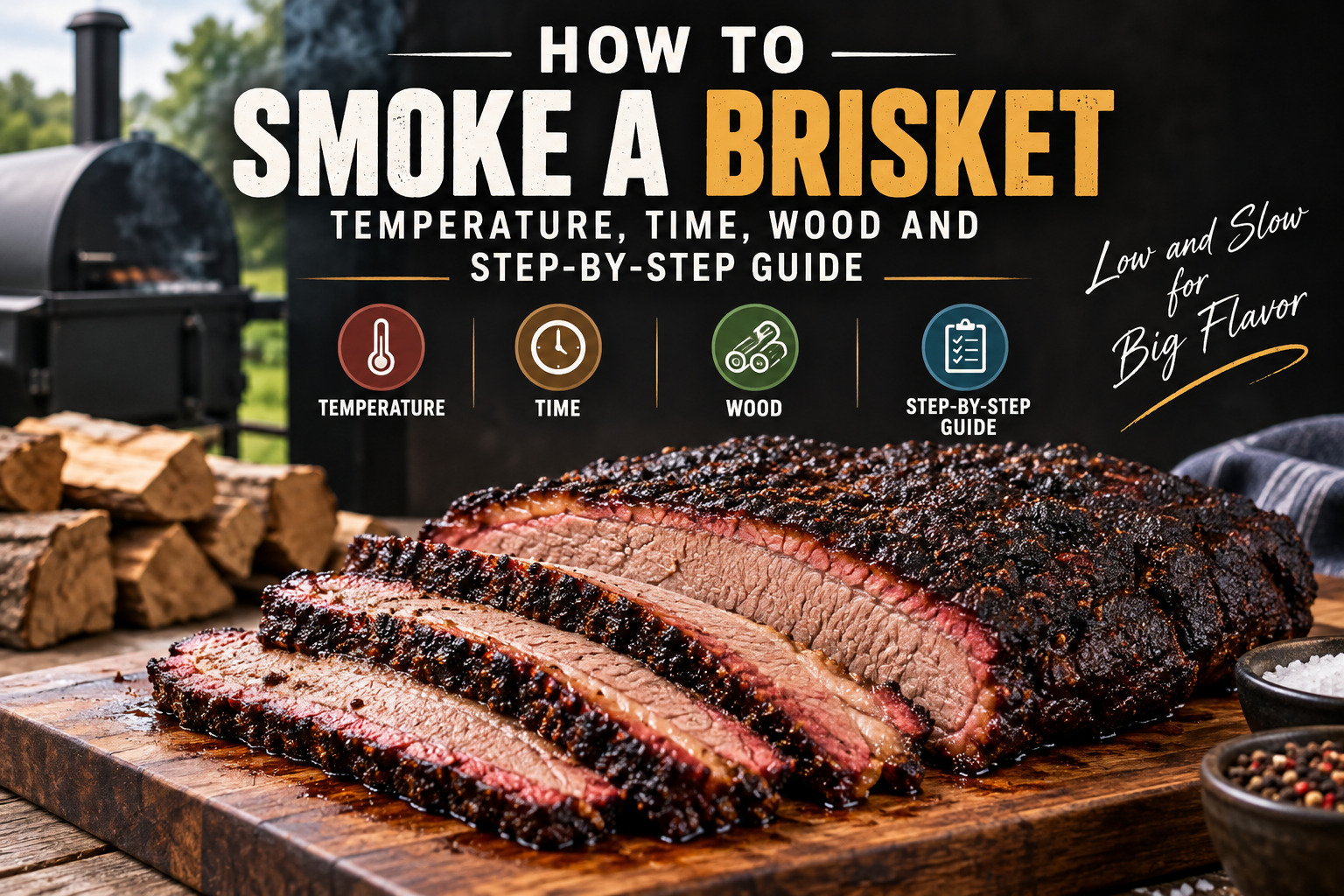
Smoking a brisket is one of the most rewarding skills you can learn in backyard barbecue. A properly smoked beef brisket combines a dark, flavorful bark, a smoky aroma, rendered fat, juicy slices, and meat tender enough to pull apart with gentle pressure without becoming mushy.
It is also one of the easiest barbecue projects to overcomplicate.
You will hear people argue about 225°F versus 250°F, fat cap up versus down, butcher paper versus foil, whether brisket should be injected, exactly when it should be wrapped, which wood is best, and whether the finished internal temperature should be 195°F, 203°F, or something else entirely.
All of those details can influence the result, but successful brisket cooking comes down to a few fundamental principles: choose a good brisket, trim it properly, season it evenly, maintain steady heat, build good smoke early in the cook, allow the fat and connective tissue to render, judge doneness by tenderness rather than temperature alone, and give the meat enough time to rest before slicing.
Once you understand those principles, brisket becomes much more predictable.
This complete guide explains how to smoke a brisket from beginning to end, including brisket selection, trimming, seasoning, smoker temperature, estimated cooking time, wood choice, wrapping, the stall, internal temperature, resting, slicing, storage, reheating, and common mistakes.
Whether you are using an offset smoker, pellet grill, charcoal smoker, ceramic cooker, gravity-fed smoker, or another barbecue setup, the same basic process applies.
What Is Beef Brisket?
Brisket comes from the lower chest area of the cow. Because these muscles support a significant amount of the animal’s weight and are used constantly, brisket contains a large amount of connective tissue.
That is why brisket can be tough when cooked quickly.
Low-and-slow barbecue transforms that tough connective tissue over many hours. Collagen gradually breaks down, fat renders, and the meat becomes tender.
A full brisket, commonly called a whole packer brisket, contains two primary muscles:
The Flat
The flat is the long, relatively lean section of the brisket. It produces the traditional rectangular slices most people associate with smoked brisket.
Because the flat contains less intramuscular fat than the point, it is usually the part most likely to dry out if the brisket is overcooked.
The Point
The point is thicker, fattier, and more irregularly shaped. It overlaps part of the flat and usually contains considerably more marbling.
The point is extremely rich and forgiving because of its higher fat content.
It is also commonly used for burnt ends.
When smoking a whole packer brisket, both muscles are cooked together. The challenge is getting the leaner flat tender without drying it out while allowing the fattier point enough time to render properly.
What Size Brisket Is Best for Smoking?
For a traditional barbecue brisket, a whole packer weighing approximately 10 to 16 pounds before trimming is an excellent range.
Smaller briskets cook faster but may be less forgiving because they contain less mass and can dry out more easily.
Very large briskets can produce outstanding results, but they require more cooking time and enough smoker space to accommodate them comfortably.
For many backyard smokers, a brisket weighing around 12 to 14 pounds before trimming offers a good combination of manageable cooking time, thickness, and yield.
Remember that the finished brisket will weigh considerably less than the raw brisket.
Weight is lost from:
- Trimming fat
- Removing hard fat and thin edges
- Moisture evaporation
- Fat rendering
- Cooking shrinkage
A large brisket may lose 30 percent or more of its starting weight by the time it is trimmed and cooked.
How to Choose a Good Brisket
Your brisket-smoking process begins at the meat counter.
Technique matters, but the quality and shape of the raw brisket can make your job significantly easier.
Look for Good Marbling
Marbling refers to the small streaks of fat distributed throughout the muscle.
Briskets with better marbling generally remain juicier during long cooks.
The point will naturally have more marbling than the flat, but you should still look for visible intramuscular fat throughout the flat whenever possible.
Look for a Thick Flat
Avoid briskets with an extremely thin flat.
The thinnest section tends to finish cooking first and can become dry while the thicker areas are still becoming tender.
A brisket with relatively even thickness is easier to cook evenly.
Check Flexibility
When packaged briskets can be handled safely, some pitmasters gently bend them.
A brisket that bends relatively easily may indicate a softer fat structure and good marbling, although flexibility alone does not guarantee quality.
Examine the Shape
A compact, evenly shaped brisket is usually easier to smoke than one with extremely thin corners or an unusually long, narrow flat.
Those thin sections tend to overcook.
Do Not Judge Brisket Only by Weight
Two 14-pound briskets may cook very differently.
One might have a thick flat and heavy marbling. Another might have a large amount of external fat that will be removed during trimming.
Shape, thickness, marbling, and usable meat matter just as much as the number printed on the package.
How Much Brisket Do You Need Per Person?
Raw brisket loses significant weight during trimming and cooking.
As a general planning estimate, consider purchasing approximately 1/2 to 3/4 pound of raw brisket per adult.
For guests with large appetites, or if brisket is the main attraction with limited side dishes, plan toward the higher end.
For example, a 12-pound raw brisket may be suitable for approximately 16 to 20 people when accompanied by several barbecue sides, although actual serving sizes vary.
It is usually better to have leftover brisket than to run out.
Smoked brisket reheats very well when stored properly.
Should You Trim a Brisket Before Smoking?
Yes.
Proper trimming improves airflow, seasoning coverage, bark formation, rendering, and overall cooking consistency.
A whole packer brisket can arrive with thick areas of fat that will not fully render during smoking.
Leaving every piece of exterior fat intact does not automatically make brisket juicier.
Much of that fat simply remains as a thick, unpleasant layer.
The goal is not to remove all the fat. The goal is to shape the brisket into a relatively aerodynamic piece of meat with enough protective fat to support a long cook.
How to Trim a Brisket Step by Step
Trim the brisket while it is cold.
Cold fat is firmer and easier to cut cleanly.
A sharp boning knife or trimming knife makes the job considerably easier.
Step 1: Remove Loose and Ragged Pieces
Begin by removing very thin pieces of meat hanging from the edges.
These sections are likely to burn or dry out before the rest of the brisket is done.
You want smooth, rounded edges wherever practical.
Step 2: Trim the Fat Cap
The fat cap is the thick layer of exterior fat covering one side of the brisket.
Trim it to approximately 1/4 inch thick.
It does not need to be mathematically perfect.
Some spots can be slightly thicker or thinner.
The objective is to leave enough fat to protect the surface while avoiding a thick layer that blocks seasoning and smoke.
Step 3: Remove Hard Fat
Some fat on a brisket is soft and will render relatively well.
Other fat is dense and waxy.
Large chunks of hard fat, particularly around the seam between the point and flat, should be reduced.
You do not need to completely separate the muscles.
Simply remove excessive hard deposits while preserving the overall structure of the brisket.
Step 4: Square Up the Flat
Thin corners can become dry or burnt.
Trim exceptionally thin portions so that the remaining flat has more consistent thickness.
This may seem wasteful, but those trimmings can be saved for ground beef, burgers, sausage, chili, or other dishes.
Step 5: Round Sharp Corners
Sharp corners and jagged edges are exposed to more heat and airflow.
Rounding them slightly helps promote more even cooking and bark development.
Step 6: Inspect the Finished Shape
When finished, your brisket should look smooth and relatively streamlined rather than irregular and bulky.
You do not have to achieve competition-level trimming.
For backyard barbecue, removing the major problem areas is enough.
Should You Season Brisket Overnight?
You can season brisket shortly before smoking or several hours in advance.
Both methods work.
Seasoning the brisket several hours ahead allows salt additional time to penetrate the meat.
This resembles a dry-brining process.
If your schedule allows, seasoning the brisket the evening before an early morning cook is convenient.
Place the seasoned brisket uncovered or loosely covered in the refrigerator.
However, do not believe that overnight seasoning is required for good brisket.
A well-seasoned brisket placed directly into the smoker can still produce excellent barbecue.
Best Brisket Seasoning
Classic Texas-style brisket seasoning is remarkably simple.
The traditional foundation is:
- Coarse black pepper
- Kosher salt
A common starting point is approximately equal parts salt and coarse black pepper by volume.
However, there is no universal ratio.
Some cooks prefer considerably more pepper.
Others add:
- Garlic powder
- Onion powder
- Paprika
- Mustard powder
- Chili powder
- Cayenne
- Seasoned salt
For a smoke-forward brisket with a strong traditional bark, a simple salt, pepper, and garlic mixture is difficult to beat.
One example is:
- 2 parts coarse black pepper
- 1 part kosher salt
- 1/2 part granulated garlic
The exact amount depends on brisket size.
Season generously and evenly, but avoid building such a thick coating that the seasoning becomes pasty.
Do You Need a Binder on Brisket?
A binder is a thin coating applied before seasoning to help the rub adhere.
Common binders include:
- Yellow mustard
- Worcestershire sauce
- Hot sauce
- Oil
A binder is optional.
The surface moisture of the brisket is usually sufficient to hold seasoning.
If you use one, apply only a very thin layer.
The goal is not to create a thick mustard coating.
Most binders contribute relatively little flavor after many hours of smoking.
What Is the Best Temperature to Smoke Brisket?
Brisket can be smoked successfully at several temperatures.
The most popular range is approximately 225°F to 275°F.
Smoking Brisket at 225°F
Smoking at 225°F is the traditional low-and-slow approach.
Advantages include:
- Long smoke exposure
- Gentle cooking
- Large margin for timing adjustments
- Strong traditional barbecue process
Disadvantages include:
- Very long cook times
- Greater chance of an overnight cook
- More fuel consumption
- More time spent managing the smoker
A large brisket at 225°F can require a very long day.
Smoking Brisket at 250°F
For many backyard pitmasters, 250°F is an excellent balance.
It is hot enough to cook efficiently but still low enough to render brisket slowly.
At this temperature, you can develop excellent bark and smoke flavor without extending the cook unnecessarily.
Smoking Brisket at 275°F
Cooking at 275°F is increasingly popular.
Brisket does not automatically become dry simply because the smoker is operating above 225°F.
A well-marbled brisket can cook beautifully at 275°F.
Advantages include:
- Faster cooking
- Excellent bark formation
- More predictable same-day cooks
- Reduced time managing the fire
You must still pay attention to tenderness and moisture, but 275°F is not too hot for brisket.
Best Temperature for Beginners
For most beginners, approximately 250°F is an ideal starting point.
It gives you enough time to learn how the brisket changes throughout the cook without requiring an extremely long smoking session.
Maintain a reasonably steady temperature rather than obsessing over tiny fluctuations.
A smoker drifting temporarily between 240°F and 260°F is not a problem.
Brisket does not require laboratory-level temperature control.
How Long Does It Take to Smoke a Brisket?
Brisket cooking time cannot be predicted perfectly.
A common estimate is approximately 1 to 1.5 hours per pound when smoking at lower temperatures, but this should only be used for planning.
Briskets of identical weight can finish hours apart.
Cook time depends on:
- Smoker temperature
- Brisket thickness
- Amount of marbling
- Starting meat temperature
- Weather
- Humidity
- Airflow
- Smoker design
- Wrapping method
- How frequently the smoker is opened
- Length and severity of the stall
A 12-pound trimmed brisket might finish in 9 hours on one cook and require 13 hours on another.
That is why brisket should be cooked according to tenderness, not according to a strict clock.
Brisket Cooking Time by Smoker Temperature
These are rough planning ranges rather than guarantees.
At 225°F
Expect approximately 1.25 to 1.75 hours per pound in many situations.
At 250°F
Expect approximately 1 to 1.5 hours per pound.
At 275°F
Expect approximately 45 minutes to 1.25 hours per pound.
Again, thickness is often more important than total weight.
A compact 14-pound brisket can sometimes cook differently from a long, thin 12-pound brisket.
Always build extra time into your schedule.
Brisket can rest for several hours when held properly, so finishing early is far better than keeping hungry guests waiting.
What Wood Is Best for Smoking Brisket?
Brisket pairs well with medium to strong smoke woods.
The best choice depends on the flavor profile you prefer.
Oak
Oak is arguably the most versatile brisket wood.
It produces a balanced smoke flavor that is strong enough for beef without easily becoming overwhelming.
Post oak is particularly associated with Central Texas barbecue.
Oak is an excellent choice for beginners.
Hickory
Hickory produces a stronger, richer smoke flavor.
It works extremely well with beef and creates classic barbecue character.
However, excessive hickory smoke can become harsh, especially when the fire is dirty.
Use clean-burning hickory rather than trying to create heavy clouds of smoke.
Mesquite
Mesquite is powerful.
It can produce fantastic brisket when managed carefully, particularly in regional Texas barbecue styles.
However, inexperienced cooks sometimes overuse it.
Too much mesquite can create bitter or acrid flavors.
Consider mixing mesquite with oak if you want a strong southwestern character without overwhelming the meat.
Pecan
Pecan is somewhat milder and slightly sweeter than hickory.
It creates excellent color and complements beef well.
Pecan can also be combined with oak.
Cherry
Cherry produces a mild, subtly sweet smoke and can encourage an attractive dark reddish bark.
It is often blended with oak or hickory rather than used as the only wood for brisket.
Apple
Apple smoke is relatively mild and slightly sweet.
It is more commonly associated with pork and poultry, but it can still be used for brisket, especially when combined with oak or hickory.
Best Wood Combination for Brisket
For a balanced brisket, consider:
- Oak alone
- Oak and hickory
- Oak and cherry
- Oak and pecan
There is no requirement to mix woods.
High-quality oak and a clean fire can produce exceptional brisket.
Clean Smoke Is More Important Than the Wood Species
The quality of combustion matters enormously.
Good barbecue smoke should generally look thin, clean, and light rather than like dense white clouds.
Heavy dirty smoke may deposit bitter compounds on the meat.
With an offset smoker, allow the wood to burn cleanly.
Good airflow usually produces better barbecue than choking the fire in an attempt to generate more visible smoke.
Your goal is not to make as much smoke as possible.
Your goal is to expose the brisket to clean smoke for several hours.
Fat Cap Up or Fat Cap Down?
This is one of the oldest brisket arguments.
There is no single answer for every smoker.
The best approach is usually to place the fat cap toward the stronger heat source.
For example, if most heat reaches the brisket from below, cooking fat-side down can help protect the flat.
If the heat comes primarily from above, fat-side up may make more sense.
Contrary to a popular claim, exterior fat does not simply melt downward and soak deeply into the meat.
Rendered fat may coat the exterior, but the primary value of the fat cap is protection and flavor rather than self-basting the entire brisket internally.
For many pellet grills and smokers with strong heat from below, fat-side down is a practical approach.
In some offset smokers, positioning will depend on firebox placement, airflow, and rack configuration.
How to Smoke a Brisket Step by Step
Now we can put the complete process together.
Step 1: Select and Trim the Brisket
Choose a whole packer brisket with good marbling and a reasonably thick flat.
Keep the meat refrigerated until you are ready to trim.
Trim away excessive fat, hard deposits, ragged pieces, and extremely thin edges.
Leave approximately 1/4 inch of fat cap.
Shape the brisket so air and smoke can flow smoothly around it.
Step 2: Apply the Seasoning
Lightly apply a binder if desired.
Then season all exposed surfaces.
Do not forget the edges.
Press the seasoning gently against the surface rather than rubbing aggressively, which can cause uneven patches.
Allow the brisket to sit while you prepare the smoker.
If you seasoned it overnight, you can move directly toward cooking.
Step 3: Preheat the Smoker
Preheat your smoker to approximately 250°F.
Allow the smoker to stabilize before adding the meat.
A stable smoker is much easier to manage than one that is still climbing rapidly in temperature.
For charcoal smokers, establish a clean-burning fire.
For pellet smokers, confirm that you have enough pellets for the expected cook.
For offset smokers, allow the initial dirty smoke to clear before adding the brisket.
Step 4: Place the Brisket on the Smoker
Position the brisket so the thicker point faces the hotter area of your cooker when practical.
The point contains more fat and can tolerate additional heat.
Place the fat cap toward the primary heat source.
Insert a temperature probe into the thickest portion of the flat if you are using a leave-in thermometer.
Do not insert the probe into a thick fat pocket.
Close the smoker.
The first few hours are important for bark formation and smoke exposure, so avoid constantly opening the lid.
Step 5: Maintain the Smoker Around 250°F
Keep the cooker around 250°F.
Small fluctuations are normal.
Do not panic because the temperature temporarily reaches 265°F or drops to 235°F.
Correct major deviations gradually.
Constantly changing vents, fuel, or controller settings can create bigger temperature swings than simply allowing the smoker to stabilize.
Step 6: Let the Bark Develop
During the early stage of the cook, the surface darkens as smoke, seasoning, heat, moisture, and rendered fat interact.
This becomes the bark.
A good bark should look dark, dry, and firmly attached to the meat.
Depending on your smoker and cooking temperature, significant bark formation may take approximately four to seven hours.
Do not wrap according to time alone.
Wait until the bark looks right.
Should You Spritz Brisket?
Spritzing is optional.
Some pitmasters spray the brisket periodically with:
- Water
- Apple cider vinegar and water
- Beef broth
- Worcestershire mixtures
A light spritz can prevent isolated areas from drying excessively and may influence bark formation.
However, constantly opening the smoker to spray the brisket can extend your cooking time and disrupt temperatures.
If the brisket surface looks healthy, there is no need to spray simply because a certain amount of time has passed.
If you do spritz, begin only after the seasoning has adhered firmly to the surface.
Spraying too early can wash away your rub.
Step 7: Understand the Brisket Stall
At some point, often when the brisket reaches approximately 150°F to 175°F internally, the temperature may stop rising quickly.
This is known as the stall.
You might watch the internal temperature remain near the same number for an hour or longer.
Nothing is wrong.
Moisture evaporating from the surface cools the meat, similar to how perspiration cools skin.
Heat continues entering the brisket, but evaporation offsets some of that energy.
The stall can last several hours.
This is one reason brisket cooking times vary so much.
Step 8: Decide Whether to Wrap the Brisket
Wrapping is optional but popular.
The primary advantages are:
- Shorter stall
- Reduced surface evaporation
- More predictable cooking
- Better moisture retention
- Protection from excessive smoke or bark darkening
The disadvantage is that wrapping can soften the bark.
The three primary approaches are butcher paper, foil, or no wrap.
Butcher Paper vs Foil vs No Wrap
Butcher Paper
Unwaxed food-grade butcher paper is popular because it allows some moisture to escape while still reducing evaporative cooling.
Benefits include:
- Good bark preservation
- Faster cooking than unwrapped brisket
- Less steaming than foil
- Traditional barbecue texture
For many people, butcher paper offers the best overall compromise.
Aluminum Foil
Foil creates a much tighter barrier.
It traps moisture efficiently and can accelerate cooking.
Benefits include:
- Faster cook
- Strong moisture retention
- Useful when you are behind schedule
Disadvantages include:
- Softer bark
- More steaming
- Increased chance of a pot-roast-like exterior if excessive liquid collects
Foil is still an effective method and has been used successfully for decades.
No Wrap
Leaving the brisket unwrapped maximizes bark exposure.
Benefits include:
- Firm bark
- Maximum smoke exposure
- Traditional texture
Disadvantages include:
- Longer cook
- Greater moisture loss
- More sensitivity to airflow and smoker conditions
Experienced cooks can produce outstanding unwrapped brisket, but beginners often find wrapping more forgiving.
What Temperature Should You Wrap Brisket?
Do not wrap simply because the thermometer reaches exactly 165°F.
Use appearance as your primary guide.
A brisket is ready to wrap when:
- The bark is dark
- The rub does not wipe off easily
- The surface looks properly developed
- Smoke flavor has had enough time to build
This often occurs somewhere around 160°F to 175°F internal temperature, but the exact number is not critical.
A brisket with underdeveloped bark should remain exposed longer even if it has reached a typical wrapping temperature.
Step 9: Wrap the Brisket
Lay out enough butcher paper to completely wrap the brisket with multiple overlapping folds.
Place the brisket on the paper and wrap tightly.
Avoid leaving large air gaps.
Some cooks add a small amount of rendered beef tallow before closing the paper.
This is optional.
Tallow may enrich the surface and help preserve moisture, particularly around the flat.
Once wrapped, return the brisket to the smoker.
Place it seam-side down so the package stays closed.
Step 10: Continue Cooking Until Tender
After wrapping, continue cooking around 250°F to 275°F.
At this stage, smoke absorption becomes less important.
The main goal is rendering connective tissue and reaching tenderness.
The brisket’s internal temperature will eventually rise into the 190s.
This is where many beginners make a mistake: they pull the brisket as soon as the thermometer reaches a specific target.
Temperature tells you when to begin checking.
It does not tell you with certainty that the brisket is finished.
What Internal Temperature Is Brisket Done?
Many briskets finish somewhere around 195°F to 205°F.
A commonly cited number is approximately 203°F.
But 203°F should not be treated as a mandatory finish line.
One brisket may be perfectly tender at 198°F.
Another might still feel tight at 203°F and need additional time.
Begin checking tenderness when the flat enters the upper 190s.
Use a temperature probe, skewer, or similar tool to test several locations.
A properly cooked brisket should offer very little resistance.
Pitmasters often describe the sensation as inserting a probe into softened butter.
The flat is the most important area to evaluate because it is leaner and less forgiving than the point.
What Does Probe Tender Mean?
Probe tenderness can seem vague until you experience it.
When brisket is undercooked, the probe feels like it is pushing through firm muscle.
You may encounter noticeable resistance.
As connective tissue breaks down, that resistance decreases.
When ready, the probe should slide into the thick areas of the flat with minimal effort.
Do not expect absolutely zero resistance everywhere.
Brisket still has structure.
What you are looking for is a significant change from firm and tight to soft and yielding.
Undercooked Brisket vs Overcooked Brisket
Understanding the difference helps troubleshoot problems.
Signs of Undercooked Brisket
- Tough slices
- Strong resistance when probing
- Slices difficult to pull apart
- Tight connective tissue
- Meat feels firm despite high internal temperature
The solution is usually more cooking.
Signs of Overcooked Brisket
- Slices crumble when cut
- Meat falls apart rather than bending
- Flat feels excessively soft
- Texture resembles shredded beef
- Slices cannot support their own weight
The brisket may still taste excellent, but it has passed the ideal slicing stage.
Step 11: Remove the Brisket from the Smoker
Once the flat is probe tender, remove the brisket from the cooker.
Do not immediately begin slicing.
This is one of the most important stages of the entire process.
Brisket needs to rest.
Why Resting Brisket Is So Important
A long rest allows the brisket’s internal temperature to decline gradually while juices redistribute and rendered gelatin stabilizes.
Slicing immediately after the cook can result in excessive moisture running onto the cutting board.
The texture may also be softer and less controlled.
Resting transforms a good brisket into a better brisket.
How Long Should Brisket Rest?
A minimum rest of around one hour is better than no rest.
Two to four hours is often excellent.
Longer heated holds can also work extremely well when the brisket is maintained safely.
Many professional barbecue restaurants hold briskets for hours before serving.
For backyard cooking, planning to finish several hours before mealtime gives you considerable flexibility.
It is far easier to hold a finished brisket than to rush an unfinished one.
How to Rest Brisket
There are several methods.
Counter Rest
Allow the brisket to rest while wrapped until its temperature declines.
This works for shorter rests.
Do not leave cooked meat at room temperature for excessive periods.
Insulated Cooler
A popular backyard method is to place the wrapped brisket in an insulated cooler, sometimes surrounded by clean towels.
The cooler helps retain heat for several hours.
Warm Oven
A warm oven provides more controlled holding.
If your oven can maintain a suitably low holding temperature, it can keep brisket warm for an extended period.
Avoid an oven setting so hot that the brisket continues actively cooking and becomes overdone.
Whatever method you use, prioritize safe hot-holding practices when keeping cooked meat for extended periods.
Should You Let Brisket Cool Before a Long Hold?
If the brisket comes directly from a 250°F or 275°F smoker and immediately enters a heavily insulated environment, carryover heat may continue cooking it.
Some pitmasters allow the brisket to vent briefly before beginning a long hold.
The objective is to slow further cooking while preserving moisture.
Do not leave it exposed long enough to become cold.
A short period of venting can be useful before rewrapping or placing it into a warm holding environment.
Step 12: Slice the Brisket Correctly
Even perfectly cooked brisket can become chewy if sliced incorrectly.
Always slice brisket against the grain.
The challenge is that the flat and point contain muscle fibers running in different directions.
How to Slice the Flat
Begin at the thin end of the flat.
Cut perpendicular to the visible grain.
Slices around pencil thickness are a useful starting point.
Very tender brisket may require slightly thicker slices.
How to Slice the Point
When you reach the point, the grain changes direction.
Rotate the brisket as needed and continue slicing against the grain.
Because the point is fattier, slightly thicker slices often work well.
How to Test a Brisket Slice
A well-cooked slice should hold together when lifted but separate with a gentle pull.
If it immediately breaks apart, the brisket may be overcooked.
If it stretches and resists strongly, it may be undercooked.
The ideal texture lies between those extremes.
Complete Brisket Timeline Example
Because every brisket cooks differently, this example is only a planning framework.
Suppose you have a trimmed 12-pound brisket and plan to smoke at approximately 250°F.
5:00 a.m.
Preheat smoker and stabilize around 250°F.
5:30 a.m.
Place seasoned brisket on smoker.
9:30 a.m.
Inspect bark.
Spritz only if needed.
11:00 a.m.
Brisket may be entering the stall around 160°F to 170°F.
If bark is dark and set, wrap in butcher paper.
2:00 p.m.
Internal temperature may be approaching the 190s.
Begin monitoring more closely.
3:00 p.m. to 5:00 p.m.
Begin checking probe tenderness.
Remove brisket when the flat feels properly tender.
5:00 p.m.
Begin resting or heated holding.
7:00 p.m.
Slice and serve.
Your actual brisket may finish several hours earlier or later.
Build your schedule around the possibility of variation.
Overnight Brisket vs Same-Day Brisket
Both strategies work.
Overnight Cook
An overnight cook is convenient for very large briskets cooked at lower temperatures.
The disadvantage is that traditional smokers may require attention while you would normally be sleeping.
Pellet smokers and temperature-controlled cookers make overnight smoking more manageable.
Always ensure your smoker is operating safely and has adequate fuel before relying on a long unattended period.
Same-Day Cook
Cooking around 250°F to 275°F makes same-day brisket easier.
Starting very early in the morning can produce a finished brisket by afternoon, leaving several hours for resting.
For most backyard gatherings, finishing early and holding the brisket is usually the least stressful strategy.
Can You Smoke Brisket at 200°F?
You can, but there is rarely a strong reason to cook an entire brisket that low.
At 200°F, rendering and connective-tissue breakdown occur very slowly.
Cooking time becomes extremely long, and the brisket may spend excessive time drying at the surface.
Some cooks begin at lower temperatures for smoke exposure and then increase the pit temperature later.
That technique can work, especially on pellet smokers.
However, beginners generally achieve more predictable results between approximately 225°F and 275°F.
Can You Smoke Brisket at 300°F?
Yes.
Hot-and-fast brisket techniques may use temperatures around 300°F or even slightly higher.
The cooking window becomes smaller, so temperature and tenderness must be monitored more closely.
Hot-and-fast brisket can still become juicy and tender because tenderness depends on rendering and connective-tissue breakdown rather than simply keeping smoker temperature as low as possible.
However, around 250°F to 275°F provides a more forgiving starting point for beginners.
Pellet Grill Brisket Tips
Pellet grills are popular because they maintain stable temperature with minimal fire management.
For better pellet-grill brisket:
- Start with a clean firepot
- Keep enough pellets available for the entire cook
- Use stronger wood pellets such as oak or hickory
- Consider cooking at a lower temperature for the first few hours if you want more smoke exposure
- Place the fat cap toward the primary heat source
- Use the upper rack if your grill has strong direct heat from underneath
- Avoid opening the lid unnecessarily
Pellet smokers generally produce a lighter smoke profile than traditional offset smokers, but they can still make excellent brisket.
Offset Smoker Brisket Tips
Offset smokers provide outstanding smoke flavor but require more active fire management.
For clean offset-smoker brisket:
- Use properly seasoned wood
- Maintain a small, hot, clean-burning fire
- Keep airflow open enough for efficient combustion
- Avoid constantly choking the exhaust
- Add smaller splits as needed instead of smothering the fire with excessive fuel
- Position the point toward the hotter firebox side
- Rotate the brisket if your cooker has significant hot spots
Temperature swings are normal.
Focus on maintaining a reasonable average cooking temperature.
Charcoal Smoker Brisket Tips
Charcoal smokers can provide excellent temperature stability.
Use a controlled fuel arrangement that allows charcoal to ignite gradually.
Add wood chunks throughout the charcoal so clean smoke is produced during the early stages of the cook.
Avoid using excessive wood.
A few well-positioned chunks can provide plenty of smoke over several hours.
Should You Put a Water Pan in the Smoker?
A water pan can help stabilize cooker temperature and increase humidity.
It may be particularly useful in smokers with dry heat or large temperature fluctuations.
However, water pans are not mandatory.
If your smoker already produces good brisket without one, there is no need to add unnecessary complexity.
When using a water pan, place it where it will not block essential airflow.
Should You Inject a Brisket?
Injection is optional.
Competition cooks sometimes inject briskets with beef broth, phosphates, seasonings, or commercial injection mixtures to increase moisture and flavor.
For traditional backyard brisket, injection is not required.
A high-quality, well-marbled brisket can become extremely juicy with proper cooking alone.
If you choose to inject, distribute the liquid throughout the flat instead of creating large pockets.
Do not assume more injection automatically produces better meat.
Should You Add Beef Tallow When Wrapping?
Adding rendered beef tallow has become popular.
Tallow can coat the brisket surface and contribute richness.
It may be especially useful when cooking a lean brisket.
However, it is not a substitute for proper rendering.
Pouring large amounts of fat over undercooked brisket will not transform tough connective tissue into tender meat.
Use tallow as an optional finishing tool rather than a requirement.
Why Is My Brisket Dry?
Dry brisket can have several causes.
The Flat Was Too Lean
Very lean briskets have less internal protection against moisture loss.
The Flat Was Too Thin
Thin flats cook rapidly and can overcook before the thicker point is ready.
The Brisket Was Overcooked
If slices crumble easily and the meat seems dry despite being very soft, it may have cooked too long.
The Brisket Was Sliced Too Soon
Cutting into a piping-hot brisket can release significant moisture.
The Brisket Was Sliced Too Thin
Extremely thin slices lose moisture and cool quickly.
The Brisket Was Improperly Reheated
High-temperature reheating can dry leftover brisket.
Why Is My Brisket Tough?
Tough brisket is frequently undercooked.
This surprises beginners because the thermometer may already show 195°F or even 200°F.
But the connective tissue may still require more time.
If the probe meets significant resistance, continue cooking.
Temperature is a guide.
Tenderness determines the finish.
Why Is My Brisket Bark Soft?
Soft bark can result from:
- Wrapping too early
- Using foil
- Excessive spritzing
- Too much moisture inside the wrapping
- Applying an overly wet binder
- Insufficient time exposed to heat and smoke
- Holding in a steamy environment
Allow the bark to develop completely before wrapping.
Butcher paper generally preserves bark better than foil.
Why Is My Brisket Bark Bitter?
Bitter brisket is often associated with poor combustion.
Potential causes include:
- Thick white smoke
- Smoldering wood
- Insufficient airflow
- Too much wood
- Excessive soot
- Dirty smoker surfaces
- Overuse of powerful woods such as mesquite
Clean fire management is one of the biggest differences between acceptable barbecue and excellent barbecue.
Why Did My Brisket Cook So Fast?
Occasionally a brisket finishes far ahead of schedule.
Reasons can include:
- Smaller trimmed weight
- Thin shape
- Higher pit temperature
- Short stall
- Wrapping early
- Hot spots in the smoker
Do not deliberately continue cooking a tender brisket just because your planned serving time is hours away.
Remove it when tender and hold it properly.
Why Is My Brisket Taking So Long?
Long cooks can result from:
- Lower smoker temperatures
- Large or thick briskets
- Extended stall
- Frequent lid opening
- Cold weather
- Strong evaporative cooling
- Unwrapped cooking
If your brisket is behind schedule and the bark is already developed, wrap it and increase the pit temperature moderately.
Brisket can tolerate 275°F very well.
How to Make Burnt Ends From Brisket Point
Burnt ends are rich cubes cut from the brisket point.
After the brisket has cooked enough for the muscles to separate easily, the point can be removed from the flat.
Cut the point into approximately 1-inch cubes.
Season lightly and return the cubes to the smoker.
Some cooks add barbecue sauce, beef tallow, or additional seasoning.
Cook until the cubes develop caramelized edges and an exceptionally tender texture.
The point’s high fat content makes it ideal for this preparation.
How to Store Leftover Brisket
Refrigerate leftover brisket promptly in airtight containers or tightly sealed packaging.
Whenever possible, store brisket in larger pieces rather than slicing everything immediately.
A large piece retains moisture better during reheating.
Include some rendered juices or tallow with the meat if available.
How to Reheat Smoked Brisket Without Drying It Out
Gentle reheating works best.
Keep the brisket wrapped and warm it slowly until hot throughout.
Adding a small amount of reserved brisket juice or beef tallow can help preserve moisture.
Avoid exposing thin slices to extremely high heat for long periods.
Microwaving can work for small portions, but use moderate power and short intervals.
For larger portions, an oven provides more controlled heating.
Can You Freeze Smoked Brisket?
Yes.
Brisket freezes very well.
Vacuum sealing is particularly useful because it limits air exposure and preserves moisture.
Freeze brisket in convenient meal-sized portions.
Whole chunks generally retain moisture better than thin individual slices.
Allow refrigerated brisket to cool properly before freezing.
Common Brisket Mistakes Beginners Should Avoid
Mistake 1: Choosing a Poorly Shaped Brisket
An extremely thin flat makes the entire cook more difficult.
Mistake 2: Leaving Too Much Hard Fat
Thick waxy fat does not magically disappear during smoking.
Trim excessive deposits.
Mistake 3: Using Too Much Dirty Smoke
More visible smoke does not equal more barbecue flavor.
Clean smoke is better.
Mistake 4: Opening the Smoker Constantly
Every inspection disrupts heat and airflow.
Trust the process.
Mistake 5: Wrapping According to Temperature Alone
Wait until the bark is developed.
Mistake 6: Pulling the Brisket at Exactly 203°F
Probe tenderness matters more than a predetermined number.
Mistake 7: Not Allowing Enough Time
Brisket does not care about your dinner schedule.
Start early.
Mistake 8: Skipping the Rest
A proper rest is part of the cooking process.
Mistake 9: Slicing With the Grain
Even tender brisket will feel chewier when sliced incorrectly.
Mistake 10: Cutting the Entire Brisket Immediately
Slice only what you plan to serve.
An unsliced portion stays juicier.
Simple Brisket Recipe for Beginners
If you want to simplify everything in this guide into one dependable process, use this method.
Ingredients
- 1 whole packer beef brisket, approximately 10 to 16 pounds
- Kosher salt
- Coarse black pepper
- Granulated garlic, optional
- Beef tallow, optional
Equipment
- Smoker or pellet grill
- Sharp trimming knife
- Instant-read thermometer
- Leave-in meat thermometer, optional
- Butcher paper or aluminum foil
- Cutting board
- Sharp slicing knife
Preparation
Trim the brisket while cold.
Leave approximately 1/4 inch of fat cap.
Remove excessive hard fat and thin edges.
Season generously with salt and coarse black pepper.
Add garlic if desired.
Smoking
Preheat smoker to approximately 250°F.
Place the brisket on the cooker with the fat cap facing the stronger heat source.
Cook undisturbed during the first several hours.
Add clean smoke from oak, hickory, pecan, or your preferred smoking wood.
Bark Development
After several hours, inspect the exterior.
Spritz only if specific areas look excessively dry.
Continue smoking until the bark is dark and firmly set.
Wrapping
When the bark looks ready, commonly around 160°F to 175°F internal temperature, wrap tightly in butcher paper.
Add a small amount of beef tallow if desired.
Finish Cooking
Return the brisket to the smoker.
Continue cooking at approximately 250°F to 275°F.
Begin checking tenderness when the internal temperature reaches the upper 190s.
Remove the brisket when a probe enters the flat with very little resistance.
This commonly occurs somewhere around 195°F to 205°F.
Resting
Rest for at least one hour.
For better results, plan for two to four hours of properly controlled resting or holding.
Slicing
Slice the flat against the grain.
When you reach the point, adjust your cutting direction because the grain changes.
Serve immediately after slicing.
Brisket Temperature Quick Reference
For easier planning, remember these approximate temperature stages:
225°F to 275°F: Normal smoking temperature range.
250°F: Excellent all-purpose brisket smoking temperature.
150°F to 175°F internal: Typical stall range.
160°F to 175°F internal: Common wrapping range, provided bark is developed.
195°F internal: Good point to begin checking tenderness.
195°F to 205°F internal: Common finishing range.
Do not treat any internal temperature as an absolute requirement.
Brisket is finished when the connective tissue has rendered and the flat feels probe tender.
How Much Wood Do You Need for Brisket?
The answer depends entirely on the smoker.
An offset smoker may require wood throughout much of the cook because wood is both the heat source and smoke source.
A charcoal smoker may need only several wood chunks.
A pellet grill automatically feeds compressed wood pellets.
Do not measure smoke quality by the total quantity of wood consumed.
Flavor comes from proper combustion and controlled smoke exposure.
If you are using a charcoal smoker, begin conservatively.
You can always adjust future cooks if you want stronger smoke flavor.
Oversmoked brisket cannot be easily fixed.
Does Brisket Stop Taking Smoke?
Meat can continue interacting with smoke throughout the cook, but smoke adhesion is strongest while the surface remains relatively cool and moist.
As the bark develops and the brisket becomes hotter and drier, additional smoke has a diminishing effect.
After wrapping, smoke exposure becomes minimal.
That is why the first several hours of the cook are particularly important.
There is little reason to create heavy smoke late in the process.
Should Brisket Be at Room Temperature Before Smoking?
It is unnecessary to leave a large brisket sitting out for hours trying to bring it to room temperature.
A whole brisket takes a long time to warm significantly.
Season it and place it into the smoker while properly chilled.
The brisket will warm gradually during cooking.
This approach also reduces unnecessary time outside refrigeration.
Can You Cut a Brisket in Half Before Smoking?
You can, but keeping the point and flat together generally provides the traditional whole-packer experience.
Separating the muscles can shorten cooking time and allows you to control each section independently.
However, the flat becomes more exposed and may dry more easily.
For beginners, smoking the whole packer is usually simpler.
Is Brisket Better the Next Day?
Fresh brisket served after a proper rest is difficult to beat.
However, smoked brisket can still be excellent the next day.
In fact, cooking ahead can be practical for events because it removes the unpredictability of trying to finish exactly at serving time.
The key is cooling, storing, and reheating it properly.
Keep the brisket as intact as possible and reheat gently with retained juices.
Frequently Asked Questions About Smoking Brisket
What is the best temperature to smoke brisket?
Around 250°F is one of the best all-purpose temperatures. It provides a good balance of smoke exposure, rendering, bark formation, and manageable cooking time. Brisket can also be cooked successfully at 225°F or 275°F.
How long does a brisket take at 250°F?
A rough estimate is approximately 1 to 1.5 hours per pound, but actual cooking time can vary considerably. Use time only for planning and determine doneness by tenderness.
What temperature should brisket be when finished?
Many briskets finish between approximately 195°F and 205°F internally. Begin checking the flat for probe tenderness in the upper 190s. The brisket is done when the probe enters with minimal resistance.
Is 203°F the perfect brisket temperature?
Not necessarily. It is a useful reference point, not a universal rule. Some briskets are tender before 203°F, while others need additional cooking.
When should I wrap brisket?
Wrap when the bark is dark and firmly set. This often happens between approximately 160°F and 175°F internal temperature, but appearance should guide your decision.
What wood is best for brisket?
Oak is one of the best choices because it produces balanced smoke flavor. Hickory, pecan, mesquite, and cherry can also work well. Oak and hickory or oak and cherry are excellent combinations.
Should brisket be fat-side up or down?
Place the fat cap toward the primary heat source. In many smokers where heat comes strongly from underneath, this means fat-side down.
How long should brisket rest?
At least one hour is recommended, while two to four hours can produce even better results when the brisket is held properly.
Do I need to spritz brisket?
No. Spritzing is optional. Use it only when the surface needs additional moisture.
Do I need to inject brisket?
No. A well-marbled brisket can become exceptionally juicy without injection.
Is butcher paper better than foil?
Butcher paper generally preserves bark better, while foil traps more moisture and tends to cook faster. Both methods can produce good brisket.
Why did my brisket stall at 165°F?
Evaporative cooling from surface moisture can temporarily slow the rise in internal temperature. This is normal and is known as the brisket stall.
Can I finish brisket in the oven after wrapping?
Yes. Once the brisket is wrapped and the bark is developed, the heat source matters much less because the meat receives little additional smoke. A controlled oven can finish the cooking process effectively.
Should I cook brisket according to weight?
Weight can help estimate your starting time, but thickness and meat composition also have major effects. Never determine doneness according to hours per pound alone.
How do I know whether brisket is undercooked?
If the flat is still tough, the probe meets strong resistance, and the slices require considerable force to pull apart, it probably needs more cooking.
How do I know whether brisket is overcooked?
If the slices crumble apart immediately and cannot hold their structure, the brisket may be overcooked.
Final Tips for Smoking Better Brisket
Brisket rewards patience more than perfection.
You do not need a commercial smoker, secret seasoning formula, complicated injection, or an exact finishing temperature to produce excellent barbecue.
Start with a good piece of beef.
Trim it into a shape that will cook evenly.
Season it thoroughly.
Run your smoker somewhere around 250°F with a clean fire.
Allow the bark to develop before wrapping.
Cook until the flat becomes genuinely tender instead of automatically removing the meat when your thermometer displays a specific number.
Then give the brisket enough time to rest.
Those fundamentals matter more than most of the minor arguments surrounding brisket technique.
It is also important to remember that no two briskets behave exactly the same way.
One brisket may stall for three hours while another barely stalls at all. One may become tender at 198°F while another remains tight until 205°F. One may finish two hours ahead of schedule while another makes you wonder whether dinner will ever happen.
Experienced pitmasters do not eliminate those differences. They learn how to respond to them.
Use temperature to understand where the brisket is in the cooking process, but use texture to determine when the cook is complete.
Use the clock to plan when you start, but do not use the clock to decide when you stop.
Use smoke to complement the beef, not overpower it.
And always leave enough time for the rest.
If you follow that approach, brisket becomes less mysterious with every cook. Soon you will recognize when the bark is ready, understand how your particular smoker behaves, know where its hot spots are, anticipate the stall, and feel the difference between a brisket that needs another 30 minutes and one that is ready to come off the pit.
That experience is ultimately what turns brisket smoking from a recipe into a skill.
A well-smoked brisket should emerge with a deeply colored bark, clean wood-smoke aroma, rendered fat, juicy interior, and slices that bend without immediately falling apart. The flat should be tender rather than dry, while the point should be rich and succulent.
Achieving that result does not require chasing a magical number.
Maintain a clean fire, cook patiently, trust your senses, and give the brisket the time it needs.
That is the foundation of great smoked brisket.