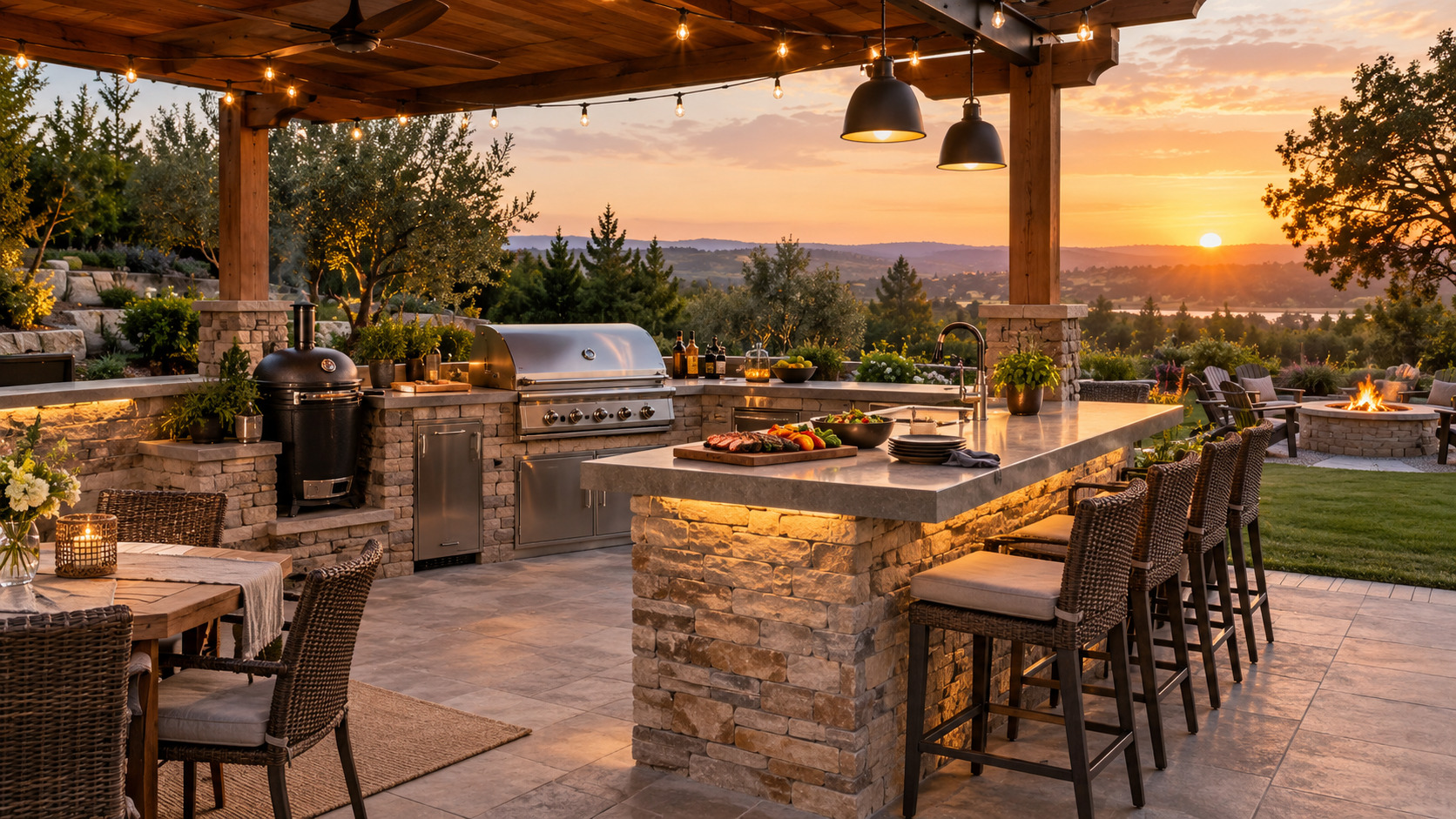
A well-designed backyard BBQ area can completely change the way you use your outdoor space. Instead of carrying food, utensils, drinks and cooking equipment back and forth from the house every time you grill, you can create a dedicated outdoor cooking and entertaining area where practically everything you need is within reach.
The best backyard BBQ areas are not necessarily the biggest or most expensive. They are spaces designed around how the homeowner actually cooks.
For one person, the ultimate setup might be a charcoal grill, preparation counter and comfortable dining table beneath a pergola. Someone who regularly smokes brisket may prefer a large offset smoker, butcher-block work surface and dedicated firewood storage. Another homeowner may want a complete outdoor kitchen with a built-in gas grill, refrigerator, sink, storage cabinets, pizza oven and bar seating.
The important part is planning the area as a complete system rather than simply placing a grill on the patio.
Cooking equipment, countertop space, ventilation, storage, lighting, electrical outlets, weather protection and seating should all work together.
Budget matters as well.
A functional backyard BBQ station can sometimes be created for a few hundred dollars using equipment you already own. A polished built-in grilling station may cost several thousand dollars, while an elaborate outdoor kitchen with stonework, appliances, utilities and covered entertaining space can easily become a major home-improvement project.
This guide explains how to plan and build the ultimate backyard BBQ area, including realistic cost ranges, essential equipment, grill choices, outdoor kitchen layouts, countertop materials, storage solutions, lighting, shelter and design ideas for different yard sizes and budgets.
What Is a Backyard BBQ Area?
A backyard BBQ area is a dedicated outdoor space designed primarily for grilling, smoking, preparing food and entertaining.
At the simplest level, it may contain:
- A freestanding grill
- A preparation table
- Outdoor seating
- Storage for grilling tools
- Basic outdoor lighting
More elaborate BBQ areas can function almost like full kitchens and may include:
- Built-in grills
- Pellet smokers
- Offset smokers
- Charcoal grills
- Outdoor refrigerators
- Ice makers
- Sinks
- Pizza ovens
- Side burners
- Flat-top griddles
- Warming drawers
- Cabinets
- Trash storage
- Bars
- Televisions
- Outdoor speakers
- Pergolas
- Fire pits
- Dining areas
Unlike an indoor kitchen, however, outdoor cooking spaces must withstand sunlight, rain, wind, humidity, temperature changes, grease, smoke and insects.
That means material selection and equipment placement become especially important.
The ultimate backyard BBQ area combines four main functions:
Cooking
You need equipment capable of preparing the types of food you enjoy cooking.
Preparation
You need enough counter space for seasoning meat, assembling burgers, preparing vegetables and handling finished food.
Storage
Grilling tools, fuel, plates, paper towels, thermometers and accessories should be easy to access.
Entertaining
Guests should have somewhere comfortable to sit without standing directly beside hot grills or smoky cooking equipment.
When all four functions are properly planned, outdoor cooking becomes significantly easier and more enjoyable.
How Much Does a Backyard BBQ Area Cost?
The cost of a backyard BBQ area varies enormously because projects can range from a basic grill station to a luxury outdoor kitchen.
A useful way to think about costs is to divide projects into four general levels.
Basic Backyard BBQ Setup: Approximately $500 to $2,500
A basic BBQ area may include:
- Freestanding grill
- Portable preparation table
- Grill cover
- Outdoor dining furniture
- Storage box
- Basic lighting
- Small patio or grilling pad
This level works well for renters, homeowners with smaller yards and anyone who wants a practical setup without permanent construction.
You can also upgrade it gradually.
For example, you might start with a charcoal grill and folding preparation table, then add a smoker, better furniture and permanent lighting later.
Mid-Range BBQ Station: Approximately $2,500 to $8,000
At this level, the space may include:
- Premium freestanding grill
- Smoker
- Permanent countertop
- Outdoor cabinets
- Small refrigerator
- Pergola or shade structure
- Improved patio surface
- Dining area
- Electrical outlets
A modular outdoor kitchen system is often attractive within this budget because it provides the appearance of a built-in kitchen without extensive masonry construction.
Built-In Outdoor Kitchen: Approximately $8,000 to $25,000
This budget can support a much more complete BBQ area with features such as:
- Built-in gas grill
- Side burner
- Refrigerator
- Sink
- Stone or masonry island
- Durable countertops
- Storage drawers
- Trash cabinet
- Bar seating
- Lighting
- Electrical and plumbing connections
- Covered cooking area
At this level, labor becomes a major part of the budget.
Running utilities, building masonry islands and constructing roof structures can cost as much as or more than the appliances themselves.
Luxury Backyard BBQ Area: $25,000 to $75,000 or More
High-end outdoor kitchens may include:
- Multiple grills
- Built-in smoker
- Kamado cooker
- Pizza oven
- Large refrigerator
- Beverage refrigerator
- Ice maker
- Outdoor sink
- Dishwasher
- Premium stainless-steel cabinets
- Stone counters
- Large pavilion
- Television
- Outdoor audio
- Bar
- Fireplace
- Fire pit
- Dining area
- Landscape lighting
- Custom masonry
Projects involving extensive patio construction, landscaping or pool integration can exceed these ranges considerably.
Where the Money Goes
Understanding the major cost categories can help you allocate your budget more effectively.
A typical project budget may include:
Cooking Equipment
The grill is usually one of the largest individual purchases.
A basic charcoal grill might cost a few hundred dollars, while a premium built-in gas grill may cost several thousand dollars.
Smokers and specialty equipment add additional costs.
Countertops and Cabinetry
Outdoor cabinets vary greatly in price depending on material.
Common options include:
- Stainless steel
- Powder-coated aluminum
- Masonry
- Concrete
- Polymer
- Weather-resistant wood
Countertop materials such as granite, concrete or porcelain can also represent a significant portion of the budget.
Patio Construction
If you already have a concrete patio, your project becomes much easier.
Building a new patio may involve:
- Excavation
- Base preparation
- Drainage
- Concrete
- Pavers
- Stone
- Labor
Large patios can therefore add thousands of dollars.
Utilities
Running electricity, natural gas or plumbing to an outdoor kitchen can become expensive, particularly when utilities need to travel long distances from the house.
Shelter
Pergolas and awnings can be relatively affordable.
Full roof structures or outdoor pavilions can cost considerably more because they may require foundations, framing, roofing, electrical work and permits.
Furniture
A dining table, chairs, lounge furniture and bar stools can add hundreds or thousands of dollars depending on quality.
Landscaping
Plants, retaining walls, drainage improvements, decorative stone and lighting can transform the appearance of the BBQ area but should be included in the original budget.
Start by Deciding How You Actually Cook
One of the biggest mistakes people make when designing an outdoor kitchen is purchasing appliances before deciding how they plan to use the space.
Instead, think about your normal cooking habits.
If you mainly grill hamburgers, steaks, chicken and vegetables, a high-quality gas or charcoal grill may handle almost everything you need.
If you regularly cook brisket, pork shoulder and ribs, smoker space becomes much more important.
If you cook breakfast outdoors, entertain large groups or enjoy smash burgers, a flat-top griddle may be extremely valuable.
Pizza enthusiasts may prioritize a dedicated pizza oven.
Consider how often you cook outdoors as well.
Someone grilling twice a month needs a different kitchen from someone who cooks outside four nights every week.
It helps to think about your favorite meals rather than individual appliances.
For example:
Steak nights
You may want a powerful gas grill, infrared burner or charcoal cooker capable of intense heat.
BBQ weekends
You may want a smoker, large preparation surface and wood or pellet storage.
Family meals
A gas grill and side burner may provide convenience and fast startup.
Large parties
You may need multiple cooking surfaces, warming space and a large refrigerator.
Breakfast cooking
A flat-top griddle becomes particularly useful.
Once you understand your cooking style, equipment decisions become much easier.
Choosing the Main Grill
The grill is usually the centerpiece of the BBQ area.
There are four main categories worth considering.
Gas Grills
Gas grills are popular because they are fast and convenient.
Turn on the burners, allow the grill to preheat and you can begin cooking relatively quickly.
Advantages include:
- Quick startup
- Easy temperature control
- Simple cleanup
- Excellent weeknight convenience
- Multiple burner zones
- Large cooking surfaces available
Gas grills work particularly well in outdoor kitchens because built-in versions integrate neatly into counters.
Potential disadvantages include less traditional smoke flavor compared with charcoal or wood cooking.
Many BBQ enthusiasts solve this problem by combining a gas grill with a smoker.
Charcoal Grills
Charcoal remains one of the most popular fuels for traditional backyard grilling.
Charcoal grills can produce high temperatures and excellent smoky flavor.
They are also relatively simple mechanically.
Advantages include:
- Excellent grilling flavor
- High-temperature cooking
- Affordable models available
- No electricity required
- Fuel widely available
However, charcoal takes longer to light and requires more cleanup.
You also need safe storage for charcoal.
For enthusiasts who enjoy the cooking process itself, these disadvantages may not matter.
Pellet Grills
Pellet grills combine automated temperature control with wood-smoke flavor.
An electric controller feeds hardwood pellets into a burn pot, allowing users to select a cooking temperature.
They are particularly useful for:
- Brisket
- Pork shoulder
- Ribs
- Chicken
- Turkey
- Reverse-seared steaks
The convenience of maintaining low smoking temperatures without constantly adjusting dampers makes pellet grills extremely attractive for many homeowners.
However, pellet grills require electricity and pellet storage.
If your BBQ area will include one, install convenient weather-resistant electrical outlets nearby.
Kamado Grills
Ceramic kamado cookers are highly versatile.
They can function as:
- Grills
- Smokers
- Roasting ovens
- Pizza ovens
Their thick ceramic construction retains heat extremely well.
Kamado grills can operate at low smoking temperatures for long periods or reach very high temperatures for searing and pizza cooking.
If incorporated into an outdoor kitchen, the counter must be designed specifically for the cooker.
Heat protection and manufacturer clearance requirements are especially important.
Offset Smokers
For traditional wood-fired BBQ, the offset smoker remains a favorite.
A fire burns inside a separate firebox, while heat and smoke travel through the main cooking chamber.
Good offset smokers can produce exceptional BBQ, but they require more attention than pellet smokers.
You must manage:
- Fire size
- Airflow
- Wood quality
- Temperature
- Smoke quality
Because offset smokers release considerable smoke and heat, they should usually be positioned where airflow carries smoke away from seating areas and the house.
They also require space.
A large smoker can dominate a small patio, so measure carefully before purchasing.
Consider Using Multiple Cooking Methods
The ultimate BBQ area does not necessarily rely on a single grill.
Different cooking technologies are good at different things.
A particularly versatile setup might include:
- Gas grill for fast everyday cooking
- Pellet or offset smoker for long BBQ sessions
- Charcoal or kamado grill for high-heat cooking
- Flat-top griddle for breakfast and burgers
You do not need all of these, but combining two complementary cooking systems provides far more flexibility than buying one extremely expensive grill.
For many homeowners, a gas grill plus smoker is an excellent combination.
The gas grill handles weeknight meals while the smoker handles slow weekend cooking.
Another strong combination is a kamado grill and flat-top griddle.
How Much Counter Space Do You Need?
Counter space is one of the most underestimated parts of outdoor kitchen design.
Imagine preparing ribs.
You may need room for:
- Cutting board
- Raw ribs
- Seasonings
- Sauce
- Knife
- Paper towels
- Thermometer
- Serving tray
Without adequate preparation space, even an expensive kitchen becomes frustrating.
Try to provide usable countertop space immediately beside the grill.
Ideally, you should have landing space on both sides.
One side can hold raw ingredients and cooking tools.
The other can handle finished food.
Even a compact BBQ station should aim for several feet of usable preparation space.
Larger kitchens benefit from separate preparation and serving zones.
Best Outdoor Countertop Materials
Outdoor countertops must tolerate weather, heat, grease and frequent cleaning.
Granite
Granite remains one of the strongest outdoor countertop choices.
Advantages include:
- Excellent durability
- Heat resistance
- Attractive appearance
- Easy cleaning
Some varieties may require sealing.
Very dark surfaces can become extremely hot under direct summer sun, so shade can improve comfort.
Concrete
Concrete countertops can create a modern or industrial appearance.
They can be poured into custom shapes, making them useful for unusual kitchen layouts.
Proper sealing is important because unsealed concrete can absorb grease and stains.
Porcelain
Outdoor-rated porcelain slabs are becoming increasingly popular.
They offer:
- Strong stain resistance
- UV resistance
- Low maintenance
- Modern appearance
Large-format porcelain can provide a sleek visual finish.
Tile
Tile can be relatively affordable and offers many design possibilities.
However, grout lines require maintenance and can collect grease.
For that reason, large tiles with fewer grout lines are generally easier to maintain.
Stainless Steel
Stainless steel provides a professional cooking appearance and excellent durability.
It is easy to clean but can show fingerprints and scratches.
It can also become extremely hot in direct sunlight.
Outdoor Kitchen Layout Ideas
Outdoor kitchens commonly use layouts similar to indoor kitchens.
Straight-Line BBQ Station
A straight kitchen places the grill, countertop, storage and possibly refrigerator along one wall or island.
This is ideal for smaller patios.
Benefits include:
- Compact footprint
- Lower construction cost
- Easy access to equipment
- Simple utility installation
A straight station may be only six to ten feet long but still provide plenty of functionality.
L-Shaped Outdoor Kitchen
An L-shaped design creates more countertop space without requiring a huge area.
One section can contain the cooking equipment while the second functions as a preparation counter or bar.
This design naturally creates separation between the cook and guests.
U-Shaped Outdoor Kitchen
A U-shaped kitchen provides maximum storage and counter space.
It works particularly well for serious outdoor cooks.
One side can contain the grill and smoker.
Another can contain the sink and refrigerator.
The third can provide bar seating.
The disadvantage is cost and space.
U-shaped kitchens require larger patios and more cabinetry.
Outdoor Kitchen Island
A standalone island can create an impressive centerpiece.
The cooking equipment may face the yard while guests sit along the opposite side.
However, make sure smoke and heat do not constantly blow toward guests.
Galley Layout
A galley-style kitchen uses two parallel counters.
One side might contain cooking appliances while the other holds food preparation and beverage equipment.
This arrangement can work well beneath narrow covered patios.
Create Separate Cooking and Social Zones
A well-designed BBQ area should allow the person cooking to interact with guests without guests getting in the way.
Avoid placing seating directly in front of grill doors or smoker lids.
People walking through the cooking zone can also create safety problems.
Ideally, organize the space into three zones:
Cooking zone
Contains grills, burners and smokers.
Preparation zone
Contains countertops, sink and storage.
Entertainment zone
Contains bar stools, dining tables and lounge furniture.
Guests can remain close enough to socialize without interfering with cooking.
The Importance of the Outdoor Work Triangle
Indoor kitchen designers often organize refrigerators, sinks and cooking equipment around a work triangle.
The same principle can help outdoors.
Your three key areas are typically:
- Grill
- Refrigerator
- Sink or preparation counter
You should be able to move between them easily without walking across the entire patio.
If the refrigerator is 20 feet away from the grill, you will constantly walk back and forth.
Good layout reduces unnecessary movement.
Should You Add an Outdoor Sink?
A sink is convenient but not absolutely necessary.
It becomes especially useful when the outdoor kitchen is far from the house.
An outdoor sink allows you to:
- Wash hands
- Rinse vegetables
- Clean utensils
- Fill containers
- Perform basic cleanup
However, plumbing installation can significantly increase project cost.
You must also consider winterization in freezing climates.
If your BBQ area sits only a few steps from the indoor kitchen, skipping the sink can sometimes save substantial money without sacrificing much convenience.
Should You Install an Outdoor Refrigerator?
An outdoor refrigerator is one of the most useful additions to a frequently used BBQ area.
It can hold:
- Drinks
- Sauces
- Marinades
- Vegetables
- Butter
- Cheese
- Prepared ingredients
However, use an appliance specifically rated for outdoor conditions.
Indoor refrigerators are not designed for rain, humidity and outdoor temperature extremes.
Built-in refrigerators also require proper ventilation.
Do not tightly enclose an appliance that requires airflow around its cooling system.
Add a Side Burner
Side burners are extremely useful and require relatively little space.
They allow you to cook foods that would otherwise require going inside.
Common uses include:
- Boiling corn
- Heating sauces
- Cooking beans
- Frying food
- Using cast-iron skillets
- Boiling seafood
A double side burner provides even greater flexibility if you frequently prepare entire meals outdoors.
Consider a Flat-Top Griddle
Flat-top griddles have become popular because they expand what can be cooked outdoors.
They are excellent for:
- Smash burgers
- Bacon
- Eggs
- Pancakes
- Fried rice
- Cheesesteaks
- Fajitas
- Vegetables
- Seafood
A griddle can complement a traditional grill very well.
If space is limited, some grills support removable griddle plates that provide similar functionality without requiring another appliance.
Adding a Pizza Oven
Pizza ovens can become one of the most entertaining features in a backyard kitchen.
Dedicated ovens may use:
- Wood
- Gas
- Pellets
High temperatures allow pizzas to cook quickly while creating crisp crusts.
Before installing one, consider how often you will actually use it.
A pizza oven can consume significant counter space.
If pizza is only an occasional meal, a portable oven may provide better value than a permanent built-in model.
Plan Storage Before Building
Outdoor storage makes a BBQ station dramatically more practical.
Items commonly stored outside include:
- Tongs
- Spatulas
- Grill brushes
- Thermometers
- Heat-resistant gloves
- Cutting boards
- Aluminum foil
- Butcher paper
- Smoking wood
- Pellets
- Charcoal accessories
Dry drawers and sealed cabinets protect equipment from moisture and insects.
Avoid storing anything outdoors that is particularly vulnerable to humidity unless the cabinet is designed to protect it.
Include a Trash Cabinet
A pull-out trash bin is one of the least glamorous but most useful outdoor kitchen features.
Cooking produces:
- Packaging
- Paper towels
- Food scraps
- Disposable gloves
- Foil
- Trimmings
Without nearby trash storage, waste quickly accumulates on countertops.
A pull-out cabinet keeps the space cleaner and hides the trash container from guests.
Store Fuel Safely
Different grills require different fuels.
Charcoal should be stored somewhere dry.
Wood pellets can absorb moisture and become unusable, so they need particularly good protection.
Smoking wood should remain dry and preferably have airflow around it.
Propane cylinders should be handled and stored according to applicable safety requirements and appliance instructions.
Never design decorative cabinetry in a way that blocks required ventilation around fuel systems.
Choosing the Patio Surface
Your cooking area needs a stable, noncombustible surface.
Common options include:
Concrete
Concrete is durable, easy to clean and relatively practical.
Stamped or stained concrete can create a more decorative appearance.
Pavers
Pavers offer excellent design flexibility.
Individual damaged pavers can also be replaced.
Proper base preparation is essential to prevent settling.
Natural Stone
Stone creates an upscale appearance.
However, some stone surfaces can stain from grease.
Sealing may be necessary.
Porcelain Pavers
Outdoor porcelain provides excellent stain resistance and contemporary styling.
Proper installation is critical.
Gravel
Gravel can work around informal BBQ spaces but is less ideal directly beneath cooking equipment.
It can make moving heavy grills difficult and is not as easy to clean after grease spills.
Provide Proper Drainage
Outdoor kitchens are exposed to rain and cleaning water.
Water should drain away from:
- The house
- Cabinets
- Appliances
- Electrical equipment
Patios should generally have slight slope so water does not collect underneath cabinets.
Poor drainage can lead to:
- Mold
- Rust
- Staining
- Foundation problems
- Insect activity
- Freeze damage
Drainage planning is therefore just as important as appliance selection.
Build Shade Into the Design
A BBQ area sitting in direct summer sun can become uncomfortable.
Adding shade dramatically increases how often you can use the space.
Common options include:
- Pergolas
- Pavilions
- Roof extensions
- Retractable awnings
- Shade sails
- Large umbrellas
Permanent roofing provides the strongest weather protection but usually costs the most.
A pergola can create visual structure while allowing more airflow.
Be Careful When Covering Grills
Cooking appliances generate substantial heat, smoke and combustion gases.
Never place a grill or smoker beneath an enclosure without following the equipment manufacturer’s required clearances and ventilation instructions.
Important considerations include:
- Roof clearance
- Wall clearance
- Combustible materials
- Ventilation
- Exhaust systems
- Fire resistance
Large covered outdoor kitchens may require ventilation equipment similar to commercial-style exhaust hoods.
Local codes can also affect installation requirements.
Safety should take priority over appearance.
Protect the BBQ Area From Wind
Wind can make grilling difficult.
It can:
- Reduce burner performance
- Blow smoke toward guests
- Carry grease
- Affect smoker temperatures
- Extinguish burners
Observe prevailing wind direction before choosing equipment locations.
A privacy wall, hedge or strategically positioned structure may help block strong wind.
However, never completely enclose equipment that requires ventilation.
Add Proper Outdoor Lighting
Lighting is essential if you plan to cook after sunset.
You need two types of lighting.
Task Lighting
Task lighting illuminates working areas.
Good locations include:
- Above grill surfaces
- Above countertops
- Near sinks
- Inside storage areas
The cook should be able to see food color and doneness clearly.
Ambient Lighting
Ambient lighting creates atmosphere around the rest of the patio.
Options include:
- Wall lights
- Pendant lights
- Landscape lighting
- String lights
- Step lights
- Post lights
Avoid placing extremely bright lights directly in guests’ eyes.
A layered lighting design usually produces the best result.
Electrical Planning
Modern BBQ areas often require more electricity than homeowners expect.
Potential electrical equipment includes:
- Pellet grills
- Refrigerators
- Ice makers
- Lighting
- Rotisserie motors
- Blenders
- Televisions
- Speakers
- Phone chargers
- Fans
Installing several properly positioned outdoor-rated electrical outlets during construction is usually much easier than adding them later.
Outdoor electrical systems should use appropriate weather protection and safety devices.
Electrical work should follow local requirements and may require a licensed electrician.
Natural Gas Versus Propane
Gas grills commonly run on natural gas or propane.
Propane
Advantages include:
- Portability
- No permanent gas line required
- Easy installation
The disadvantage is eventually running out of fuel.
Large grilling sessions can become inconvenient if a cylinder empties unexpectedly.
Keeping a properly stored backup cylinder can reduce this risk.
Natural Gas
A natural gas connection provides continuous fuel without replacing cylinders.
It works particularly well for permanent outdoor kitchens.
However, installation requires a suitable gas line.
Depending on the location of the kitchen, running that line can become expensive.
Also remember that grills are designed for specific fuel types.
Do not assume a propane grill can simply be connected to natural gas without an approved conversion.
Stainless Steel Quality Matters
Outdoor kitchens frequently use stainless-steel appliances and cabinets because of their weather resistance.
However, not all stainless steel performs equally outdoors.
Climate matters.
Coastal environments expose metal to salt air, which can accelerate corrosion.
Regular cleaning is still required even with high-quality stainless steel.
Grease, salt, moisture and food residue should not be allowed to remain indefinitely on appliance surfaces.
Design Enough Ventilation Into Cabinets
Built-in grills and gas appliances require ventilation.
Do not treat the outdoor kitchen island as a sealed box.
Ventilation openings may be required based on fuel type and appliance specifications.
This becomes particularly important when propane or natural gas components are located within the island.
Always follow appliance installation requirements rather than guessing ventilation placement.
Fire Safety Around the BBQ Area
Fire safety should influence the entire design.
Keep grills away from combustible materials.
Potential hazards include:
- Wood siding
- Deck railings
- Roof framing
- Dry vegetation
- Curtains
- Furniture
- Decorations
It is also smart to keep an appropriate fire extinguisher accessible.
Do not place the extinguisher immediately beside the grill where reaching it could require moving toward the fire.
Locate it nearby but in a safe, accessible location.
Outdoor BBQ Area on a Wooden Deck
A deck can support a great grilling space, but it requires careful planning.
Hot grease, sparks and charcoal can damage combustible decking.
Follow grill clearance requirements and use appropriate protective surfaces where necessary.
Large masonry kitchens are extremely heavy.
Before constructing stone islands or installing heavy appliances on an elevated deck, make sure the structure is capable of supporting the load.
Structural evaluation may be necessary.
Create Comfortable Seating
A BBQ area becomes much more valuable when guests have somewhere comfortable to stay.
Possible seating arrangements include:
Outdoor Dining Table
Best for family dinners and full meals.
Bar Seating
Ideal for guests who want to socialize with the cook.
Lounge Seating
Useful around larger patios where people stay after dinner.
Built-In Benches
Built-in seating can save space and create a polished appearance.
Try to keep seating outside the hottest cooking zone.
Bar stools placed directly beside a grill may expose guests to heat, smoke and grease.
Add a Dining Zone
Even if you already have bar seating, a proper dining table can be extremely useful.
Allow enough room for people to pull chairs out and walk behind seated guests.
One common design mistake is filling the patio with oversized furniture until circulation becomes difficult.
Measure furniture dimensions before construction rather than assuming everything will fit later.
Add a Beverage Station
Separating drinks from the cooking area helps reduce traffic around the grill.
A beverage station might contain:
- Outdoor refrigerator
- Ice storage
- Countertop
- Glass storage
- Bottle opener
- Water dispenser
Guests can then serve themselves without entering the cook’s workspace.
This becomes especially valuable when hosting larger gatherings.
Think About a Television Carefully
Outdoor televisions can be fun for sports or movie nights, but placement matters.
Consider:
- Sun glare
- Rain exposure
- Viewing angle
- Heat
- Smoke
- Electrical access
Do not mount a television directly above a hot grill unless the installation has specifically been designed for that environment.
Smoke and grease can damage electronics over time.
Add Outdoor Speakers
Music can improve the atmosphere without taking up much space.
Outdoor-rated speakers can be mounted around the patio or integrated into landscaping.
Keep volume reasonable, especially in neighborhoods with nearby homes.
Incorporate a Fire Pit
A fire pit can extend the usability of the BBQ area into cooler evenings.
However, it should normally be placed away from the primary cooking equipment.
Creating separate zones can work well:
BBQ zone: cooking and dining.
Fire zone: lounging and conversation.
Keep adequate distance between flames, structures, furniture and vegetation.
Use Landscaping to Make the Space Feel Finished
A BBQ area consisting only of appliances and concrete can feel incomplete.
Landscaping softens the space.
Ideas include:
- Raised planters
- Ornamental grasses
- Small trees
- Herb gardens
- Privacy hedges
- Decorative gravel
- Flower beds
An herb garden near the cooking station can be both attractive and functional.
Common cooking herbs include:
- Rosemary
- Thyme
- Basil
- Parsley
- Mint
- Oregano
Avoid placing plants where hot exhaust will repeatedly damage them.
Backyard BBQ Design Idea 1: The Compact Grill Station
For a small yard, you do not need a full outdoor kitchen.
A six- to eight-foot grilling station can include:
- Quality gas or charcoal grill
- Countertop
- Two storage cabinets
- Tool drawer
- Small refrigerator
- Nearby dining table
Place it against a noncombustible wall or use it as a freestanding island.
A simple pergola can provide shade without making the space feel crowded.
This configuration offers most of the functionality homeowners use regularly while controlling cost.
Backyard BBQ Design Idea 2: The Smoker’s Corner
For someone passionate about low-and-slow BBQ, build the space around the smoker.
The area may include:
- Offset smoker
- Pellet smoker
- Large stainless or stone preparation table
- Wood storage
- Pellet storage
- Cutting board station
- Outdoor sink
- Strong task lighting
Place the smoker near an open edge of the patio so smoke can escape easily.
A separate gas grill can handle fast cooking.
The preparation area should be large enough for trimming brisket and handling full racks of ribs.
Backyard BBQ Design Idea 3: The Family Outdoor Kitchen
A family-focused design prioritizes convenience.
An L-shaped kitchen can contain:
- Built-in gas grill
- Side burner
- Refrigerator
- Sink
- Trash storage
- Cabinets
- Counter seating
Place a dining table nearby.
This setup allows most meals to be prepared outside without repeated trips indoors.
Backyard BBQ Design Idea 4: The Entertainer’s Kitchen
For frequent parties, increase cooking capacity and separate drinks from cooking.
Consider:
- Large gas grill
- Smoker
- Griddle
- Beverage refrigerator
- Ice storage
- Large bar
- Dining table
- Lounge seating
- Television
- Outdoor speakers
A U-shaped kitchen provides substantial counter space.
A covered pavilion can turn the area into a true outdoor living room.
Backyard BBQ Design Idea 5: The Rustic BBQ Pit
A rustic design works particularly well with charcoal and wood-fired cooking.
Materials might include:
- Brick
- Natural stone
- Timber accents
- Concrete counters
- Black steel fixtures
Equipment could include:
- Offset smoker
- Charcoal grill
- Wood-fired pizza oven
Add visible firewood storage and heavy wooden furniture.
The result can resemble a traditional smokehouse rather than a modern kitchen.
Backyard BBQ Design Idea 6: Modern Minimalist Outdoor Kitchen
A modern BBQ area uses clean lines and fewer visible accessories.
Typical materials include:
- Large porcelain slabs
- Smooth concrete
- Stainless steel
- Powder-coated metal
Choose handleless cabinets where practical.
Hide appliances behind clean cabinet lines.
Keep the color palette simple.
Integrated lighting can emphasize architectural surfaces at night.
Backyard BBQ Design Idea 7: Poolside BBQ Area
If the BBQ area sits near a pool, design traffic carefully.
Wet swimmers should not have to walk directly through the cooking area.
Use slip-resistant flooring.
A beverage refrigerator becomes especially useful.
Shade is also important because poolside areas often receive strong direct sunlight.
Keep electrical equipment appropriately protected from water.
Backyard BBQ Design Idea 8: Budget-Friendly DIY BBQ Area
You can create an impressive outdoor cooking space without a permanent kitchen.
Start with:
- Freestanding grill
- Portable smoker
- Stainless preparation table
- Weatherproof storage box
- Outdoor table
- Umbrella
- String lighting
Position everything around an existing patio.
Matching furniture and storage can make even inexpensive equipment look intentional.
Upgrade individual pieces over time.
Where to Spend More Money
Certain components are worth prioritizing.
Main Grill
If you grill frequently, buying a durable grill with strong construction and replacement-part availability can provide better long-term value.
Countertops
Cheap materials that crack, fade or absorb grease can become expensive to replace.
Cabinetry
Outdoor cabinets face difficult environmental conditions.
Poor materials may swell, rust or deteriorate quickly.
Electrical and Gas Work
Utility work should be performed correctly.
This is not an area where unsafe shortcuts are worth the savings.
Patio Foundation
A stable foundation protects everything built above it.
Fixing settling pavers or cracked foundations after the kitchen is installed can be difficult.
Where You Can Save Money
Not every feature requires premium spending.
Skip Appliances You Rarely Use
An ice maker sounds impressive but may not justify its cost for occasional gatherings.
The same applies to built-in pizza ovens or warming drawers.
Use Freestanding Equipment
Freestanding grills and smokers often cost less than premium built-in systems and are easier to replace.
Delay Decorative Upgrades
Install functional components first.
Decorative lighting, landscaping and furniture can be improved later.
Build in Phases
A good BBQ area can grow over several years.
For example:
Phase one: patio and grill.
Phase two: counters and storage.
Phase three: refrigerator and utilities.
Phase four: pergola and entertainment features.
Planning the final layout from the beginning ensures later upgrades fit properly.
Common Backyard BBQ Design Mistakes
Avoiding mistakes can save more money than finding cheap materials.
Too Little Counter Space
This is perhaps the most common problem.
Leave room beside cooking appliances.
No Place for Trash
Without nearby waste storage, countertops become cluttered.
Seating Too Close to Heat
Guests do not enjoy sitting in front of grill exhaust.
Ignoring Wind Direction
Smoke repeatedly blowing toward the house can make an otherwise beautiful kitchen frustrating.
Poor Lighting
Cooking steak in dim lighting is difficult.
Install dedicated task lighting.
Buying Too Many Appliances
An outdoor kitchen full of equipment you rarely use wastes money and counter space.
No Future Expansion Plan
Even if you start small, consider where additional equipment could be installed later.
Forgetting Electrical Outlets
Outdoor cooking increasingly relies on electronics.
Install more outlets than you think you will need.
Choosing Indoor Materials
Outdoor environments are much harsher than indoor kitchens.
Cabinets, refrigerators, lighting and furniture should be suitable for outdoor use.
How Much Space Should You Allow?
Space requirements depend on equipment.
A compact BBQ area may fit comfortably within approximately 80 to 120 square feet.
A more complete kitchen and dining space may require 200 to 400 square feet.
Large entertaining patios can exceed 500 square feet.
Instead of focusing only on total square footage, consider circulation.
You need room to:
- Open grill lids
- Open refrigerator doors
- Walk behind bar stools
- Pull dining chairs back
- Carry food
- Access storage
- Move safely around hot equipment
Marking the proposed layout on the ground using tape or chalk can reveal problems before construction begins.
Measure Every Appliance Before Construction
Built-in equipment requires precise openings.
Do not rely on estimated appliance dimensions.
Manufacturers typically specify required cutout dimensions, clearances and ventilation.
The cabinet should be designed around those requirements.
Replacing a built-in grill years later can be difficult if the original opening is an unusual size.
For that reason, standardized dimensions and replaceable trim systems can provide long-term flexibility.
Make Cleaning Easy
BBQ cooking creates grease.
Choose surfaces that can be wiped clean easily.
Consider:
- Smooth countertops
- Removable grease trays
- Accessible trash storage
- Nearby water
- Washable flooring
Avoid unnecessarily complicated decorative surfaces immediately beside cooking equipment.
Grease eventually reaches almost everything nearby.
A beautiful kitchen that takes hours to clean will be used less frequently.
Weatherproofing Your Outdoor BBQ Area
Outdoor equipment lasts longer when protected from weather.
Use grill covers when appropriate.
Keep water from collecting on countertops.
Seal porous stone when required.
Inspect cabinet seals.
Clean stainless steel regularly.
In freezing climates, winterize plumbing and appliances according to manufacturer instructions.
Weather protection can add years to the useful life of an outdoor kitchen.
Designing for Year-Round Use
Depending on climate, several upgrades can extend the BBQ season.
Roof
Provides protection from rain and snow.
Wind Protection
Helps maintain comfort in cooler weather.
Outdoor Heaters
Can make winter gatherings more pleasant.
Ceiling Fans
Improve comfort during hot summer weather.
Lighting
Allows cooking during shorter winter days.
A space designed for several seasons typically provides greater value than one usable only on perfect summer evenings.
Should a Backyard BBQ Area Add Home Value?
A professionally designed outdoor kitchen may improve the appeal of a home, especially in climates where outdoor living is common.
However, the project should primarily be designed for your own use rather than assuming every dollar spent will increase resale value.
Overly specialized kitchens may not appeal equally to every buyer.
Durable, attractive and practical outdoor living areas tend to have broader appeal.
A simple high-quality setup can therefore sometimes make more financial sense than an extremely elaborate installation.
A Practical Example of a $5,000 Backyard BBQ Area
A moderate budget can create a very capable space.
You might allocate money toward:
- Good freestanding grill
- Small smoker
- Stainless preparation table
- Outdoor refrigerator
- Storage cabinet
- Outdoor dining furniture
- Lighting
- Shade umbrella or simple pergola improvements
Using an existing patio keeps costs down.
The result may not look like a luxury magazine kitchen, but it can provide excellent cooking functionality.
Example of a $15,000 Outdoor Kitchen
A larger budget could support:
- Built-in gas grill
- Stone or modular island
- Granite countertop
- Outdoor refrigerator
- Side burner
- Storage drawers
- Trash cabinet
- Electrical outlets
- Lighting
- Bar seating
Depending on labor and utility requirements, a sink might also fit within this budget.
This represents a strong balance between luxury and practicality for many homeowners.
Example of a $30,000-Plus BBQ Area
A premium project could include:
- Large built-in grill
- Pellet or offset smoker
- Griddle
- Pizza oven
- Refrigerator
- Beverage center
- Sink
- Extensive cabinetry
- Large stone countertops
- Covered pavilion
- Television
- Dining furniture
- Landscape lighting
At this level, the BBQ area becomes an extension of the home rather than simply a place to grill.
The Best Order for Building a Backyard BBQ Area
Careful sequencing prevents expensive rework.
Step 1: Define How You Will Use the Space
Determine what you normally cook and how many people you entertain.
Step 2: Establish the Budget
Include equipment, construction, utilities, furniture and landscaping.
Step 3: Measure the Area
Map the available patio and yard space.
Step 4: Choose Major Appliances
Select the grill, smoker and other large equipment before designing cabinet openings.
Step 5: Plan Utilities
Determine requirements for:
- Electricity
- Gas
- Water
- Drainage
Step 6: Design the Layout
Plan cooking, preparation, storage and guest zones.
Step 7: Build the Foundation
Construct or improve the patio.
Step 8: Install Utilities
Utility work should generally occur before permanent cabinets and counters are completed.
Step 9: Build the Kitchen Structure
Install islands, cabinets and appliance supports.
Step 10: Install Countertops
Make sure openings match appliance specifications.
Step 11: Install Equipment
Fit grills, refrigerators, sinks and burners.
Step 12: Add Lighting and Shelter
Finish the functional infrastructure.
Step 13: Furnish the Space
Add dining furniture, bar stools and lounge seating.
Step 14: Landscape the Surroundings
Plants and lighting give the space a finished appearance.
Final Backyard BBQ Planning Checklist
Before construction begins, verify that your plan answers the following questions:
- What type of cooking will you do most often?
- What is your main grill?
- Do you need a smoker?
- Do you need a griddle?
- Do you need a side burner?
- Is there enough countertop space?
- Where will raw food be prepared?
- Where will finished food be placed?
- Where will utensils be stored?
- Where will trash go?
- Where will fuel be stored?
- Is there enough electrical capacity?
- Do you need natural gas?
- Do you need plumbing?
- Where will rainwater drain?
- Which direction does smoke normally travel?
- Are grills safely separated from combustible surfaces?
- Is there adequate ventilation?
- Is task lighting installed?
- Is there shade?
- Where will guests sit?
- Can people walk comfortably through the area?
- Can appliances be replaced in the future?
- Are materials designed for outdoor exposure?
If these questions have clear answers, the finished BBQ area is much more likely to work well in everyday use.
Building the Ultimate Backyard BBQ Area
The ultimate backyard BBQ area is not defined by how many appliances it contains.
It is defined by how easily and comfortably you can cook there.
A $3,000 grilling station with the right layout can be more useful than a $30,000 outdoor kitchen designed primarily for appearance.
Start with the fundamentals.
Choose cooking equipment that matches the food you actually prepare.
Provide generous preparation space.
Create convenient storage.
Separate guests from high-heat cooking zones.
Plan electricity, gas and plumbing before construction.
Protect the area from excessive sun and rain.
Use outdoor-rated materials that can survive years of weather.
Most importantly, think about the entire cooking process.
Imagine carrying raw steaks outside.
Where do you put them?
Where are the seasonings?
Where are your tongs?
Where does the serving tray sit while you cook?
Where do you wash your hands?
Where do guests stand?
Where does smoke travel?
Where do you throw away packaging?
Those small details determine whether an outdoor kitchen feels effortless or frustrating.
For many homeowners, the ideal design is surprisingly simple: a dependable grill, dedicated smoker, several feet of counter space, good storage, strong lighting, shade and a comfortable dining area.
Others may benefit from a complete kitchen with refrigeration, plumbing and multiple cooking appliances.
There is no single correct configuration.
A backyard BBQ area should reflect your cooking style, available space and budget.
Design the functional parts first and the decorative parts second.
When equipment, preparation surfaces, storage, lighting, ventilation and seating are properly coordinated, the backyard becomes far more than a place to keep a grill.
It becomes an outdoor cooking space where weeknight dinners are easier, long BBQ sessions are more enjoyable and gatherings naturally center around the food.
Whether you build a modest grill station or a complete covered outdoor kitchen, thoughtful planning is what turns a basic patio into the ultimate backyard BBQ area.