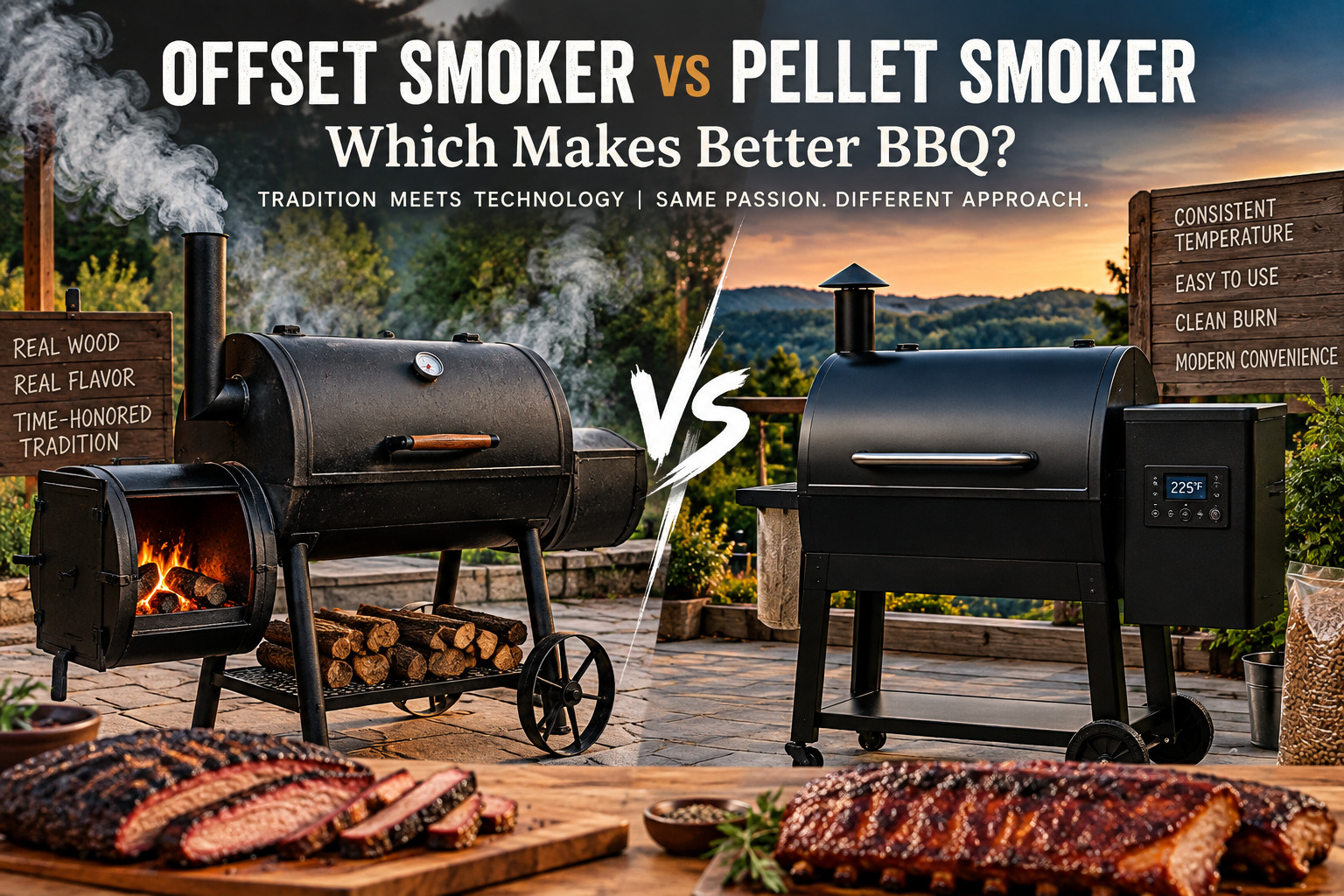
Choosing between an offset smoker and a pellet smoker is one of the most important decisions a serious backyard barbecue cook can make. Both types of smokers can produce tender brisket, juicy pork shoulder, smoky ribs, beautifully cooked chicken, and countless other barbecue favorites. However, the way they create heat and smoke is very different, and those differences affect flavor, bark, cooking effort, temperature control, fuel use, and the overall barbecue experience.
An offset smoker represents the traditional approach to low-and-slow barbecue. You build a real wood fire in a separate firebox, manage airflow manually, and guide hot smoke through the cooking chamber. Cooking on an offset requires attention and skill, but when everything is working correctly, it can create deep wood-smoke flavor and a dark, impressive bark that many barbecue enthusiasts consider the standard for authentic smoked meat.
A pellet smoker takes a much more automated approach. Instead of managing wood splits and airflow throughout the cook, you fill a hopper with compressed hardwood pellets, set your desired temperature, and allow an electronic controller to regulate the fire. Pellet smokers make low-and-slow barbecue considerably easier and more predictable, especially for beginners or busy cooks who do not want to spend an entire day tending a fire.
So which makes better BBQ?
If your definition of better barbecue is maximum smoke flavor, traditional fire management, and competition-style bark, a well-designed offset smoker usually has the advantage. If better barbecue means consistent results, easier temperature control, less work, and the ability to smoke meat while doing other things, a pellet smoker may be the better choice.
The answer becomes clearer once you understand how the two smokers work and how each design affects the cooking process.
What Is an Offset Smoker?
An offset smoker is a wood-burning smoker with two primary sections: a firebox and a cooking chamber.
The firebox sits beside or slightly below the main cooking chamber. Wood or charcoal burns inside the firebox, and heat and smoke travel from the firebox into the cooking chamber before exiting through a chimney.
Because the fire is physically separated from the food, meat cooks primarily through indirect heat and circulating smoke rather than direct flames.
The classic offset smoker design usually includes:
- A horizontal cylindrical cooking chamber
- A smaller firebox attached to one side
- Cooking grates inside the main chamber
- Adjustable air vents
- A chimney or smokestack
- Thermometers or temperature probe ports
- Heavy steel construction on higher-quality models
Offset smokers are strongly associated with traditional Texas-style barbecue, particularly brisket.
Many professional barbecue restaurants use enormous commercial offset smokers because they provide exceptional smoke flavor and can cook large quantities of meat at the same time.
However, backyard offset smokers vary dramatically in quality.
A thick steel offset smoker with good airflow can hold temperature relatively well. A cheap thin-metal offset smoker may leak smoke, lose heat quickly, and require constant adjustment.
That difference in construction quality is extremely important when comparing offsets with pellet smokers.
What Is a Pellet Smoker?
A pellet smoker, often called a pellet grill, uses small compressed hardwood pellets as fuel.
Instead of manually building and maintaining a wood fire, pellets are stored in a hopper. An electrically powered auger gradually moves pellets from the hopper into a burn pot.
A hot rod ignites the pellets, and a fan supplies oxygen while circulating heat and smoke throughout the cooking chamber.
The smoker’s digital controller monitors temperature and adjusts how quickly pellets are fed into the burn pot.
A typical pellet smoker includes:
- A pellet hopper
- An electric auger
- A burn pot
- An ignition system
- A fan
- A digital temperature controller
- Temperature sensors
- Cooking grates
- Grease-management components
Most modern pellet smokers operate much like an outdoor oven.
You might set the temperature to 225°F, place a pork shoulder inside, insert a meat probe, and allow the smoker to control itself for several hours.
Some pellet smokers can even automatically change cooking temperatures once the meat reaches a specific internal temperature.
This automation is the biggest reason pellet smokers have become so popular.
Offset Smoker vs Pellet Smoker: Quick Comparison
The fundamental difference is simple.
An offset smoker prioritizes traditional live-fire barbecue.
A pellet smoker prioritizes convenience and temperature consistency.
Here is how they generally compare.
| Category | Offset Smoker | Pellet Smoker |
|---|---|---|
| Smoke flavor | Excellent | Very good |
| Bark development | Excellent | Very good |
| Temperature control | Manual | Automatic |
| Learning curve | High | Low |
| Fire management | Constant attention | Minimal attention |
| Fuel | Wood splits or charcoal plus wood | Hardwood pellets |
| Electricity required | No | Yes |
| Overnight cooking | Requires monitoring | Very convenient |
| Startup process | More involved | Very easy |
| Cleanup | Moderate | Moderate |
| Maintenance | Mostly mechanical | Mechanical and electronic |
| Weather sensitivity | Moderate to high | Moderate |
| Cooking capacity | Often large | Varies widely |
| Traditional BBQ experience | Excellent | Limited |
| Beginner friendliness | Moderate to difficult | Excellent |
| Maximum smoke intensity | High | Moderate |
| Consistency | Skill-dependent | Excellent |
| Versatility | Strong for smoking | Strong for smoking, roasting, and grilling |
| Portability | Usually limited | Usually limited by electricity |
| Long-term mechanical simplicity | Excellent | More components can fail |
Both smokers are capable of producing excellent food. The difference lies in how much involvement you want during the process and what qualities you value most.
Which Smoker Produces Better Smoke Flavor?
For maximum smoke flavor, the offset smoker generally wins.
The reason comes down to combustion.
A properly managed offset smoker burns real hardwood logs or splits. The continuous combustion of wood creates a complex mixture of aromatic compounds that interact with the surface of the meat.
Different woods can create noticeably different flavor profiles.
For example, oak provides a balanced smoke flavor suitable for almost everything. Hickory tends to be stronger. Pecan can provide a slightly sweeter character. Fruit woods such as apple or cherry produce lighter, sweeter smoke.
Because an offset smoker continuously burns larger pieces of natural hardwood, it can generate a deeper smoke profile than most pellet smokers.
Pellet smokers still produce authentic wood smoke, but pellets burn differently from traditional wood splits.
Pellets are made by compressing dried wood material into small cylinders. Because they are extremely dry and burn efficiently, pellet smokers tend to produce a cleaner and often lighter smoke profile.
That is not necessarily a disadvantage.
Heavy smoke does not automatically mean better barbecue.
Poorly managed wood fires can create thick white smoke containing compounds that make food taste bitter, harsh, or even unpleasant.
The goal of traditional offset smoking is generally a clean-burning fire producing light, almost transparent blue smoke.
An experienced offset smoker operator who maintains clean combustion can achieve extraordinary smoke flavor.
However, a beginner who struggles with fire management may actually produce better-tasting food on a pellet smoker.
Pellet smokers make it difficult to create extremely bitter, dirty smoke because the combustion process is tightly controlled.
Therefore:
For experienced pitmasters seeking maximum smoke complexity, offset smokers usually produce superior results.
For beginners seeking reliable, balanced smoke flavor, pellet smokers may provide better results more consistently.
Smoke Flavor Is Not the Same as Smoke Intensity
One common mistake is judging barbecue quality entirely by how smoky the meat tastes.
Good barbecue should taste like meat, seasoning, rendered fat, smoke, and cooking reactions working together.
If smoke dominates every bite, the food may actually be oversmoked.
Offset smokers give cooks enormous control over smoke intensity.
You can adjust:
- Wood species
- Split size
- Fire size
- Airflow
- Combustion efficiency
- Meat placement
- Cooking temperature
- Wood moisture level
This level of control allows experienced cooks to fine-tune flavor.
Pellet smokers simplify most of these variables.
Different pellets can influence flavor, but the differences may be less dramatic than changing wood species in a traditional offset smoker.
Many pellet smoker owners use stronger woods such as hickory or mesquite blends when they want more noticeable smoke.
Cooking at lower temperatures can also increase smoke exposure because pellet smokers often produce more smoke during slower burn cycles.
Which Smoker Creates Better Bark?
Offset smokers generally produce better bark.
Bark is the dark, flavorful crust that develops on smoked meat such as brisket, pork shoulder, and ribs.
Good bark develops from several processes working together:
- Seasoning
- Smoke particles
- Surface dehydration
- Rendered fat
- Protein reactions
- Caramelization of certain ingredients
- Long exposure to circulating heat
Offset smokers tend to create strong airflow through the cooking chamber. This moving air helps remove moisture from the meat’s surface.
As the exterior dries slightly, seasonings and smoke compounds combine to create a thicker, darker bark.
Pellet smokers can also create excellent bark, especially when meat is cooked unwrapped for several hours. However, the environment inside many pellet smokers can be slightly gentler and less aggressive than the airflow inside a traditional offset.
The result may be a somewhat softer bark.
That difference is particularly noticeable on brisket.
A brisket cooked properly on an offset smoker can develop a very dark, almost black exterior while remaining moist inside.
A pellet-smoked brisket can develop excellent bark as well, but it may require additional techniques.
For example, pellet smoker users often improve bark by:
- Cooking at 225°F to 250°F initially
- Leaving the brisket unwrapped longer
- Using coarse salt and pepper seasoning
- Avoiding excessive spritzing
- Increasing temperature later in the cook
- Using butcher paper instead of foil
- Allowing plenty of airflow around the brisket
Pellet smokers can absolutely produce attractive bark, but offsets generally make it easier to achieve a more aggressive traditional barbecue crust once the fire is managed correctly.
Temperature Control: Pellet Smokers Win Easily
Temperature control is where pellet smokers have their greatest advantage.
On most modern pellet smokers, you simply turn the smoker on and select a temperature.
The controller handles most of the work.
If the smoker begins cooling down, additional pellets enter the burn pot.
If the smoker becomes too hot, the feed rate decreases.
Advanced controllers can maintain remarkably stable temperatures throughout long cooking sessions.
An offset smoker requires much more involvement.
You may need to:
- Start a charcoal bed
- Add wood splits
- Adjust the intake vent
- Adjust the chimney
- Monitor combustion
- Add another log every 30 to 60 minutes
- Respond to wind
- Respond to temperature changes
- Manage coal buildup
- Move food if one section runs hotter
An experienced pitmaster eventually develops a rhythm.
Instead of constantly staring at a thermometer, they learn how their smoker behaves.
They know approximately when another split needs to be added. They recognize whether the fire needs more oxygen based on the appearance of the flames and smoke.
However, developing this skill takes time.
Pellet smokers remove most of this learning curve.
Which Is Easier for Beginners?
Pellet smokers are significantly easier for beginners.
Imagine cooking your first brisket.
With a pellet smoker, the process may look like this:
Season the brisket.
Preheat the smoker to 225°F or 250°F.
Place the brisket on the grate.
Insert a temperature probe.
Monitor the cook occasionally.
Wrap the brisket when the bark is developed.
Continue cooking until tender.
Rest the brisket.
The smoker automatically manages the fire.
With an offset smoker, you must learn barbecue and fire management simultaneously.
You must understand:
- How to build the initial fire
- How large the fire should be
- How much wood to add
- When to add wood
- How much airflow the fire needs
- How weather changes affect temperature
- How to avoid dirty smoke
- How to control temperature spikes
- How to prevent the fire from dying
This extra complexity can be rewarding, but it can also overwhelm beginners.
Someone who mainly wants delicious smoked meat with minimal frustration will usually be happier starting with a pellet smoker.
Someone who actively wants to learn traditional fire management may prefer an offset from the beginning.
Fire Management on an Offset Smoker
Fire management is the heart of offset smoking.
A good offset fire should usually be relatively small, hot, and clean.
Many beginners make the mistake of creating a large smoldering fire and then closing the vents to reduce the temperature.
That often creates poor combustion.
When wood burns without enough oxygen, thick white smoke can develop.
That smoke may produce bitter flavors and dark soot.
A better approach is usually to maintain a smaller fire with adequate oxygen.
A common offset-smoking routine involves establishing a bed of hot coals and then adding one properly sized wood split at a time.
The split ignites quickly and burns cleanly.
As the fire begins weakening, another split is added.
This creates a repeating rhythm throughout the cook.
The exact timing depends on:
- Smoker size
- Steel thickness
- Weather
- Wood size
- Wood species
- Desired cooking temperature
- Firebox design
Learning this rhythm is one of the pleasures of traditional barbecue.
It is also one of the main reasons offset smoking requires significantly more attention than pellet smoking.
How Pellet Smokers Manage Fire Automatically
Pellet smokers automate fire management through a combination of electronics and mechanical components.
The controller reads the smoker’s internal temperature.
When additional heat is needed, the auger delivers more pellets.
A fan supplies oxygen to keep the pellets burning.
This automated cycle continues throughout the cook.
Higher-end pellet smokers often use sophisticated control algorithms that make small adjustments to pellet delivery.
This can keep temperatures extremely stable.
However, pellet smokers are not completely maintenance-free.
Problems can still occur.
For example:
- The pellet hopper may run empty.
- Pellets can absorb moisture and swell.
- The auger can jam.
- Ash can accumulate in the burn pot.
- Grease can build up.
- Temperature probes can become dirty.
- Electrical components can eventually fail.
Even so, the amount of active fire management is dramatically lower than with an offset smoker.
Which Is Better for Overnight Smoking?
Pellet smokers are generally much better for overnight cooks.
Long barbecue cooks can easily last 10 to 16 hours depending on the meat and cooking temperature.
A large brisket or pork shoulder may need to cook through the night.
With an offset smoker, someone must continue managing the fire.
You cannot simply add several large logs and go to sleep because the smoker temperature and smoke quality may change dramatically.
Some experienced cooks arrange their schedule so the most demanding portion of the cook happens during waking hours, but traditional offsets still require monitoring.
Pellet smokers are much more suitable for overnight cooking.
Once the hopper is filled and the temperature is set, the smoker can usually operate for many hours without intervention.
Modern wireless thermometer systems can provide additional peace of mind by alerting you if temperatures move outside a chosen range.
That makes pellet smokers especially attractive for people who regularly cook brisket overnight.
Cooking Capacity
Both smoker types are available in many sizes, so cooking capacity depends heavily on the specific model.
However, traditional offset smokers can offer enormous capacity.
Large offsets may have multiple racks and extremely long cooking chambers capable of holding several briskets, pork shoulders, or racks of ribs simultaneously.
This makes offsets popular for:
- Large family gatherings
- Catering
- Restaurants
- Barbecue competitions
- Parties
- Community events
Pellet smokers also come in large sizes, although affordable backyard models may have less usable cooking space than similarly priced large offsets.
When comparing advertised cooking area, pay attention to grate layout.
Manufacturers sometimes include small upper racks when calculating total square inches.
A smoker may advertise a large cooking area while providing significantly less space on the main grate.
For brisket, ribs, and pork shoulder, main-grate dimensions are often more important than the total advertised area.
Heat Distribution and Hot Spots
Offset smokers usually have noticeable temperature differences across the cooking chamber.
The area closest to the firebox tends to be hotter.
Depending on the design, temperature differences of 25°F, 50°F, or more may exist from one side to the other.
Experienced cooks use these zones strategically.
For example, the hotter side can be used for chicken while brisket cooks farther away from the fire.
Some offsets include tuning plates, baffles, or reverse-flow designs intended to distribute heat more evenly.
Reverse-flow smokers send heat beneath a metal plate before allowing it to travel back across the food toward the chimney.
This can create more consistent temperatures across the cooking chamber.
Pellet smokers generally distribute heat more evenly.
Fans circulate hot air around the cooking chamber, creating an environment somewhat similar to a convection oven.
There can still be hot spots, particularly near the burn pot or around certain edges, but temperature variation is often smaller.
This predictability makes pellet smokers easier to use.
Offset Smoker vs Pellet Smoker for Brisket
Brisket is where offset smokers show their strongest advantage.
Traditional offset cooking can create exceptional brisket with:
- Deep smoke flavor
- Heavy bark
- Excellent fat rendering
- A pronounced smoke ring
- Rich beef flavor
Many legendary barbecue restaurants rely on offsets for precisely this reason.
The combination of real hardwood combustion, strong airflow, and long cooking times can produce extraordinary results.
However, excellent offset brisket requires skill.
A poorly managed fire can ruin an expensive brisket.
Pellet smokers make brisket easier.
Temperature consistency allows beginners to focus on meat preparation and tenderness rather than fire control.
Pellet brisket can be outstanding, especially when cooking technique is good.
For maximum smoke flavor and bark, the offset wins.
For consistent brisket with substantially less effort, the pellet smoker wins.
Offset Smoker vs Pellet Smoker for Ribs
Both smokers are excellent for ribs.
Offset-smoked ribs usually have a stronger wood-smoke character.
The active airflow can also produce particularly attractive bark.
Pellet smokers make ribs extremely easy because ribs generally require only several hours of cooking.
You can set the smoker around 225°F to 275°F and allow the controller to handle the fire.
Pellet smokers are especially convenient when cooking multiple batches of ribs for a party because temperature management requires very little attention.
The quality difference between good offset ribs and good pellet-smoked ribs may be smaller than the difference seen with brisket.
Offset Smoker vs Pellet Smoker for Pork Shoulder
Pork shoulder works beautifully on either smoker.
Because pork shoulder has a large amount of connective tissue and fat, it responds extremely well to long cooking times.
Offset smokers can produce deeper smoke flavor and stronger bark.
Pellet smokers make the long cook much easier.
A pork shoulder may need 10 hours or longer depending on size and cooking temperature.
Maintaining an offset fire for that entire period requires significant involvement.
With a pellet smoker, you can often cook pork shoulder with very little attention.
For most casual backyard cooks, pellet smokers are especially practical for pulled pork.
Offset Smoker vs Pellet Smoker for Chicken
Chicken can be excellent on either smoker, but cooking temperature matters.
Chicken skin often becomes rubbery when cooked entirely at very low temperatures.
Many pitmasters prefer smoking chicken around 275°F to 325°F or increasing the temperature toward the end of the cook.
Pellet smokers handle these temperature changes easily.
You can simply adjust the controller.
Offset smokers can also reach higher temperatures, but changing temperature requires adjusting the fire.
Both can produce excellent smoked chicken, although pellet smokers may be more convenient for cooks who want precise control.
Offset Smoker vs Pellet Smoker for Turkey
Whole turkey benefits from consistent temperatures and clean smoke.
Pellet smokers are particularly convenient for holiday cooking because they allow you to smoke the turkey while focusing on side dishes.
Offset smokers can provide deeper smoke flavor, but poultry absorbs smoke relatively quickly.
For this reason, extremely heavy smoke is often unnecessary.
Pellet smokers are arguably one of the best options for cooks who want predictable smoked turkey.
Can Pellet Smokers Produce a Smoke Ring?
Yes.
Pellet smokers can produce a smoke ring.
The smoke ring is the pink layer that forms beneath the surface of smoked meat.
It is created through chemical reactions involving gases produced during combustion.
A large smoke ring looks impressive, but it is important to understand that smoke ring size is not a reliable measurement of barbecue quality.
Excellent meat can have a small smoke ring.
Mediocre barbecue can have a large smoke ring.
Offset smokers frequently create strong smoke rings because of continuous wood combustion.
Pellet smokers can also produce visible smoke rings, particularly when meat begins cooking cold and remains exposed to smoke during the early stages.
Fuel Differences
Offset smokers and pellet smokers use different types of fuel.
Traditional offsets generally burn:
- Hardwood splits
- Logs
- Charcoal combined with wood
- Lump charcoal combined with wood
Pellet smokers burn compressed hardwood pellets.
Each fuel has advantages.
Wood for Offset Smokers
Natural wood provides powerful flavor and is available in many species.
Popular smoking woods include:
- Oak
- Hickory
- Pecan
- Cherry
- Apple
- Maple
- Mesquite
Wood availability varies by region.
If you have affordable access to seasoned hardwood, operating an offset smoker can be economical.
If quality smoking wood is difficult to obtain locally, fuel costs may become significant.
Pellets for Pellet Smokers
Pellets are convenient because they come in bags and are easy to store.
They are clean, compact, and relatively simple to measure.
Pellet consumption depends on cooking temperature, weather, smoker insulation, and model efficiency.
Low-temperature smoking generally consumes fewer pellets than high-temperature cooking.
However, pellets must be kept dry.
Moisture can cause them to expand and break apart.
Wet pellets may clog the auger or create feeding problems.
A sealed storage container is highly recommended.
Does an Offset Smoker Cost More to Operate?
Not necessarily.
Operating cost depends heavily on your local fuel prices.
If firewood is inexpensive where you live, an offset smoker may cost very little to operate.
If you must purchase premium packaged hardwood, the cost can increase significantly.
Pellets are convenient but generally need to be purchased continuously.
Serious pellet smoker owners who barbecue frequently may use many bags throughout the year.
When comparing smoker costs, it is therefore useful to consider not only the initial purchase price but also long-term fuel availability.
Electricity Requirements
Offset smokers do not require electricity.
This is an important advantage.
You can use an offset smoker almost anywhere that open-fire cooking is permitted.
That includes remote locations where electrical outlets are unavailable.
Pellet smokers require electricity to operate the:
- Auger
- Controller
- Fan
- Igniter
If the electricity goes out, the pellet smoker stops functioning properly.
This means pellet smokers are less convenient for remote camping unless you have a suitable portable power source.
For normal backyard cooking, electricity is rarely a major limitation.
However, it is something buyers should consider.
Reliability and Mechanical Complexity
Offset smokers are mechanically simple.
A traditional offset may have almost no moving parts.
If the steel body remains structurally sound, the smoker can potentially last for decades.
Possible maintenance issues usually involve:
- Rust
- Paint damage
- Door seals
- Thermometers
- Grates
- Hinges
- Wheels
- Firebox corrosion
Pellet smokers contain considerably more technology.
Potential failure points include:
- Controllers
- Auger motors
- Fans
- Temperature sensors
- Igniters
- Wiring
- Displays
Quality pellet smokers are generally reliable, but electronic or mechanical parts can eventually require replacement.
Someone who values extreme long-term simplicity may prefer an offset smoker.
Cleaning an Offset Smoker
Offset smokers are relatively straightforward to clean.
After cooking, you typically need to:
- Remove ash from the firebox
- Brush cooking grates
- Remove excessive grease
- Clean accumulated debris
- Inspect the chimney
- Protect exterior steel from rust
You do not need to remove every trace of smoke residue from the cooking chamber.
A seasoned interior surface can actually help protect the steel.
However, thick grease buildup should be removed because it can create unpleasant flavors or fire hazards.
Cleaning a Pellet Smoker
Pellet smokers require several maintenance tasks.
You typically need to:
- Vacuum ash from the burn pot
- Clean cooking grates
- Empty grease collection systems
- Clean drip trays
- Inspect the fire pot
- Remove excessive ash from the cooking chamber
- Keep pellets dry
- Occasionally clean temperature sensors
Ash buildup in a pellet smoker can interfere with ignition and temperature control.
Many experienced users periodically vacuum the cooking chamber after several cooking sessions.
The exact cleaning frequency depends on how heavily the smoker is used.
Which Is Better in Cold Weather?
Cold weather creates challenges for both smokers.
Low outdoor temperatures increase heat loss.
Offsets made from thin metal can struggle significantly in winter.
Thick steel dramatically improves performance.
A heavy offset smoker absorbs and retains heat, helping stabilize cooking temperatures.
Insulated smokers perform even better.
Pellet smokers automatically compensate for cold conditions by feeding additional pellets into the burn pot.
This helps maintain temperature but increases fuel consumption.
An insulated blanket designed for the smoker can improve cold-weather efficiency.
In extremely cold climates, construction quality becomes important regardless of smoker type.
Which Is Better in Wind?
Wind can make offset smoking difficult.
Airflow entering the firebox may increase combustion unexpectedly.
Strong wind around the chimney can also affect how smoke moves through the smoker.
Experienced offset users often position the smoker so the firebox is protected from strong wind.
Pellet smokers are generally less affected because the controller continuously adjusts fuel delivery.
However, strong cold wind can still increase heat loss.
Again, pellet consumption may increase.
Rain and Weather Protection
Both smokers should ideally be protected from heavy rain.
Offset smokers can continue operating in light rain, but exposed steel may eventually rust if poorly maintained.
Pellet smokers contain electrical components, making weather protection particularly important.
A covered patio or weather-resistant shelter makes year-round smoking much easier.
Always maintain adequate ventilation and clearance from combustible materials.
Never operate a smoker inside an enclosed room, garage, or other poorly ventilated space.
High-Heat Grilling Ability
Pellet smokers are often marketed as grills as well as smokers.
Many models can reach 450°F, 500°F, or higher.
Some include direct-flame access for improved searing.
However, a pellet grill does not always perform exactly like a traditional charcoal or gas grill.
The indirect heat design that makes pellet smokers excellent for low-and-slow cooking can limit direct searing performance.
Offset smokers are also primarily designed for smoking rather than grilling.
Some fireboxes include cooking grates, allowing users to grill directly over charcoal or wood.
This can be useful for:
- Steaks
- Burgers
- Sausages
- Vegetables
If high-temperature grilling is a major priority, you may eventually want a dedicated grill in addition to your smoker.
The Traditional BBQ Experience
For some barbecue enthusiasts, cooking is about more than food.
Managing a live wood fire is part of the experience.
You split wood.
You light the fire.
You adjust vents.
You watch the smoke.
You listen to the crackling fire.
You learn how your smoker responds to weather.
Over time, the process becomes almost instinctive.
This connection with the fire is something pellet smokers intentionally remove.
A pellet smoker may create excellent barbecue, but the process feels different.
You are operating a cooking appliance rather than actively managing a wood fire.
Neither approach is wrong.
They simply appeal to different personalities.
The Time Commitment Difference
This may be the most important consideration for many buyers.
Offset smokers require time.
If you cook a brisket for 12 hours, you may spend much of that time near the smoker.
You do not necessarily need to watch it every minute, but you need to be available to add wood and make adjustments.
Pellet smokers dramatically reduce this commitment.
You can:
- Prepare other food
- Work around the house
- Watch a game
- Spend time with guests
- Sleep during overnight cooks
For people with busy schedules, that convenience may be more valuable than the extra smoke intensity of an offset.
The Learning Curve
Offset smoking has a much steeper learning curve.
You need to learn both meat cooking and fire management.
Your first few cooks may involve significant temperature fluctuations.
That does not mean the food will be bad.
Pork shoulder, ribs, chicken, and sausages are forgiving foods for learning how an offset behaves.
Over time, you learn:
- Your smoker’s preferred fire size
- Which vent positions work best
- How different wood sizes burn
- Where the hot spots are
- How often to add fuel
- How weather affects airflow
Eventually, maintaining 250°F can become surprisingly natural.
Pellet smokers require much less learning.
You still need to understand barbecue fundamentals such as seasoning, tenderness, wrapping, resting, and internal temperature.
However, fire control is largely automated.
Which Smoker Is More Consistent?
Pellet smokers are generally more consistent.
If you cook the same pork shoulder using the same settings several times, the cooking environment will be relatively repeatable.
This consistency is useful when developing recipes.
Offset smoker results depend more heavily on the cook.
Temperature may vary throughout the session.
Smoke intensity may change.
Weather conditions may influence the fire.
An experienced offset pitmaster can produce extremely consistent results, but that consistency comes from skill rather than automation.
Offset Smoker Quality Matters More Than Many Buyers Realize
Not all offset smokers perform equally.
Cheap offsets are often built from thin steel.
Thin steel loses heat quickly.
Doors may not seal properly.
Fireboxes may be poorly sized.
Chimneys may be positioned incorrectly.
These problems make fire management much more difficult.
A high-quality offset smoker usually includes:
- Thick steel
- Strong welds
- Tight-fitting doors
- Proper chimney diameter
- Good airflow
- Heavy-duty grates
- Large wheels
- Durable handles
The difference between a cheap offset and a premium offset can be dramatic.
Ironically, beginners sometimes buy inexpensive offsets because they want to learn traditional barbecue, only to discover that the poor construction makes learning much harder.
Pellet Smoker Controller Quality Matters Too
Pellet smokers also vary greatly in quality.
One of the most important components is the temperature controller.
Older or inexpensive controllers may allow noticeable temperature swings.
Modern advanced controllers can make smaller, more precise adjustments.
Other quality factors include:
- Hopper size
- Auger reliability
- Temperature probe accuracy
- Steel thickness
- Grease management
- Cooking grate quality
- Weather resistance
- App reliability
- Replacement-part availability
Do not judge a pellet smoker only by the size of its digital screen or the number of advertised features.
Basic construction quality still matters.
Which Is Better for Large Parties?
Both can work well.
Large offset smokers are excellent for feeding crowds.
You can load multiple briskets, pork shoulders, rib racks, sausages, and other meats into a large cooking chamber.
However, you will still need someone managing the fire.
Large pellet smokers are easier when hosting guests.
You can load the smoker and focus on entertaining rather than repeatedly checking the fire.
For casual parties, the pellet smoker’s convenience may be more valuable.
For dedicated barbecue events where tending the smoker is part of the experience, an offset can be ideal.
Which Is Better for Competition BBQ?
Both smoker types can produce competition-quality food depending on the rules and category.
Traditional offsets remain highly respected because skilled pitmasters can precisely control smoke, airflow, and heat.
However, modern barbecue competitions feature many cooker styles.
Winning barbecue depends on far more than smoker type.
Successful competitors carefully manage:
- Meat selection
- Trimming
- Injection
- Seasoning
- Smoke
- Temperature
- Wrapping
- Glazing
- Tenderness
- Resting
- Presentation
A great pitmaster with a pellet smoker can outperform an inexperienced cook using an expensive offset.
Equipment helps, but technique matters more.
Which Makes Better BBQ for Restaurants?
Traditional barbecue restaurants often prefer large offsets because they provide strong smoke flavor and enormous cooking capacity.
However, offsets require trained staff.
Someone must manage the fire throughout the cooking process.
Pellet smokers provide greater consistency and reduce labor requirements.
For restaurants where barbecue is only part of the menu, automated smokers may be more practical.
For restaurants built around traditional smoked meats, offset smokers can reinforce the authenticity of the cooking process.
Cost of Buying an Offset Smoker
Offset smokers cover an enormous price range.
Entry-level models can be relatively inexpensive.
Premium handcrafted offsets can cost several thousand dollars.
Large commercial offsets can cost much more.
The biggest cost factor is often steel.
Thicker steel improves heat retention but adds weight and manufacturing expense.
When buying an offset smoker, consider long-term value rather than simply choosing the cheapest model.
A durable heavy-steel offset may last decades.
Cost of Buying a Pellet Smoker
Pellet smokers also range from budget backyard models to premium stainless-steel cookers.
More expensive pellet smokers may include:
- Larger cooking areas
- Better controllers
- Wi-Fi connectivity
- Multiple temperature probes
- Larger hoppers
- Better insulation
- Improved grease management
- Direct-flame cooking
- Stainless-steel components
Because pellet smokers contain electronic and mechanical systems, replacement-part availability should be considered.
Buying from a manufacturer with long-term parts support can be important.
Offset Smoker Advantages
Offset smokers offer several major advantages.
Stronger Smoke Flavor
Real hardwood combustion can create deep, complex barbecue flavor.
Excellent Bark
Strong airflow helps develop dark, firm bark.
Traditional Cooking Experience
Many enthusiasts enjoy managing a live wood fire.
No Electricity Required
Offsets can operate anywhere suitable fuel is available.
Mechanical Simplicity
There are few parts that can fail.
Huge Cooking Capacity
Large offsets can handle impressive amounts of food.
Fine Control Over Smoke
Experienced cooks can adjust wood, airflow, fire size, and combustion characteristics.
Long-Term Durability
A heavy steel offset can potentially last decades with proper maintenance.
Offset Smoker Disadvantages
Offsets also have meaningful disadvantages.
Constant Fire Management
Long cooks require frequent attention.
Steep Learning Curve
Beginners must learn how to manage both food and fire.
Temperature Fluctuations
Maintaining precise temperatures requires skill.
Fuel Availability
Quality hardwood may be expensive or difficult to obtain.
Weather Sensitivity
Cold and wind can make fire management more challenging.
Heavy Weight
Quality offsets are often extremely heavy.
Cheap Models Can Be Frustrating
Thin steel and air leaks can make temperature control difficult.
Pellet Smoker Advantages
Pellet smokers provide a very different set of benefits.
Extremely Easy Temperature Control
Set the temperature and let the controller manage the fire.
Beginner Friendly
New cooks can focus on meat rather than fire management.
Excellent Consistency
Repeatable cooking temperatures produce predictable results.
Great for Overnight Cooks
Long brisket and pork shoulder sessions require minimal attention.
Convenient Fuel
Pellets are clean and easy to store.
Versatility
Pellet smokers can smoke, roast, bake, and often grill.
Fast Startup
There is no need to build and stabilize a traditional wood fire.
Remote Monitoring
Many modern models support wireless temperature monitoring.
Pellet Smoker Disadvantages
Pellet smokers are not perfect.
Lighter Smoke Flavor
Most pellet smokers produce less intense smoke than traditional offsets.
Electricity Required
They cannot operate normally without power.
More Mechanical Components
Controllers, fans, augers, and igniters can eventually fail.
Pellets Must Stay Dry
Moisture can ruin pellets and create feed problems.
Less Traditional Experience
You lose the hands-on fire-management aspect of barbecue.
Maximum Heat Can Be Limited
Some pellet grills are not ideal for intense steakhouse-style searing.
Who Should Buy an Offset Smoker?
An offset smoker may be the better choice if you:
- Want maximum smoke flavor
- Want competition-style bark
- Enjoy managing live fire
- Have access to quality hardwood
- Frequently cook large quantities of meat
- Want a smoker that can last for decades
- Do not want to depend on electricity
- Enjoy learning traditional barbecue techniques
- Have enough time to monitor long cooks
An offset is especially rewarding for barbecue enthusiasts who view smoking meat as a hobby rather than simply a method of preparing dinner.
Who Should Buy a Pellet Smoker?
A pellet smoker may be better if you:
- Are new to barbecue
- Want consistent results
- Have limited time
- Frequently cook overnight
- Do not want to manage a fire
- Prefer digital temperature control
- Want to smoke while working on other tasks
- Appreciate modern convenience
- Want one cooker capable of several cooking styles
For most casual backyard cooks, the pellet smoker provides an excellent balance between authentic smoke flavor and convenience.
Can You Get Offset-Like Flavor From a Pellet Smoker?
You may not completely reproduce a traditional offset smoke profile, but you can significantly increase smoke flavor.
Several strategies can help.
Cook at Lower Temperatures Early
Pellet smokers often generate more visible smoke at lower temperatures.
Starting brisket or pork shoulder around 200°F to 225°F can increase smoke exposure.
Use Stronger Pellet Flavors
Hickory, oak, and mesquite blends may create stronger flavor than mild fruit woods.
Keep the Meat Unwrapped Longer
Wrapping reduces smoke exposure.
Allowing bark to develop fully before wrapping can improve smoke flavor.
Start With Cold Meat
Cold meat can remain exposed to smoke longer before the exterior temperature rises.
Keep the Smoker Clean
A clean burn pot and proper airflow help the smoker operate correctly.
Some cooks also use additional smoke-producing accessories, although they should be used carefully to avoid producing dirty or bitter smoke.
Can You Make an Offset Smoker Easier to Use?
Yes.
Several habits can dramatically simplify offset smoking.
Use consistently sized wood splits.
Preheat wood near the firebox so the next split ignites quickly.
Keep the exhaust vent mostly open to encourage clean airflow.
Control temperature primarily through fire size rather than choking the exhaust.
Use a reliable grate-level thermometer.
Learn where hot spots exist.
Avoid constantly opening the cooking chamber.
Most importantly, practice.
Fire management becomes dramatically easier after several cooks.
Common Mistakes With Offset Smokers
Beginners frequently make several predictable mistakes.
Building Too Large a Fire
A huge fire creates excessive heat.
The cook then closes the vents, creating poor combustion.
Choking the Fire
Restricting oxygen can create thick white smoke.
Adding Cold, Large Logs
Oversized wood can smolder before igniting properly.
Constantly Adjusting Vents
Small temperature fluctuations are normal.
Repeated adjustments can make the fire less stable.
Obsessing Over Exact Temperature
Barbecue does not require the smoker to stay exactly at 250°F every second.
A range between roughly 235°F and 275°F can still produce excellent results for many meats.
Opening the Lid Too Frequently
Every inspection releases heat and extends cooking time.
Common Mistakes With Pellet Smokers
Pellet smokers simplify barbecue but still require good habits.
Using Damp Pellets
Moist pellets can create auger problems and poor combustion.
Ignoring Ash Buildup
Too much ash can affect ignition and temperature control.
Expecting Heavy Offset Smoke
Pellet smoke is generally more subtle.
Cooking Everything at 225°F
Not every food needs extremely low temperatures.
Chicken, turkey, and certain other meats often benefit from higher cooking temperatures.
Relying Only on Internal Temperature
Meat tenderness matters more than a single number.
Brisket should feel tender when probed before it is removed.
Skipping the Rest
Brisket and pork shoulder benefit greatly from resting after cooking.
Is Pellet-Smoked BBQ Still Real BBQ?
Absolutely.
Barbecue is defined by the cooking process and result, not by whether the fire is manually managed.
Pellet smokers burn real hardwood fuel and generate real smoke.
They simply automate combustion.
Traditionalists may prefer offset smokers, but dismissing pellet-smoked food as inauthentic ignores the excellent barbecue these cookers can produce.
The better question is not whether pellet barbecue is real.
The better question is which cooking experience and flavor profile you prefer.
Offset Smoker vs Pellet Smoker for Busy Families
For busy households, pellet smokers are usually more practical.
You can season food in the morning, start the smoker, and spend much of the cooking period doing other activities.
Offset smokers demand more attention.
Someone who works from home may enjoy adding logs between tasks.
Someone managing children, household responsibilities, or weekend activities may find that fire management becomes inconvenient.
Convenience often determines how frequently a smoker gets used.
A smoker that produces slightly stronger flavor but rarely gets used may be less valuable than a pellet smoker that becomes part of your regular cooking routine.
Which Smoker Is Better for Learning BBQ?
This depends on what you want to learn.
If you want to learn meat preparation, seasoning, tenderness, resting, and general barbecue technique, a pellet smoker provides an easier learning environment.
Because temperature is controlled automatically, you can focus on the food.
If you want to master the complete traditional process, including combustion and airflow, an offset smoker teaches more skills.
Many barbecue enthusiasts eventually own both.
They may use the pellet smoker for convenient weekday cooking and the offset smoker for weekend sessions when they want the full live-fire experience.
Can You Own Both?
For serious barbecue enthusiasts, owning both can make sense.
The two smokers complement each other.
Use the offset smoker when:
- You have plenty of time
- You want maximum smoke flavor
- You are cooking for a special event
- You want traditional barbecue
Use the pellet smoker when:
- You are busy
- You are cooking overnight
- You want predictable temperatures
- You want smoked food with minimal effort
Many people eventually discover that the best smoker depends on the situation.
Which Smoker Produces Better BBQ Overall?
If both smokers are operated by skilled cooks, an offset smoker generally has the highest flavor potential.
Real hardwood combustion produces a complex smoke profile that pellet smokers often struggle to fully replicate.
The airflow and dry cooking environment of a quality offset also help produce exceptional bark.
This is why offsets remain strongly associated with world-class traditional barbecue.
However, maximum potential is not the same as average real-world results.
A pellet smoker produces excellent barbecue with far less effort.
Because temperatures remain stable, beginners are less likely to ruin expensive meat.
The difference between a poorly managed offset brisket and a properly cooked pellet brisket can be enormous.
In that situation, the pellet smoker easily produces better food.
The cook matters more than the cooker.
Frequently Asked Questions
Does an offset smoker make food smokier than a pellet smoker?
Usually, yes. Offset smokers burn larger pieces of real hardwood continuously, which generally produces stronger and more complex smoke flavor.
Can pellet smokers make competition-quality BBQ?
Yes. Pellet smokers can produce excellent brisket, ribs, pork, and chicken. Cooking technique, seasoning, meat quality, and tenderness remain extremely important.
Are offset smokers difficult to use?
They require more practice than pellet smokers. The main challenge is learning how to maintain a clean wood fire and stable cooking temperature.
Are pellet smokers truly set-and-forget?
They are much closer to set-and-forget cooking than offsets, but they still require basic monitoring. You should ensure the hopper contains enough pellets and occasionally check temperatures.
Which smoker is better for brisket?
For maximum smoke flavor and bark, a quality offset smoker usually wins. For convenience and consistency, a pellet smoker is easier.
Which smoker is better for beginners?
Pellet smokers are generally much easier for beginners.
Do pellet smokers need electricity?
Yes. The controller, fan, auger, and ignition system require electrical power.
Can an offset smoker work without charcoal?
Yes. Many experienced pitmasters cook entirely with hardwood once the initial fire is established.
Do pellet smokers create enough smoke flavor?
For many people, yes. The smoke is generally cleaner and lighter than traditional offset smoke.
Are expensive offset smokers worth it?
For serious barbecue enthusiasts, thick steel and good construction can make a major difference in temperature stability and ease of fire management.
Are pellet smokers good for overnight brisket?
They are excellent for overnight cooking because the controller automatically maintains temperature.
Which smoker requires more maintenance?
Pellet smokers require cleaning of ash and grease plus maintenance of electronic and mechanical components. Offset smokers require rust prevention, ash removal, and general cleaning but have fewer components that can fail.
Which smoker lasts longer?
A well-built heavy steel offset can potentially last decades. Pellet smokers can also last many years, but electronic and mechanical parts may eventually need replacement.
Can you grill steaks on an offset smoker?
Some offset fireboxes include direct grilling grates. However, the main cooking chamber is designed primarily for indirect smoking.
Can you grill steaks on a pellet smoker?
Yes, particularly on models capable of high temperatures or direct-flame cooking. However, searing performance varies by model.
Is pellet fuel more convenient than firewood?
Yes. Pellets are clean, compact, easy to measure, and easy to store as long as they remain dry.
Which smoker is better for someone who works full time?
A pellet smoker is usually more practical because it requires significantly less supervision.
Final Verdict: Offset Smoker vs Pellet Smoker
Both offset smokers and pellet smokers can produce excellent barbecue, but they are designed for different types of cooks.
Choose an offset smoker if your priority is traditional barbecue, deep hardwood smoke, heavy bark, and complete control over the fire. Offset smoking demands more time and skill, but mastering the process can be extremely rewarding. For cooks who enjoy fire management as much as eating the finished barbecue, an offset is difficult to beat.
Choose a pellet smoker if your priority is convenience, consistency, and reliable low-and-slow cooking. Pellet smokers allow you to produce excellent brisket, ribs, pork shoulder, turkey, and chicken without spending the entire cook managing a fire. They are particularly valuable for beginners, busy families, overnight cooking, and anyone who wants repeatable results.
When comparing absolute barbecue potential, a properly managed offset smoker generally has the edge in smoke complexity and bark development.
When comparing convenience and consistency, a pellet smoker wins decisively.
The best smoker therefore depends on what you expect from the cooking experience.
If you want to master wood, fire, airflow, and traditional pit barbecue, choose the offset smoker.
If you want to set the temperature, cook excellent barbecue, and spend more time enjoying your day, choose the pellet smoker.
Neither option automatically produces great BBQ.
A skilled cook who understands seasoning, smoke, temperature, tenderness, wrapping, and resting can create outstanding food on either smoker. The difference is whether you want technology managing the fire for you or whether managing that fire is part of what makes barbecue enjoyable.