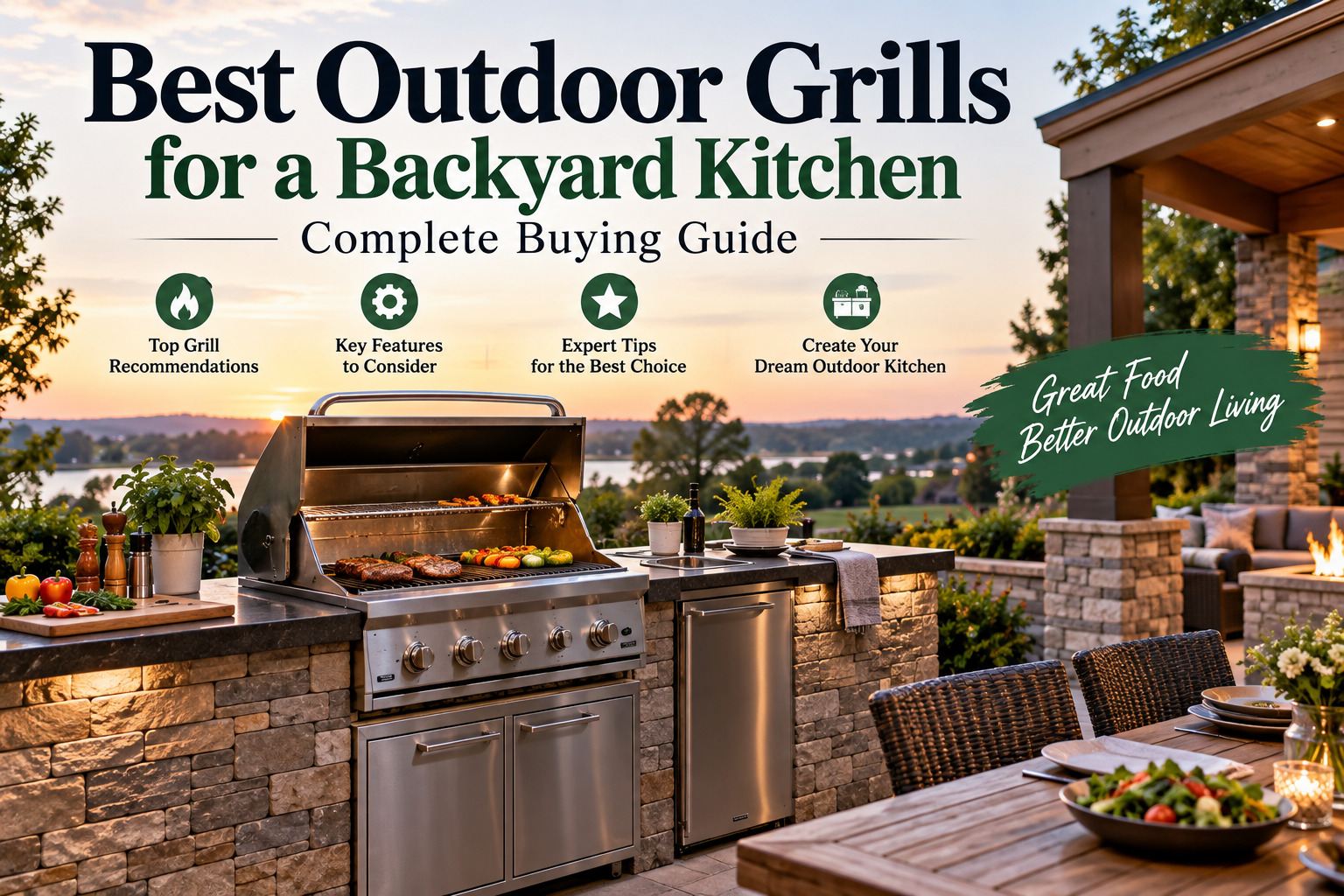
A well-designed backyard kitchen can transform an ordinary patio into a true outdoor living space, but the grill remains the centerpiece of almost every successful setup. Whether you plan to cook quick weeknight burgers, slow-smoke brisket for weekend gatherings, sear premium steaks, roast whole chickens, or entertain large groups, choosing the right outdoor grill can determine how enjoyable and practical your backyard kitchen becomes.
Buying a grill for a backyard kitchen is different from buying a small portable grill for occasional use. A permanent or semi-permanent outdoor kitchen requires more careful planning. You need to think about cooking area, fuel type, cabinet dimensions, ventilation, weather resistance, construction materials, heat output, storage, maintenance, electrical requirements, and how the grill fits into the overall kitchen layout.
The best outdoor grill is therefore not necessarily the most expensive model or the one with the highest advertised BTU rating. The right choice is a grill that fits your cooking habits, available space, preferred fuel source, climate, budget, and long-term outdoor kitchen plans.
Some homeowners want the convenience of a built-in gas grill that can reach cooking temperature within minutes. Others prefer the smoky flavor produced by charcoal or wood. Pellet grills appeal to cooks who want automated temperature control for smoking, while kamado grills offer excellent heat retention and impressive versatility.
This complete buying guide explains the major categories of outdoor grills, the most important features to compare, common installation considerations, realistic costs, and how to choose the best grill for your backyard kitchen.
What Makes a Grill Good for a Backyard Kitchen?
A backyard kitchen grill needs to do more than simply cook food. It should function reliably as a permanent outdoor appliance and integrate properly with the surrounding cabinetry, countertops, utilities, and work areas.
Several characteristics become especially important when selecting a grill for this type of installation.
Durable Outdoor Construction
Outdoor grills are continuously exposed to conditions that indoor appliances never experience.
Depending on where you live, a grill may face:
- Rain
- Humidity
- Intense sunlight
- Freezing temperatures
- Salt air
- Dust
- Wind
- Temperature changes
- Snow
- Grease buildup
High-quality stainless steel construction is generally preferred because it resists corrosion while tolerating high cooking temperatures.
However, not all stainless steel is identical.
Premium outdoor grills commonly use 304 stainless steel for major exterior components because it provides strong corrosion resistance. Some less expensive grills use 430 stainless steel, which can still perform well but may be more susceptible to corrosion in harsh coastal or humid environments.
Thickness also matters. Thin metal can warp or discolor more easily, while heavier stainless-steel components tend to retain their shape and feel more substantial.
Sufficient Cooking Capacity
Your grill needs enough space for the amount of food you normally prepare.
A small family may comfortably use a 24- to 30-inch grill. Someone who regularly hosts backyard parties may prefer a 36- to 42-inch cooking surface.
Larger grills can handle more food, but they also require:
- More cabinet space
- More fuel
- Longer preheating
- Larger ventilation clearances
- More cleaning
Choosing a grill that matches your actual cooking needs is usually better than simply purchasing the largest model available.
Reliable Heat Distribution
Uneven heat is one of the most frustrating problems with inexpensive grills.
Poorly designed burners may create extremely hot areas directly over the flame while leaving surrounding sections noticeably cooler.
A quality grill uses burners, heat diffusers, cooking grids, and firebox design to distribute heat more consistently across the cooking surface.
Even heat allows you to cook multiple steaks, burgers, chicken pieces, or vegetables without constantly moving food around to compensate for temperature differences.
Easy Temperature Control
Outdoor cooking becomes easier when the grill responds predictably to adjustments.
Gas grills should provide smooth burner control.
Pellet grills should maintain stable temperatures electronically.
Charcoal and kamado grills should have adjustable airflow systems that allow you to control combustion.
Good temperature control is particularly important when cooking foods requiring longer cooking times.
Replaceable Components
Even premium grills require maintenance eventually.
Burners, igniters, cooking grates, heat shields, thermometers, and other parts wear over time.
A grill from a manufacturer that supports replacement parts can remain useful for many years.
This can be particularly important with built-in grills because replacing the entire appliance may require modifying countertops or cabinets if a new model has different dimensions.
Built-In Grill vs Freestanding Grill for an Outdoor Kitchen
One of the first decisions is whether to install a built-in grill or use a freestanding grill beside your outdoor kitchen.
Both approaches can work well.
Built-In Outdoor Grills
Built-in grills are designed to slide into a dedicated opening in an outdoor kitchen island.
The grill head is installed above cabinets, drawers, or storage compartments while utilities such as gas and electricity are routed through the island.
Built-in grills create a clean, professional appearance.
They also allow the grill to become part of a larger cooking station containing features such as:
- Countertops
- Refrigerators
- Storage drawers
- Trash cabinets
- Sinks
- Side burners
- Pizza ovens
- Ice makers
- Beverage centers
Built-in grills are ideal when you are constructing a permanent outdoor kitchen.
However, installation requires more planning because the island dimensions must match the grill manufacturer’s specifications.
You must also consider ventilation and combustible clearances.
Freestanding Outdoor Grills
Freestanding grills include their own cart, wheels, storage cabinet, or stand.
They are generally easier to install because they do not require custom cabinetry.
Simply position the grill near the outdoor kitchen while maintaining appropriate clearances.
Freestanding grills can also be moved or replaced more easily.
They are often a better option when:
- You are renting
- Your outdoor kitchen is temporary
- You expect to move
- You want flexibility
- You do not want to modify cabinetry
- You are working with a smaller budget
A freestanding grill can still function beautifully beside a countertop and preparation area.
Gas Grills: The Most Popular Choice for Backyard Kitchens
Gas grills remain one of the most popular options for permanent backyard kitchens because they combine convenience, performance, and ease of use.
Turn the burners on, ignite the grill, allow it to preheat, and you can often begin cooking within several minutes.
Gas grills are particularly useful for families that grill frequently.
Natural Gas vs Propane
Gas grills usually operate on either natural gas or propane.
Some models can be converted between fuel types using manufacturer-approved conversion kits, while others are designed exclusively for one fuel.
Natural Gas
Natural gas grills connect directly to a household natural gas supply.
The biggest advantage is convenience.
You do not need to refill propane cylinders.
Once the connection is installed, you have a continuous fuel supply whenever you want to cook.
Natural gas is especially attractive for permanent outdoor kitchens where gas lines can be installed during construction.
However, installation may require a licensed professional depending on local building codes.
The grill also becomes less portable because it remains connected to a fixed gas line.
Propane
Propane grills usually use refillable tanks.
The standard portable propane cylinder commonly used with backyard grills is convenient because it does not require a permanent gas connection.
Propane may be preferable when natural gas is unavailable.
Outdoor kitchen cabinets can include dedicated compartments for propane storage, although ventilation requirements must be followed carefully.
One disadvantage is that propane can run out unexpectedly.
Keeping a spare tank nearby can help prevent interrupted cooking.
Advantages of Gas Grills
Gas grills offer several important benefits for backyard kitchens.
They preheat quickly, provide easy temperature control, and require relatively little cleanup compared with charcoal.
They are excellent for:
- Burgers
- Hot dogs
- Steaks
- Chicken
- Fish
- Vegetables
- Kebabs
- Sausages
- Quick weeknight meals
Multiple burners also make indirect cooking possible.
For example, you can turn off the center burner while leaving burners on the sides active. Food placed above the inactive section receives indirect heat, allowing the grill to function similarly to an outdoor oven.
Disadvantages of Gas Grills
Gas grills do not naturally produce the same intense smoke flavor associated with charcoal or wood.
Wood chips, smoker boxes, or specialized smoke accessories can add flavor, but the result is generally different from traditional charcoal or wood cooking.
Gas grills also contain more mechanical components such as:
- Burners
- Ignition systems
- Valves
- Regulators
- Gas hoses
These components may eventually require maintenance or replacement.
Charcoal Grills for Maximum Traditional Flavor
For many barbecue enthusiasts, charcoal remains the preferred fuel because of the distinctive aroma and flavor it can produce.
Charcoal grills are simpler mechanically than gas grills but require more involvement from the cook.
Instead of turning a knob, you control temperature by adjusting:
- Charcoal quantity
- Charcoal position
- Intake vents
- Exhaust vents
- Airflow
This learning curve is part of the experience that many enthusiasts enjoy.
Advantages of Charcoal Grills
Charcoal can generate extremely high temperatures, making it excellent for searing steaks.
It also produces smoke and combustion aromas that contribute to traditional grilled flavor.
Charcoal grills work particularly well for:
- Steaks
- Burgers
- Ribs
- Chicken
- Pork
- Kebabs
- Smoked meats
- Direct-fire cooking
Two-zone cooking is easy to create by placing charcoal on one side of the grill and leaving the other side without coals.
This gives you both a high-heat zone and a cooler indirect zone.
Disadvantages of Charcoal Grills
Charcoal takes more time to prepare.
You must light the charcoal, wait for it to reach the appropriate temperature, and adjust airflow during cooking.
Afterward, ash must be removed.
Temperature control can also require practice.
For someone who wants to grill quickly after returning home from work, gas may be more convenient.
For someone who considers outdoor cooking a hobby, charcoal can be extremely rewarding.
Pellet Grills for Smoking and Automated Cooking
Pellet grills have become popular because they combine wood-fired flavor with digital temperature control.
Instead of manually managing a wood fire, pellet grills burn compressed hardwood pellets.
An electric auger automatically feeds pellets from a storage hopper into a fire pot.
A controller monitors cooking temperature and adjusts fuel delivery.
This makes low-and-slow barbecue much easier than traditional fire management.
Why Pellet Grills Work Well in Backyard Kitchens
Pellet grills are excellent for cooks who regularly prepare:
- Brisket
- Pork shoulder
- Ribs
- Whole chicken
- Turkey
- Smoked salmon
- Roasts
- Pulled pork
Many pellet grills can also bake and roast.
Some models reach temperatures high enough for grilling, although dedicated gas or charcoal grills often provide stronger direct searing performance.
For this reason, some premium backyard kitchens include both a gas grill and a pellet smoker.
The gas grill handles quick, high-temperature cooking while the pellet grill manages long smoking sessions.
Pellet Grill Advantages
One of the biggest advantages is temperature automation.
Instead of frequently adjusting vents or adding charcoal, you choose a target temperature.
The controller attempts to maintain that temperature automatically.
Many modern units also support meat probes and programmable cooking functions.
The wood pellets produce real combustion smoke, providing more natural smoke flavor than most gas grills.
Pellet Grill Disadvantages
Pellet grills require electricity.
Without power, the auger, fan, and controller cannot operate.
They also contain more electronic and mechanical components than traditional charcoal grills.
Pellets must remain dry because moisture can cause them to swell, break apart, or jam the feed system.
Pellet grills also require ash and grease cleaning.
Kamado Grills for Versatility and Heat Retention
Kamado grills are thick-walled charcoal cookers inspired by traditional ceramic cooking vessels.
The heavy ceramic construction provides excellent insulation.
Once heated, a kamado can maintain stable temperatures using relatively small amounts of charcoal.
Kamado grills can operate across a broad temperature range.
They can be used for:
- Low-temperature smoking
- Roasting
- Baking
- Grilling
- High-temperature searing
- Pizza
This versatility makes them attractive for backyard cooks who want a single charcoal appliance capable of multiple cooking techniques.
Why Kamado Grills Are Different
Traditional metal charcoal grills lose heat relatively quickly through their walls.
Kamado cookers retain large amounts of heat because of their ceramic construction.
This means airflow adjustments can produce significant temperature changes.
Once the grill reaches the desired temperature, careful vent adjustment allows long cooking sessions with good fuel efficiency.
Kamado Grill Advantages
Major advantages include:
- Excellent heat retention
- Efficient charcoal use
- Stable temperatures
- High-temperature capability
- Strong smoke flavor
- Excellent moisture retention
- Versatility
A kamado can smoke pork shoulder at low temperature in the morning and bake pizza at very high temperature later in the evening.
Kamado Grill Disadvantages
Ceramic kamado grills are extremely heavy.
Large models can weigh hundreds of pounds.
Moving them requires care because ceramic components may crack if dropped or struck.
Built-in outdoor kitchen installations also require specialized supports because kamado grills are shaped differently from conventional rectangular grill heads.
Flat-Top Griddles as a Secondary Outdoor Cooking Surface
Outdoor griddles have become increasingly popular and can be an excellent addition to a backyard kitchen.
Instead of cooking food on open grill grates, a griddle uses a large heated metal surface.
This allows you to cook foods that would otherwise fall through grill grates.
Examples include:
- Eggs
- Pancakes
- Bacon
- Fried rice
- Smash burgers
- Chopped vegetables
- Cheesesteaks
- Shrimp
- Tacos
- Breakfast foods
A griddle usually should not replace the primary grill unless you specifically prefer griddle cooking.
However, combining a built-in gas grill with a dedicated griddle creates an extremely versatile outdoor cooking setup.
Hybrid Grills
Hybrid grills combine more than one fuel source.
Examples may include gas and charcoal cooking chambers or grills capable of using gas burners alongside wood or charcoal accessories.
The appeal is obvious: you gain convenience and flavor options in one appliance.
However, hybrid units can also involve compromises.
A dedicated gas grill may perform better at gas grilling, while a dedicated charcoal grill may provide more charcoal capacity.
Hybrid grills are most useful when space is limited and you genuinely expect to use both fuel types frequently.
How Large Should Your Outdoor Grill Be?
Grill size is usually described using both exterior width and cooking surface area.
Built-in grill heads are commonly available in widths such as:
- 24 inches
- 27 inches
- 30 inches
- 32 inches
- 36 inches
- 40 inches
- 42 inches
- 48 inches
The ideal size depends on how many people you normally cook for.
Small Households
For approximately two to four people, a 24- to 30-inch grill may provide enough capacity.
This size is compact while still allowing multiple steaks, burgers, or chicken pieces to cook simultaneously.
It is also suitable for smaller patios and outdoor kitchens.
Medium-Sized Families
A 30- to 36-inch grill is often the most versatile choice.
It provides enough cooking area for daily meals while offering additional space when guests visit.
For many homeowners, this is the practical sweet spot.
Frequent Entertainers
If you frequently cook for eight, ten, or more people, a 36- to 42-inch grill may be worthwhile.
The larger cooking area allows multiple foods to cook at once.
You can maintain separate heat zones for meat, vegetables, and indirect cooking.
Very Large Outdoor Kitchens
Large 48-inch grills can become the visual centerpiece of luxury outdoor kitchens.
However, they require substantial counter and cabinet space.
Before purchasing one, consider whether the added cooking area will actually be used.
A massive grill that consumes valuable countertop space may not be the best design for every backyard.
Understanding Grill BTUs
BTU stands for British Thermal Unit and represents a measurement of heat energy.
Manufacturers often advertise total BTU output prominently.
However, BTU numbers should not be treated as the sole measure of grill performance.
A grill with a very high BTU rating is not automatically better.
What matters is how efficiently the grill uses that heat.
Important factors include:
- Firebox design
- Burner placement
- Lid insulation
- Ventilation
- Cooking grate material
- Heat diffuser design
- Cooking surface size
A smaller, well-insulated grill can sometimes achieve higher cooking temperatures than a larger grill with more total BTUs.
One useful comparison is BTUs relative to cooking area, but even this does not fully account for construction quality.
The best approach is to evaluate BTU output together with grill design and heat distribution.
Stainless Steel Grades and Grill Construction
Construction quality is particularly important for a built-in grill because replacing the appliance can be expensive and inconvenient.
304 Stainless Steel
304 stainless steel is commonly used in premium outdoor appliances.
It offers strong resistance to corrosion and performs well in many outdoor environments.
It is particularly desirable for:
- Grill bodies
- Hoods
- Cooking grates
- Burners
- Cabinets
- Doors
430 Stainless Steel
430 stainless steel is less expensive and is sometimes used in more affordable grills.
It can perform adequately in many climates, especially when maintained properly.
However, it generally offers less corrosion resistance than 304 stainless steel.
Cast Stainless Steel Burners
Premium grills sometimes use cast stainless steel burners.
These burners are heavier and thicker than basic stamped metal burners.
They can provide excellent durability and heat output.
Brass Burners
Some high-end grills use cast brass burners.
Brass is extremely durable and resistant to corrosion.
However, grills using brass burners are usually expensive.
Grill Grate Materials
Cooking grates affect heat retention, searing, cleaning, and long-term durability.
Stainless Steel Grates
Stainless steel grates are popular because they resist corrosion and are relatively easy to maintain.
Thick stainless rods retain heat better than thin ones.
Premium grills often use heavy-gauge stainless steel cooking grids.
Cast Iron Grates
Cast iron retains heat extremely well and can produce excellent sear marks.
However, traditional cast iron requires maintenance to prevent rust.
Porcelain-coated cast iron reduces maintenance but the coating can eventually chip.
Stainless Steel Rod Thickness
When comparing premium grills, look beyond the phrase “stainless steel grates.”
The diameter and weight of the rods can differ significantly.
Heavier grates typically retain more heat and provide more substantial contact with food.
Infrared Burners
Infrared burners are designed to generate extremely intense radiant heat.
They are commonly used for steak searing.
Some grills include a dedicated infrared burner inside the main cooking area.
Others offer a side-mounted infrared searing station.
Infrared burners can reach very high temperatures quickly, making them excellent for creating a browned crust on steaks.
However, they are not always necessary for everyday cooking.
If you frequently cook steaks, lamb chops, or other foods requiring aggressive searing, an infrared burner can be valuable.
Rotisserie Systems
A rotisserie rotates food slowly above the heat source.
This technique works well for:
- Whole chickens
- Turkey
- Pork loin
- Roast beef
- Leg of lamb
Higher-end outdoor grills often include a rear infrared rotisserie burner.
This burner directs heat toward the rotating food rather than directly underneath it.
The result can be more even roasting with less flare-up from dripping fat.
If you enjoy cooking whole poultry or roasts, a rotisserie system is worth considering.
Side Burners and Power Burners
A side burner extends the cooking capability of your outdoor kitchen.
Instead of carrying pots between the indoor and outdoor kitchens, you can prepare sauces, boil vegetables, or heat side dishes outside.
A standard side burner works similarly to a burner on an indoor gas range.
A high-output power burner produces significantly more heat.
Power burners can be useful for:
- Large stockpots
- Seafood boils
- Woks
- Large skillets
- Frying
- Rapid boiling
If you regularly host large gatherings, a power burner can be one of the most useful accessories in the entire outdoor kitchen.
Smoker Boxes and Wood Flavor
Some gas grills include integrated smoker boxes.
These compartments hold wood chips or wood chunks.
As the wood heats, it produces smoke that circulates through the cooking chamber.
While this does not completely replicate a traditional wood smoker, it can add noticeable smoke aroma to foods.
Common wood flavors include:
- Hickory
- Apple
- Cherry
- Mesquite
- Pecan
- Oak
Wood choice can influence flavor intensity.
Warming Racks
A warming rack sits above the primary cooking surface.
It can be used to keep finished food warm while other items continue cooking.
It can also provide gentler heat for buns, vegetables, or delicate foods.
When comparing grills, consider whether the warming rack is removable.
A removable rack provides additional vertical space when cooking larger foods.
Grill Hood Design
The hood is more important than it may appear.
A deep, well-insulated hood allows the grill to retain heat while roasting or cooking indirectly.
Some premium grills use double-wall hoods.
The outer surface remains somewhat cooler while the inner layer helps retain heat.
A tall hood also provides room for large foods such as whole chickens or rotisserie roasts.
Built-In Thermometers
Most outdoor grills include a hood-mounted thermometer.
This thermometer measures air temperature near the hood rather than directly at the cooking grate.
It is useful for general reference but may not represent the exact temperature surrounding the food.
Serious barbecue cooks often use separate digital probes to monitor both grill and meat temperature.
Still, a large, easy-to-read hood thermometer is a convenient feature.
Interior Grill Lighting
Built-in lighting is extremely useful if you cook at night.
Premium grills may include internal halogen or LED lighting inside the cooking chamber.
Some also include illuminated control knobs.
Lighting becomes particularly valuable in outdoor kitchens where overhead lighting is limited.
When designing the kitchen, consider installing task lighting above the grill area even if the grill contains internal lights.
Ignition Systems
A reliable ignition system makes gas grilling easier.
Common systems include:
- Battery-powered electronic ignition
- Piezoelectric ignition
- Hot-surface ignition
- Flame-thrower ignition
Regardless of the system, a good grill should provide a manual lighting option in case the primary ignition fails.
Grease Management
Grease management affects both safety and cleaning.
A properly designed grill directs grease away from burners and toward a removable collection tray.
The tray should be accessible without disassembling large portions of the grill.
Poor grease management can result in:
- Flare-ups
- Difficult cleaning
- Unpleasant odors
- Grease fires
- Corrosion
For frequent grillers, easy grease-tray access is an important feature.
Flare-Up Control
Fat dripping directly onto flames can create sudden flare-ups.
Quality grills often use heat diffusers, ceramic briquettes, stainless-steel trays, or angled flame tamers between the burners and cooking grates.
These components help distribute heat while reducing direct contact between grease and flames.
Some flare-up is normal during grilling, but excessive flare-ups can burn food and create safety concerns.
Outdoor Grill Installation Requirements
Built-in grills require careful installation.
Always follow the specific installation requirements supplied by the grill manufacturer because dimensions and clearance requirements vary.
Several general factors deserve attention.
Grill Cutout Dimensions
A grill’s advertised width is not necessarily the same as the opening required in your countertop.
Manufacturers provide precise cutout dimensions for:
- Width
- Depth
- Height
These measurements must be followed carefully.
Do not build the island opening based only on the grill’s exterior width.
Ventilation
Outdoor kitchen islands containing gas appliances require ventilation.
Gas can accumulate inside enclosed cabinets if a leak occurs.
Proper ventilation openings allow trapped gas to escape.
Vent placement depends partly on fuel type.
Propane is heavier than air and can settle near the bottom of an enclosure.
Natural gas is lighter than air and tends to rise.
Local building codes and appliance installation instructions should always be followed.
Combustible Materials
Wood framing, vinyl siding, and other combustible materials may require separation from the grill.
Some installations require insulated jackets around built-in grills when the surrounding structure contains combustible materials.
An insulated jacket forms a protective barrier between the hot grill body and nearby construction materials.
Never assume a grill can be installed directly into a wood-framed island without additional protection.
Electrical Connections
Many modern grills require electrical power even if cooking heat comes from gas.
Electricity may power:
- Ignition
- Interior lights
- Rotisserie motors
- Digital displays
- Smart controls
Pellet grills require electricity continuously during operation.
Outdoor outlets should be properly rated and installed according to applicable electrical codes.
Vent Hoods and Covered Patios
Outdoor grills produce heat, smoke, grease, and combustion gases.
If the grill is installed beneath a covered patio, roof, pavilion, or other structure, proper ventilation becomes especially important.
Outdoor-rated vent hoods may be necessary depending on the installation.
The hood should be sized appropriately for the grill and cooking environment.
A residential indoor range hood generally should not be assumed suitable for outdoor grill ventilation.
Best Grill Location in a Backyard Kitchen
Where you position the grill affects safety and workflow.
Ideally, the grill should be close to preparation space without placing extreme heat directly beside refrigerators or other appliances.
A useful outdoor kitchen workflow often includes:
- Refrigerator or food storage
- Preparation counter
- Grill or cooking appliance
- Serving counter
Provide countertop space near the grill so you have somewhere to place trays, utensils, seasonings, and cooked food.
Avoid positioning the grill where smoke will constantly blow toward seating areas.
Also consider doors, windows, neighboring properties, and prevailing wind direction.
How Much Counter Space Should Be Beside the Grill?
Countertop space is easy to underestimate.
A large grill surrounded by almost no preparation area can be inconvenient.
Ideally, provide working surfaces on both sides when possible.
One side can hold uncooked food and cooking tools.
The other can serve as a landing area for finished food.
The exact amount depends on available space, but even modest countertops dramatically improve usability.
Best Grill Type for Different Cooking Styles
Choosing a grill becomes easier when you focus on the food you actually cook.
Best for Quick Everyday Cooking: Gas Grill
Gas provides convenience and predictable temperature control.
It is ideal for households that grill several times per week.
Best for Traditional Barbecue Flavor: Charcoal Grill
Charcoal offers strong grilled flavor and excellent high-temperature performance.
It is best for enthusiasts willing to manage the fire manually.
Best for Brisket and Slow-Smoked Meat: Pellet Grill
Pellet grills simplify long smoking sessions through automated temperature control.
They are excellent for cooks who want wood smoke without continuously tending a fire.
Best for Maximum Versatility: Kamado Grill
Kamado grills can smoke, grill, roast, bake, and sear.
They are particularly appealing to enthusiasts who enjoy experimenting with different cooking techniques.
Best for Breakfast and Smash Burgers: Griddle
A flat-top griddle handles foods that cannot be cooked easily on conventional grill grates.
It works best as a complementary outdoor appliance.
Should You Install More Than One Grill?
For serious outdoor cooking enthusiasts, using multiple appliances can be better than searching for one grill that does everything.
A popular combination is:
Built-in gas grill + pellet smoker
The gas grill handles fast cooking and high-temperature grilling, while the pellet smoker handles brisket, ribs, and pork shoulder.
Another excellent combination is:
Built-in gas grill + kamado
This setup provides both convenience and traditional charcoal cooking.
A larger luxury kitchen might include:
- Gas grill
- Kamado
- Griddle
- Pizza oven
- Side burner
The key is avoiding unnecessary appliances that consume counter space without being used regularly.
How Much Should You Spend on an Outdoor Grill?
Outdoor grill prices vary enormously.
Basic freestanding grills may cost several hundred dollars, while luxury built-in grills can cost several thousand dollars or substantially more.
A useful way to think about pricing is by category.
Budget Outdoor Grills
Approximately $300 to $1,000.
These grills can provide excellent everyday cooking but may use lighter materials and simpler burners.
They are often better suited to freestanding installations.
Mid-Range Outdoor Grills
Approximately $1,000 to $3,000.
This range includes many durable grills with:
- Stainless steel construction
- Multiple burners
- Better heat distribution
- Rotisserie options
- Improved warranties
This category provides a strong balance for many backyard kitchens.
Premium Built-In Grills
Approximately $3,000 to $6,000.
Premium grills may include:
- Heavy stainless-steel construction
- Cast burners
- Infrared burners
- Rotisserie systems
- Interior lights
- Thicker cooking grates
- Strong warranties
These grills are designed for frequent use and permanent outdoor installations.
Luxury Outdoor Grills
Approximately $6,000 and above.
Luxury appliances emphasize premium materials, powerful burners, sophisticated engineering, large cooking surfaces, and extensive warranties.
They can be excellent appliances, but the additional cost is most justified when the entire outdoor kitchen is designed as a long-term premium installation.
Do Not Spend Your Entire Outdoor Kitchen Budget on the Grill
The grill may be the centerpiece, but the rest of the kitchen matters too.
Your budget may also need to cover:
- Countertops
- Cabinetry
- Plumbing
- Electricity
- Gas lines
- Refrigeration
- Lighting
- Flooring
- Roofing
- Ventilation
- Seating
- Storage
- Construction labor
A balanced outdoor kitchen with a good mid-range grill can be more practical than a luxury grill surrounded by inadequate workspace.
Grill Warranties
Warranty coverage can reveal how confident a manufacturer is in its product.
High-quality grills sometimes provide long or limited-lifetime warranties on major components such as:
- Grill body
- Cooking grids
- Burners
- Hood
- Firebox
Other parts may have shorter warranty periods.
Read warranty terms carefully.
A “lifetime warranty” may apply only to specific components rather than the entire appliance.
Electronic systems, ignition parts, lighting, and valves may have different coverage periods.
Outdoor Grill Maintenance
Regular maintenance can dramatically extend grill life.
Clean the Cooking Grates
Brush cooking grates after grilling while they are still warm.
This prevents heavy food buildup.
Periodically perform a deeper cleaning.
Empty Grease Trays
Do not allow grease trays to overflow.
Accumulated grease creates odors and increases fire risk.
Inspect Burners
Check gas burner ports for blockages.
Food debris, insects, and corrosion can interfere with proper flames.
Healthy gas flames should generally burn evenly.
Clean Heat Diffusers
Heat shields or flame tamers collect grease and carbon.
Periodic cleaning helps maintain even heat.
Protect the Grill
A fitted cover helps protect freestanding grills.
Built-in grills may also benefit from dedicated covers.
Covers reduce exposure to:
- Rain
- Dust
- Bird droppings
- Pollen
- Sunlight
Allow the grill to cool before covering it.
Check Gas Connections
Inspect hoses, regulators, and connections periodically.
If you smell gas, stop using the appliance until the source has been identified and corrected.
Outdoor Grills in Coastal Environments
Salt air creates especially difficult conditions for outdoor appliances.
Even stainless steel can develop surface corrosion when exposed continuously to salt.
Homeowners near the coast should prioritize:
- High-quality stainless steel
- Regular cleaning
- Protective covers
- Frequent rinsing of salt deposits
- Premium hardware
Avoid allowing salt residue to remain on metal surfaces.
Common Mistakes When Buying a Backyard Kitchen Grill
Several mistakes repeatedly lead to disappointing outdoor kitchens.
Buying the Grill After Building the Island
The grill should be selected before the final cutout is constructed.
Otherwise, you may end up modifying expensive countertops.
Choosing Based Only on BTUs
High BTU output does not guarantee even heat or better cooking.
Construction quality matters more.
Buying a Grill That Is Too Large
A huge grill may look impressive but can reduce valuable preparation space.
Choose based on actual cooking needs.
Ignoring Replacement Parts
A built-in grill should ideally remain serviceable for many years.
Confirm that common components can be replaced.
Ignoring Ventilation
Gas appliances installed inside enclosed islands require proper ventilation.
Never treat ventilation as an optional cosmetic feature.
Placing Refrigeration Too Close to Extreme Heat
Heat from the grill can make refrigerators work harder.
Proper spacing and insulation help protect surrounding appliances.
Forgetting Lighting
Outdoor kitchens are frequently used after sunset.
Planning lighting during construction is much easier than adding it later.
Underestimating Counter Space
A good outdoor kitchen requires room to prepare and serve food, not just cook it.
Recommended Outdoor Grill Configuration for Most Homeowners
For a typical household building a permanent backyard kitchen, a high-quality 30- to 36-inch built-in gas grill is often the most practical primary appliance.
This size provides enough cooking capacity for family meals and moderate entertaining while leaving room for useful countertop space.
Look for features such as:
- 304 stainless-steel construction
- Multiple independently controlled burners
- Heavy stainless cooking grates
- Reliable ignition
- Good grease management
- Even heat distribution
- Rotisserie capability
- Replaceable burners
- Strong manufacturer warranty
If you enjoy traditional barbecue, add a pellet smoker or kamado nearby rather than attempting to make the gas grill handle every type of cooking.
Best Setup for a Small Backyard Kitchen
Small kitchens need to use space efficiently.
A strong setup might include:
- 24- to 30-inch grill
- Compact refrigerator
- Storage drawer
- Preparation counter
Avoid installing too many specialized appliances.
A versatile grill and useful countertop space will usually provide more value.
Best Setup for a Medium Backyard Kitchen
Medium-sized kitchens have room for additional cooking options.
A practical configuration could include:
- 30- to 36-inch built-in gas grill
- Side burner
- Outdoor refrigerator
- Storage drawers
- Trash cabinet
- Generous counter space
This arrangement can support both daily cooking and entertaining.
Best Setup for a Large Luxury Backyard Kitchen
A larger kitchen can create separate cooking zones.
For example:
- 36- to 42-inch gas grill
- Kamado grill
- Pellet smoker
- Power burner
- Outdoor refrigerator
- Beverage refrigerator
- Sink
- Ice maker
- Storage
- Large preparation island
The cooking appliances should be selected according to how often they will actually be used.
More appliances do not automatically create a better kitchen.
Gas Grill vs Pellet Grill for a Backyard Kitchen
This comparison is particularly common.
Gas grills are better for speed.
Pellet grills are better for smoking.
A gas grill might be ready for burgers in ten to fifteen minutes.
A pellet smoker may require more startup time but provides better low-and-slow cooking.
Gas grilling generally requires more active cooking at higher temperatures.
Pellet smoking allows food to cook for hours at controlled temperatures.
If you mostly prepare steaks, burgers, chicken breasts, vegetables, and quick dinners, choose gas.
If you mostly prepare brisket, ribs, pork shoulder, turkey, and smoked meats, choose pellet.
If your budget and space allow, having both provides the strongest combination.
Gas Grill vs Charcoal Grill
Gas prioritizes convenience.
Charcoal prioritizes traditional fire cooking.
Gas advantages include:
- Faster startup
- Easier temperature adjustments
- Cleaner operation
- Less ash
- Better convenience
Charcoal advantages include:
- Stronger smoke flavor
- Very high heat potential
- Traditional grilling experience
- Simpler mechanical design
For a primary backyard kitchen grill used several nights per week, gas usually wins on convenience.
For weekend barbecue enthusiasts, charcoal may provide the more enjoyable cooking experience.
Kamado vs Pellet Grill
Both are excellent for low-and-slow cooking, but they operate very differently.
A pellet grill uses electricity and automated fuel delivery.
A kamado uses charcoal and manual airflow.
Pellet grills require less fire management.
Kamados provide a more traditional charcoal experience and can reach extremely high temperatures.
Choose pellet if convenience matters most.
Choose kamado if versatility, charcoal flavor, and high-temperature cooking matter more.
Frequently Asked Questions About Outdoor Grills
What is the best type of grill for an outdoor kitchen?
For most homeowners, a built-in gas grill offers the best combination of convenience, durability, cooking capacity, and integration with outdoor cabinetry.
Charcoal, pellet, and kamado grills may be better for cooks who prioritize smoke flavor or specialized barbecue techniques.
What size built-in grill should I buy?
A 30- to 36-inch grill is appropriate for many households.
Smaller kitchens may use a 24- to 30-inch model, while frequent entertainers may prefer 36 inches or larger.
Is a built-in grill worth the money?
A built-in grill can be worthwhile when creating a permanent outdoor kitchen.
It provides a cleaner appearance and integrates with countertops and storage.
However, freestanding grills remain more affordable and easier to replace.
Is 304 stainless steel important?
304 stainless steel is desirable because of its strong corrosion resistance.
It is especially valuable in humid or coastal environments.
However, overall construction quality matters in addition to stainless-steel grade.
How many burners should an outdoor grill have?
Three or four burners provide excellent flexibility for many households.
Multiple burners allow different temperature zones and indirect cooking.
Large grills may contain additional burners.
Do outdoor grills need electricity?
Traditional gas and charcoal grills may not require continuous electricity, although some gas grills use electricity for lights or ignition.
Pellet grills require electricity during operation.
Can a built-in grill be installed under a covered patio?
It may be possible, but ventilation, clearances, and manufacturer requirements must be followed carefully.
A properly designed outdoor ventilation hood may be necessary.
Can I put a grill directly next to an outdoor refrigerator?
It is usually better to provide separation or insulation.
Heat from the grill can increase the refrigerator’s operating temperature and reduce efficiency.
How long should an outdoor grill last?
Lifespan varies dramatically depending on construction quality, climate, maintenance, usage, and replacement-part availability.
A well-maintained premium stainless-steel grill may serve for many years.
Are infrared burners worth it?
They are valuable for cooks who frequently prepare steaks and want extremely high searing temperatures.
They are less essential for people who mainly cook chicken, vegetables, burgers, or slow-roasted foods.
Should I buy a grill with a rotisserie?
A rotisserie is worthwhile if you enjoy cooking whole chickens, roasts, turkey, or large cuts of meat.
Otherwise, it may be an optional feature rather than a requirement.
Is a pellet grill good enough to replace a gas grill?
It can be, depending on cooking style.
Pellet grills excel at smoking and roasting, but some do not sear as aggressively as dedicated gas grills.
People who regularly cook steaks or quick meals may prefer having a separate gas grill.
Do I need a sink beside the grill?
A sink is convenient but not essential.
It adds plumbing complexity and cost.
For smaller outdoor kitchens, preparation space and refrigeration may provide more value.
Final Buying Checklist
Before purchasing an outdoor grill for your backyard kitchen, review the following factors carefully:
Fuel source: Decide between natural gas, propane, charcoal, pellets, or a combination.
Grill width: Choose a size based on cooking habits rather than appearance alone.
Cooking surface: Confirm that the actual grate area is large enough.
Construction: Prioritize durable stainless steel and solid components.
Burners: Look for even heat distribution and independently controlled zones.
Cooking grates: Heavy stainless steel or quality cast iron can improve cooking performance.
Searing: Consider an infrared burner if steak cooking is important.
Rotisserie: Useful for poultry and larger roasts.
Lighting: Valuable for nighttime cooking.
Grease management: Make sure trays are easy to remove and clean.
Replacement parts: Choose a manufacturer that supports long-term service.
Warranty: Compare coverage for burners, body, cooking grids, and electronics.
Cutout dimensions: Verify exact measurements before constructing the island.
Ventilation: Include proper cabinet vents for gas installations.
Clearances: Maintain required spacing from combustible materials.
Utilities: Plan gas, electricity, and plumbing before construction.
Counter space: Preserve enough preparation and serving area around the grill.
Weather exposure: Consider your local climate and corrosion risk.
Maintenance: Choose a grill you are willing to clean and maintain regularly.
The Best Outdoor Grill Is the One That Fits Your Backyard Kitchen
There is no single outdoor grill that is perfect for every homeowner.
A busy family preparing quick dinners several times per week may be happiest with a high-quality built-in gas grill. A barbecue enthusiast who spends weekends smoking brisket may prefer a pellet grill or charcoal smoker. Someone who enjoys experimenting with everything from pizza to steaks may appreciate the versatility of a kamado.
The most successful backyard kitchens often focus on complementary appliances rather than trying to find one grill that performs every cooking technique equally well.
For most permanent outdoor kitchens, a durable 30- to 36-inch built-in gas grill provides an excellent starting point. It offers convenient temperature control, substantial cooking capacity, straightforward operation, and easy integration with cabinets and countertops.
From there, specialized appliances can be added according to your interests. A pellet smoker brings wood-fired barbecue capabilities. A kamado provides charcoal flavor and extreme temperature versatility. A flat-top griddle expands the menu to breakfasts, smash burgers, stir-fried foods, and other dishes that traditional grill grates cannot handle easily.
Construction quality should remain one of the highest priorities. A backyard kitchen represents a significant investment, and replacing a poorly constructed built-in grill after only a few years can be frustrating and expensive. Durable stainless steel, strong burners, substantial cooking grates, effective grease management, reliable ignition, available replacement parts, and meaningful warranty coverage are generally more important than decorative features.
Planning is equally important.
Choose the grill before finalizing the outdoor kitchen island. Confirm exact cutout dimensions. Plan utility connections. Provide proper ventilation. Respect clearance requirements. Allow enough preparation space around the cooking area. Consider where smoke will travel and how guests will move around the kitchen.
Think about how you actually cook rather than how you imagine an outdoor kitchen should look.
Someone who grills hamburgers twice per month probably does not need a massive 48-inch luxury grill. Someone who regularly hosts twenty guests may quickly become frustrated with a compact two-burner model. Someone who loves smoked barbecue should not assume that a powerful gas grill will completely replace a dedicated smoker.
The right grill should make outdoor cooking easier, more enjoyable, and more frequent.
When the grill matches your cooking style, fuel preference, available space, and long-term plans, it becomes more than another backyard appliance. It becomes the center of the outdoor kitchen—the place where everyday meals, weekend barbecues, celebrations, and gatherings are prepared for years to come.