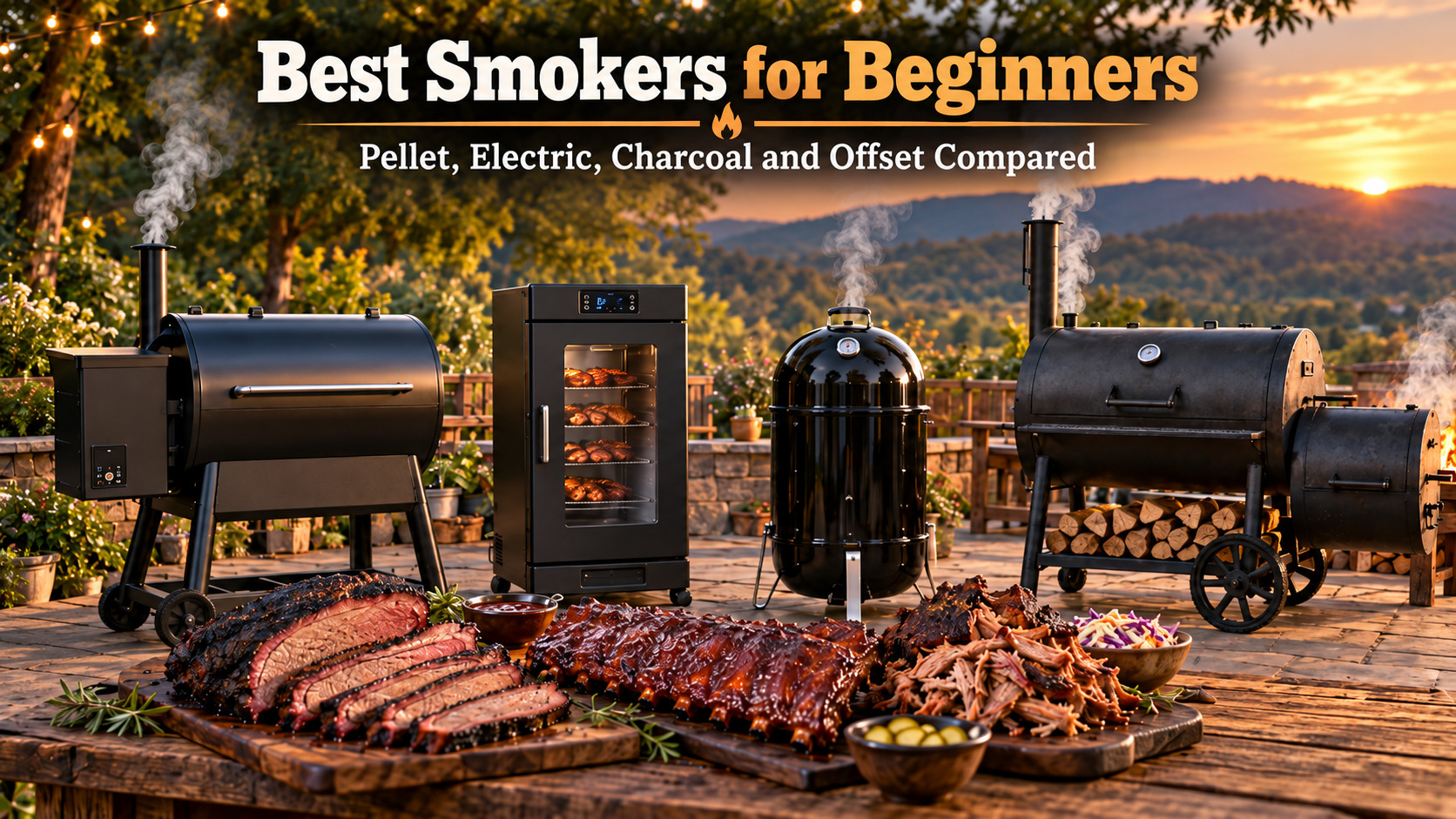
Smoking meat at home can look complicated when you are getting started. Experienced barbecue cooks talk about airflow, wood species, fire management, smoke quality, temperature swings, bark formation, stall temperatures, water pans, spritzing, wrapping, and resting as though all of these things are second nature.
For a beginner, however, the first decision is much simpler and much more important: choosing the right smoker.
The type of smoker you buy can determine whether your first few barbecue sessions feel enjoyable or frustrating. A smoker that matches your lifestyle can make ribs, pork shoulder, chicken, brisket, turkey, sausage, and other foods surprisingly approachable. A smoker that demands more attention than you expected may leave you adjusting vents for hours and wondering why the temperature refuses to stay where you want it.
Four smoker categories dominate the beginner conversation: pellet smokers, electric smokers, charcoal smokers, and offset smokers.
Each can produce excellent barbecue, but they do so in very different ways.
Pellet smokers prioritize automation and convenience. Electric smokers are extremely easy to operate and require very little fire management. Charcoal smokers offer stronger traditional barbecue flavor while still being manageable for newcomers. Offset smokers provide the classic wood-fired barbecue experience, but they require much more skill and attention.
There is no single smoker that is automatically best for every beginner.
The best smoker for you depends on how much involvement you want, how important smoke flavor is, how much space you have, what foods you plan to cook, how often you expect to barbecue, and whether you view fire management as an enjoyable hobby or an unnecessary complication.
This detailed guide compares pellet, electric, charcoal, and offset smokers from a beginner’s perspective so you can choose a smoker that you will actually enjoy using.
Quick Comparison: Pellet vs Electric vs Charcoal vs Offset Smokers
Before examining each category in depth, it helps to understand the basic differences.
| Smoker Type | Ease of Use | Smoke Flavor | Temperature Control | Attention Required | Typical Learning Curve | Best For |
|---|---|---|---|---|---|---|
| Pellet | Excellent | Good | Excellent | Low | Easy | Beginners wanting convenience |
| Electric | Excellent | Mild to good | Excellent | Very low | Very easy | Maximum simplicity |
| Charcoal | Moderate | Excellent | Good once learned | Moderate | Moderate | Flavor-focused beginners |
| Offset | Difficult | Excellent | Manual | High | Steep | Enthusiasts wanting traditional barbecue |
A pellet smoker is often the easiest overall recommendation for someone who wants authentic smoked food without constantly managing a fire.
An electric smoker can be even simpler because there is no combustion fuel to manage in the traditional sense. However, electric smokers generally produce a lighter smoke profile.
A charcoal smoker provides a stronger traditional barbecue experience while remaining significantly easier than most offset smokers.
An offset smoker gives the cook the greatest involvement and potentially outstanding smoke flavor, but it is usually the most demanding choice for a first-time smoker owner.
What Makes a Smoker Beginner-Friendly?
A smoker does not need to be technologically advanced to be beginner-friendly. Instead, it should make the important parts of barbecue predictable.
A beginner-friendly smoker generally performs well in several areas.
Stable Cooking Temperatures
Low-and-slow barbecue usually happens within relatively narrow temperature ranges.
If your smoker constantly jumps from 200°F to 325°F and then drops back to 210°F, cooking becomes unnecessarily stressful.
Small temperature fluctuations are completely normal. Even expensive smokers cycle above and below their target temperature.
The important issue is stability.
A good beginner smoker should allow you to establish a cooking temperature and maintain approximately that temperature without constant intervention.
Pellet and electric smokers are particularly strong in this area because electronic controllers regulate their heat.
Charcoal smokers can also maintain stable temperatures once the vents are properly adjusted.
Offsets require significantly more manual management.
Predictable Fuel Consumption
Beginners benefit from knowing roughly how long the smoker can operate before more fuel is needed.
A pellet smoker with a large hopper may cook for many hours without requiring additional pellets.
An electric smoker can continue cooking as long as electricity is available, although wood chips or chunks may occasionally need replenishing.
A properly loaded charcoal smoker may operate for many hours on one load of charcoal.
An offset smoker usually requires wood splits to be added repeatedly throughout the cooking session.
Easy Startup
The less complicated startup is, the more likely a beginner is to use the smoker regularly.
Pellet smokers typically require filling the hopper, turning on the controller, selecting a temperature, and waiting for preheating.
Electric smokers are similarly straightforward.
Charcoal smokers require lighting charcoal and establishing airflow.
Offset smokers require building and maintaining a clean-burning wood fire.
None of these methods is impossible for beginners, but the amount of effort differs substantially.
Forgiveness
Barbecue is full of variables.
Outside temperature, wind, meat size, moisture, fuel quality, smoker construction, and even how frequently you open the lid can affect cooking.
A beginner smoker should tolerate minor mistakes.
Pellet and electric smokers tend to be highly forgiving.
Charcoal smokers are forgiving once you understand basic vent management.
Offset smokers are less forgiving because poorly managed combustion can create dirty smoke, unstable temperatures, or excessively smoky food.
Easy Cleanup
Cleaning is rarely the most exciting part of barbecue, but it strongly affects how often a smoker gets used.
Grease trays, ash containers, removable racks, disposable liners, and accessible cooking chambers can make maintenance much easier.
A smoker that takes 45 minutes to clean after every cook may discourage occasional users.
Pellet Smokers: Best Overall Choice for Many Beginners
Pellet smokers have become extremely popular because they combine outdoor wood-fired cooking with digital temperature control.
Instead of manually managing charcoal or wood logs, a pellet smoker burns compressed hardwood pellets.
The pellets are stored inside a hopper. An electric auger moves pellets into a small burn pot. An igniter starts combustion, while a fan supplies oxygen. A digital controller monitors temperature and adjusts fuel delivery automatically.
From the user’s perspective, operation can feel similar to using an outdoor oven.
Select a temperature, allow the cooker to preheat, add the food, and let the controller manage most of the fire.
That simplicity makes pellet smokers one of the strongest choices for first-time barbecue cooks.
Advantages of Pellet Smokers for Beginners
Very Easy Temperature Control
Temperature management is one of the hardest parts of traditional smoking.
Pellet smokers largely automate it.
You might set the smoker to 225°F, 250°F, or 275°F, and the controller automatically feeds pellets based on the heat required.
Modern pellet controllers are generally much more sophisticated than early systems and can maintain remarkably stable temperatures.
You should still monitor your food, but you do not need to constantly adjust vents or add individual wood splits.
Long Unattended Cooking
Large cuts such as pork shoulder and brisket can take many hours.
A pellet smoker with sufficient hopper capacity can often operate through a significant portion of the cook without needing fuel added.
That means you can prepare food, spend time with family, work around the house, or sleep during part of an overnight cook rather than checking the fire every 30 minutes.
This convenience is one of the biggest reasons beginners succeed with pellet smokers.
Consistent Results
Consistency matters when you are learning.
If your smoker behaves similarly every time, it becomes easier to understand how different meats cook.
You can change one variable at a time.
Perhaps you cook ribs at 250°F instead of 225°F.
Perhaps you change the rub.
Perhaps you wrap the pork shoulder later.
Because the smoker itself behaves predictably, you can understand how those changes affect your results.
Easy Startup
Pellet smokers eliminate much of the traditional fire-building process.
There is no chimney starter full of charcoal and no stack of wood splits that needs to develop into a clean fire.
Most users simply fill the hopper, switch on the smoker, select the desired temperature, and allow it to preheat.
Versatile Cooking
Pellet smokers are not limited to traditional barbecue.
Depending on the unit’s temperature range, you can cook:
- Brisket
- Ribs
- Pork shoulder
- Chicken
- Turkey
- Sausage
- Meatloaf
- Fish
- Vegetables
- Baked dishes
- Pizza
- Burgers
- Desserts
Some pellet grills can reach temperatures high enough for respectable grilling, although their direct-searing performance varies significantly.
Relatively Clean Operation
Pellets produce less messy fuel handling than charcoal.
There is still ash, grease, and food residue, but cleanup is usually manageable.
Many models include grease buckets or grease trays that simplify maintenance.
Disadvantages of Pellet Smokers
Pellet smokers are convenient, but they are not perfect.
They Require Electricity
Unlike charcoal and offset smokers, pellet smokers depend on electrical power.
The controller, auger, ignition system, and fan all require electricity.
If you want to smoke food in locations without convenient power access, this can be a limitation.
More Mechanical Components
Automation introduces complexity.
Pellet smokers contain:
- Control boards
- Motors
- Augers
- Fans
- Temperature sensors
- Ignition rods
Any of these components can eventually fail.
Mechanical failures are not necessarily common, but pellet smokers have more potential failure points than simple charcoal cookers.
Smoke Flavor Can Be Milder
Many people love the flavor produced by pellet smokers.
However, when directly compared with a well-managed charcoal or offset smoker, the smoke profile can be noticeably lighter.
Pellet combustion is efficient and controlled, which is excellent for clean cooking but sometimes produces less intense smoke flavor.
Beginners may actually appreciate this because heavily smoked meat can become bitter.
Still, someone seeking aggressive traditional smoke flavor may eventually prefer charcoal or wood.
Pellets Must Stay Dry
Wood pellets absorb moisture.
Wet pellets can swell, break apart, or cause problems in the hopper and auger.
Pellets should therefore be stored in a dry, sealed container.
Leaving pellets in a smoker exposed to humid or rainy conditions can sometimes create unnecessary problems.
Who Should Buy a Pellet Smoker?
A pellet smoker is ideal if you want barbecue to fit naturally into a busy lifestyle.
Choose pellet if you:
- Want excellent convenience
- Prefer digital temperature control
- Cook long barbecue sessions
- Do not want to manage charcoal vents
- Want repeatable results
- Enjoy experimenting with different foods
- Prefer a smoker that can also function as an outdoor cooker
- Want relatively easy cleanup
For many first-time buyers, pellet is the safest overall recommendation.
Electric Smokers: Easiest Smoker for Complete Beginners
Electric smokers remove even more fire management from the process.
An electric heating element generates heat inside an insulated cooking cabinet. Wood chips, chunks, or another smoke-producing material are placed near the heating element to generate smoke.
Many models include thermostatic control.
You select a temperature, and the heating element cycles as needed.
Because the smoker does not depend on maintaining burning charcoal or a wood fire, electric smoking is remarkably approachable.
Advantages of Electric Smokers
Extremely Simple Operation
Electric smokers are among the easiest smokers available.
A typical process looks like this:
- Add wood chips or chunks.
- Turn on the smoker.
- Set the temperature.
- Allow it to preheat.
- Add your food.
- Monitor the meat until finished.
There is very little traditional fire management.
For someone intimidated by charcoal or wood, this can make barbecue much more accessible.
Stable Temperature
An insulated electric smoker can maintain relatively consistent heat with minimal intervention.
Temperature stability is especially helpful when cooking forgiving beginner foods such as pork shoulder.
Instead of thinking about airflow and fuel arrangement, you can focus on understanding meat temperature, tenderness, seasoning, wrapping, and resting.
Efficient Fuel Use
Electricity provides the majority of the heat, so relatively little wood is required for smoke.
That means wood usage is often much lower than with offset smoking.
Excellent for Small Spaces
Many electric smokers use vertical cabinet designs.
The footprint can therefore be relatively small while still providing multiple cooking racks.
This makes them useful for patios and locations where horizontal space is limited.
You should always follow local rules, building policies, manufacturer clearances, and outdoor appliance safety requirements.
Good for Low-and-Slow Cooking
Electric smokers perform especially well at traditional smoking temperatures.
They can be excellent for:
- Pork shoulder
- Ribs
- Sausage
- Turkey
- Chicken
- Fish
- Cheese when appropriate cold-smoking equipment and safe techniques are used
- Jerky when proper food-safety procedures are followed
Disadvantages of Electric Smokers
Less Traditional Smoke Flavor
Electric smokers often produce a lighter smoke flavor than charcoal or offset smokers.
Because the wood is primarily producing smoke rather than providing the main heat source, the flavor profile can differ from a live charcoal or wood fire.
This is not necessarily bad.
Many people prefer moderate smoke.
However, serious barbecue enthusiasts often prefer the complexity produced by combustion from charcoal and hardwood.
Limited High-Temperature Performance
Many electric smokers are designed mainly for smoking rather than grilling.
They may not reach the temperatures required for aggressive searing.
If you want one cooker to smoke brisket and sear steaks over intense heat, an electric cabinet smoker may not be the best all-in-one solution.
Electricity Is Mandatory
Like pellet smokers, electric smokers require power.
Power outages or inconvenient outlet locations can interrupt your cooking plans.
Outdoor extension cords should only be used when appropriate for the appliance and operating environment.
Wood Chip Management May Be Necessary
Although temperature control is automatic, smoke production may not be completely automatic.
Some smokers require wood chips to be replenished periodically.
Different models handle wood differently, so this should be considered before purchasing.
Who Should Buy an Electric Smoker?
Electric smokers are excellent for people who prioritize simplicity above everything else.
Choose electric if you:
- Want the easiest possible learning experience
- Have little interest in managing fire
- Mostly cook at smoking temperatures
- Prefer a compact cabinet design
- Want to smoke food occasionally
- Are more interested in tender barbecue than mastering fire management
An electric smoker can be especially attractive for someone who wants homemade smoked food but does not necessarily consider barbecue a hobby.
Charcoal Smokers: Best Beginner Choice for Strong Traditional Flavor
Charcoal smokers occupy an interesting middle ground.
They require more involvement than pellet or electric smokers but much less active fire management than traditional offset smokers.
For many barbecue enthusiasts, charcoal represents the ideal balance between convenience and flavor.
Charcoal provides both heat and combustion flavor. Wood chunks can be added to the charcoal to introduce additional smoke.
Once properly configured, many charcoal smokers can maintain low cooking temperatures for hours.
Several smoker designs use charcoal successfully, including:
- Bullet smokers
- Drum smokers
- Kamado-style cookers
- Vertical charcoal smokers
- Kettle grills configured for indirect smoking
- Gravity-fed charcoal smokers
Each design behaves differently, but the fundamental principles are similar.
Advantages of Charcoal Smokers
Excellent Smoke Flavor
Flavor is one of charcoal’s greatest advantages.
Charcoal itself contributes a distinctive grilled and smoked character.
Add hardwood chunks, and you can build a layered smoke profile.
Common smoking woods include:
- Hickory
- Oak
- Apple
- Cherry
- Pecan
- Maple
- Mesquite
Different woods can complement different meats.
Oak is versatile.
Hickory produces a stronger traditional barbecue flavor.
Fruit woods such as apple and cherry tend to be milder and slightly sweeter.
Mesquite can be powerful and is often best used carefully.
No Electricity Required
Traditional charcoal smokers can operate without electricity.
That makes them useful for:
- Camping
- Remote cooking
- Tailgating where permitted
- Locations without convenient outlets
- Emergency cooking situations
This simplicity also means there are fewer electronic components that can fail.
Long Burn Times Are Possible
A properly arranged charcoal bed can burn for many hours.
Techniques such as gradually igniting unlit charcoal allow the fire to spread slowly through the fuel.
Once you learn how much airflow your smoker needs, long cooks can become surprisingly manageable.
Teaches Real Fire Management
Charcoal smoking teaches valuable barbecue skills.
You learn how oxygen affects fire.
You learn how weather influences cooking temperatures.
You learn how fuel quantity changes heat output.
You learn when smoke is clean and when combustion is struggling.
These skills transfer well if you eventually move to an offset smoker.
Flexible Temperature Range
Many charcoal cookers can operate at both smoking and grilling temperatures.
A kettle or kamado cooker, for example, can often smoke pork shoulder at low temperatures and then grill burgers or sear steaks later.
This can make charcoal an excellent choice if you only want one outdoor cooker.
Disadvantages of Charcoal Smokers
More Learning Required
You cannot simply choose 250°F on most traditional charcoal smokers and expect a controller to do everything.
You control temperature primarily through:
- Fuel quantity
- Air intake
- Exhaust
- Fire arrangement
Beginners often over-adjust vents.
They see the temperature rising and close the vents dramatically.
Then the fire cools too much.
They reopen everything.
The temperature climbs again.
The result is a cycle of temperature swings.
With practice, you learn to make small adjustments and give the smoker time to respond.
Startup Takes Longer
Charcoal must be lit and stabilized before cooking.
Many cooks use a chimney starter to ignite charcoal before adding it to the smoker.
You may need 20 to 45 minutes to establish the desired cooking environment depending on the smoker and method.
Ash Cleanup
Charcoal creates significantly more ash than pellet cooking.
Ash should be removed regularly because excessive accumulation can restrict airflow.
Grease and food residue also require cleaning.
Weather Can Affect Performance
Cold temperatures and wind can increase fuel consumption.
Rain can make temperature control more difficult.
Well-insulated charcoal smokers handle these conditions better, but weather still matters.
Who Should Buy a Charcoal Smoker?
Choose charcoal if you:
- Prioritize traditional barbecue flavor
- Enjoy being involved in the cooking process
- Want to learn fire management
- Do not want to depend on electricity
- Want smoking and grilling capability
- Are willing to accept a moderate learning curve
For a beginner who genuinely wants to learn barbecue rather than simply produce smoked food conveniently, charcoal is often the most rewarding starting point.
Offset Smokers: Best for Traditional Wood-Fired Barbecue Enthusiasts
The offset smoker is one of the most recognizable pieces of traditional barbecue equipment.
A typical offset consists of two major sections.
The firebox sits to one side.
The main cooking chamber sits beside it.
A wood fire burns inside the firebox. Heat and smoke flow horizontally into the cooking chamber, pass around the food, and exit through a chimney.
The concept is simple.
Mastering it is not.
Offset smokers are incredibly rewarding when properly managed, but they require more attention and skill than pellet, electric, or charcoal smokers.
Advantages of Offset Smokers
Authentic Wood-Fired Flavor
A properly managed hardwood fire can produce exceptional barbecue.
Instead of simply adding wood for flavor, wood often provides most or all of the cooking energy.
The aroma and flavor can be deeper and more complex than those produced by highly automated smokers.
This is one reason many traditional barbecue restaurants use large offset pits.
Excellent Bark Development
Offset smokers circulate hot, dry air around the food.
This airflow can encourage excellent bark formation on:
- Brisket
- Pork shoulder
- Beef ribs
- Pork ribs
Bark is the dark, intensely flavored exterior crust created by seasoning, smoke, rendered fat, dehydration, and chemical reactions during cooking.
Producing great bark is one of the major pleasures of offset barbecue.
Large Cooking Capacity
Full-size offset smokers can provide substantial cooking area.
A larger backyard model may accommodate:
- Multiple pork shoulders
- Several racks of ribs
- Large briskets
- Whole turkeys
- Sausage
- Multiple chickens
Large capacity is valuable if you regularly cook for gatherings.
Direct Fire Experience
If you enjoy building fires, selecting wood, adjusting airflow, and actively participating in every stage of a barbecue session, an offset smoker can be extremely satisfying.
Fire management becomes part of the hobby rather than a chore.
Disadvantages of Offset Smokers
Steep Learning Curve
Offset smokers require the cook to understand combustion.
A healthy fire needs enough oxygen.
Poor airflow can create thick white or gray smoke filled with partially combusted particles.
That smoke can make food taste bitter, harsh, or dirty.
Beginners therefore need to learn how to maintain a small, clean-burning fire rather than simply producing as much smoke as possible.
Constant Attention
A typical backyard offset may require another wood split every 30 to 60 minutes depending on the smoker, wood size, weather, and desired temperature.
That means a 10-hour brisket can involve many firebox visits.
You cannot necessarily start the smoker at midnight and confidently sleep until morning.
Cheap Offsets Can Be Frustrating
This is particularly important for beginners.
Low-cost offset smokers often use thin metal.
Thin steel loses heat quickly and responds dramatically to weather.
Poorly fitting doors allow uncontrolled air leaks.
Uneven heat distribution can create large temperature differences across the cooking chamber.
A beginner may assume they are bad at fire management when the smoker itself is making the process unnecessarily difficult.
High Fuel Consumption
Offset smokers can consume significant quantities of hardwood.
Fuel costs therefore matter, especially if cooking frequently.
Access to properly seasoned hardwood is another consideration.
Large Footprint
Offsets usually require more patio or yard space than vertical electric or charcoal smokers.
Large units are also heavy and difficult to move.
Should a Beginner Buy an Offset Smoker?
A beginner can absolutely start with an offset smoker.
The important question is motivation.
If you want the easiest path to smoked brisket, buy something else.
If you want to learn the craft of live-fire barbecue, an offset may be exactly what you want.
A beginner who enjoys tending a fireplace, cooking over campfires, or learning technical skills may find offset smoking fascinating.
A beginner who wants to put dinner on the smoker and return several hours later may quickly become frustrated.
Pellet vs Electric Smoker for Beginners
Pellet and electric smokers are the two easiest categories for newcomers.
Both rely heavily on automatic temperature regulation.
However, they provide different experiences.
Flavor
Pellet smokers generally produce more noticeable wood-fired character because hardwood pellets are the primary fuel.
Electric smokers use electricity for heat while wood provides smoke flavor.
Therefore, pellet often wins on traditional barbecue flavor.
Convenience
Both are highly convenient.
Electric smokers may have a slight advantage in mechanical simplicity.
Pellet smokers automatically feed their fuel, while some electric units require wood chips to be replenished periodically.
Versatility
Pellet smokers usually offer greater versatility.
Many can cook at higher temperatures and function similarly to outdoor convection ovens.
Electric smokers are primarily dedicated low-temperature smokers.
Operating Cost
Operating costs depend heavily on local electricity prices and pellet prices.
Pellet smokers consume hardwood pellets continuously.
Electric smokers use electricity for heat and a relatively small amount of smoking wood.
For frequent long cooks, electric smoking can sometimes be economical.
Best Choice
Choose pellet if you want stronger wood flavor and a more versatile backyard cooker.
Choose electric if maximum simplicity is your priority.
Pellet vs Charcoal Smoker for Beginners
This is one of the most important comparisons for new barbecue cooks.
Pellet smokers focus on automation.
Charcoal smokers provide greater fire involvement.
Temperature Control
Pellet wins easily for convenience.
Set the controller and allow the smoker to regulate itself.
Charcoal requires manual airflow adjustment.
Smoke Flavor
Charcoal usually produces a stronger, more traditional barbecue character.
Pellet smoke is typically cleaner and milder.
Learning Curve
Pellet is easier.
Charcoal takes time to understand.
Reliability
A simple charcoal smoker has very few components that can fail.
Pellet smokers depend on electricity and electronic or mechanical parts.
Experience
Pellet smoking feels closer to controlled outdoor cooking.
Charcoal smoking feels more like traditional barbecue.
Neither approach is superior for everyone.
Charcoal vs Offset Smoker for Beginners
Both charcoal and offset smokers can produce powerful smoke flavor, but charcoal is significantly easier to manage.
A charcoal smoker can often run for hours once the vents are configured correctly.
An offset smoker typically requires continuous additions of wood.
For most beginners who want traditional flavor, charcoal is the better first step.
After gaining confidence with temperature control and combustion, moving from charcoal to an offset becomes much easier.
Electric vs Offset Smoker
These smokers are almost opposite experiences.
Electric smoking minimizes intervention.
Offset smoking maximizes involvement.
Electric smokers are better for convenience.
Offsets are better for cooks who view managing fire as a central part of barbecue.
If you frequently have limited time, an offset smoker may become something you rarely use.
The best smoker is not the cooker with the strongest theoretical flavor.
It is the smoker you will actually use regularly.
Best Smoker Type for Brisket Beginners
Brisket is often considered the ultimate barbecue challenge.
However, fire management does not need to make the challenge harder.
For a first brisket, pellet smokers are excellent.
You can maintain a stable temperature while concentrating on:
- Meat selection
- Trimming
- Seasoning
- Internal temperature
- Bark development
- Wrapping
- Tenderness
- Resting
Charcoal smokers are also excellent for brisket and provide stronger smoke flavor.
Electric smokers can produce tender brisket, although bark and smoke intensity may be lighter.
Offsets can produce exceptional brisket, but beginners must simultaneously learn brisket technique and fire management.
That creates more variables.
For most first-time brisket cooks, pellet or charcoal is preferable.
Best Smoker for Ribs
Ribs are one of the easiest foods for beginners to practice with.
They cook faster than brisket or pork shoulder and provide relatively quick feedback.
Pellet smokers work extremely well because temperature remains consistent.
Charcoal smokers produce excellent flavor and bark.
Electric smokers are convenient for ribs, particularly if you prefer softer smoke flavor.
Offsets create fantastic ribs but require more attention than is necessary for a beginner.
Best Smoker for Pork Shoulder
Pork shoulder may actually be the best beginner barbecue meat.
It contains substantial fat and connective tissue and is extremely forgiving.
Nearly every smoker category handles pork shoulder well.
Pellet smokers make long pork shoulder cooks easy.
Electric smokers provide stable temperature with little work.
Charcoal produces excellent smoke flavor.
Offsets produce outstanding bark.
If you have never smoked meat before, pork shoulder is an excellent first project regardless of your smoker.
Best Smoker for Chicken
Chicken benefits from slightly higher cooking temperatures than traditional low-and-slow brisket.
Cooking poultry too slowly can leave the skin rubbery.
Pellet and charcoal smokers tend to perform especially well because many models can easily cook at 300°F to 375°F or higher.
Electric smokers may have lower maximum temperatures depending on the design.
Offsets can cook excellent poultry but must be managed properly to maintain cleaner, hotter combustion.
Best Smoker for Small Backyards
Space can strongly influence your decision.
Vertical electric smokers usually require the smallest footprint.
Vertical charcoal smokers are also compact.
Some pellet grills are relatively large because they use a horizontal grill-style design.
Offset smokers generally require the most space because the firebox extends beyond the main cooking chamber.
Remember to account not only for the smoker itself but also for safe clearance around the cooker.
Best Smoker for Busy People
For cooks with demanding schedules, pellet smokers are difficult to beat.
You can start a long cook, monitor temperatures periodically, and allow the controller to handle fuel delivery.
Electric smokers are similarly convenient.
Charcoal smokers require more attention, especially during startup.
Offsets demand the most involvement.
If convenience determines how frequently you barbecue, choose pellet or electric.
Best Smoker for Learning Barbecue Skills
If your goal is not merely producing food but understanding barbecue, charcoal provides an excellent education.
You will learn:
- Fire behavior
- Airflow
- Fuel management
- Smoke quality
- Temperature control
- Weather effects
- Wood selection
- Cooking-zone management
These skills provide a solid foundation for eventually moving to offset smoking.
How Much Cooking Capacity Does a Beginner Need?
Beginners often buy smokers that are either much too small or unnecessarily large.
Think realistically about how many people you usually cook for.
For a small household, approximately 400 to 600 square inches of cooking area may be enough depending on smoker layout.
For larger families or frequent gatherings, 700 to 1,000 square inches can be useful.
However, published cooking area numbers can be misleading.
A smoker may advertise a large total capacity by counting several small upper racks.
Ask yourself whether the main cooking surface can physically accommodate the foods you want to prepare.
A full brisket is long.
Rib racks consume considerable horizontal space.
Turkeys are tall.
Cooking chamber dimensions therefore matter just as much as total square inches.
What Temperature Range Should a Beginner Smoker Have?
A good smoker should comfortably operate around common barbecue temperatures such as:
- 225°F
- 250°F
- 275°F
- 300°F
A broader temperature range increases versatility.
If you want to roast chicken or cook pizza, higher temperatures are useful.
If you want direct grilling and steak searing, maximum heat becomes even more important.
However, do not assume a smoker advertised at 500°F or 600°F automatically sears like a dedicated charcoal grill.
Searing requires strong radiant heat at the cooking grate.
Some smokers provide better direct heat than others.
Digital Controllers: Are They Worth It?
For pellet smokers, digital controllers are one of the most important features.
Better controllers can provide:
- Accurate temperature settings
- More stable heat
- Multiple meat probe inputs
- Timers
- Food temperature alerts
- Wireless monitoring
- Automatic keep-warm modes
Remote monitoring is convenient, but it should not replace basic cooking awareness.
Wireless connections can fail.
Temperature probes can become inaccurate.
Always understand what the smoker is doing rather than relying blindly on an app.
Built-In Thermometers vs Separate Meat Probes
The thermometer installed on a smoker measures cooking chamber temperature at a particular location.
That location may not match the temperature directly beside the food.
For accurate barbecue, a separate digital thermometer with multiple probes can be extremely useful.
One probe can monitor the smoker near the meat.
Another can monitor internal meat temperature.
However, internal temperature should not be the only measure of doneness for barbecue cuts.
Brisket and pork shoulder are generally finished based on tenderness rather than a single exact temperature.
Why Insulation Matters
A well-insulated smoker uses fuel more efficiently and handles cold weather better.
Thin metal loses heat quickly.
When outdoor temperatures fall or wind increases, poorly insulated cookers may consume significantly more fuel.
Heavy construction can also stabilize temperature because the smoker retains heat.
This is particularly important for offset smokers.
A heavier offset generally behaves more predictably than an inexpensive thin-metal cooker.
Understanding Smoke Quality
Beginners often believe more smoke means more flavor.
That is not always true.
The goal is usually clean combustion.
Thin, light smoke is generally preferable to thick clouds of harsh white smoke.
Dirty smoke can deposit unpleasant compounds onto food, creating bitterness or a numbing aftertaste.
Pellet smokers automatically create relatively clean combustion.
Electric smokers generate smoke gently from wood chips or chunks.
Charcoal smokers produce good smoke when airflow is sufficient.
Offset smokers require the most attention because the cook directly manages the wood fire.
Learning to judge smoke quality is one of the most valuable barbecue skills you can develop.
Wood Choices for Beginners
Wood species influence flavor, but beginners should avoid overcomplicating the decision.
Oak is one of the safest choices because it works well with almost everything.
Hickory provides a stronger traditional barbecue profile.
Apple and cherry are milder and work beautifully with pork and poultry.
Pecan provides a rich but relatively balanced flavor.
Mesquite is intense and can become overpowering during long cooks.
For a beginner, oak, hickory, apple, or cherry are excellent starting points.
Pellets vs Wood Chips vs Wood Chunks vs Splits
Different smokers use wood in different forms.
Pellets
Pellets are compressed sawdust manufactured for pellet grills.
They should be dry and designed specifically for cooking.
Wood Chips
Wood chips are small pieces commonly used in electric smokers.
They ignite or smolder quickly and therefore may require frequent replenishment.
Wood Chunks
Chunks are larger than chips and burn longer.
They are particularly useful in charcoal smokers.
A few chunks distributed through the charcoal can provide smoke during several stages of the cook.
Wood Splits
Splits are pieces of firewood used in offset smokers.
Properly seasoned hardwood is essential.
Wet or poorly seasoned wood can create dirty combustion and make temperature management difficult.
Lump Charcoal vs Briquettes for Beginners
Charcoal smokers can generally use either lump charcoal or briquettes.
Briquettes are manufactured to have relatively uniform size and burn characteristics.
That consistency can make temperature control easier for beginners.
Lump charcoal consists of irregular pieces of carbonized hardwood.
It can burn hot and produce very little ash, but piece sizes vary.
For long low-and-slow cooks, high-quality briquettes are often an excellent beginner choice because they behave predictably.
Once you become familiar with your smoker, you can experiment with lump charcoal.
How Much Should a Beginner Spend on a Smoker?
Spending more does not automatically produce better barbecue.
Technique matters tremendously.
However, extremely cheap smokers can create unnecessary frustration.
For pellet smokers, spending enough to obtain a reliable controller, reasonable construction quality, and replacement part availability is worthwhile.
For electric smokers, insulation and temperature control matter more than decorative features.
For charcoal smokers, good airflow control and durable construction are important.
For offset smokers, construction quality is especially critical.
A bargain-priced offset made from very thin steel may be much harder to operate than a heavier, more expensive model.
In that category, saving money can actually make learning more difficult.
Features Beginners Should Prioritize
When comparing smokers, prioritize functional features rather than marketing claims.
Important features include:
- Stable temperature control
- Sufficient cooking area
- Easy access to fuel
- Easy ash removal
- Accessible grease management
- Strong cooking grates
- Reliable door seals
- Useful temperature probes
- Durable construction
- Replacement part availability
- Convenient hopper size for pellet smokers
- Adjustable vents for charcoal smokers
- Proper chimney placement on offsets
Fancy screens and large numbers of presets are less important than basic reliability.
Features Beginners May Not Need
Manufacturers frequently advertise extra features that sound essential but may have little impact on actual barbecue quality.
These can include:
- Large collections of automatic recipes
- Decorative lighting
- Excessive numbers of temperature presets
- Unnecessary storage accessories
- Complex touchscreen interfaces
- Large numbers of included probes
These features can be convenient, but the smoker’s ability to produce consistent heat should come first.
Common Beginner Smoker Mistake: Opening the Lid Too Often
Every time you open the smoker, heat escapes.
You may also disrupt airflow and extend cooking time.
Beginners frequently open the cooker because they want to check progress.
Try to trust your thermometer.
Open the smoker when you have a reason to:
- Check bark
- Spritz
- Wrap
- Rotate food
- Test tenderness
You do not need to look at the meat every 15 minutes.
Common Mistake: Chasing Exact Temperature
Your smoker does not need to remain exactly at 250°F.
A range between roughly 240°F and 260°F is generally perfectly acceptable for many barbecue cooks.
Even larger temporary swings may not ruin your food.
Constantly adjusting controls in response to tiny temperature changes often creates larger problems.
Barbecue happens over hours.
Think in trends rather than individual thermometer readings.
Common Mistake: Using Too Much Smoke
A beginner may continue adding wood because the smoker is not producing dramatic clouds.
That can quickly oversmoke food.
Good smoke is often barely visible.
Start conservatively.
You can always use slightly more wood next time.
Removing bitter smoke flavor from already-cooked meat is much harder.
Common Mistake: Cooking Only by Time
Recipes may say ribs take five hours or brisket takes 12 hours.
These numbers are estimates.
Every piece of meat is different.
A larger brisket may take much longer than a smaller one.
Fat content, thickness, cooking temperature, weather, smoker behavior, and wrapping technique all affect cooking time.
Use time to plan.
Use tenderness to determine doneness.
Common Mistake: Cooking Only by Internal Temperature
Internal temperature is extremely useful, but it is not the entire story.
A brisket may be tender at one temperature and tough at the same temperature during another cook.
Collagen breakdown takes time.
The final test should usually involve inserting a temperature probe or skewer into the meat.
When brisket is finished, the probe should enter the thickest areas with very little resistance.
Pork shoulder should become similarly tender and pull apart easily.
Common Mistake: Skipping the Rest
Resting meat can be just as important as smoking it.
Large barbecue cuts benefit from resting because juices redistribute and the internal structure relaxes.
Brisket in particular can improve dramatically with an extended warm rest.
Do not spend 12 hours cooking a beautiful brisket and then immediately slice it because everyone is hungry.
Plan your cooking schedule so the meat finishes early.
Finishing early is easy to manage.
Finishing two hours late is stressful.
Common Mistake: Ignoring Food Safety
Smoking happens at relatively low temperatures, so proper food handling matters.
Keep raw meat refrigerated until preparation.
Avoid cross-contamination.
Wash hands and utensils after handling raw meat.
Cook poultry to safe internal temperatures.
Do not leave perishable foods in unsafe temperature conditions for excessive periods.
Use clean cutting boards and serving utensils.
Barbecue technique should never come at the expense of food safety.
How Hard Is Smoker Cleanup?
Cleanup requirements vary significantly.
Pellet Smokers
You will need to clean:
- Grease trays
- Cooking grates
- Fire pots
- Ash
- Grease drainage systems
Pellet smokers should periodically be vacuumed when completely cool and disconnected from power.
Electric Smokers
Electric smokers are generally easy to maintain.
Clean cooking racks and grease pans.
Interior walls often develop a dark seasoning layer that does not need to be scrubbed completely clean after every cook.
Charcoal Smokers
Ash removal is the primary additional task.
Allow ash to cool completely before disposal.
Remove excessive grease buildup and clean cooking grates.
Offset Smokers
Offset smokers can require more work.
The firebox accumulates ash.
The cooking chamber develops grease.
Chimneys and airflow paths should remain clear.
Large pits require occasional deeper cleaning.
How Long Do Smokers Last?
Durability depends on construction, weather protection, maintenance, and component complexity.
Simple charcoal smokers can last for many years because they contain relatively few mechanical parts.
Heavy steel offset smokers can last decades when properly maintained.
Pellet smokers may have durable bodies but eventually require replacement electronics, fans, motors, sensors, or igniters.
Electric smokers may also eventually need heating elements or controllers replaced.
Regardless of smoker type, protecting the cooker from rain and standing moisture significantly improves longevity.
Should You Buy a Smoker Cover?
For outdoor storage, a properly fitted weather-resistant cover is usually a worthwhile investment.
Water can accelerate:
- Rust
- Paint deterioration
- Electrical problems
- Pellet swelling
- Grease contamination
Allow the smoker to cool before covering it.
Do not trap large amounts of moisture underneath the cover for extended periods.
Beginner-Friendly First Foods to Smoke
Do not make your first smoking session unnecessarily difficult.
Several foods are excellent for learning.
Pork Shoulder
Probably the most forgiving beginner option.
It has enough fat and connective tissue to tolerate long cooking.
Chicken Thighs
Affordable, flavorful, and relatively quick.
They allow you to practice temperature control without committing an entire day.
Pork Ribs
Excellent for learning bark development and tenderness.
Sausage
Simple and fast, although excessive heat can cause casings to split.
Meatloaf
Smoked meatloaf is surprisingly forgiving and absorbs smoke beautifully.
Once you feel comfortable, move to brisket and larger beef ribs.
Which Smoker Creates the Best Bark?
Offset smokers and charcoal smokers generally have an advantage because of strong combustion and airflow.
Pellet smokers can still produce excellent bark, especially if meat is not wrapped too early.
Electric smokers can create bark, but their moist enclosed environment and lower airflow may sometimes produce a softer exterior.
You can improve bark by:
- Using a proper seasoning layer
- Allowing surface moisture to evaporate
- Avoiding excessive spritzing
- Waiting before wrapping
- Maintaining clean airflow
Which Smoker Is Cheapest to Operate?
Operating costs depend on fuel prices where you live.
Electric smokers can be inexpensive because they primarily use electricity and relatively small amounts of wood.
Charcoal costs vary based on brand and how efficiently your smoker burns.
Pellet smokers require continuous hardwood pellet consumption.
Offset smokers can be inexpensive if you have affordable local hardwood, but expensive if you must purchase packaged cooking wood.
Do not evaluate purchase price alone.
If you cook every weekend, fuel cost eventually becomes significant.
Which Smoker Is Best for Overnight Cooking?
Pellet smokers are generally the easiest for overnight smoking.
Fill the hopper, verify that everything is operating correctly, and monitor temperatures.
Electric smokers are also suitable for long unattended cooking provided the unit is designed for the application and used safely.
Charcoal smokers can run overnight with proper fuel arrangement, but beginners may want to gain experience before trusting a long unattended burn.
Offset smokers are generally the worst choice for sleeping through the night because the fire requires regular attention.
Which Smoker Is Best in Cold Weather?
Insulation matters more than fuel type alone.
A well-insulated electric smoker can perform efficiently in cold conditions.
High-quality pellet smokers can also handle winter cooking but may consume more fuel.
Ceramic charcoal cookers are particularly strong in cold weather because their thick walls retain heat.
Thin offset smokers can struggle because heat escapes rapidly.
Wind protection can dramatically improve performance, but never use a smoker in an enclosed or unsafe area.
Which Smoker Is Best for Apartments?
This depends heavily on building rules, fire codes, lease agreements, and outdoor space regulations.
Many apartment buildings prohibit solid-fuel cooking such as charcoal or wood.
Some prohibit smokers entirely.
An electric smoker may sometimes be permitted where live-fire appliances are not, but you must confirm local rules.
Never operate a smoker indoors, inside a garage, or in another enclosed space.
Combustion appliances produce dangerous gases, including carbon monoxide.
Best Smoker for Beginners Who Want Convenience
Choose a pellet smoker.
It provides one of the best combinations of:
- Real wood fuel
- Automatic temperature control
- Long cooking capability
- Versatility
- Beginner-friendly operation
For the average new barbecue enthusiast, pellet smokers are difficult to beat.
Best Smoker for Beginners on Simplicity
Choose an electric smoker.
Few methods make low-and-slow cooking easier.
You can concentrate on the food without worrying about traditional fire management.
Best Smoker for Beginners Who Prioritize Flavor
Choose a charcoal smoker.
It provides a stronger traditional barbecue flavor than many automated options without requiring the constant management of an offset.
Charcoal also teaches useful skills that will help if you eventually become more serious about barbecue.
Best Smoker for Beginners Who Want Traditional Barbecue
Choose an offset smoker only if tending the fire sounds enjoyable.
The offset is not merely a cooking appliance.
It becomes part of the cooking process.
You will manage fuel, airflow, coal beds, wood splits, smoke quality, and temperature throughout the day.
For the right person, that experience is extremely rewarding.
For someone seeking convenience, it can be exhausting.
Beginner Smoker Ranking by Ease of Use
From easiest to hardest:
- Electric smoker
- Pellet smoker
- Charcoal smoker
- Offset smoker
However, ease of use should not be your only deciding factor.
The best experience comes from matching the smoker to the type of cooking you enjoy.
Beginner Smoker Ranking by Smoke Flavor
For traditional barbecue character, a general ranking is:
- Offset smoker
- Charcoal smoker
- Pellet smoker
- Electric smoker
Actual results depend heavily on technique.
A badly managed offset can produce worse-tasting food than a properly operated electric smoker.
Equipment creates possibilities.
Skill determines whether those possibilities become good barbecue.
Beginner Smoker Ranking by Convenience
For convenience:
- Electric smoker
- Pellet smoker
- Charcoal smoker
- Offset smoker
Pellet smokers may actually rank first for some users because they combine automation with automatic wood-fuel delivery.
Beginner Smoker Ranking by Versatility
For general outdoor cooking:
- Pellet smoker
- Charcoal smoker
- Offset smoker
- Electric smoker
This ranking varies by model.
Some charcoal grills are extremely versatile, and some pellet units provide limited direct searing.
What Smoker Should You Buy as a Complete Beginner?
For most beginners, the decision can be simplified into four questions.
If you want to press a button and cook, choose pellet.
If you want maximum simplicity and mainly low-temperature smoking, choose electric.
If you want authentic charcoal flavor and enjoy learning fire control, choose charcoal.
If you want to master traditional wood-fired barbecue and do not mind spending hours managing a fire, choose offset.
The biggest mistake is choosing based on what professional pitmasters use instead of how you actually want to cook.
A restaurant pitmaster may spend an entire working day managing fires.
You may be smoking ribs while caring for children, working from home, watching a game, or entertaining guests.
Different lifestyles require different equipment.
How to Choose the Right Smoker Step by Step
Before buying, answer the following questions.
How Often Will You Smoke Food?
If you expect to smoke once every few months, simplicity matters.
An electric smoker may be ideal.
If you plan to cook every weekend, a more capable pellet or charcoal smoker may be worth the investment.
How Much Time Do You Want to Spend Managing Fire?
This may be the most important question.
If your answer is almost none, choose electric or pellet.
If you enjoy moderate involvement, choose charcoal.
If tending a fire is part of the experience you want, choose offset.
How Important Is Strong Smoke Flavor?
If subtle smoke is enough, electric may satisfy you.
If you want moderate wood flavor, pellet works well.
If you want deeper traditional barbecue flavor, consider charcoal.
If you want full live-fire hardwood cooking, consider offset.
Do You Need Grilling Capability?
If yes, choose carefully.
Many electric smokers cannot grill.
Some pellet smokers grill reasonably well but may not provide intense direct radiant heat.
Charcoal cookers are often excellent for both smoking and grilling.
Offsets may include direct cooking areas, but their main purpose is smoking.
How Much Space Do You Have?
Measure your cooking area.
Remember clearance requirements.
Do not purchase a huge offset if it consumes most of your patio.
Do You Have Easy Access to Electricity?
If not, eliminate most pellet and electric models.
Charcoal becomes the obvious choice for portability.
How Much Maintenance Are You Willing to Do?
All smokers need cleaning.
However, fuel systems and electronics add maintenance considerations to pellet smokers.
Offsets require firebox cleaning and rust prevention.
Charcoal creates ash.
Electric smokers are relatively simple.
A Practical Beginner Decision Guide
Here is the simplest way to narrow the choices.
Buy a pellet smoker if: you want convenience without giving up wood-fired cooking.
Buy an electric smoker if: you want smoking to be as simple as possible.
Buy a charcoal smoker if: flavor matters more than automation.
Buy an offset smoker if: you want barbecue itself to become a hobby.
Best Overall Smoker Type for Most Beginners
For the broadest range of new backyard cooks, a pellet smoker is the strongest overall choice.
It reduces one of the largest barriers to learning barbecue: fire management.
That allows beginners to focus on understanding the food itself.
You can learn how brisket feels when tender.
You can understand when ribs bend correctly.
You can experiment with rubs.
You can compare wrapped versus unwrapped cooking.
You can practice resting meat.
Once you master those fundamentals, you can decide whether you want to explore more traditional fire management.
Pellet smokers are therefore not merely convenient.
They can also provide an excellent platform for learning barbecue fundamentals.
Best Value Smoker Type for Enthusiastic Beginners
For someone who wants to become deeply involved in barbecue without immediately jumping into offset cooking, charcoal may provide the greatest long-term value.
A well-designed charcoal smoker can produce competition-quality barbecue.
It has few mechanical components.
Fuel is widely available.
It works without electricity.
It teaches fire management.
Some charcoal cookers can also grill, roast, and sear.
The learning curve is higher than pellet smoking, but it is manageable.
When an Electric Smoker Is the Better Choice
Do not assume electric smokers are only for people who do not care about barbecue.
They can be extremely useful.
Imagine someone who wants to smoke:
- Salmon
- Turkey breast
- Sausage
- Pork shoulder
- Ribs
They want consistent results but do not want to spend Saturday managing a fire.
An electric smoker can be perfect.
Convenience is not a weakness if it means you cook more often.
When an Offset Smoker Is Worth the Difficulty
An offset becomes worthwhile when the process itself is valuable to you.
There is something satisfying about building a clean-burning fire, watching the smoker settle into temperature, adding another split at the right moment, and gradually transforming a large piece of meat over many hours.
Offset smoking connects you directly with the combustion process.
You hear the wood crackle.
You smell the changing smoke.
You watch the coal bed develop.
You respond to weather.
You control the entire cooking environment manually.
For many enthusiasts, that process becomes just as enjoyable as eating the finished barbecue.
How Beginners Can Improve Quickly
Regardless of the smoker you choose, keep notes.
Record:
- Meat weight
- Smoker temperature
- Seasoning
- Wood type
- Start time
- Wrap time
- Internal temperature
- Finish time
- Rest duration
- Final tenderness
- What you liked
- What you would change
After several cooks, patterns become obvious.
Maybe your ribs are consistently too soft.
Cook them slightly less.
Maybe brisket bark is weak.
Wrap later.
Maybe chicken skin is rubbery.
Increase cooking temperature.
Maybe smoke flavor is too intense.
Use less wood.
Barbecue improvement comes from repeating cooks and changing variables deliberately.
Do Beginners Need Expensive Barbecue Accessories?
No.
A small number of useful tools are better than dozens of unnecessary gadgets.
A beginner smoking kit should include:
- Reliable instant-read thermometer
- Leave-in meat thermometer
- Heat-resistant gloves
- Long tongs
- Sharp slicing knife
- Cutting board
- Heavy-duty foil or butcher paper if you plan to wrap meat
- Cleaning brush suitable for your cooking grates
You can add more equipment later.
Do not delay learning barbecue because you think you need a collection of specialized tools.
How Long Does It Take to Learn Smoking?
You can produce good barbecue on your first cook.
Mastery takes longer.
After three to five cooks, most beginners become significantly more comfortable with their smoker.
After 10 to 20 cooks, temperature management, timing, seasoning, and tenderness become more intuitive.
Different meats teach different lessons.
Ribs teach texture.
Pork shoulder teaches patience.
Chicken teaches temperature management.
Brisket teaches tenderness and timing.
Every cook improves your understanding.
Frequently Asked Questions About Smokers for Beginners
Is a pellet smoker better than charcoal for beginners?
A pellet smoker is generally easier because temperature control is automatic. Charcoal requires learning vent adjustment and fuel management. However, charcoal usually produces a stronger traditional barbecue flavor.
Is an electric smoker worth buying for a beginner?
Yes. Electric smokers are among the easiest ways to begin smoking food. They maintain temperature automatically and require minimal fire management. They are especially suitable for people who value simplicity.
Is an offset smoker too difficult for a beginner?
Not necessarily, but it requires significantly more attention. Beginners must learn fire management, airflow, wood selection, and smoke quality. If learning those skills sounds enjoyable, starting with an offset can be rewarding.
Do pellet smokers produce enough smoke flavor?
Pellet smokers produce noticeable wood smoke flavor, although it is usually milder than charcoal or traditional offset barbecue. Many people prefer the cleaner, more subtle profile.
Is charcoal difficult to control?
Charcoal requires practice, but good smoker design makes temperature management relatively straightforward. Once airflow and fuel arrangement are understood, a charcoal smoker can maintain stable temperatures for many hours.
What is the easiest meat to smoke first?
Pork shoulder is one of the easiest. It is forgiving, flavorful, affordable in many markets, and tolerant of long cooking times.
Should a beginner smoke brisket?
Yes, but brisket is more expensive and less forgiving than pork shoulder. Learning your smoker with chicken, ribs, or pork shoulder first can make your first brisket cook easier.
What smoker requires the least attention?
Electric smokers require extremely little attention. Pellet smokers are also highly automated and can run for long periods with minimal intervention.
Which smoker produces the strongest smoke flavor?
A well-managed offset smoker generally provides the strongest traditional wood-fired character. Charcoal smokers with hardwood chunks are also excellent.
Can a pellet smoker replace a grill?
Sometimes. Many pellet smokers can grill at high temperatures, but direct searing performance varies. Charcoal grills generally provide stronger radiant heat for traditional steak searing.
Can an electric smoker be used as a grill?
Most traditional electric cabinet smokers are designed for low-and-slow cooking rather than grilling. Their maximum temperature may be too low for aggressive searing.
How much cooking space should a beginner buy?
Choose enough space for your normal household plus occasional guests. For many families, a medium-sized smoker is more practical than an oversized unit.
Does expensive equipment make better barbecue?
Not automatically. Better construction can make temperature control easier, especially with offset smokers, but technique is still critical. A knowledgeable cook using modest equipment can produce excellent food.
Should beginners use a water pan?
A water pan can help stabilize temperatures in some smokers and create a more humid cooking environment. Whether it is useful depends on smoker design and what you are cooking.
Do you need to soak wood chips?
Usually not. Dry wood generally produces more predictable combustion. Soaking chips delays burning but can also create steam before the wood begins producing useful smoke.
How much smoke should come out of the chimney?
A smoker does not need to produce thick clouds continuously. Thin, light smoke or nearly invisible exhaust often indicates cleaner combustion.
What smoker is easiest to clean?
Electric smokers are often among the easiest. Pellet smokers are also manageable when grease trays and fire pots are cleaned regularly.
Can you leave a smoker outside?
Many smokers are designed for outdoor storage, but exposure to rain and humidity can shorten their life. A suitable cover and dry storage conditions help protect the cooker.
Do smokers work in winter?
Yes. However, cold weather increases heat loss and may increase fuel consumption. Insulated smokers handle cold conditions better.
Is Wi-Fi necessary on a pellet smoker?
No. Wireless monitoring is convenient but not essential. A reliable controller and accurate thermometer matter more than app connectivity.
What temperature should beginners smoke meat at?
Around 250°F is an excellent general-purpose starting temperature for many barbecue foods. It provides good smoke exposure while cooking somewhat faster than very low 225°F smoking.
Final Comparison: Which Beginner Smoker Wins?
There is no universal winner, because each smoker solves a different problem.
A pellet smoker is the best all-around choice for most beginners because it combines wood-fired flavor, digital temperature control, long unattended cooking, and excellent versatility.
An electric smoker is the easiest choice for someone who wants homemade smoked food with the least possible involvement.
A charcoal smoker is the best choice for beginners who prioritize traditional flavor and want to develop genuine fire-management skills.
An offset smoker is the best choice for the beginner who already knows that tending a live wood fire is part of the experience they want.
Think about the type of barbecue cook you want to become.
If barbecue is something you want to prepare while doing other things, automation will make the hobby more enjoyable.
If controlling heat and smoke sounds interesting, charcoal gives you a rewarding balance between technique and convenience.
If spending an afternoon beside a wood fire sounds like a perfect weekend, an offset may eventually become your favorite cooker.
The best smoker is not necessarily the one that produces the most smoke, has the largest cooking chamber, reaches the highest temperature, or includes the most technology.
It is the smoker that matches your schedule, your patience, your cooking goals, and your preferred level of involvement.
For most first-time buyers, starting with a dependable pellet or charcoal smoker provides the best combination of success and room to grow. Electric smokers remain an excellent option when simplicity comes first, while offset smokers reward enthusiasts willing to invest the time required to master live-fire cooking.
Choose the smoker whose operating style fits your life, learn how it behaves, cook on it regularly, keep notes, improve one technique at a time, and you will quickly discover that great backyard barbecue depends far more on consistency and practice than on owning the most complicated smoker.