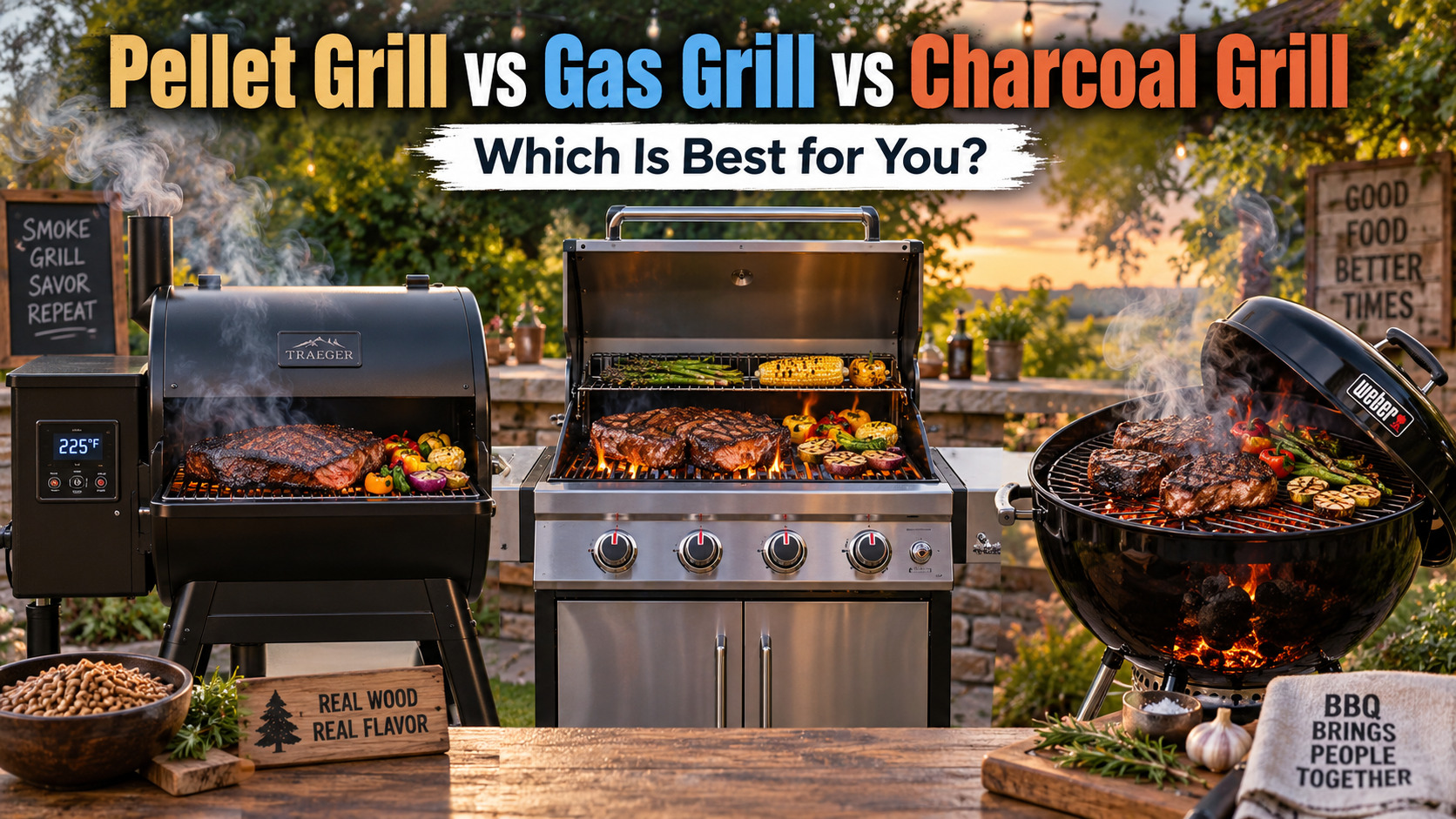
Choosing between a pellet grill, gas grill, and charcoal grill is one of the biggest decisions a backyard cook can make. All three can produce excellent food, but they create very different cooking experiences.
A pellet grill focuses on convenience, controlled wood-fired cooking, and low-and-slow barbecue. A gas grill emphasizes speed, simplicity, and convenient weeknight grilling. A charcoal grill delivers traditional live-fire cooking, strong smoke and char flavor, and excellent high-heat performance, but usually requires more hands-on attention.
There is no single grill that is objectively best for every person.
The right choice depends on what you cook, how often you grill, how much time you want to spend managing fire, whether you care more about smoking or searing, how much convenience matters, and what kind of flavor you expect from outdoor cooking.
Someone who regularly smokes brisket overnight may strongly prefer a pellet grill. A family that cooks burgers and chicken after work may get much more value from a gas grill. A barbecue enthusiast who enjoys managing a live fire and wants powerful charcoal flavor may never want to give up charcoal.
This guide provides an in-depth pellet grill vs gas grill vs charcoal grill comparison so you can understand the real strengths and weaknesses of each cooking system before buying.
Pellet Grill vs Gas Grill vs Charcoal Grill: Quick Comparison
Before exploring every category in detail, here is a simplified overview.
| Feature | Pellet Grill | Gas Grill | Charcoal Grill |
|---|---|---|---|
| Startup speed | Moderate | Excellent | Slow to moderate |
| Ease of use | Excellent | Excellent | Moderate |
| Temperature control | Excellent | Excellent | Requires practice |
| Smoke flavor | Excellent | Mild | Excellent |
| High-heat searing | Moderate to good | Good to excellent | Excellent |
| Low-and-slow smoking | Excellent | Moderate | Excellent |
| Fuel | Wood pellets | Propane or natural gas | Charcoal |
| Electricity required | Yes | Usually no | No |
| Cleanup | Moderate | Easy | More involved |
| Fire management | Minimal | Minimal | Hands-on |
| Automation | Excellent | Limited | Limited |
| Best for beginners | Excellent | Excellent | Good with practice |
| Traditional barbecue experience | Moderate | Low | Excellent |
| Versatility | Excellent | Excellent | Excellent |
| Portability | Limited on many models | Varies | Excellent on simple models |
These ratings are generalizations. Individual grill designs can vary considerably.
For example, some premium pellet grills are capable of much stronger searing than older pellet grills. Certain gas grills can produce impressive smoke when used with wood chips or smoker accessories. Large ceramic charcoal cookers can hold stable temperatures for hours once properly adjusted.
Understanding the fundamental differences between the three fuel systems, however, makes choosing the right category much easier.
What Is a Pellet Grill?
A pellet grill is an electronically controlled outdoor cooker that burns compressed hardwood pellets.
Instead of manually adding charcoal or logs, you pour pellets into a storage container called a hopper. An electric auger gradually moves those pellets toward a small combustion chamber called a fire pot.
An electric ignition system starts the fire, while a fan supplies oxygen.
A temperature controller monitors the internal temperature and automatically adjusts pellet delivery and airflow to keep the cooker close to your selected temperature.
This automated system is the biggest reason pellet grills have become popular.
Cooking brisket at 225°F does not necessarily require constantly adjusting vents or adding fuel. You select your target temperature, allow the grill to preheat, place the meat inside, and let the controller manage much of the fire for you.
Modern pellet grills may also include features such as:
- Digital temperature controllers
- Wi-Fi connectivity
- Bluetooth connectivity
- Integrated meat probes
- Multiple temperature sensors
- Smartphone monitoring
- Programmable cooking stages
- Keep-warm modes
- Pellet-level sensors
- Direct-flame searing systems
Although pellet grills are often called pellet smokers, they are capable of more than smoking.
Depending on the model, you can roast chicken, bake pizza, cook vegetables, make ribs, smoke pork shoulder, grill burgers, cook sausages, bake desserts, and sometimes sear steaks.
Their biggest advantage is combining wood-fired flavor with digital temperature control.
What Is a Gas Grill?
A gas grill burns propane or natural gas through metal burners positioned underneath the cooking grates.
When you turn a burner knob and activate the ignition system, gas flows into the burner and creates a controlled flame.
Heat shields, flavorizer bars, ceramic briquettes, or similar components may sit between the burners and cooking grates. These protect burners from dripping grease while spreading heat across the cooking surface.
Gas grills are popular primarily because they are fast and convenient.
You can walk outside, open the lid, ignite the grill, and often be cooking within several minutes.
Temperature adjustments are also extremely simple. Turning the burner controls increases or decreases the flame almost immediately.
For someone who grills several times per week, this convenience can be extremely valuable.
Gas grills range from simple two-burner units to massive outdoor cooking systems equipped with:
- Four or more main burners
- Infrared searing burners
- Side burners
- Rotisserie burners
- Warming racks
- Griddle inserts
- Smoker boxes
- Built-in lighting
- Storage cabinets
- Integrated thermometers
A high-quality gas grill can function almost like an outdoor kitchen.
Gas does not naturally create the same wood-smoke profile as pellet or charcoal cooking, but its combination of speed, clean operation, and temperature control makes it one of the most practical fuel systems available.
What Is a Charcoal Grill?
A charcoal grill burns either charcoal briquettes, lump charcoal, or sometimes a combination of charcoal and wood.
Unlike pellet grills and gas grills, basic charcoal cookers generally do not regulate the fire automatically.
Instead, you control temperature by adjusting:
- The amount of charcoal
- The arrangement of charcoal
- Intake vents
- Exhaust vents
- Distance between food and coals
Opening vents allows more oxygen to reach the fire, usually increasing temperature. Restricting airflow reduces combustion and lowers heat.
This manual process gives charcoal cooking its learning curve.
It can take time to understand how much charcoal to use, when to adjust vents, how weather affects the fire, and how to maintain stable temperatures for long barbecue sessions.
However, many enthusiasts consider this process part of the enjoyment.
Charcoal grills range from inexpensive portable kettles to sophisticated ceramic cookers, barrel grills, drum smokers, kamado grills, gravity-fed cookers, and large competition-style systems.
Charcoal is capable of both very low temperatures and extremely high temperatures.
That flexibility makes it one of the most versatile grilling fuels available.
Pellet Grill vs Gas Grill vs Charcoal Grill for Flavor
Flavor is usually the first concern when comparing grill types.
The biggest distinction involves combustion.
Pellet grills burn hardwood.
Charcoal grills burn carbonized wood and can also use additional hardwood chunks.
Gas grills primarily burn propane or natural gas, which contributes much less smoke flavor.
Pellet Grill Flavor
Pellet grills provide a clean, relatively mild wood-smoke flavor.
Different pellet varieties may include woods such as:
- Hickory
- Oak
- Cherry
- Apple
- Pecan
- Maple
- Mesquite
The smoke profile generally changes somewhat depending on pellet composition and cooking temperature.
Pellet grills typically produce more noticeable smoke at lower temperatures. When the grill operates at higher temperatures, pellet combustion becomes more efficient and smoke flavor usually becomes less pronounced.
This makes pellet grills especially effective for foods such as:
- Brisket
- Pork shoulder
- Pork ribs
- Turkey
- Chicken
- Salmon
- Sausages
- Meatloaf
People who enjoy barbecue but prefer cleaner, gentler smoke often appreciate pellet grills.
However, someone looking for very intense smoke flavor may find standard pellet cooking milder than charcoal with wood chunks or an offset smoker burning logs.
Gas Grill Flavor
Gas grilling creates excellent browning, caramelization, and grilled flavor, particularly when food is cooked over high heat.
What it lacks is substantial natural wood smoke.
Drippings falling onto heated surfaces may vaporize and contribute additional grilled flavor, but this should not be confused with the flavor produced by actual hardwood combustion.
You can add smoke to a gas grill using accessories or wood chips, but it generally requires more effort and usually does not duplicate the flavor profile of dedicated wood-burning equipment.
Gas is therefore ideal when you primarily care about:
- Browning
- Searing
- Convenience
- Direct grilling
- Ingredient flavor
- Fast cooking
For steaks, burgers, vegetables, kebabs, hot dogs, seafood, and chicken breasts, many people are perfectly satisfied with the flavor from gas grilling.
Charcoal Grill Flavor
Charcoal offers perhaps the most distinctive traditional backyard grilling flavor.
When meat juices and fat drip onto hot charcoal, combustion creates aromatic compounds that rise back toward the food.
You can further increase smoke complexity by adding hardwood chunks.
Charcoal cooking can produce rich flavors that many people strongly associate with barbecue.
It works particularly well for:
- Steaks
- Burgers
- Chicken
- Ribs
- Pork shoulder
- Brisket
- Kebabs
- Corn
- Sausages
For pure traditional grilled flavor, charcoal is difficult to beat.
Flavor Winner
If maximum traditional smoke and fire flavor is your priority, charcoal generally wins.
For cleaner wood-smoked barbecue with greater convenience, pellet grills are excellent.
Gas comes third for smoke flavor but remains excellent for browning and high-temperature grilling.
Which Grill Is Easiest to Use?
Convenience is where the differences become dramatic.
Pellet Grill Ease of Use
Pellet grills are remarkably simple considering they burn real wood.
The basic process is usually:
- Fill the hopper with pellets.
- Turn on the grill.
- Select a temperature.
- Allow it to preheat.
- Add the food.
- Monitor the cook.
The grill automatically controls pellet delivery and combustion.
For long cooks, this reduces the amount of attention required compared with conventional charcoal smokers.
Some models can even send temperature information to your phone.
However, pellet grills have more mechanical and electronic components.
Augers, fans, controllers, igniters, probes, and motors can eventually require troubleshooting or replacement.
Gas Grill Ease of Use
Gas grills may be even simpler for short cooking sessions.
Turn the gas on, ignite the burners, preheat, and start cooking.
There is no ash, no pellet hopper, and no charcoal chimney.
If dinner needs to be ready quickly, gas is hard to beat.
Temperature adjustments are immediate and intuitive.
Because of this, gas grills are extremely beginner-friendly.
Charcoal Grill Ease of Use
Charcoal requires more preparation.
You need to light the charcoal, wait for it to ignite properly, arrange the coals, configure the vents, and monitor temperature.
Lighting can be simplified with a charcoal chimney, but the overall process still requires more involvement than pushing a button.
Long cooking sessions may require additional fuel management.
Charcoal becomes significantly easier with experience, but it has the steepest learning curve of the three systems.
Ease-of-Use Winner
For everyday grilling, gas is arguably the easiest.
For smoking and long unattended cooks, pellet grills are the easiest.
Charcoal requires the most skill and involvement.
Startup Time
How quickly you can start cooking matters more than many buyers initially realize.
Imagine coming home after work and wanting grilled chicken ready within 30 minutes.
This scenario strongly favors gas.
Gas Grill Startup
Many gas grills can reach useful grilling temperatures in roughly 10 to 15 minutes, depending on weather, grill construction, and desired temperature.
Ignition takes seconds.
There is no fuel preparation other than confirming the gas supply.
Pellet Grill Startup
Pellet grills usually need time for their ignition cycle and preheating process.
Depending on the model and target temperature, you may need approximately 10 to 20 minutes or longer before cooking.
Starting a pellet grill is easy, but not always quite as fast as gas.
Charcoal Grill Startup
Traditional charcoal generally takes the longest.
Using a chimney starter, charcoal may require approximately 15 to 25 minutes to become properly lit, followed by additional time to arrange the coals and stabilize the cooker.
For low-and-slow barbecue, establishing your target temperature may take longer.
Startup Winner
Gas is the clear choice for maximum speed.
Temperature Control
Reliable temperature control can be the difference between relaxed barbecue and constant fire management.
Pellet Grill Temperature Control
Temperature control is one of the strongest advantages of pellet grills.
The controller constantly monitors the grill and adjusts fuel delivery.
Quality pellet grills can hold relatively consistent cooking temperatures for long periods.
You may still see normal temperature fluctuations as pellets ignite and burn, but you do not usually need to manually control airflow.
This makes pellet grills ideal for:
- Overnight brisket
- Pulled pork
- Ribs
- Smoked turkey
- Low-temperature fish
- Long roasting sessions
Gas Grill Temperature Control
Gas grills also provide excellent temperature control.
Turn the burner up and the temperature rises.
Turn the burner down and heat decreases.
Multiple burners allow you to create separate temperature zones.
For example, you can keep one side hot for searing and another cooler for indirect cooking.
This flexibility is excellent for grilling foods that require both direct and indirect heat.
Charcoal Grill Temperature Control
Charcoal gives you enormous control, but you have to earn it.
You manage temperature through vent adjustments, fuel quantities, charcoal placement, and airflow.
Once mastered, a good charcoal grill can maintain remarkably stable temperatures.
A ceramic kamado cooker, for instance, can hold low cooking temperatures for long periods because its insulated construction retains heat efficiently.
But achieving that stability requires more understanding than setting a digital controller.
Temperature Control Winner
Pellet grills are best for automatic control.
Gas grills are best for rapid manual temperature changes.
Charcoal provides excellent control for experienced cooks but requires greater skill.
Pellet Grill vs Gas Grill vs Charcoal Grill for Smoking
If smoking meat is your primary goal, this category deserves special attention.
Smoking on a Pellet Grill
Pellet grills were practically designed for convenient low-and-slow barbecue.
You can smoke brisket for many hours without continuously adding fuel.
Large pellet hoppers may hold enough fuel for very long cooking sessions.
Integrated temperature probes further simplify the process.
Pellet grills are particularly attractive for people who want authentic wood-fired cooking without becoming full-time fire managers.
The primary compromise is smoke intensity.
Pellet smoke is often lighter than the smoke produced by charcoal and wood chunks or traditional wood-burning smokers.
Smoking on a Gas Grill
Smoking on gas is possible but less natural.
You can configure burners for indirect heat and add a smoker box containing wood chips or chunks.
The grill then functions somewhat like an indirect smoker.
This can work surprisingly well for chicken, ribs, fish, pork, and other foods.
However, gas grills were not primarily designed as smokers.
Maintaining very low temperatures may also be challenging on some models.
Smoking on a Charcoal Grill
Charcoal grills can be outstanding smokers.
You can arrange charcoal using methods such as indirect two-zone setups, charcoal baskets, or extended fuel arrangements designed to burn slowly.
Adding wood chunks creates authentic barbecue smoke.
Charcoal smokers can produce exceptional brisket, ribs, pork shoulder, chicken, and turkey.
The disadvantage is fire management.
You need to understand airflow and monitor conditions during long cooks.
Smoking Winner
Pellet wins for smoking convenience.
Charcoal wins for traditional smoke character and hands-on control.
Gas is capable but generally less ideal for dedicated smoking.
Pellet Grill vs Gas Grill vs Charcoal Grill for Searing
Searing requires intense heat.
This is one category where traditional pellet grills historically struggled compared with gas and charcoal.
Searing on a Pellet Grill
Pellet grills cook primarily using indirect convection heat.
Many models can reach temperatures around traditional grilling levels, while certain newer or premium designs include direct-flame access or dedicated searing sections.
These improvements make modern pellet grills much more capable than earlier generations.
You can produce excellent steaks on many pellet grills, especially by smoking the meat first and finishing it at high temperature.
This technique is often called reverse searing.
However, if extreme direct heat is your highest priority, charcoal or a powerful gas searing burner may still perform better.
Searing on a Gas Grill
Gas grills are excellent for searing.
High-output burners can heat heavy cooking grates to temperatures capable of creating impressive crust.
Premium grills may also include infrared burners specifically designed for intense searing.
Gas offers another important advantage: control.
You can maintain a high-heat zone for searing while keeping another area cooler.
This makes it easy to move thick steaks between direct and indirect heat.
Searing on a Charcoal Grill
Charcoal is exceptional for searing.
A concentrated bed of hot charcoal can generate tremendous radiant heat.
By positioning the cooking grate close to the coals, you can create extremely aggressive searing conditions.
Charcoal also adds fire-roasted flavor during the process.
For someone obsessed with ribeye, porterhouse, burgers, and other foods that benefit from intense direct heat, charcoal remains one of the strongest choices.
Searing Winner
Charcoal and high-quality gas grills generally lead this category.
Pellet grills are improving significantly but vary more by model.
Low-and-Slow Cooking
Low-and-slow cooking involves maintaining temperatures roughly in the traditional barbecue range for many hours.
Pellet grills excel here because their entire control system is designed around stable temperature management.
Charcoal is also excellent, particularly when using smokers, kamados, or properly configured kettle grills.
Gas can maintain low temperatures using indirect cooking methods, but smoking flavor generally requires additional wood.
For low-and-slow convenience, pellet grills win.
For traditional low-and-slow barbecue with deeper fire management, charcoal remains outstanding.
High-Heat Cooking
High-temperature cooking covers steak searing, pizza, burgers, certain vegetables, and fast direct grilling.
Charcoal can reach extremely high temperatures.
Gas can also generate powerful direct heat, especially with high-output or infrared burners.
Pellet grills can reach grilling temperatures, but performance differs considerably between models.
If most of your cooking happens above 400°F, investigate the maximum temperature and direct-flame capabilities of any pellet grill before purchasing.
Versatility
All three grill types can be versatile, but they achieve versatility differently.
Pellet Grill Versatility
A pellet grill behaves almost like an outdoor wood-fired convection oven.
You can:
- Smoke
- Roast
- Bake
- Grill
- Barbecue
- Braise
- Cook pizza
- Bake bread
- Make desserts
Because heat circulates through the cooking chamber, food cooks relatively evenly.
Many people use pellet grills for foods they would normally prepare indoors.
Gas Grill Versatility
Gas grills offer excellent multi-zone cooking.
With multiple independently controlled burners, you can simultaneously cook foods at different temperatures.
Accessories can expand functionality further.
Possible uses include:
- Direct grilling
- Indirect roasting
- Rotisserie cooking
- Griddle cooking
- Wok cooking
- Searing
- Smoking with accessories
- Side-burner cooking
Charcoal Grill Versatility
Charcoal offers perhaps the widest temperature range.
A charcoal cooker can run low for smoking or extremely hot for searing.
With the correct accessories and techniques, you can:
- Smoke
- Grill
- Roast
- Sear
- Bake
- Cook pizza
- Use a rotisserie
- Cook over direct flame
Charcoal requires more skill, but there are few cooking methods it cannot handle.
Fuel Costs
The true cost of grilling includes more than the purchase price.
Fuel expenses accumulate over years of cooking.
Wood Pellet Costs
Pellet consumption depends heavily on temperature and weather.
Low-temperature smoking uses pellets relatively slowly, while high-temperature grilling increases consumption.
Cold weather and windy conditions may also cause the grill to burn more fuel.
Pellet prices vary by brand, wood type, bag size, and location.
Storage matters too.
Pellets absorb moisture easily and should be kept dry.
Propane Costs
Gas usage depends on burner output and cooking time.
Because gas grills preheat quickly and cooking sessions are often short, fuel consumption can be economical for everyday use.
A standard propane tank can support many typical grilling sessions before needing replacement or refilling.
Natural gas models may be even more convenient because they connect to a home’s gas supply.
Charcoal Costs
Charcoal costs vary considerably.
Standard briquettes may be relatively inexpensive, while premium lump charcoal can cost significantly more.
Long barbecue sessions can consume substantial quantities of charcoal.
However, experienced cooks often learn to manage fuel efficiently.
Some grills also allow partially burned charcoal to be saved and reused.
Initial Purchase Price
Your budget may strongly influence the decision.
Pellet Grill Pricing
Pellet grills tend to cost more than simple charcoal grills because they contain:
- Electronic controllers
- Auger motors
- Fans
- Igniters
- Temperature sensors
- Pellet hoppers
Entry-level models may be affordable, but premium pellet grills can become expensive.
Gas Grill Pricing
Gas grills exist at almost every price level.
You can find basic compact grills, mainstream backyard models, and luxury outdoor kitchen systems costing many times more.
Your money often goes toward burner quality, materials, cooking area, heat distribution, warranties, and additional features.
Charcoal Grill Pricing
Charcoal has the lowest entry barrier.
A simple kettle grill can provide excellent cooking performance for relatively little money.
However, premium ceramic kamado grills and sophisticated charcoal smokers can also be expensive.
The difference is that you do not need a complicated cooker to produce excellent food over charcoal.
Maintenance Requirements
Every grill needs maintenance, but the workload differs.
Pellet Grill Maintenance
Pellet grills create ash from burning wood.
Eventually, you need to clean the fire pot and cooking chamber.
Grease trays also require regular attention.
Because the system contains electronics and moving parts, owners should protect the grill from moisture and follow proper shutdown procedures.
Common maintenance areas include:
- Fire pot
- Grease tray
- Temperature sensor
- Cooking grates
- Hopper
- Auger
- Ash buildup
Leaving wet pellets inside the hopper can be particularly problematic because pellets can swell, break down, and potentially obstruct the auger.
Gas Grill Maintenance
Gas grills are relatively clean.
There is no ash.
Routine maintenance generally involves:
- Cleaning grates
- Emptying grease trays
- Cleaning burner ports
- Removing debris
- Checking ignition components
- Inspecting hoses and connections
Over time, burners may corrode and require replacement.
Charcoal Grill Maintenance
Charcoal produces ash, which needs to be removed regularly.
Grease and carbon also accumulate on cooking surfaces and inside the grill.
Simple charcoal grills contain relatively few components, however, so mechanical maintenance is minimal.
There are no motors, electronic controllers, fans, or igniters on a basic charcoal grill.
Reliability and Longevity
Simple machines usually have fewer potential points of failure.
That principle applies here.
Charcoal Grill Reliability
Basic charcoal grills are extremely simple.
If the grill body, grates, vents, and handles remain functional, the cooker can continue operating.
There are very few components that can fail.
Gas Grill Reliability
Gas grills add valves, burners, ignition systems, regulators, and hoses.
These components can eventually wear out, but good grills are generally straightforward to repair.
Pellet Grill Reliability
Pellet grills contain the most technology.
Potential failure points include:
- Controllers
- Temperature sensors
- Igniters
- Auger motors
- Fans
- Electrical wiring
High-quality models can be highly reliable, but the electronic system inevitably introduces greater mechanical complexity.
Electricity Requirements
This is one of the most overlooked differences.
Pellet grills require electricity.
Without electricity, the controller, auger, fan, and ignition system cannot function normally.
That matters if you grill:
- While camping
- During power outages
- At remote properties
- During tailgating
- Far from electrical outlets
Portable power stations or generators can solve the problem, but they add complexity.
Gas and conventional charcoal grills typically operate independently of household electricity.
For emergency cooking and off-grid reliability, charcoal and propane have significant advantages.
Portability
Charcoal dominates the simple portable-grill market.
Compact charcoal grills are inexpensive, lightweight, and require no electrical connection.
Small propane grills are also excellent for camping and tailgating.
Pellet grills can be portable, but they still require pellets and electricity.
Some manufacturers produce compact pellet cookers designed for travel, but the overall system remains more complicated than a basic charcoal or propane grill.
Weather Performance
Outdoor cooking means dealing with wind, rain, heat, and cold.
Pellet Grills in Cold Weather
Pellet grills compensate for heat loss by feeding additional fuel into the fire.
This can help maintain temperature, but pellet consumption increases.
Insulated blankets or well-insulated cooking chambers can improve efficiency.
Gas Grills in Cold Weather
Gas grills generally perform reliably in cold conditions, although preheating may take longer and fuel consumption can increase.
Very low temperatures can affect propane performance, especially when fuel levels are low.
Charcoal Grills in Cold Weather
Charcoal still works in cold conditions, but heat loss and wind can make temperature management more challenging.
Insulated charcoal cookers such as ceramic kamados perform particularly well because they retain heat efficiently.
Cooking Capacity
Cooking capacity depends more on individual grill size than fuel type.
However, pellet grills often provide multiple racks and large smoking areas because much of the cooking is indirect.
Large gas grills provide substantial primary cooking surfaces plus warming racks.
Charcoal cookers vary widely.
A basic kettle may provide enough room for a family, while large barrel smokers and kamado systems can handle significantly more food.
When comparing capacity, do not look only at the manufacturer’s total square-inch number.
Consider:
- Main grate size
- Upper rack dimensions
- Usable vertical clearance
- Whether racks interfere with larger foods
- How much indirect cooking space is available
A large advertised cooking area is not always equally useful.
Pellet Grill vs Gas Grill vs Charcoal Grill for Beginners
Beginners often benefit from consistency.
Pellet and gas grills both reduce the number of variables you need to manage.
Pellet Grill for Beginners
A pellet grill is excellent for someone who wants to learn barbecue.
You can focus on:
- Meat preparation
- Seasoning
- Internal temperature
- Bark formation
- Tenderness
- Resting
The grill manages most fire control automatically.
This dramatically reduces the learning curve for brisket, ribs, pork shoulder, and other smoked foods.
Gas Grill for Beginners
Gas is ideal for beginner grilling.
The controls operate similarly to a stovetop.
You can easily learn direct and indirect cooking without managing charcoal.
Charcoal Grill for Beginners
Charcoal takes longer to master, but beginners should not be intimidated.
A basic kettle grill can teach valuable skills related to:
- Fire building
- Heat zones
- Airflow
- Fuel control
- Smoke
- Direct heat
- Indirect heat
Anyone interested in traditional barbecue may enjoy learning these skills.
Best Grill for Busy Families
For busy families, gas often makes the most sense.
Suppose dinner needs to be prepared at 6:30 p.m.
You can ignite the grill at 6:10, preheat it, cook burgers, chicken, sausages, vegetables, or fish, clean the grates, and shut everything down quickly.
A pellet grill is another excellent family option.
It requires slightly more startup time but allows you to cook with wood flavor while doing other things.
Charcoal provides excellent results but creates additional preparation and cleanup.
For families grilling primarily on weeknights, convenience may matter more than maximum smoke flavor.
Best Grill for Barbecue Enthusiasts
This depends on what type of enthusiast you are.
A barbecue enthusiast who loves controlling fire may choose charcoal.
Someone who loves experimenting with brisket, ribs, pork shoulder, and smoked foods but does not want to manage airflow may prefer pellet.
A steak-focused enthusiast may favor charcoal or a powerful gas grill.
There is no contradiction in owning multiple grill types.
In fact, serious outdoor cooks often eventually own two or more because each system excels at different tasks.
Pellet Grill vs Gas Grill vs Charcoal Grill for Steaks
Steak is an interesting comparison because smoking and searing both matter.
Pellet-Grilled Steak
A pellet grill excels at reverse-seared steak.
You can slowly smoke a thick ribeye until it approaches your desired internal temperature, then finish it over intense heat.
If your pellet grill has strong direct-flame capability, the entire process can happen on one cooker.
Otherwise, some cooks use a separate cast-iron surface or secondary grill for the final sear.
Gas-Grilled Steak
Gas makes steak cooking easy.
Create a very hot zone for searing and a cooler zone for indirect finishing.
High-end infrared burners can produce extremely intense heat.
The result is excellent crust development with precise control.
Charcoal-Grilled Steak
Charcoal arguably creates the most dramatic steak experience.
The combination of intense radiant heat, charcoal aroma, and dripping fat hitting hot coals creates classic steakhouse-style fire flavor.
For pure steak cooking, charcoal is extremely difficult to beat.
Pellet Grill vs Gas Grill vs Charcoal Grill for Burgers
Burgers cook quickly and benefit from strong direct heat.
Gas is fantastic because you can cook many burgers quickly with minimal preparation.
Charcoal provides outstanding char-grilled flavor.
Pellet grills can also cook excellent burgers, particularly models capable of higher temperatures, but traditional indirect pellet cooking may produce less aggressive crust.
For weeknight burgers, gas may be the practical winner.
For maximum backyard cookout flavor, charcoal has an advantage.
Pellet Grill vs Gas Grill vs Charcoal Grill for Chicken
Chicken works beautifully on all three.
Pellet grills provide excellent smoke flavor and even cooking.
Gas grills give you strong temperature control, which is particularly useful for preventing flare-ups while cooking fatty chicken pieces.
Charcoal creates outstanding crispy skin and grilled flavor.
Whole chickens are particularly good candidates for pellet cooking because the convection-style heat helps cook them evenly.
Chicken thighs and wings are excellent over charcoal.
Boneless chicken breasts are quick and convenient on gas.
Pellet Grill vs Gas Grill vs Charcoal Grill for Ribs
Ribs are where pellet grills begin to demonstrate their strongest advantages.
Low, consistent temperatures and hardwood smoke make pellet cookers almost ideal for ribs.
You can prepare them, place them on the smoker, monitor temperature, and make only occasional adjustments.
Charcoal can produce equally impressive or potentially stronger smoke flavor, especially with wood chunks, but requires more fire management.
Gas can cook tender ribs using indirect heat, but adding genuine smoke requires an additional setup.
Pellet and charcoal are the strongest choices for dedicated rib lovers.
Pellet Grill vs Gas Grill vs Charcoal Grill for Brisket
Brisket requires patience and temperature stability.
Pellet grills simplify the process dramatically.
Large pellet hoppers can support long cooking sessions while electronic controllers maintain the set temperature.
This makes pellet grills particularly attractive for overnight brisket.
Charcoal smokers can produce outstanding brisket with excellent bark and smoke character.
However, the cook may require more monitoring depending on the smoker design.
Gas can cook brisket indirectly, but most barbecue enthusiasts would prefer pellet or charcoal if brisket is a major priority.
Pellet Grill vs Gas Grill vs Charcoal Grill for Pizza
All three can produce good pizza with the right setup.
Charcoal grills, especially ceramic kamado cookers, can achieve very high temperatures suitable for pizza.
Gas grills can also produce high heat and work well with pizza stones.
Pellet grills provide pleasant wood-fired flavor, though maximum temperature varies significantly by model.
If pizza is important to you, check the actual maximum operating temperature before purchasing any grill.
Pellet Grill vs Gas Grill vs Charcoal Grill for Vegetables
Vegetables work well on all grill types.
Gas offers excellent control and speed.
Charcoal gives vegetables attractive char and fire flavor.
Pellet grills are especially effective when roasting vegetables slowly or adding subtle wood smoke.
The best option depends more on cooking style than the vegetable itself.
Safety Considerations
All outdoor grills involve heat, combustion, and potential fire hazards.
Regardless of fuel type, grills should be operated according to manufacturer instructions and kept away from combustible structures.
Pellet Grill Safety
Important considerations include grease management and proper shutdown.
Because pellets are mechanically fed into a fire pot, following the manufacturer’s startup and shutdown procedure is important.
Ash and grease should also be cleaned regularly.
Gas Grill Safety
Gas connections should be inspected periodically.
Never ignore the smell of gas.
Hoses, regulators, valves, and fuel tanks should remain in good condition.
The lid should generally be open during ignition according to the grill manufacturer’s procedures.
Charcoal Grill Safety
Charcoal produces significant heat and remains hot long after cooking.
Ashes can contain live embers for many hours.
Never dispose of hot charcoal in combustible containers.
Charcoal grills should never be operated inside enclosed spaces because combustion produces carbon monoxide.
The same general indoor-use warning applies to fuel-burning outdoor cooking appliances unless specifically designed and approved for indoor use.
Environmental Considerations
Comparing environmental impact is complicated because it depends on fuel sourcing, manufacturing, transportation, grill efficiency, and cooking behavior.
Wood pellets are generally produced from compressed wood material.
Charcoal production involves heating wood with limited oxygen, and the efficiency and sourcing of charcoal vary widely.
Propane is a fossil fuel.
Rather than declaring one system universally environmentally superior, buyers who care about environmental impact should consider:
- How frequently they cook
- Fuel efficiency
- Grill durability
- Sustainable fuel sourcing
- Product lifespan
- Transportation
- Avoiding unnecessary fuel consumption
A durable grill used efficiently for many years can be preferable to repeatedly replacing cheaply constructed equipment.
Pellet Grill Pros and Cons
Pellet Grill Pros
Excellent temperature automation: You can set a temperature and allow the controller to manage fuel and airflow.
Authentic wood fuel: Pellets provide real wood-fired flavor without requiring you to burn logs manually.
Excellent smoking performance: Brisket, ribs, pork shoulder, turkey, and other barbecue foods are extremely easy to prepare.
Long unattended cooking: Large hoppers make extended cooking sessions practical.
Versatility: Pellet grills can smoke, roast, bake, grill, and sometimes sear.
Easy learning curve: Beginners can produce impressive barbecue relatively quickly.
Modern technology: Wi-Fi, probes, alerts, and mobile monitoring add convenience.
Pellet Grill Cons
Electricity required: The grill cannot operate normally without electrical power.
More mechanical complexity: Controllers, augers, fans, and igniters introduce potential failure points.
Pellets require dry storage: Moisture can damage pellets and cause feeding problems.
Searing varies by model: Some pellet grills do not produce the same intense direct heat as charcoal.
Higher initial cost: Pellet systems are generally more complicated than basic charcoal grills.
More delicate than simple charcoal grills: Electronics require protection from water and extreme weather.
Gas Grill Pros and Cons
Gas Grill Pros
Fast startup: Gas grills can be ready for cooking quickly.
Easy temperature adjustment: Burner knobs make heat control simple.
Excellent for weeknight cooking: Short preparation and cleanup make gas ideal for frequent use.
Strong searing: Quality gas grills can reach excellent steak-searing temperatures.
Minimal ash: Gas produces no solid fuel ash.
Multiple cooking zones: Independent burners make direct and indirect cooking easy.
Reliable convenience: There is very little fire-management learning curve.
Gas Grill Cons
Limited natural smoke flavor: Propane and natural gas do not create wood smoke.
Less traditional barbecue character: Some enthusiasts miss the live-fire experience.
Smoking requires additional equipment or technique: Wood chips or smoker accessories may be necessary.
Burners eventually require maintenance: Corrosion and blocked ports can affect performance.
Fuel supply must be monitored: Running out of propane during dinner is frustrating.
Charcoal Grill Pros and Cons
Charcoal Grill Pros
Excellent flavor: Charcoal creates traditional barbecue character.
Outstanding searing: Concentrated charcoal can produce extremely high temperatures.
Excellent smoking capability: Add wood chunks and use indirect setups for authentic barbecue.
Wide temperature range: Charcoal can handle low smoking temperatures and intense searing.
Simple equipment: Basic grills have very few mechanical components.
Low entry price: Excellent charcoal grills can be relatively affordable.
Portable options: Charcoal works well for camping, tailgating, and travel.
No electricity required: Charcoal is useful for off-grid cooking.
Charcoal Grill Cons
Longer startup: Lighting and stabilizing charcoal takes time.
More cleanup: Charcoal produces ash.
Greater learning curve: Temperature control requires practice.
More active fire management: Long cooks may need additional attention.
Less convenient for quick dinners: Starting charcoal for a ten-minute cooking session may feel inefficient.
Which Grill Is Cheapest to Own?
There is no universal answer because ownership cost depends on grill price, fuel costs, maintenance, repair expenses, and cooking frequency.
A basic charcoal kettle usually has the lowest initial purchase price.
Gas grills can be very economical for frequent short cooking sessions.
Pellet grills often have higher initial costs and more mechanical components, but their convenience may justify the expense for someone who regularly smokes large cuts of meat.
Instead of focusing exclusively on purchase price, estimate how you actually expect to use the grill.
A $300 grill used four nights per week may provide more value than a $1,500 grill used six times per year.
Which Grill Requires the Least Cleanup?
Gas generally wins.
There is no ash to remove.
You primarily deal with cooking residue, grease, and occasional burner maintenance.
Pellet grills create a moderate amount of ash and grease.
Charcoal produces the most ash.
However, modern ash-management systems can make charcoal cleanup significantly easier.
Which Grill Gives the Most Authentic Barbecue Experience?
If by authentic you mean controlling a real fire, charcoal wins.
You ignite the fuel, adjust airflow, monitor temperature, add wood, and respond to changing conditions.
This hands-on process is deeply connected to traditional barbecue.
Pellet grills still burn real wood, but the electronics perform most of the fire management.
Gas delivers outdoor grilling without much of the traditional fire-building process.
The important question is whether you consider this involvement enjoyable or inconvenient.
For some cooks, tending a fire is half the fun.
For others, it is precisely what they want to avoid.
Which Grill Is Best for Apartment or Small-Space Cooking?
The answer depends heavily on local building and property rules.
Many apartments, condominiums, balconies, and shared residential buildings restrict or prohibit certain fuel-burning grills.
Never assume a grill is permitted simply because it fits physically.
Where regulations allow outdoor grilling, compact gas grills are convenient because they produce little ash.
Portable electric equipment may sometimes be allowed where open flames are prohibited, although specific rules vary.
Pellet grills still involve active combustion despite their electronic controls.
Charcoal generally creates the most concern regarding sparks, open flame, and ash.
Always follow building rules and applicable fire regulations.
Which Grill Is Best for Tailgating?
Gas and charcoal are usually the simplest choices.
Portable propane grills offer extremely fast cooking.
Portable charcoal grills offer classic flavor and do not require electricity.
Portable pellet grills are increasingly capable, but you need both pellets and a suitable power source.
For maximum simplicity, small propane grills usually win.
For maximum flavor, charcoal is excellent.
Which Grill Is Best for Camping?
Charcoal is attractive for camping because it requires no electricity.
Portable propane grills are even more convenient where propane cooking is permitted.
Pellet grills can work at powered campsites or with portable battery systems, but the setup is more complicated.
Fire restrictions are important.
During periods of high wildfire danger, charcoal or wood-burning equipment may be restricted even when gas cooking appliances remain permitted.
Always follow local restrictions.
Which Grill Is Best for Large Parties?
Gas grills are excellent for large parties when you need to cook many burgers, hot dogs, steaks, chicken pieces, and vegetables quickly.
Multiple burners allow simultaneous cooking zones.
Large pellet grills are fantastic for preparing large amounts of barbecue ahead of time.
You can smoke multiple pork shoulders, racks of ribs, briskets, or chickens with relatively little active supervision.
Large charcoal grills provide tremendous cooking capability but require more fire management.
For fast service, choose gas.
For large amounts of smoked meat, pellet grills are particularly convenient.
Pellet Grill vs Gas Grill vs Charcoal Grill for Meal Prep
Meal preparation changes the equation.
If you want to cook a large amount of chicken, pork, turkey, vegetables, or other foods for the coming week, pellet grills are extremely useful.
Large cooking surfaces and controlled indirect heat allow you to prepare substantial quantities at once.
Gas grills are excellent for high-volume direct grilling.
Charcoal can produce outstanding meal-prep food but requires more attention.
Pellet grills therefore have a strong advantage for low-effort bulk cooking.
Do Pellet Grills Replace Gas Grills?
Sometimes, but not always.
A high-quality pellet grill can handle most typical backyard cooking.
However, someone who frequently cooks steaks or burgers quickly may still appreciate the instant heat and strong searing ability of a gas grill.
A pellet grill is particularly good as a gas grill replacement if you prioritize:
- Smoking
- Roasting
- Indirect cooking
- Wood flavor
- Long cooks
Gas may remain preferable if you primarily cook:
- Thin steaks
- Burgers
- Hot dogs
- Seafood
- Vegetables
- Quick weeknight meals
Many outdoor cooks eventually use both.
Do Pellet Grills Replace Charcoal Grills?
A pellet grill can replace charcoal for someone who wants smoke flavor without manual fire management.
But the flavor and experience are different.
Pellet combustion tends to be clean and controlled.
Charcoal creates a more intense live-fire character and can deliver tremendous direct heat.
If you enjoy lighting charcoal and managing vents, a pellet grill may feel less engaging.
If you consider fire management an inconvenience, pellet cooking may feel revolutionary.
Should You Own Two Types of Grills?
For serious outdoor cooking, this may actually be the best solution.
A common combination is pellet plus gas.
The pellet grill handles:
- Brisket
- Ribs
- Pulled pork
- Turkey
- Smoked chicken
- Long roasting
The gas grill handles:
- Steaks
- Burgers
- Vegetables
- Fast lunches
- Weeknight dinners
- High-temperature finishing
Another excellent combination is pellet plus charcoal.
The pellet grill provides convenience for long smoking sessions.
The charcoal grill provides direct-fire flavor and intense searing.
Gas plus charcoal also works well for cooks who do not need dedicated pellet-smoking automation.
Owning multiple grills is not necessary, but each fuel system genuinely offers different advantages.
How to Choose the Right Grill for Your Lifestyle
Instead of asking which grill is best in general, ask a more useful question:
What will I actually cook most often?
Choose a Pellet Grill If:
You regularly want to cook brisket, pork shoulder, ribs, turkey, chicken, smoked fish, or other low-and-slow foods.
You want real wood-fired flavor without constantly managing the fire.
You enjoy technology such as digital controls, temperature probes, and smartphone monitoring.
You frequently cook for several hours at a time.
You value consistency more than traditional fire-building.
You are willing to clean ash periodically and maintain electronic components.
You have reliable access to electricity.
Choose a Gas Grill If:
You want the fastest and most convenient grilling experience.
You frequently grill after work.
Your typical foods include burgers, steak, chicken breast, vegetables, seafood, sausages, and kebabs.
You want simple temperature control.
You prefer minimal cleanup.
You do not care strongly about deep smoke flavor.
You want multiple heat zones and powerful direct grilling.
Choose a Charcoal Grill If:
Flavor is your highest priority.
You enjoy the process of building and controlling a fire.
You want both low-temperature smoking and extremely high-temperature searing.
You want simple equipment with few mechanical components.
You often cook outdoors away from electrical outlets.
You do not mind waiting for charcoal to ignite.
You are willing to practice airflow and temperature control.
The Best Choice for Different Types of Cooks
Best for the Complete Beginner: Gas Grill
Gas provides the easiest transition from indoor cooking to outdoor grilling.
The controls are intuitive, startup is fast, and temperature changes are immediate.
Best for the Beginner Interested in Barbecue: Pellet Grill
Anyone specifically interested in brisket, ribs, pork shoulder, and smoked foods will probably learn more quickly on a pellet grill because fire management is automated.
Best for Traditionalists: Charcoal Grill
Charcoal provides the strongest connection to classic backyard barbecue.
Best for Busy Families: Gas Grill
Nothing beats turning a knob and cooking dinner minutes later.
Best for Long Smoking Sessions: Pellet Grill
Automated fuel feeding and temperature control are extremely valuable during ten-hour or longer cooks.
Best for Steak Lovers: Charcoal or High-Heat Gas
Both can produce intense searing temperatures.
Charcoal adds classic live-fire flavor, while gas provides more convenience.
Best for Technology Fans: Pellet Grill
Wi-Fi, digital controllers, probes, alerts, and automated temperature regulation make pellet grills the most technologically advanced option.
Best for Off-Grid Cooking: Charcoal
No electricity, no motors, and no electronic controller are necessary.
Portable propane is also excellent.
Best for Maximum Smoke Flavor: Charcoal
Charcoal combined with hardwood chunks creates powerful traditional barbecue flavor.
Best for Easy Wood-Smoked Flavor: Pellet Grill
Pellets provide genuine hardwood combustion without requiring manual fire management.
Questions to Ask Before Buying
Before spending money on any grill, answer these questions.
How Often Will You Grill?
If you expect to grill four or five nights every week, convenience matters enormously.
Gas becomes very attractive.
If most of your outdoor cooking happens on weekends and you enjoy the process, charcoal may be perfect.
If your weekend cooking sessions regularly last six to twelve hours, pellet automation becomes valuable.
What Foods Will You Cook Most Often?
Your typical menu matters more than marketing claims.
For brisket and ribs, prioritize smoking ability.
For steak and burgers, prioritize direct heat.
For whole chicken and turkey, stable indirect heat becomes important.
For pizza, maximum temperature matters.
How Much Time Do You Have?
Charcoal rewards patience.
Pellet grills reduce active cooking labor.
Gas minimizes startup and shutdown time.
How Important Is Smoke Flavor?
If smoke flavor is essential, pellet or charcoal should be high on your list.
If you primarily care about grilled texture, browning, and convenience, gas may be entirely sufficient.
Do You Enjoy Managing Fire?
This may be the most important question.
Some people genuinely enjoy controlling vents, adjusting coals, and watching a live fire.
Others find it frustrating.
Neither preference is wrong.
Choose equipment that makes you want to cook more often.
Do You Have Electricity Nearby?
Pellet grills require electrical power.
If your cooking area is far from an outlet, plan accordingly.
How Much Maintenance Are You Comfortable With?
Gas requires relatively little cleanup.
Charcoal creates ash.
Pellet grills create ash and also contain electronic and mechanical components.
How Much Space Do You Have?
Measure your cooking area before buying.
Consider not just grill width but also:
- Lid clearance
- Side shelves
- Hopper dimensions
- Propane storage
- Safe distance from combustible surfaces
- Room for opening doors and cabinets
Common Pellet Grill Buying Mistakes
One common mistake is assuming every pellet grill can sear like charcoal.
Check the maximum temperature and whether the grill offers direct flame access.
Another mistake is buying insufficient cooking capacity.
Large briskets and multiple rib racks require more room than burgers.
Pellet hopper capacity also matters for long cooks.
Small hoppers require more frequent refilling.
Finally, buyers sometimes underestimate pellet storage requirements.
Hardwood pellets must remain dry.
Common Gas Grill Buying Mistakes
Do not choose a gas grill purely based on total burner output.
Grill design, heat distribution, cooking grate construction, lid design, and burner layout matter significantly.
More burners are not automatically better either.
A well-designed three-burner grill can outperform a cheaply constructed six-burner grill.
Material quality matters because gas grills may remain outdoors for years.
Pay attention to burner quality and availability of replacement components.
Common Charcoal Grill Buying Mistakes
Beginners sometimes choose very small charcoal grills because they are inexpensive.
Small grills can be convenient, but limited cooking area makes indirect two-zone cooking more difficult.
Another mistake is ignoring vent quality.
Accurate airflow control is fundamental to charcoal cooking.
A good lid and adjustable vents make temperature management dramatically easier.
Finally, do not assume charcoal cooking is inherently difficult.
A basic chimney starter and proper two-zone setup simplify the process considerably.
Pellet Grill vs Gas Grill vs Charcoal Grill: Frequently Asked Questions
Is a pellet grill healthier than a charcoal grill?
There is no simple rule that one grill automatically produces healthier food.
Cooking method matters greatly.
Avoiding excessive charring, preventing grease fires, maintaining the grill properly, and cooking food appropriately are more useful considerations than assuming one fuel system is universally healthier.
Does food taste better on charcoal or pellet grills?
Taste is subjective.
Charcoal generally creates a stronger, more traditional fire-grilled flavor.
Pellets produce cleaner, gentler hardwood smoke.
Some people strongly prefer charcoal, while others prefer the smoother smoke character of pellet cooking.
Can a pellet grill grill burgers?
Yes.
Pellet grills can cook excellent burgers.
For strong crust formation, use a higher temperature.
Models with direct-flame capability can provide more aggressive searing.
Can you cook without smoke on a pellet grill?
Pellet grills always burn wood, so combustion contributes some smoke characteristics.
At higher temperatures, however, pellet combustion becomes cleaner and smoke flavor is often much less noticeable.
Can a gas grill smoke meat?
Yes.
Use indirect heat and introduce wood smoke using an appropriate smoker box or similar technique.
It can work well, although a dedicated pellet or charcoal smoker may provide a more straightforward smoking experience.
Can charcoal grills maintain 225°F?
Yes.
With proper airflow and charcoal arrangement, many charcoal grills can maintain temperatures around traditional barbecue ranges for extended periods.
The process requires more practice than entering a temperature on a pellet controller.
Are pellet grills good for steaks?
Yes, particularly for reverse searing.
Pellet grills can slowly smoke steaks before finishing them at high temperature.
Dedicated direct-flame systems improve searing performance.
Do pellet grills use a lot of electricity?
The electrical system powers components such as the auger, fan, controller, and igniter.
Fuel heat still comes from burning pellets rather than an electric heating element.
Electricity consumption is generally not comparable to a fully electric oven, although actual usage varies by design.
Can you use a pellet grill in the rain?
Outdoor cooking appliances should be operated and protected according to manufacturer instructions.
Pellet grills contain electronics and dry wood pellets, making moisture protection particularly important.
How long do pellet grills last?
Lifespan depends on construction quality, maintenance, climate exposure, frequency of use, and component availability.
A quality pellet grill that is kept clean, covered, and maintained appropriately can provide many years of service.
How long do gas grills last?
Again, quality matters enormously.
Low-cost grills may experience burner and body corrosion sooner, while heavier-duty models can remain usable for many years with replacement components.
How long do charcoal grills last?
Simple charcoal grills can last a very long time because they contain few moving components.
Rust and physical deterioration are usually the primary concerns.
Pellet Grill vs Gas Grill vs Charcoal Grill: Final Verdict
The pellet grill vs gas grill vs charcoal grill debate does not have one universal winner because these cooking systems were designed around different priorities.
Choose a pellet grill if you want the easiest path to wood-fired barbecue.
Pellet grills are particularly good for brisket, ribs, pulled pork, turkey, chicken, and other foods that benefit from long cooking sessions. Their combination of hardwood fuel and electronic temperature control allows you to produce excellent barbecue without spending the entire day managing a fire.
For someone who loves smoked food but values convenience, a pellet grill is difficult to beat.
Choose a gas grill if convenience and speed are your highest priorities.
Gas grills are outstanding for busy households because they can be started quickly, adjusted instantly, and cleaned with relatively little effort. They excel at steaks, burgers, chicken, vegetables, sausages, seafood, and almost every form of everyday grilling.
If you plan to cook outdoors several nights each week, the convenience of gas may result in you using your grill far more frequently.
Choose a charcoal grill if you value flavor, direct-fire cooking, simplicity, and the traditional barbecue experience.
Charcoal produces distinctive flavor, excellent smoke, and extremely high searing temperatures. It can handle everything from slow-smoked brisket to intensely seared steak.
The trade-off is time and involvement.
You need to light the fuel, manage airflow, remove ash, and develop fire-control skills.
For enthusiasts, that involvement is not necessarily a disadvantage. It is often part of what makes charcoal cooking enjoyable.
If you are still undecided, think about your typical Saturday afternoon.
If you imagine putting a brisket on the smoker and checking temperatures from your phone while relaxing with family, buy a pellet grill.
If you imagine arriving home at 6 p.m., turning on the grill, and serving burgers at 6:30, buy a gas grill.
If you imagine lighting a chimney of charcoal, adjusting the vents, hearing steak sizzle directly over glowing coals, and enjoying the entire fire-cooking process, buy a charcoal grill.
The best grill is ultimately the one whose cooking style matches your lifestyle.
Pellet grills maximize controlled wood-fired convenience. Gas grills maximize speed and simplicity. Charcoal grills maximize traditional flavor and hands-on fire cooking.
Once you identify which of those qualities matters most to you, choosing between a pellet grill, gas grill, and charcoal grill becomes much easier.