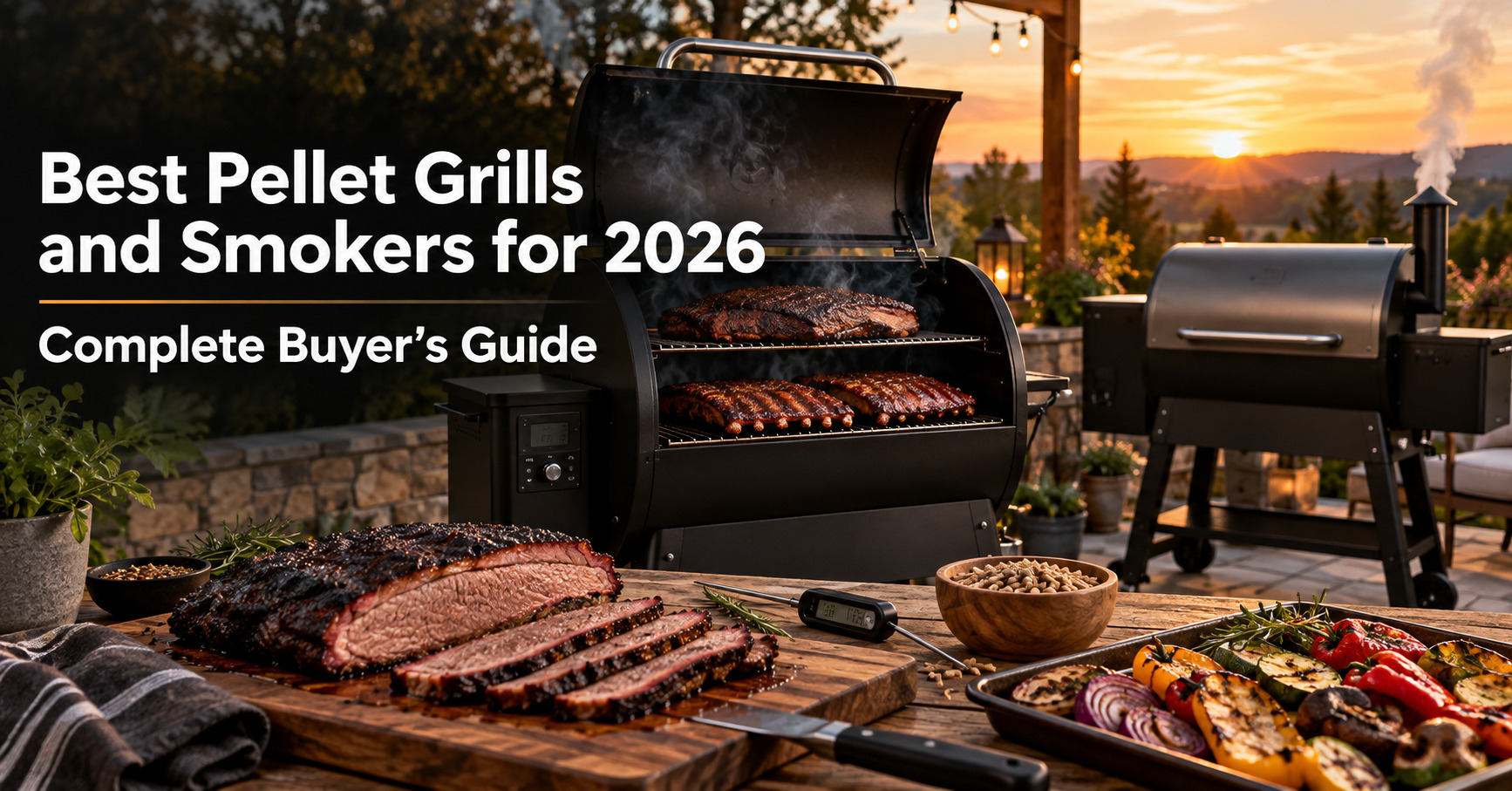
Pellet grills have changed backyard barbecue by combining the flavor of real wood cooking with the convenience of modern temperature control. Instead of constantly adjusting vents, adding charcoal, or feeding logs into a firebox, a pellet grill automatically delivers hardwood pellets to a controlled fire while regulating airflow and temperature.
That convenience is one reason pellet grills and smokers have become popular with everyone from first-time backyard cooks to experienced barbecue enthusiasts.
The market has also become much more competitive.
Buying a pellet grill in 2026 no longer means simply choosing between a few basic smokers. Today’s models can include PID temperature controllers, Wi-Fi connectivity, Bluetooth monitoring, integrated meat probes, high-temperature grilling modes, smoke-enhancement systems, ash-management systems, oversized pellet hoppers, removable racks, direct-flame cooking, and even optional pizza ovens or griddles.
The challenge is deciding which features actually matter.
A grill with the longest specification sheet is not automatically the best pellet grill for your backyard. Someone who primarily smokes brisket has very different priorities from someone who wants to cook burgers three nights a week. A family of four probably does not need the same cooking capacity as someone regularly feeding twenty guests.
This guide examines some of the best pellet grills and smokers available in 2026 and explains how to choose the right one based on cooking style, capacity, smoke production, temperature range, construction quality, ease of cleaning, technology, and long-term value.
Best Pellet Grills and Smokers for 2026: Quick Picks
For buyers who want the short version, these are the standout choices in the major categories:
Best Overall Pellet Grill: Camp Chef Woodwind Pro 36
Best Smart Pellet Grill: Traeger Woodridge Pro
Best Pellet Smoker for Ease of Use: Weber Smoque XL
Best High-Temperature Pellet Grill: recteq Backyard Beast 1200
Best Premium Heavy-Duty Pellet Grill: Yoder Smokers YS640S
Best Value Pellet Grill: Pit Boss Navigator 850 Connected
Best Pellet Grill for Accessories and Expansion: Green Mountain Grills Peak Prime 2.0
Best Rugged Pellet Grill: Grilla Grills Silverbac
Best Vertical Pellet Smoker: Pit Boss Copperhead Onyx Edition
There is no universal winner for every backyard. Each model approaches pellet cooking differently, which is why understanding your cooking priorities matters more than simply buying the most expensive grill.
Pellet Grill Comparison at a Glance
| Pellet Grill or Smoker | Best For | Cooking Capacity | Maximum Temperature | Hopper | Connectivity |
|---|---|---|---|---|---|
| Camp Chef Woodwind Pro 36 | Smoke flavor | Large | Around 500°F class | Large | Wi-Fi |
| Traeger Woodridge Pro | Smart grilling | 970 sq. in. | 500°F | 24 lb. | Wi-Fi |
| Weber Smoque XL | Easy smoking | 918 sq. in. | 500°F | Large | Wi-Fi/Bluetooth |
| recteq Backyard Beast 1200 | High heat and capacity | 1,220 sq. in. | 700°F | 30 lb. | Wi-Fi |
| Yoder YS640S | Premium construction | 1,070 sq. in. | 600°F | 20 lb. | Smart controls |
| Pit Boss Navigator 850 | Value | 932 sq. in. | 500°F | 30 lb. | Wi-Fi/Bluetooth |
| GMG Peak Prime 2.0 | Versatility | 738 sq. in. standard | 550°F | 20 lb. | Wi-Fi |
| Grilla Silverbac | Durability | Up to roughly 692 sq. in. | 500°F | 20 lb. class | Wi-Fi |
| Pit Boss Copperhead Onyx | Dedicated smoking | 1,300 sq. in. | 420°F | 65 lb. | Digital controls |
Specifications can vary slightly by configuration and market, and manufacturers occasionally revise models during a product cycle.
1. Camp Chef Woodwind Pro 36 — Best Overall Pellet Grill for 2026
The Camp Chef Woodwind Pro deserves serious consideration from anyone who loves pellet-grill convenience but believes conventional pellet smokers sometimes produce smoke that is too mild.
That has historically been one of the biggest criticisms of pellet grills.
Traditional offset smokers burn larger pieces of wood and can create considerably more smoke. Pellet grills burn small, compressed hardwood pellets very efficiently. That efficiency is convenient and clean, but efficient combustion can also produce a lighter smoke profile.
Camp Chef addresses that problem differently from many competitors.
The defining feature of the Woodwind Pro is its Smoke Box. Instead of relying exclusively on pellets, the cook can add wood chunks, wood chips, or other compatible smoking material to supplement the normal pellet fire. Camp Chef specifically promotes wood chunks and chips for use in the Woodwind Pro Smoke Box.
That seemingly simple feature significantly expands how the grill can be used.
A beginner can simply fill the hopper with pellets, select a temperature, and use the Woodwind Pro like a conventional pellet grill.
An enthusiast can experiment with different woods in the Smoke Box and manage the additional smoke manually.
For example, you might run oak pellets in the hopper while adding a few chunks of hickory for brisket. Pork could be cooked with a mild pellet blend and supplemented with apple or cherry wood.
That gives the Woodwind Pro something relatively unusual: convenience when you want convenience and greater control when you want to become more involved in the cooking process.
Why the Woodwind Pro Stands Out
Smoke production is the biggest advantage, but it is not the only one.
The Woodwind platform also provides connected temperature monitoring and the type of automated pellet management buyers expect from a modern premium pellet grill.
Camp Chef has also built an accessory ecosystem around its grills. Depending on the configuration, buyers can add cooking accessories that expand the grill beyond traditional low-and-slow barbecue.
This flexibility makes the Woodwind Pro particularly attractive to serious backyard cooks who want one primary outdoor cooker instead of separate machines for every cooking technique.
Camp Chef backs Woodwind Pro grill bodies, hopper bodies, lids, legs, bottom shelves, and grates against rust-through for six years, with different coverage periods for various mechanical and electronic components.
Best Foods for the Woodwind Pro
The Woodwind Pro is particularly well suited to:
- Brisket
- Pork shoulder
- Pork ribs
- Beef ribs
- Turkey
- Whole chickens
- Sausages
- Smoked cheese at appropriate low temperatures
- Reverse-seared steaks
- Smoked vegetables
- Large holiday meals
Who Should Buy It?
Buy the Woodwind Pro if smoke flavor is near the top of your priority list.
It is particularly appropriate for cooks moving from charcoal or offset smoking who worry that a pellet grill will not provide enough smoke character.
It is also a strong option for enthusiasts who enjoy experimenting rather than treating their grill as an entirely automatic appliance.
Potential Drawbacks
The Woodwind Pro sits toward the premium end of the mainstream pellet-grill market.
It may therefore be unnecessary for someone who plans to cook burgers, chicken breasts, vegetables, and the occasional pork shoulder.
Additional smoke also requires additional attention. The Smoke Box is useful precisely because it gives the cook greater control, but that means it can involve more interaction than simply selecting a temperature and walking away.
For enthusiasts, that is an advantage.
For someone seeking absolute simplicity, another model may be better.
2. Traeger Woodridge Pro — Best Smart Pellet Grill
Traeger played a major role in turning pellet cooking into a mainstream category, and the Woodridge generation represents a modern interpretation of the traditional Traeger formula.
The Woodridge Pro offers approximately 970 square inches of cooking space, a maximum cooking temperature of 500°F, and a 24-pound hopper. Traeger describes capacity sufficient for approximately six chickens, eight rib racks, or eight pork butts depending on arrangement.
Those numbers put the Woodridge Pro firmly into family-and-entertaining territory.
You can prepare a weeknight dinner without feeling as if you are operating an unnecessarily enormous smoker, but there is enough capacity for holiday cooking and backyard parties.
Traeger’s Biggest Advantage: The Overall Ecosystem
Many manufacturers now offer Wi-Fi.
That alone is no longer unusual.
Traeger’s advantage is the experience surrounding the grill.
The company has spent years developing connected cooking features, recipes, accessories, pellets, probes, and software intended to work together as an ecosystem.
For someone buying a first pellet grill, that can make the learning curve less intimidating.
Set your cooking temperature, let the controller manage the fire, monitor the meat temperature, and concentrate on when the food is ready rather than constantly controlling combustion.
Super Smoke and Wood-Fired Flavor
The Woodridge Pro includes Traeger’s Super Smoke functionality along with its FreeFlow firepot system. Traeger positions the combination as a way of keeping fresh smoke moving through the cooking chamber.
It still behaves differently from burning splits of wood in a traditional offset smoker, but it gives owners a convenient way of emphasizing smoke flavor during appropriate portions of a cook.
This can be especially useful early in long cooks when meat tends to absorb smoke most effectively.
500°F Maximum Temperature
The Woodridge Pro reaches a maximum listed temperature of 500°F.
That is enough for many everyday grilling tasks, including:
- Burgers
- Chicken
- Pork chops
- Sausages
- Vegetables
- Reverse-seared steaks
- Roasting
However, shoppers whose top priority is extremely aggressive steakhouse-style searing may prefer a machine capable of 600°F, 700°F, or direct-flame cooking.
The Woodridge Pro should be thought of primarily as an excellent smoker, roaster, and general outdoor cooker that can grill—not necessarily as a replacement for every dedicated high-heat grill.
Who Should Buy the Traeger Woodridge Pro?
It is ideal for someone who values:
- A polished user experience
- Smart features
- Large cooking capacity
- Strong manufacturer support
- Easy temperature control
- A mature accessory ecosystem
- Predictable results
It is also one of the easier premium pellet grills to recommend to someone who wants barbecue without turning fire management into a hobby.
3. Weber Smoque XL — Best Pellet Smoker for Ease of Use
Weber’s Smoque line takes a smoker-focused approach to pellet cooking.
The Smoque XL provides approximately 918 square inches of total cooking space, including a 595-square-inch primary cooking surface and 323-square-inch upper area. Its maximum listed cooking temperature is 500°F. Weber includes two food probes and supports connected control through Weber Connect.
The result is a machine aimed heavily at people who want straightforward smoking without giving up modern convenience.
SmokeBoost
Weber includes a SmokeBoost setting designed to maintain conditions favorable to stronger smoke absorption.
This is important because smoke generation is becoming a major competitive battleground in the pellet-grill market.
Early pellet grills often emphasized temperature stability above everything else.
Manufacturers are now recognizing that barbecue enthusiasts also want visible smoke and a stronger wood-fired profile.
SmokeBoost gives Smoque owners a dedicated mode for that purpose.
SmoqueVent Airflow
Smoke flavor depends on more than simply generating smoke.
Airflow determines how smoke travels around the food, how combustion behaves, and how efficiently heat moves through the cooking chamber.
Weber designed its SmoqueVent system to circulate smoke through the smoker while promoting both flavor development and browning.
Fast Recovery
Opening any smoker releases heat.
A good controller therefore needs to recognize the temperature drop and return the cooking chamber to the target temperature without massively overshooting it.
Weber promotes a Rapid React PID system for relatively fast startup and recovery.
That may sound like a small specification, but it becomes important during real cooking.
Consider preparing six racks of ribs. You open the lid to sauce them. Chamber temperature drops rapidly. A well-managed system brings the smoker back to the target temperature predictably instead of spending the next twenty minutes struggling to recover.
Cleanup Is a Major Strength
Pellet grills produce ash.
Fat also drips from meat.
Those two materials eventually need to be removed.
Any pellet grill that makes cleanup difficult becomes less enjoyable to own over time.
Weber designed the Smoque with enclosed grease and ash management intended to simplify routine cleanup.
That makes the Smoque particularly attractive to buyers who want to smoke regularly rather than only on special occasions.
The easier cleanup becomes, the more likely you are to actually use the smoker.
Who Should Buy the Weber Smoque XL?
Choose it if you prioritize:
- Simple operation
- Smoking rather than extreme searing
- Convenient cleanup
- Smart monitoring
- Large cooking capacity
- A familiar mainstream brand
It is an especially sensible choice for families entering serious barbecue for the first time.
4. recteq Backyard Beast 1200 — Best High-Temperature Pellet Grill
One common reason people hesitate to buy pellet grills is high-temperature performance.
Pellet grills are excellent smokers because automatic fuel delivery makes low-temperature control relatively easy.
Searing is more difficult.
A traditional charcoal grill can produce extremely intense radiant heat. Many gas grills can also heat specialized searing burners far beyond normal smoking temperatures.
recteq addresses that limitation by giving several of its current pellet grills unusually wide temperature ranges.
The Backyard Beast 1200 offers approximately 1,220 square inches of cooking space, a 30-pound hopper, Wi-Fi connectivity, and a listed temperature range from 180°F to 700°F.
That 700°F upper limit significantly changes how the grill can be used.
From Brisket to Burgers
At the low end, you can smoke:
- Brisket
- Pork shoulder
- Ribs
- Sausage
- Turkey
- Salmon
At higher temperatures, the grill becomes more practical for:
- Burgers
- Chicken thighs
- Pizza
- Roasted vegetables
- Reverse-seared steaks
- Fast weeknight cooking
No pellet grill creates exactly the same cooking environment as every other grill type, but a broader temperature range makes it easier to rely on a single cooker.
Large Capacity
With 1,220 square inches of total cooking space, the Backyard Beast is a serious entertainment machine.
recteq estimates capacity for approximately 50 burgers, eight racks of baby back ribs, 126 wings, or nine pork butts depending on setup.
Most families will rarely fill it completely.
That extra space becomes valuable during parties, holidays, neighborhood gatherings, or batch cooking.
30-Pound Hopper
Pellet hopper capacity matters most during long unattended cooks.
At low temperatures, consumption can be modest, although actual pellet use depends heavily on weather, grill design, temperature setting, pellet characteristics, and how frequently the lid is opened.
A 30-pound hopper gives substantial fuel reserve for overnight briskets and other extended cooks.
It also reduces the chance of discovering halfway through a cook that the auger has run out of pellets.
Construction
recteq emphasizes stainless-steel components in several key areas of the Backyard Beast, including the firepot, grates, and drip pan.
For buyers who plan to leave a pellet grill outdoors under a cover throughout the year, corrosion resistance and material quality can matter as much as smart features.
Who Should Buy It?
The Backyard Beast 1200 is an excellent choice if you want one pellet cooker capable of functioning as both a serious smoker and a more convincing high-temperature grill.
It is particularly attractive to users who:
- Frequently cook for groups
- Want a large hopper
- Want temperatures beyond the typical 500°F ceiling
- Value stainless-steel cooking components
- Want connected controls
For small patios or couples who rarely entertain, however, it may simply be more grill than necessary.
5. Yoder Smokers YS640S — Best Premium Heavy-Duty Pellet Grill
There is a point where pellet grills transition from consumer appliances into equipment that feels closer to a traditional heavy-duty smoker.
The Yoder YS640S sits firmly in that category.
Yoder lists approximately 1,070 square inches of cooking area, a 20-pound hopper, a temperature range extending from roughly 150°F to 600°F, and a substantial weight of around 335 pounds. The cooking chamber uses heavy steel construction.
That weight tells you something important.
This is not designed primarily around portability.
It is built around mass, durability, heat retention, and traditional smoker-style construction.
Why Heavy Steel Matters
A heavier cooking chamber can offer several advantages.
First, thermal mass helps stabilize the cooking environment.
Opening the lid still releases hot air, but the hot steel itself retains substantial energy.
Second, thick construction generally performs better during cold or windy conditions than very thin sheet metal.
Third, many serious barbecue enthusiasts simply prefer the feel and long-term durability of substantial steel equipment.
The tradeoff is obvious: you will not casually move a 335-pound smoker around the patio every weekend.
600°F Capability
The YS640S reaches higher temperatures than many traditional pellet smokers.
That improves versatility, especially when paired with accessories and cooking configurations designed for grilling.
Owners can therefore use it for traditional low-and-slow barbecue while still preparing higher-temperature foods without immediately reaching for another grill.
Expandability
Yoder offers a considerable selection of accessories for the YS640S, including additional racks, griddles, stainless-steel shelves, storage components, insulating equipment, and other cooking accessories.
This makes it attractive as a long-term platform.
Instead of replacing the smoker when your cooking interests change, you can modify or expand the existing system.
Who Should Buy It?
The YS640S is best suited to serious enthusiasts who value construction quality above low initial cost.
It makes sense if:
- You barbecue frequently
- You keep equipment for many years
- You appreciate heavy steel
- You want a premium cooking platform
- You regularly cook large cuts
- You are willing to pay more for durability
It is harder to justify for a beginner who has never smoked a brisket and is still unsure whether pellet cooking will become a regular hobby.
6. Pit Boss Navigator 850 Connected — Best Value Pellet Grill
Pellet grills can become expensive surprisingly quickly.
Once Wi-Fi, multiple probes, stainless-steel parts, large cooking areas, and premium controllers are added, prices can move well beyond what casual backyard cooks expect to spend.
The Pit Boss Navigator 850 Connected occupies an appealing middle ground.
It provides approximately 932 square inches of cooking area, a 30-pound hopper, a temperature range of roughly 180°F to 500°F, Wi-Fi and Bluetooth connectivity, and an included meat probe.
Those specifications cover what most families actually need.
Flame Broiler System
The Navigator also incorporates Pit Boss’s Flame Broiler design.
One traditional weakness of pellet grills is that food is usually separated from the firepot by heat deflectors and drip trays.
That is ideal for indirect smoking.
It is less ideal when you want direct exposure to intense heat.
A flame-access system gives cooks another option for finishing foods at higher intensity.
That makes the Navigator attractive to people transitioning from a conventional grill who do not want every meal to feel like indirect smoking.
30-Pound Hopper
The large hopper is particularly impressive in this price category.
Long brisket cooks can easily run ten hours or longer.
Even if your grill would theoretically complete the entire cook without refilling, extra hopper capacity gives peace of mind.
You can fill the hopper before bed and avoid worrying that the cooker will suddenly shut down because it ran out of fuel.
Who Should Buy It?
The Navigator 850 makes sense for buyers who want:
- Plenty of cooking space
- Wi-Fi
- Bluetooth
- A large pellet hopper
- Low-and-slow capability
- Occasional higher-heat grilling
- Good overall value
Someone entering pellet cooking for the first time could use a Navigator for years before genuinely needing anything more advanced.
7. Green Mountain Grills Peak Prime 2.0 — Best for Accessories and Expansion
The Green Mountain Grills Peak Prime 2.0 is one of the more interesting pellet cookers for buyers who enjoy modifying their outdoor cooking setup.
Its standard cooking area is approximately 738 square inches, with the manufacturer advertising expansion up to roughly 1,386 square inches using its rack system. It operates from approximately 150°F to 550°F and includes a 20-pound hopper.
Those specifications are competitive, but the accessory system is where the Peak Prime becomes particularly interesting.
RACKT System
Green Mountain Grills designed the Prime 2.0 generation around an expandable internal rack system.
Additional shelves can significantly increase usable cooking space.
This is useful because advertised square inches can sometimes be misleading.
A huge primary grate is excellent for burgers.
Multiple vertical racks can be much better for jerky, ribs, wings, fish, vegetables, sausages, and other foods that benefit from several cooking levels.
The ability to configure the chamber differently depending on the meal gives the Peak Prime more flexibility than a fixed two-rack design.
SideBURN Capability
Green Mountain Grills also offers a high-temperature side cooking attachment for compatible models.
This helps address the usual pellet-grill searing problem.
Rather than forcing the pellet firepot to do every job, the cooker can be expanded with specialized equipment.
Pizza and Rotisserie Options
The Peak Prime platform can also accommodate pizza and rotisserie-related accessories.
That makes it appealing to households trying to create a complete outdoor kitchen around one central grill.
12-Volt Direct Power System
The Prime 2.0 design uses 12-volt direct power to operate its fan and auger system.
Green Mountain Grills says its controller can vary motor and fan speed to maintain precise temperature control and improve fuel efficiency.
Instead of thinking of the auger as simply turning on and off, more sophisticated controllers can adjust fuel delivery behavior based on what is happening inside the cooker.
That is one reason modern pellet grills maintain temperature much better than many early designs.
Who Should Buy It?
The Peak Prime 2.0 is best for someone who enjoys accessories and expects their outdoor cooking interests to expand.
You may start with brisket and ribs.
Later you might want to cook pizza.
Then perhaps rotisserie chicken.
Then you decide you need extra shelves for jerky.
A modular platform gives you room to grow.
8. Grilla Grills Silverbac — Best Rugged Pellet Grill
The Silverbac has built a following among people who prioritize solid construction and straightforward pellet cooking.
Current Silverbac configurations provide Wi-Fi-enabled controls, automated temperature management, probe support, and heavy construction.
For example, the Silverbac All-Terrain configuration lists approximately 507 square inches on the primary grate and roughly 692 square inches with the upper rack. Its temperature range runs from approximately 180°F to 500°F.
This is not the largest grill on the list.
That may actually be an advantage.
Realistic Family Capacity
People often overestimate how much cooking space they need.
If you normally cook for three to six people, a massive 1,500-square-inch pellet grill can consume additional fuel, occupy more patio space, and take longer to clean without providing much daily benefit.
A medium-sized cooker can be easier to live with.
The Silverbac has enough space for normal family barbecue while remaining manageable.
All-Season Cooking
Grilla places emphasis on all-season performance.
This matters for buyers living in regions with cold winters.
Pellet consumption normally rises as outside temperatures fall because the grill must burn more fuel to maintain the same chamber temperature.
Wind can make the problem worse.
A solidly built cooker with effective temperature control can therefore provide meaningful advantages for year-round barbecue.
PID and Alternative Control Behavior
Some versions of the Silverbac controller allow different approaches to temperature management.
Strict PID control aims to maintain consistent temperature.
Other cooking modes can intentionally permit more fluctuation, which may encourage smoke production.
That touches on an important truth about pellet grills: absolute temperature stability and maximum smoke are not always the same goal.
Wood tends to produce different smoke characteristics depending on combustion conditions.
A controller that holds an almost perfectly flat temperature curve may not always produce the smoke profile preferred by every pitmaster.
Providing multiple approaches gives the cook more flexibility.
Who Should Buy It?
The Silverbac is worth considering for buyers who value:
- Rugged construction
- Medium-sized capacity
- Simple pellet cooking
- Wi-Fi capability
- Year-round use
- A more traditional smoker feel
9. Pit Boss Copperhead Onyx Edition — Best Vertical Pellet Smoker
Not everyone needs a pellet grill.
Some people really want a smoker.
That distinction is important.
If your cooking consists primarily of ribs, brisket, pork shoulder, sausages, turkey, jerky, and similar smoked foods, using patio space for a large horizontal grill may not be the most efficient solution.
A vertical pellet smoker stacks cooking racks upward.
The Pit Boss Copperhead Onyx Edition illustrates the advantage.
It offers approximately 1,300 square inches of cooking space across multiple racks, a huge 65-pound pellet hopper, and a temperature range running from roughly 130°F to 420°F.
That configuration is built for long-duration smoking.
65-Pound Hopper
A 65-pound hopper is enormous compared with normal pellet grills.
For dedicated smoking, that makes sense.
Some cooks can run far longer than expected.
A brisket might take twelve to sixteen hours.
Large pork shoulders can require similar time.
Multiple batches of jerky may occupy much of a day.
A huge hopper reduces refilling.
Vertical Space Efficiency
The Copperhead offers a lot of cooking area without requiring the same horizontal footprint as an equivalently sized conventional pellet grill.
This can be particularly useful on patios where width is limited.
Lower Temperature Capability
The ability to operate around 130°F is useful for specialized low-temperature cooking.
However, the 420°F upper range reveals its purpose.
This is not primarily a steak-searing machine.
It is a smoker.
If you already own a gas grill, charcoal kettle, flat-top griddle, or dedicated searing cooker, pairing it with a vertical pellet smoker can actually be a better strategy than expecting one pellet grill to perform every job.
Who Should Buy It?
Choose a vertical pellet smoker if:
- Smoking is your main priority
- You already have a separate grill
- You cook large batches
- You need multiple racks
- You want a huge hopper
- Patio width is limited
- High-temperature searing is not important
How Pellet Grills Work
Understanding how a pellet grill works makes comparing models much easier.
Despite major differences in price, most pellet grills share the same fundamental components.
Pellet Hopper
Hardwood pellets are stored in a hopper attached to the cooking chamber.
Hopper capacities vary dramatically.
Compact grills may hold less than 20 pounds.
Large backyard models often hold 20 to 30 pounds.
Dedicated vertical smokers can hold significantly more.
Auger
An electrically powered auger moves pellets from the hopper toward the firepot.
The controller determines how much fuel the fire needs and adjusts pellet delivery accordingly.
When additional heat is required, more fuel is delivered.
When the target temperature has been reached, pellet delivery slows.
Firepot
Pellets fall into a small combustion chamber called the firepot.
An electric igniter starts the fire during startup.
Once combustion is established, the pellets continue burning as new fuel arrives.
Combustion Fan
A fan supplies oxygen to the fire.
Airflow is critical.
More oxygen generally produces stronger and cleaner combustion.
Modern controllers may vary fan speed depending on temperature requirements.
Temperature Sensor
A sensor continuously measures the temperature inside the grill.
The controller compares actual temperature with the temperature you selected.
It then adjusts pellet feeding and airflow to correct the difference.
Heat Deflector
Most pellet grills place a metal heat deflector over the firepot.
This spreads heat across the chamber and prevents most foods from sitting directly over the flame.
Drip Tray
A drip tray collects grease while also providing another layer between food and the fire.
This helps create the indirect convection-style cooking environment associated with pellet grills.
Chimney or Exhaust System
Hot air and smoke eventually leave the cooking chamber through an exhaust.
Air must continuously move through the grill.
A smoker is not intended to trap smoke indefinitely.
Good barbecue comes from clean smoke flowing across the food.
Pellet Grill vs. Pellet Smoker: What Is the Difference?
The terms are frequently used interchangeably.
Technically, most pellet grills are also smokers.
A traditional horizontal pellet grill typically has a broad cooking grate and a temperature range extending high enough for everyday grilling.
A dedicated pellet smoker may prioritize:
- Lower temperatures
- Taller vertical capacity
- Additional racks
- Larger hopper capacity
- Longer smoking sessions
The tradeoff is reduced high-temperature grilling ability.
If you want one appliance for burgers, chicken, brisket, ribs, vegetables, and pizza, choose a pellet grill.
If you already have another grill and primarily need low-and-slow capacity, a vertical pellet smoker may be better.
How to Choose the Best Pellet Grill
The best pellet grill is determined by how you cook.
These are the most important factors.
Cooking Area
Manufacturers advertise cooking area in square inches.
More is not automatically better.
Approximately 400 to 600 square inches of primary cooking area can already handle plenty of food for a normal household.
Larger units become useful when cooking:
- Multiple pork shoulders
- Several briskets
- Large quantities of ribs
- Dozens of wings
- Holiday turkeys
- Food for parties
Look at the shape of the cooking space as well as the advertised number.
A second rack dramatically increases the advertised area but may not accommodate tall foods.
Primary-grate dimensions are especially important if you frequently cook large briskets or whole turkeys.
Temperature Range
Temperature range tells you a lot about the grill’s intended purpose.
180°F to 500°F
This range is common and handles nearly everything most pellet owners cook.
It is excellent for smoking and adequate for general grilling.
150°F or Lower
Temperatures around 150°F can be useful for jerky, extra-low smoking, and certain specialized recipes.
600°F to 700°F
Higher temperatures improve:
- Searing
- Pizza
- Burgers
- Crispy chicken skin
- Roasted vegetables
- Fast grilling
If steaks are a major priority, favor a high-temperature pellet grill or direct-flame system.
Hopper Capacity
A large hopper primarily buys convenience.
You do not necessarily need 30 pounds of pellets for every cook.
However, extra capacity means fewer interruptions.
For routine family cooking, around 20 pounds is generally comfortable.
For frequent overnight smoking, a 24- to 30-pound hopper is useful.
Dedicated smokers may benefit from even more.
PID Temperature Control
PID stands for proportional-integral-derivative.
You do not need to understand the mathematics to benefit from it.
A PID controller repeatedly measures the difference between your selected temperature and actual grill temperature.
Instead of simply switching between maximum heating and no heating, the system can make finer corrections.
The result is typically more stable cooking.
This is particularly useful during long cooks when you want to maintain something such as 225°F or 250°F for many hours.
Wi-Fi
Wi-Fi can sound unnecessary until you use it during an overnight brisket.
Instead of walking outside repeatedly, you can check:
- Grill temperature
- Meat temperature
- Cooking progress
- Alerts
Some systems also allow remote temperature adjustments.
Wi-Fi should not be the reason you buy an otherwise inferior grill, but it is genuinely useful.
Bluetooth
Bluetooth provides direct short-range connectivity.
Its range is generally much shorter than Wi-Fi.
The advantage is that it may work without relying on your home network.
Many modern grills include both.
Meat Probes
Integrated meat probes allow the grill controller to display internal food temperature.
This matters because barbecue should ultimately be cooked based on doneness rather than time alone.
Two pork shoulders placed beside each other can finish at different times.
Temperature probes make monitoring easier.
Having at least two probe ports is useful for people who regularly cook multiple meats.
Smoke Control
Smoke-enhancement systems deserve special attention.
Pellet grills naturally produce smoke, but smoke intensity varies considerably by temperature and controller behavior.
Features such as:
- Dedicated smoke modes
- Adjustable smoke settings
- Wood-chip boxes
- Wood-chunk boxes
- Alternative controller modes
can increase the cook’s ability to modify smoke production.
If strong barbecue flavor is your priority, this category should matter more than a flashy touchscreen.
Direct-Flame Capability
Traditional pellet grills cook primarily with indirect heat.
Some manufacturers include sliding plates or specialized mechanisms that expose food to more direct heat.
This can improve:
- Steak crust
- Burger browning
- Chicken skin
- Vegetable charring
Direct-flame capability increases versatility, although grease management becomes more important at high temperatures.
Construction Quality
Do not judge a pellet grill only by electronics.
Electronics can eventually be replaced.
The body of the grill determines how the machine behaves for years.
Look at:
- Steel thickness
- Stainless-steel components
- Powder coating
- Lid fit
- Weld quality
- Wheels
- Casters
- Shelving
- Handle construction
- Hopper lid
- Weather resistance
A grill living outdoors experiences rain, humidity, grease, smoke, thermal cycling, and sometimes freezing weather.
Construction matters.
Cleaning System
Pellet grills require cleaning.
There is no technology that completely eliminates this.
Ash accumulates inside the cooking chamber.
Grease accumulates on trays and surfaces.
Ignoring either eventually causes performance and safety problems.
Look for grills with:
- Removable ash cups
- Accessible firepots
- Grease collection
- Easy-to-remove drip trays
- Removable cooking racks
- Large access openings
Convenient cleaning systems become increasingly valuable the longer you own the grill.
Pellet Consumption: How Much Fuel Does a Pellet Grill Use?
Pellet consumption depends on multiple factors:
- Cooking temperature
- Outside temperature
- Wind
- Grill insulation
- Cooking chamber size
- Controller behavior
- Pellet density
- How frequently the lid is opened
Low-temperature smoking often consumes roughly around a pound of pellets per hour, although actual use can be lower or considerably higher depending on conditions.
High-temperature grilling may use substantially more.
Suppose your grill averages one pound per hour during a twelve-hour brisket cook.
That means approximately twelve pounds of pellets.
A twenty-pound bag would therefore comfortably cover the cook.
If extremely cold or windy conditions significantly increase consumption, having additional pellets available becomes important.
Never begin a long cook with exactly the theoretical quantity required.
Maintain a reserve.
Which Wood Pellets Produce the Best Flavor?
Pellet species affects flavor, although perhaps less dramatically than many beginners expect.
Some popular choices include:
Hickory
Hickory produces a classic barbecue profile.
It pairs particularly well with:
- Pork
- Beef
- Ribs
- Sausage
The flavor can become aggressive if heavily applied.
Oak
Oak is one of the most versatile woods.
It burns reliably and produces a balanced smoke flavor.
It works well with:
- Brisket
- Beef ribs
- Pork
- Poultry
- Vegetables
If you only want to buy one type of pellet, oak is an excellent starting point.
Apple
Apple provides a milder, slightly sweet smoke profile.
It works especially well with:
- Pork
- Chicken
- Turkey
Cherry
Cherry provides mild smoke and is popular partly because it can contribute attractive color to smoked meats.
It pairs well with:
- Pork
- Poultry
- Beef
Mesquite
Mesquite produces a much stronger flavor.
It is commonly associated with beef and Southwestern-style barbecue.
Beginners should use it carefully because the flavor can become dominant.
Blends
Many pellet manufacturers sell blends containing multiple hardwoods.
Blends are convenient and often provide balanced performance across different foods.
Do not become obsessed with finding one theoretically perfect pellet.
Fresh, dry, high-quality pellets and good cooking technique generally matter more.
How to Store Wood Pellets
Pellets hate moisture.
They are made from compressed wood.
When they absorb substantial humidity or water, they can swell and eventually disintegrate.
Damaged pellets can create serious auger problems.
Keep pellets:
- Indoors or in a dry storage area
- Inside an airtight container
- Away from rain
- Away from damp concrete
- Away from excessive humidity
Do not assume pellets are protected simply because they remain inside the hopper.
A grill stored outdoors can still be exposed to humid air.
If you will not use the grill for an extended period, consider emptying the hopper according to the manufacturer’s storage recommendations.
Do Pellet Grills Produce Enough Smoke Flavor?
For many people, yes.
For everyone, no.
Smoke flavor is subjective.
Someone accustomed to heavily smoked offset-barbecue brisket may find a standard pellet grill mild.
Someone accustomed to propane grilling may think the same pellet grill produces an enormous improvement in smoke flavor.
Several techniques can increase smoke intensity.
Cook Lower During the Beginning
Pellet grills tend to produce more visible smoke while operating at lower temperatures.
Starting meat at a lower temperature can therefore increase smoke exposure.
Use Smoke Modes
If your grill includes a dedicated smoke mode, use it during the early portion of the cook.
Avoid Constantly Opening the Lid
Every time the lid opens, chamber temperature and airflow change.
Let the controller work.
Use Supplemental Wood Where Designed
Systems such as the Camp Chef Woodwind Pro Smoke Box allow additional wood to be introduced safely within the grill’s intended design.
Never improvise modifications that interfere with airflow or combustion.
Are Pellet Grills Good for Searing?
They can be, but this is where model selection matters.
A standard 500°F pellet grill can cook an excellent steak.
One effective method is reverse searing.
Smoke the steak at a relatively low temperature until the interior approaches the desired doneness.
Remove it temporarily.
Increase the grill temperature as high as practical.
Return the steak and quickly brown the exterior.
However, a 500°F indirect pellet grill generally cannot reproduce the exact radiant intensity of an extremely hot charcoal fire or specialized infrared burner.
If searing matters greatly, choose:
- A 600°F-plus pellet grill
- A 700°F pellet grill
- A direct-flame system
- An optional side searing burner
Alternatively, pair the pellet smoker with a separate charcoal or gas grill.
There is nothing wrong with using specialized tools.
Are Pellet Grills Good for Beginners?
Pellet grills may be the easiest way for a beginner to produce genuinely impressive barbecue.
Consider traditional brisket cooking.
With an offset smoker, the cook must learn:
- Fire building
- Fuel selection
- Airflow
- Vent management
- Coal-bed maintenance
- Wood addition
- Temperature recovery
A pellet grill automates much of that process.
You still need to understand the food.
You need to know when to wrap, when to increase temperature, when the bark is ready, and when the meat is tender.
But fire management becomes dramatically easier.
That makes pellet grills excellent learning tools.
Instead of spending your first ten briskets learning how to maintain a fire, you can focus on seasoning, smoke exposure, bark development, rendering, internal temperature, tenderness, and resting.
Pellet Grill vs. Gas Grill
Choose a pellet grill if your priorities are:
- Smoke flavor
- Low-and-slow barbecue
- Brisket
- Ribs
- Pork shoulder
- Roasting
- Automated temperature control
Choose gas if your priorities are:
- Very fast startup
- Weeknight grilling
- High heat
- Minimal fuel handling
- Frequent burgers and steaks
For many households, owning both is ideal.
Pellet Grill vs. Charcoal Grill
Charcoal produces stronger traditional grilled flavor and can achieve extremely high temperatures.
Pellet grills offer much easier temperature control.
Choose charcoal if you enjoy managing fire.
Choose pellets if you prefer concentrating on the food.
Charcoal grills also work without electricity, while pellet grills require electrical power to operate the controller, auger, fan, and ignition system.
Pellet Grill vs. Offset Smoker
For maximum traditional barbecue involvement, offsets remain special.
Burning hardwood splits in a properly managed offset smoker can produce exceptional smoke flavor and bark.
However, offsets require substantially more attention.
During a long cook, you may need to add wood and manage airflow repeatedly.
A pellet grill can maintain temperature while you sleep.
The tradeoff is typically a milder smoke profile and less direct involvement with the fire.
The best choice depends on whether you consider fire management part of the enjoyment or an inconvenience.
Pellet Grill Maintenance
A good pellet grill can provide many years of service when maintained correctly.
Clean the Firepot
Ash eventually accumulates around the firepot.
Too much ash can interfere with ignition and combustion.
Inspect and clean it regularly according to manufacturer instructions.
Clean the Temperature Sensor
Grease and smoke residue can build up on temperature sensors.
A heavily contaminated sensor may eventually provide less accurate readings.
Clean it carefully according to the manual.
Manage Grease
Do not allow excessive grease to accumulate.
This is especially important if you occasionally operate the grill at high temperatures.
Large grease deposits can ignite.
Inspect the Auger
The auger should normally remain dry and unobstructed.
Moist pellets can expand into a dense mass that jams the system.
Proper pellet storage is the best prevention.
Cover the Grill
A quality cover reduces exposure to:
- Rain
- Dust
- Leaves
- Bird droppings
- Sun
- Snow
A cover does not make the grill waterproof, but it greatly reduces environmental exposure.
Do Not Ignore Rust
Small damaged areas in painted steel should be addressed before corrosion spreads.
Long-term durability depends partly on routine care.
What Size Pellet Grill Should You Buy?
A useful rule is to buy for your normal cooking habits rather than your largest imaginable party.
Couples and Small Families
A smaller or medium grill is usually enough.
Roughly 400 to 700 square inches can handle substantial amounts of food.
Families of Four to Six
Around 600 to 900 square inches offers excellent versatility.
Frequent Entertainers
Look toward 900 to 1,200 square inches.
Large Gatherings and Batch Cooking
More than 1,200 square inches can be worthwhile.
Remember that rack configuration matters.
A vertically organized 1,300-square-inch smoker behaves differently from a grill with one enormous primary grate.
How Much Should You Spend on a Pellet Grill?
Pellet grills can roughly be divided into several categories.
Entry-Level
Entry-level models provide basic automatic pellet feeding and digital temperature control.
They are suitable for beginners but may use thinner materials, simpler controllers, smaller hoppers, and limited connectivity.
Mid-Range
This is the sweet spot for many households.
Expect features such as:
- PID temperature control
- Wi-Fi
- Bluetooth
- Larger cooking areas
- Improved carts
- Better grease management
- Larger hoppers
- Better warranties
Premium
Premium grills increasingly emphasize:
- Heavy construction
- Stainless steel
- Advanced smoke management
- Larger chambers
- High temperature capability
- Better apps
- Modular accessories
Luxury and Competition-Oriented Equipment
At the highest level, you are often paying for construction quality rather than simply additional electronics.
Heavy-gauge steel, welded carts, premium components, specialized controllers, and domestic manufacturing can significantly increase cost.
Whether that investment is worthwhile depends on how frequently you cook.
Is an Expensive Pellet Grill Worth It?
Sometimes.
The law of diminishing returns definitely applies.
A grill costing three times as much will not make your brisket three times better.
Cooking technique still matters enormously.
However, premium equipment can offer:
- Better temperature stability
- More durable finishes
- Heavier construction
- Better cold-weather performance
- Improved smoke control
- Better wheels and shelves
- More consistent electronics
- Better warranties
- Easier replacement parts
Someone cooking twice per month may never recover much value from these improvements.
Someone cooking three times per week for ten years may appreciate them every time the grill is used.
Common Pellet Grill Buying Mistakes
Buying Too Large
A giant grill sounds impressive until you realize that ninety percent of your meals occupy one corner.
Buy enough capacity, not maximum capacity.
Ignoring Cleaning
Ash and grease management affect ownership satisfaction more than many flashy features.
Choosing Based Only on Maximum Temperature
Maximum temperature tells you something about grilling capability, but it says nothing about smoke quality, temperature consistency, construction, or usable cooking area.
Obsessing Over Wi-Fi
Connectivity is useful.
It cannot compensate for poor hardware.
Prioritize cooking performance first.
Ignoring Replacement Parts
Pellet grills contain:
- Fans
- Motors
- Controllers
- Igniters
- Sensors
- Probes
Eventually something may require replacement.
Brand support and parts availability are therefore important considerations.
Buying Cheap Pellets
Fuel quality affects combustion.
Low-quality pellets can create excess ash or inconsistent feeding.
Saving a tiny amount on fuel is rarely worthwhile if it compromises an expensive cook.
Frequently Asked Questions
What is the best pellet grill for 2026?
For buyers primarily interested in smoke flavor and versatility, the Camp Chef Woodwind Pro is one of the strongest overall choices because its Smoke Box allows cooks to supplement pellet smoke with additional wood.
However, the best grill depends on priorities.
The Traeger Woodridge Pro is especially attractive for smart features, while the recteq Backyard Beast is compelling for buyers wanting a wider high-temperature range.
What is the best pellet grill for beginners?
The Weber Smoque and Traeger Woodridge families are both beginner-friendly because they emphasize automated operation and connected monitoring.
The Pit Boss Navigator is also attractive for beginners seeking strong value.
What pellet grill produces the most smoke?
Smoke production depends on temperature, fuel, controller behavior, and cooking technique.
A system allowing supplemental wood, such as the Camp Chef Woodwind Pro, gives cooks unusually direct control over smoke intensity.
What is the best pellet grill for searing steaks?
Look for higher maximum temperatures or direct-flame capability.
The recteq Backyard Beast’s listed range extends to 700°F, making it particularly attractive among conventional pellet grills for buyers who value higher-temperature cooking.
Can you cook burgers on a pellet grill?
Absolutely.
Set the grill to a relatively high temperature and cook burgers much like you would on another outdoor grill.
Models with higher maximum temperatures or direct-flame capability generally produce stronger browning.
Can you cook pizza on a pellet grill?
Yes.
Pellet grills work particularly well for pizza when they can maintain high temperatures.
Some manufacturers also sell pizza-specific accessories.
Do pellet grills need electricity?
Yes.
Electricity powers the:
- Controller
- Auger
- Combustion fan
- Igniter
- Display
- Connectivity systems
The fire itself is fueled by wood pellets, but the grill cannot normally operate properly without electrical power.
Can a pellet grill be used in the rain?
Pellet grills are electrical appliances, so follow the manufacturer’s safety instructions regarding weather exposure.
Protect electrical components and pellets from water.
How long does a bag of pellets last?
Consumption varies considerably.
Low-temperature cooking commonly uses around a pound per hour as a rough planning estimate, while high-temperature cooking can use substantially more.
Outside temperature and wind also affect consumption.
Should pellets be left in the hopper?
Short-term storage may be acceptable in dry conditions, but pellets can absorb moisture.
For long-term storage or humid environments, emptying the hopper can reduce the risk of pellet degradation and auger jams.
Is Wi-Fi worth having on a pellet smoker?
For long cooks, yes.
Being able to monitor grill and food temperatures remotely is particularly valuable during overnight briskets and pork shoulders.
It is less important if you primarily cook quick meals while standing beside the grill.
How long do pellet grills last?
A well-built grill can last many years.
Actual lifespan depends on:
- Construction quality
- Climate
- Storage
- Maintenance
- Usage
- Electronics
- Replacement-part availability
Premium construction can improve longevity, but even expensive equipment requires maintenance.
Are pellet grills healthier than charcoal grills?
Cooking method, food choice, temperature, fat content, and degree of charring all matter.
A pellet grill should not automatically be considered healthy or unhealthy simply because pellets are used.
Avoid excessively burning food and cook meats safely.
Can pellet grills replace a regular oven?
For many recipes, yes.
Because pellet grills use controlled indirect convection heat, they can roast and bake much like outdoor convection ovens.
You can prepare:
- Bread
- Casseroles
- Desserts
- Vegetables
- Chicken
- Turkey
- Pizza
The advantage is the additional wood-fired flavor and the ability to keep heat outside the kitchen.
Final Verdict: Which Pellet Grill Should You Buy in 2026?
The pellet-grill market in 2026 offers better choices than ever, but that also means shoppers need to look beyond marketing claims.
For the strongest combination of smoke flexibility, modern temperature control, versatility, and enthusiast-focused features, the Camp Chef Woodwind Pro 36 earns our overall recommendation.
Its ability to supplement pellet combustion with real wood in the Smoke Box directly addresses one of the most common criticisms of pellet cooking: relatively mild smoke.
For buyers prioritizing technology and a polished connected experience, the Traeger Woodridge Pro is one of the strongest alternatives. Its 970-square-inch capacity, 24-pound hopper, 500°F maximum temperature, connected controls, and Super Smoke functionality make it an excellent family-sized smart cooker.
For someone who wants straightforward smoking, large capacity, and relatively convenient cleanup, the Weber Smoque XL deserves serious attention. Its 918-square-inch cooking area, SmokeBoost mode, connected controller, included probes, and integrated grease-and-ash management create a particularly approachable package.
If high-temperature grilling matters almost as much as smoking, the recteq Backyard Beast 1200 stands out because of its 180°F-to-700°F operating range, substantial 1,220-square-inch capacity, and 30-pound hopper.
Serious enthusiasts who care more about heavy construction and long-term ownership than purchase price should consider the Yoder YS640S. At approximately 335 pounds with heavy steel construction, 1,070 square inches of cooking capacity, and temperatures reaching 600°F, it represents a different philosophy from lightweight consumer pellet grills.
Value-oriented buyers should look carefully at the Pit Boss Navigator 850 Connected. Its 932-square-inch cooking area, 30-pound hopper, Wi-Fi and Bluetooth support, 180°F-to-500°F temperature range, and direct-flame-oriented Flame Broiler system deliver a strong collection of practical features without moving into the highest price tier.
The Green Mountain Grills Peak Prime 2.0 is particularly appealing for cooks who want an expandable outdoor cooking system. Its modular rack system, optional cooking accessories, connected controls, 150°F-to-550°F temperature range, and expandable cooking capacity make it highly versatile.
And if grilling is secondary because you already own a gas or charcoal grill, consider skipping the horizontal pellet grill entirely. The Pit Boss Copperhead Onyx Edition vertical pellet smoker provides approximately 1,300 square inches of smoking capacity and an enormous 65-pound hopper in a space-efficient vertical design.
Ultimately, buying the best pellet grill is not about finding the model with the most technology.
It is about matching the cooker to the food you actually prepare.
Buy for smoke flavor if brisket and ribs dominate your weekends.
Buy for high-temperature performance if steaks and burgers are equally important.
Buy additional cooking space if you regularly entertain.
Buy stronger construction if you expect to barbecue year-round for many years.
And prioritize cleaning, fuel storage, replacement parts, and temperature control over features you may never use.
A good pellet grill removes much of the work involved in managing a wood fire without removing the pleasure of outdoor cooking. Load the hopper, select the temperature, season the food, monitor the cook, and allow controlled hardwood combustion to handle the rest.
That combination of convenience and wood-fired flavor is precisely why pellet grills have become one of the most practical ways to smoke, roast, bake, barbecue, and grill outdoors in 2026.