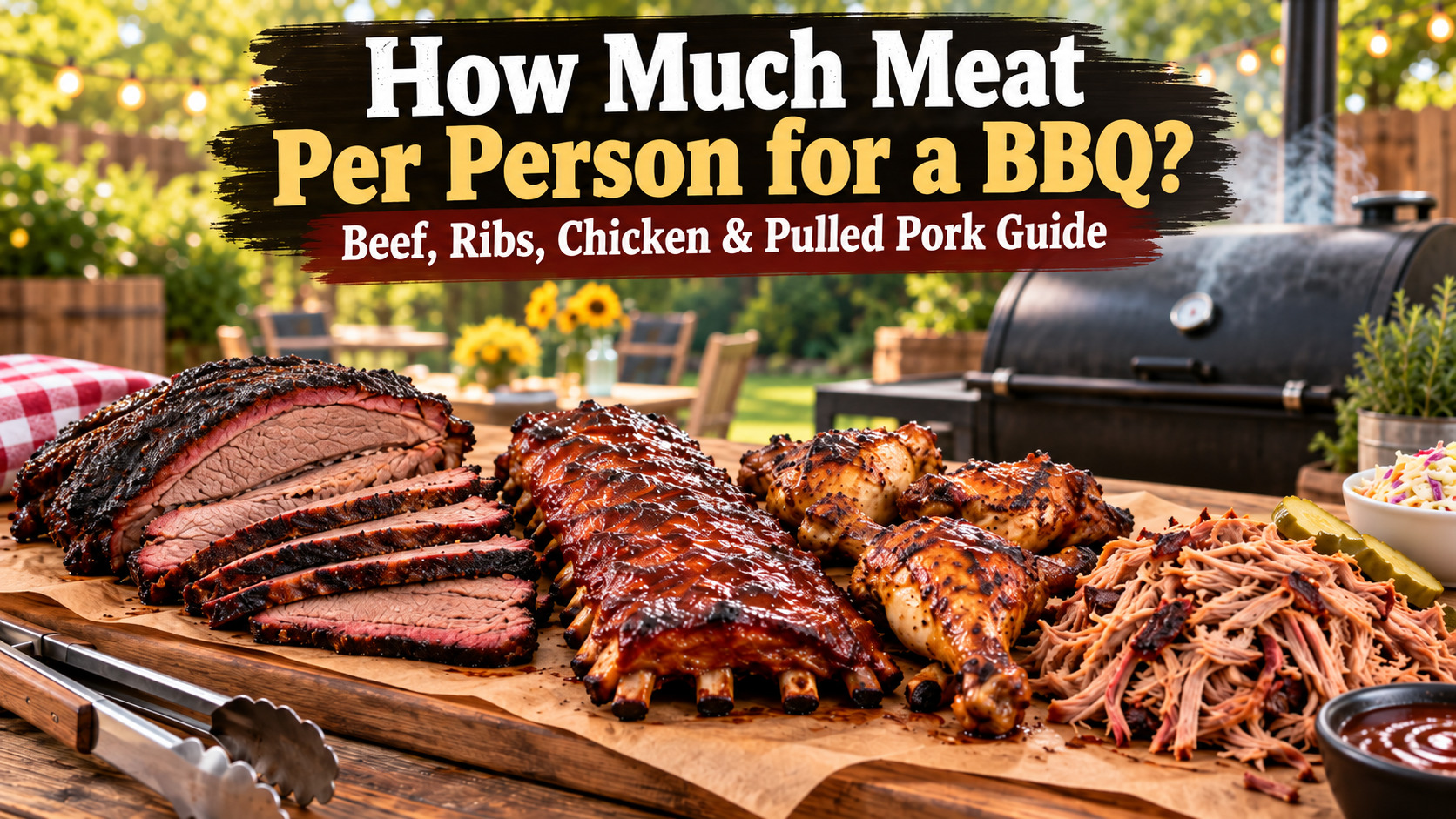
Planning a barbecue for family, friends, neighbors or a large party sounds simple until you have to answer one surprisingly difficult question: how much meat per person should you buy for a BBQ?
Buy too little and you risk running out while people are still hungry. Buy far too much and you may spend considerably more money than necessary, overload your smoker or grill, and end the day with several pounds of leftovers.
The correct amount depends on much more than the number of guests.
A BBQ serving calculation should consider the type of meat, whether the weight is measured raw or cooked, how much bone and fat the meat contains, how many side dishes you are serving, whether there are children attending, how long the event lasts and whether you are serving one meat or several.
As a practical starting point, plan approximately 1/2 pound of cooked boneless meat per adult for a normal BBQ meal. For children, approximately 1/4 pound of cooked meat per child is usually enough.
However, you normally purchase meat raw, not cooked.
Because meat loses weight during trimming and cooking, you may need approximately 3/4 to 1 pound of raw boneless meat per adult, depending on the cut.
Bone-in meats such as ribs require completely different calculations because a significant percentage of the purchased weight consists of bones.
For a BBQ with several meat choices, the amount required from each individual meat decreases because guests divide their portions among different options.
This complete guide explains exactly how to calculate BBQ meat quantities for beef, brisket, ribs, chicken, pulled pork and mixed menus so you can confidently plan everything from a small backyard cookout to a large gathering.
Quick Answer: How Much Meat Per Person for a BBQ?
If you need a fast estimate, use these general amounts.
| BBQ Meat | Recommended Raw Amount Per Adult | Typical Cooked Serving |
|---|---|---|
| Brisket | 3/4 to 1 lb | 1/3 to 1/2 lb |
| Pulled pork | 2/3 to 3/4 lb | 1/3 to 1/2 lb |
| Boneless beef | 2/3 to 3/4 lb | 1/2 lb |
| Steak | 8 to 12 oz | 6 to 9 oz |
| Pork ribs | 1/2 rack | 4 to 6 ribs |
| Beef ribs | 1 to 2 large ribs | Varies |
| Bone-in chicken | 1/2 to 3/4 lb | 1 to 2 pieces |
| Boneless chicken | 1/2 to 2/3 lb | 6 to 8 oz |
| Burgers | 1/3 to 1/2 lb | 1 to 2 patties |
| Sausages | 1/3 to 1/2 lb | 1 to 2 sausages |
For children between roughly five and twelve years old, use approximately half the adult serving.
Teenagers, especially at a long outdoor gathering, often eat approximately the same amount as adults and sometimes more.
For a party with three or more meats, you generally do not need a full serving of every meat for every person. Instead, plan a total meat allowance and divide it between the meats.
For example, rather than buying 1/2 pound of brisket, 1/2 pound of chicken and 1/2 pound of pulled pork for every guest, you might plan approximately 1/2 to 2/3 pound of total cooked meat per adult distributed among the three options.
That distinction can dramatically reduce unnecessary food.
The Most Important Rule: Calculate Cooked Meat First, Then Convert to Raw Weight
One of the most common BBQ planning mistakes is assuming that one pound of raw meat produces one pound of food.
It does not.
Meat loses weight during trimming and cooking.
Fat renders out. Moisture evaporates. Bones remain uneaten. Thick fat caps may be removed. Briskets may require substantial trimming before they even reach the smoker.
As a result, the usable amount of meat can be considerably lower than the purchased weight.
A simple planning formula is:
Raw meat required = desired cooked meat ÷ expected yield
Suppose you want 10 pounds of cooked pulled pork and expect approximately a 60% finished yield.
The calculation is:
10 ÷ 0.60 = 16.7 pounds raw pork shoulder
Therefore, you would purchase approximately 17 pounds of raw pork shoulder.
For brisket with a 50% finished yield:
10 ÷ 0.50 = 20 pounds raw brisket
The same 10 pounds of finished meat may therefore require substantially more raw brisket than raw pork shoulder.
Understanding yield is the foundation of accurate BBQ planning.
How Much Cooked Meat Does One Adult Usually Eat?
For a typical barbecue with sides, bread and drinks, a good cooked-meat target is:
6 to 8 ounces per adult
Eight ounces equals half a pound.
That means:
10 adults × 1/2 lb = 5 lb cooked meat
20 adults × 1/2 lb = 10 lb cooked meat
50 adults × 1/2 lb = 25 lb cooked meat
100 adults × 1/2 lb = 50 lb cooked meat
This is an excellent starting point for ordinary parties.
However, the number may need to increase or decrease depending on the menu.
Plan Closer to 6 Ounces Per Adult When:
You are serving several filling side dishes.
There are appetizers before the main meal.
There is bread, cornbread or rolls.
The BBQ is part of a larger buffet.
There are several meat choices.
Dessert is substantial.
The event occurs during lunch rather than dinner.
Guests include many children or light eaters.
Plan Closer to 8 Ounces Per Adult When:
Meat is the main focus of the meal.
You are serving only one or two meats.
There are relatively few side dishes.
The event lasts several hours.
You expect larger appetites.
Guests are likely to return for second servings.
Plan 10 to 12 Ounces of Cooked Meat Per Adult When:
The BBQ is intended to be extremely meat-heavy.
The crowd consists largely of hungry adults.
The event includes extended drinking or socializing.
You intentionally want leftovers.
The BBQ replaces multiple meals during a long gathering.
The safest general recommendation for most backyard BBQ events remains approximately 8 ounces of cooked meat per adult.
How Much Meat Per Child for a BBQ?
Children normally need much smaller servings.
A practical guideline is:
2 to 4 ounces cooked meat for younger children
4 to 6 ounces for older children
Teenagers should generally be counted as adults.
For simple planning, count two young children as approximately one adult.
For example:
20 adults + 10 children
Convert the 10 children to approximately 5 adult portions.
Total equivalent servings = 25 adults
25 × 1/2 lb cooked meat = 12.5 pounds cooked meat
This method works well for large gatherings when exact age-by-age calculations would be unnecessarily complicated.
Raw-to-Cooked Meat Yield Guide
Different cuts produce different finished yields.
Here are useful approximate ranges.
| Meat | Approximate Finished Yield |
|---|---|
| Brisket | 40% to 55% |
| Pork shoulder | 50% to 65% |
| Boneless chicken breast | 70% to 80% |
| Chicken thighs | 65% to 75% |
| Whole chicken | 45% to 55% edible meat |
| Steak | 70% to 80% |
| Ground beef burgers | 70% to 80% |
| Pork ribs | 40% to 55% edible portion |
| Beef ribs | 35% to 50% edible portion |
| Sausages | 75% to 90% |
These numbers vary according to trimming, fat content, bone weight, cooking temperature and how long the meat is cooked.
For planning a large event, it is usually better to use a slightly conservative yield rather than assuming the maximum possible yield.
If you estimate a brisket at 50% yield and it actually finishes at 55%, you simply have a little extra food.
If you estimate 60% but receive only 45%, you may suddenly have much less meat than expected.
How Much Beef Per Person for a BBQ?
Beef can mean several different things at a BBQ.
You may be serving brisket, steak, beef ribs, chuck roast, tri-tip or sliced roast beef.
Each requires a slightly different calculation.
For general boneless cooked beef, plan approximately:
6 to 8 ounces cooked beef per adult
That equals approximately:
1/3 to 1/2 pound cooked beef per person
If the beef loses approximately 25% to 35% of its weight during cooking, you may need around:
1/2 to 3/4 pound raw beef per person
Fatty, heavily trimmed or long-smoked cuts require more raw weight.
How Much Brisket Per Person?
Brisket is one of the most popular BBQ meats and one of the easiest meats to underestimate because its cooking loss can be substantial.
A whole packer brisket includes both the flat and point muscles, often surrounded by a significant amount of fat.
Before smoking, the brisket may lose weight during trimming.
During the cook, additional fat renders and moisture evaporates.
A brisket purchased at 15 pounds may produce only around 7 to 9 pounds of finished meat depending on trimming and cooking.
For a typical meal, plan approximately:
1/3 to 1/2 pound cooked brisket per adult
For generous servings:
1/2 pound cooked brisket per adult
Assuming approximately 50% finished yield, that means purchasing roughly:
3/4 to 1 pound raw brisket per adult
Brisket Quantity Chart
| Guests | Cooked Brisket Needed | Approximate Raw Brisket |
|---|---|---|
| 5 | 2.5 lb | 4 to 5 lb |
| 10 | 5 lb | 8 to 10 lb |
| 20 | 10 lb | 16 to 20 lb |
| 30 | 15 lb | 24 to 30 lb |
| 40 | 20 lb | 32 to 40 lb |
| 50 | 25 lb | 40 to 50 lb |
| 75 | 37.5 lb | 60 to 75 lb |
| 100 | 50 lb | 80 to 100 lb |
For larger events, brisket is usually purchased as several whole packers rather than trying to find one specific combined weight.
For example, if you need 40 pounds of raw brisket, you might smoke three briskets weighing approximately 13 to 14 pounds each.
Brisket Portions When Serving Multiple Meats
If brisket is one of several meats, you can reduce the individual brisket portion.
For a three-meat BBQ, approximately:
2 to 4 ounces cooked brisket per adult
may be sufficient.
Suppose you are feeding 50 guests and serving:
Brisket
Pulled pork
Chicken
Instead of preparing 25 pounds of cooked brisket, you might target approximately:
50 × 3 oz = 150 oz
150 ÷ 16 = 9.4 pounds cooked brisket
With approximately 50% yield, you would purchase around 19 pounds of raw brisket.
The remaining meat requirement would come from pork and chicken.
This is much more efficient than preparing a full portion of every meat for every guest.
How Much Steak Per Person for a BBQ?
Steak portions depend heavily on the size and cut.
For boneless steaks, a practical raw portion is:
8 to 12 ounces per adult
For larger appetites, a 12-ounce steak is usually generous.
For smaller eaters or a menu with numerous sides, an 8-ounce steak may be enough.
For bone-in steaks such as T-bones, porterhouses or bone-in ribeyes, increase the purchased weight because the bone contributes to the scale weight but not the edible portion.
A common raw serving range for bone-in steak is:
12 to 16 ounces per adult
Very large steaks can also be sliced and shared.
For example, rather than serving individual 20-ounce ribeyes to ten people, several large steaks can be grilled, rested, sliced and served family-style.
This is often more economical and allows guests to choose exactly how much they want.
How Much Tri-Tip Per Person?
Tri-tip generally has a better finished yield than brisket because there is less trimming and less cooking loss.
Plan approximately:
1/3 to 1/2 pound cooked tri-tip per adult
Because tri-tip may retain approximately 70% or more of its raw weight, approximately:
1/2 to 2/3 pound raw tri-tip per adult
is generally enough.
For sandwiches, portions can be smaller.
Approximately 4 to 5 ounces of cooked sliced tri-tip per sandwich usually produces a substantial serving.
How Much Pulled Pork Per Person?
Pulled pork is one of the easiest BBQ meats to serve to a crowd.
It is relatively forgiving, easy to portion, easy to hold warm and works in sandwiches, tacos, plates and sliders.
For a standard BBQ meal, plan:
1/3 to 1/2 pound cooked pulled pork per adult
For sandwiches with sides:
1/3 pound cooked pulled pork per person is often enough.
For meat-heavy plates:
1/2 pound per person provides a generous portion.
Pork shoulder commonly finishes at approximately 50% to 65% of its original raw weight.
A useful planning number is around 60%.
Therefore, for a half-pound cooked portion:
0.5 ÷ 0.60 = 0.83 pound raw pork shoulder
That means approximately:
3/4 to 1 pound raw pork shoulder per adult
provides a comfortable margin.
Pulled Pork Quantity Chart
Using approximately 1/2 pound cooked pork per adult:
| Guests | Cooked Pulled Pork | Approximate Raw Pork Shoulder |
|---|---|---|
| 5 | 2.5 lb | 4 to 5 lb |
| 10 | 5 lb | 8 to 9 lb |
| 20 | 10 lb | 16 to 18 lb |
| 30 | 15 lb | 24 to 27 lb |
| 40 | 20 lb | 32 to 36 lb |
| 50 | 25 lb | 40 to 45 lb |
| 75 | 37.5 lb | 60 to 68 lb |
| 100 | 50 lb | 80 to 90 lb |
If pulled pork is primarily being served on buns with multiple sides, you can often reduce the quantity by approximately 20% to 30%.
For example, 100 guests eating pulled pork sandwiches with coleslaw, baked beans and potato salad may be satisfied with approximately 35 to 40 pounds of cooked pork rather than 50 pounds.
How Much Pork Shoulder Does One Butt Produce?
Pork shoulder size varies.
A typical pork butt may weigh around 7 to 10 pounds raw.
After trimming and smoking, an 8-pound pork butt might produce approximately 4.5 to 5.5 pounds of pulled pork.
If each guest receives approximately 1/3 pound cooked meat, one 8-pound pork butt could provide around:
5 pounds ÷ 0.33 = approximately 15 servings
At 1/2 pound per serving:
5 ÷ 0.5 = 10 servings
Therefore, one average pork butt generally feeds approximately 10 to 15 adults, depending on portion size and the rest of the menu.
How Much Pulled Pork Per Sandwich?
A standard pulled pork sandwich usually contains approximately:
4 to 5 ounces cooked pork
A large sandwich may contain:
6 ounces or more
For sliders:
2 to 3 ounces per slider
If pulled pork sandwiches are the main meal, most adults will eat one large sandwich or two smaller sliders.
When calculating sandwich servings, do not forget that buns and toppings make the meal more filling.
A sandwich loaded with pulled pork, barbecue sauce, pickles and coleslaw feels more substantial than the same amount of pork eaten alone.
How Many Ribs Per Person for a BBQ?
Ribs are more difficult to calculate by weight because much of the rack consists of bone.
It is easier to plan ribs by number of ribs or fraction of a rack.
For pork ribs, plan approximately:
1/2 rack per adult when ribs are the primary meat.
If serving several meats, approximately:
1/4 to 1/3 rack per adult
is usually enough.
The exact number of bones depends on the rack.
How Many Baby Back Ribs Per Person?
A rack of baby back ribs usually contains approximately 10 to 13 bones.
For a rib-focused meal:
5 to 6 baby back ribs per adult
is a useful target.
For a mixed BBQ:
3 to 4 ribs per adult
may be enough.
For children:
2 to 3 ribs
is generally appropriate.
If your racks contain about 12 ribs, half a rack provides approximately six ribs.
Baby Back Rib Quantity Chart
| Guests | Ribs Per Person | Total Ribs | Approximate Racks |
|---|---|---|---|
| 5 | 6 | 30 | 3 |
| 10 | 6 | 60 | 5 |
| 20 | 6 | 120 | 10 |
| 30 | 6 | 180 | 15 |
| 50 | 6 | 300 | 25 |
| 100 | 6 | 600 | 50 |
Because rack sizes vary, purchasing one additional rack for a larger gathering provides useful insurance.
How Many Spare Ribs Per Person?
Spare ribs are larger, flatter and generally meatier than baby backs.
For a meal where ribs are the main protein, plan approximately:
4 to 5 spare ribs per adult
If serving additional meats:
2 to 3 spare ribs per person
may be sufficient.
St. Louis-style ribs are trimmed spare ribs, so the serving calculations are similar.
A full rack can often feed approximately two adults when ribs are the centerpiece of the meal.
How Many Beef Ribs Per Person?
Beef ribs vary dramatically in size.
Back ribs are very different from large plate short ribs.
Large smoked beef plate ribs may contain so much meat that one rib can be a substantial serving.
For large beef ribs:
1 large rib per adult may be enough when served with filling sides.
For smaller beef back ribs:
2 to 3 ribs per adult
may be appropriate.
When buying large beef ribs, planning by weight can also help.
Approximately 3/4 to 1 pound raw bone-in beef ribs per person is a reasonable starting point, although especially large ribs may require more.
Why Rib Calculations Should Use Bones Instead of Pounds
Imagine buying 20 pounds of ribs.
That number sounds like a large amount of meat.
However, a significant percentage may consist of bones and connective tissue.
The guests are not eating 20 pounds of actual meat.
Because bone percentage varies between racks and cuts, calculating portions based on the number of ribs usually produces more predictable results.
When buying ribs from a butcher or warehouse club, determine approximately how many racks you are purchasing and how many bones each rack contains.
How Much Chicken Per Person for a BBQ?
Chicken is another meat where the correct calculation depends heavily on whether it is bone-in or boneless.
For boneless chicken breast or thighs:
6 to 8 ounces raw per person may be sufficient for moderate portions.
For larger servings:
8 to 10 ounces raw per adult
provides more flexibility.
For bone-in chicken pieces:
2 pieces per adult is a common rule.
For example:
1 thigh + 1 drumstick
or
1 breast + 1 wing
For children, one substantial chicken piece is often enough.
How Much Boneless Chicken Breast Per Person?
A typical boneless chicken breast can weigh anywhere from approximately 6 ounces to well over 10 ounces.
Because modern chicken breasts can be large, one breast may feed one person or even two lighter eaters.
For a BBQ buffet, plan approximately:
6 to 8 ounces cooked chicken per adult
That may require around:
8 to 10 ounces raw chicken breast
depending on cooking loss.
If chicken is one of several meats, reduce the serving to approximately:
3 to 5 ounces cooked chicken per person
For 20 adults in a mixed-meat buffet, approximately 6 to 8 pounds of raw boneless chicken may therefore be enough.
How Many Chicken Thighs Per Person?
Chicken thighs are particularly useful for BBQ because they remain juicy even when cooked for longer periods.
For boneless thighs:
1 to 2 thighs per adult
For bone-in thighs:
2 thighs per adult if they are the primary meat.
If serving chicken alongside ribs, brisket or pork, one thigh per guest may be enough.
Children will often eat approximately one thigh.
How Many Drumsticks Per Person?
Drumsticks are smaller.
For adults:
2 to 3 drumsticks per person
For children:
1 to 2 drumsticks
When drumsticks are part of a mixed BBQ platter, approximately two per adult is usually plenty.
Because drumsticks are inexpensive and easy to hold, they are also a good meat to buy slightly generously.
How Much Whole Chicken Per Person?
Whole chicken includes bones, skin and parts that may not be equally popular.
A whole chicken generally produces only approximately 45% to 55% usable cooked meat.
For a meal centered around whole smoked or grilled chicken, a useful estimate is:
1 whole 4-pound chicken for every 3 to 4 adults
For 20 adults, approximately five to seven whole chickens may be appropriate depending on side dishes and whether other meats are available.
Cutting the chicken into pieces before serving allows guests to select portions and reduces waste.
How Many Burgers Per Person?
For hamburgers, planning by patty is easier than planning by total meat weight.
For a standard BBQ:
1 to 2 burgers per adult
If patties weigh approximately 1/4 pound each, many adults will eat two.
If patties weigh approximately 1/3 pound, one substantial burger plus sides may be enough for most guests.
If using 1/2-pound burgers, one burger per person is usually sufficient.
For a mixed gathering, assume approximately:
1.5 burgers per adult
This provides a margin for larger appetites without automatically doubling the quantity.
For children:
1 small burger each
is generally sufficient.
How Much Ground Beef for Burgers?
If making quarter-pound patties:
4 patties = 1 pound ground beef
For 20 guests at 1.5 patties each:
20 × 1.5 = 30 patties
30 ÷ 4 = 7.5 pounds ground beef
Round to approximately 8 pounds.
For 50 guests:
50 × 1.5 = 75 patties
75 ÷ 4 = 18.75 pounds
Approximately 19 to 20 pounds of ground beef would provide a comfortable quantity.
How Many Sausages Per Person?
Sausage is another easy BBQ food to portion.
For full-size sausages:
1 to 2 sausages per adult
If sausage is the main protein, plan approximately two.
If served alongside brisket, ribs or chicken, one per person is usually enough.
For children, one sausage is often plenty.
Because sausage has relatively little cooking loss compared with brisket or pork shoulder, its raw-to-cooked calculation is simpler.
Approximately 1/3 to 1/2 pound raw sausage per adult usually provides a generous serving.
How Much Meat Per Person When Serving Multiple BBQ Meats?
Mixed BBQ menus require a different approach.
You should not calculate a full individual serving for every meat.
Instead, calculate the total amount of cooked meat needed and distribute that amount among the available options.
Suppose you have 30 adults.
At 1/2 pound cooked meat per adult:
30 × 0.5 = 15 pounds cooked meat total
If serving three meats, you might divide that into:
6 pounds pulled pork
5 pounds brisket
4 pounds chicken
Total = 15 pounds
You could also allocate more meat to the most popular item.
For example:
7 pounds brisket
5 pounds pulled pork
3 pounds sausage
The important number is the total.
Recommended Portions for a Two-Meat BBQ
For two meats, approximately:
3 to 4 ounces cooked of each meat per adult
works well.
For 50 adults:
50 × 4 ounces × 2 meats = 400 ounces
400 ÷ 16 = 25 pounds cooked meat total
This equals exactly 1/2 pound per guest.
A menu could therefore include:
12.5 pounds cooked brisket
12.5 pounds cooked pulled pork
Convert each one separately to raw weight based on its expected yield.
At 50% brisket yield:
12.5 ÷ 0.50 = 25 pounds raw brisket
At 60% pork yield:
12.5 ÷ 0.60 = approximately 21 pounds raw pork shoulder
Total raw meat = approximately 46 pounds.
Recommended Portions for a Three-Meat BBQ
For three meats, approximately:
2 to 3 ounces cooked of each meat per adult
is usually enough.
Three 3-ounce portions equal:
9 ounces total meat per adult
That is a generous serving.
For 40 adults:
40 × 9 ounces = 360 ounces
360 ÷ 16 = 22.5 pounds cooked meat
You might divide it as:
8 pounds brisket
8 pounds pulled pork
6.5 pounds chicken
This provides variety without buying enormous quantities of every meat.
Four-Meat BBQ Portion Planning
When offering four meats, portion sizes become even smaller.
Guests rarely take a full-size portion of every item.
A good target is approximately:
2 ounces of each meat per adult
Four meats × 2 ounces = 8 ounces total meat.
For 100 adults:
100 × 8 ounces = 800 ounces
800 ÷ 16 = 50 pounds cooked meat.
You might divide those 50 pounds as:
15 pounds brisket
15 pounds pulled pork
10 pounds chicken
10 pounds sausage
The exact mix should reflect expected popularity.
Brisket and pulled pork often disappear faster than secondary meats, so giving them a slightly larger allocation is usually wise.
How Much Meat for 10 People?
For 10 adults eating a standard BBQ meal:
10 × 1/2 pound = 5 pounds cooked meat
Approximate raw quantities if serving one meat:
Brisket: 8 to 10 pounds raw
Pulled pork: 8 to 9 pounds raw
Boneless chicken: 6 to 7 pounds raw
Steak: 5 to 7 pounds raw
Pork ribs: approximately 5 racks
If serving two meats, aim for approximately 5 to 6 pounds cooked total, divided between the proteins.
How Much Meat for 20 People?
For 20 adults:
20 × 1/2 pound = 10 pounds cooked meat
Approximate single-meat quantities:
Brisket: 16 to 20 pounds raw
Pulled pork: 16 to 18 pounds raw
Boneless chicken: approximately 12 to 14 pounds raw
Steak: approximately 10 to 15 pounds raw
Baby back ribs: approximately 10 racks
For a mixed BBQ, approximately 10 to 12 pounds cooked meat total will normally be plenty.
How Much Meat for 25 People?
For 25 adults:
25 × 1/2 pound = 12.5 pounds cooked meat
You could serve:
5 pounds brisket
4 pounds pulled pork
3.5 pounds chicken
If serving pulled pork alone, you might purchase approximately 20 to 23 pounds raw.
For brisket alone, approximately 20 to 25 pounds raw provides a safer estimate.
How Much Meat for 30 People?
Thirty adult portions at 8 ounces equal:
30 × 8 = 240 ounces
240 ÷ 16 = 15 pounds cooked meat
For a three-meat BBQ:
6 pounds brisket
5 pounds pulled pork
4 pounds chicken
After accounting for yields, the raw shopping list may look approximately like:
12 pounds brisket
8 to 9 pounds pork shoulder
5 to 6 pounds chicken
Total raw meat: approximately 25 to 27 pounds.
How Much Meat for 40 People?
For 40 adults:
40 × 0.5 = 20 pounds cooked meat
Single-meat quantities might include:
Brisket: approximately 32 to 40 pounds raw
Pulled pork: approximately 32 to 36 pounds raw
Boneless chicken: approximately 25 to 28 pounds raw
Baby back ribs: approximately 20 racks
For a mixed menu, approximately 20 to 24 pounds of cooked meat total should provide comfortable portions.
How Much Meat for 50 People?
A 50-person BBQ is where careful calculations become especially valuable because small mistakes become large amounts of food.
For 50 adults:
50 × 1/2 pound = 25 pounds cooked meat
A three-meat menu might include:
10 pounds cooked brisket
8 pounds cooked pulled pork
7 pounds cooked chicken
Approximate raw amounts:
Brisket: 20 pounds
Pulled pork: 13 to 14 pounds
Chicken: 9 to 10 pounds
Total raw meat: approximately 42 to 44 pounds.
If you expect large appetites or want leftovers, increase the final amount by around 10%.
How Much Meat for 75 People?
For 75 adults:
75 × 1/2 pound = 37.5 pounds cooked meat
Round to approximately:
38 to 42 pounds cooked meat
for a comfortable event.
A possible allocation:
15 pounds brisket
13 pounds pulled pork
10 pounds chicken
Total = 38 pounds
If the event is long, meat-focused or includes relatively few sides, increasing this to approximately 45 pounds may be appropriate.
How Much Meat for 100 People?
For 100 adults:
100 × 1/2 pound = 50 pounds cooked meat
A balanced three-meat BBQ could include:
20 pounds cooked brisket
18 pounds cooked pulled pork
12 pounds cooked chicken
Total = 50 pounds
Approximate raw amounts:
Brisket: 40 pounds
Pork shoulder: approximately 30 pounds
Chicken: approximately 16 pounds
Total raw meat: around 86 pounds.
This number can look surprisingly high, but remember that brisket and pork shoulder lose significant weight during cooking.
If your 100 guests include 20 young children, adjust the calculation downward by counting those children as approximately 10 adult portions.
BBQ Meat Calculator Formula
For a basic calculation:
Number of adults × desired cooked portion = total cooked meat
Example:
60 adults × 0.5 lb = 30 lb cooked meat
Then convert the cooked amount to raw weight.
If using pork shoulder at 60% yield:
30 ÷ 0.60 = 50 lb raw pork shoulder
For brisket at 50% yield:
30 ÷ 0.50 = 60 lb raw brisket
For chicken at 75% yield:
30 ÷ 0.75 = 40 lb raw chicken
This explains why the raw shopping quantity varies so much by meat.
BBQ Meat Calculator With Adults and Children
Use this formula:
Adults + half the number of children = equivalent adult servings
Example:
40 adults
20 children
20 children ÷ 2 = 10 adult equivalents
40 + 10 = 50 equivalent adults
50 × 0.5 pound = 25 pounds cooked meat
You can then divide the 25 pounds between your selected proteins.
Should You Add Extra Meat as a Safety Margin?
Yes, but you generally do not need an enormous safety margin.
For most gatherings, add approximately:
5% to 10% additional meat
For less predictable events:
10% to 15%
may be safer.
A larger margin is useful when:
You do not know exactly how many people will attend.
The party lasts several hours.
Guests may bring additional people.
Meat is the primary attraction.
There are few side dishes.
You want leftovers intentionally.
Avoid automatically purchasing 25% or 50% extra unless you have a specific reason.
For a 100-person event, an unnecessary 25% surplus could mean dozens of extra pounds of expensive meat.
How Side Dishes Affect Meat Portions
The amount of meat people eat depends strongly on what else is available.
A BBQ with only meat and a few pickles requires larger meat portions than a buffet containing:
Macaroni and cheese
Potato salad
Baked beans
Cornbread
Coleslaw
Corn on the cob
Bread rolls
Pasta salad
Green salad
Chips
Desserts
With three or four substantial sides, many guests will be satisfied with approximately 6 ounces of cooked meat.
When sides are minimal, planning approximately 8 to 10 ounces is safer.
How Many Side Dishes Should You Serve?
For a typical BBQ, three to five sides provide a good balance.
A simple combination could include:
One starch
One vegetable
One creamy or cold salad
One bread
One optional extra
For example:
Baked beans
Corn
Coleslaw
Dinner rolls
Macaroni and cheese
With a menu this substantial, there is little reason to provide a pound of meat to every guest.
Appetizers Can Reduce Meat Consumption
If guests spend an hour eating appetizers before the BBQ is served, they will naturally eat less meat.
Appetizers may include:
Chips and dip
Vegetable trays
Cheese
Deviled eggs
Wings
Sausage bites
Nachos
Snack mixes
When appetizers are abundant, a 6-ounce cooked-meat target may be sufficient for many gatherings.
Lunch BBQ vs Dinner BBQ
People generally eat slightly smaller portions during lunch than during a long evening event.
For lunch:
6 to 8 ounces cooked meat per adult
For dinner:
8 ounces is a strong standard
For an extended evening party:
8 to 10 ounces may be safer
The difference becomes particularly noticeable at events where guests remain for many hours and return to the buffet repeatedly.
Buffet Service vs Plated Service
Buffets usually require somewhat more food than plated meals.
With plated service, portions are controlled.
If each guest receives exactly six ounces of brisket, the kitchen can calculate portions precisely.
At a buffet, one guest may take three ounces while another takes twelve.
Guests also tend to select more meat initially because they are unsure whether they will return later.
For a self-service buffet, consider adding approximately 5% to 10% above your calculated minimum.
Why Serving Utensils Matter
Large serving utensils can unintentionally increase portion sizes.
If guests use oversized tongs or large spoons, they may place much more meat on their plate than they actually eat.
For pulled pork, using moderate-sized serving tongs helps control portions.
For brisket, having someone slice and serve the meat can dramatically improve consistency.
At very large events, controlled serving during the first round is especially useful.
After everyone has eaten, remaining meat can be made freely available for second portions.
Sandwiches Require Less Meat Than BBQ Plates
Serving meat inside buns is one of the easiest ways to stretch your BBQ.
A pulled pork sandwich may use only 4 ounces of meat.
A brisket sandwich may use approximately 4 to 5 ounces.
A BBQ plate might contain 8 ounces.
Therefore, 10 pounds of cooked pulled pork can provide:
At 8-ounce plates: approximately 20 portions
At 4-ounce sandwiches: approximately 40 portions
The bread, sauce and toppings significantly increase the perceived size of the meal.
How Much Meat for BBQ Sliders?
Sliders require even less meat.
Plan approximately:
2 to 3 ounces cooked meat per slider
Most adults may eat:
2 to 3 sliders
If sliders are served with multiple sides and appetizers, two may be sufficient.
For 50 adults eating two pulled pork sliders each:
100 sliders × 2.5 ounces meat = 250 ounces
250 ÷ 16 = 15.6 pounds cooked pulled pork
At 60% yield:
15.6 ÷ 0.60 = 26 pounds raw pork shoulder
Bone-In vs Boneless Meat
Bone-in meat requires higher raw purchasing quantities.
One pound of boneless chicken breast is mostly edible meat.
One pound of ribs contains a significant amount of bone.
This is why a simple rule such as “buy half a pound of meat per person” can be misleading.
Half a pound of boneless steak may provide a reasonable serving.
Half a pound of ribs may provide very little actual meat.
Always consider edible yield.
Meat Popularity Matters
Not every meat will be equally popular.
At many BBQ events, premium meats such as brisket disappear faster than sausage or chicken.
If you divide quantities equally between three proteins, guests may consume all the brisket while substantial quantities of another meat remain.
A useful allocation for three meats might be:
40% most popular meat
35% second meat
25% third meat
For 30 pounds cooked total:
12 pounds brisket
10.5 pounds pulled pork
7.5 pounds chicken
Adjust the proportions based on your crowd.
Know Your Guests
Generic serving calculators are useful, but the people attending matter.
A group of active young adults may eat substantially more than a family gathering containing many small children and older relatives.
Ask yourself:
Are most guests adults?
Are there many teenagers?
Is the gathering centered around BBQ food?
Will alcohol be served?
Is the event several hours long?
Are guests likely to arrive hungry?
Will there be appetizers?
Are there many filling sides?
The answers help determine whether you should plan toward the low or high end of the recommended range.
How Much Meat Should You Prepare for Leftovers?
If you specifically want leftovers for the next day, add approximately:
15% to 25% extra
For example, if you calculate that your guests need 20 pounds of cooked meat:
20 × 1.20 = 24 pounds cooked meat
You would prepare approximately 24 pounds rather than 20.
Do not confuse this intentional leftover calculation with a safety margin.
If you already add 10% for uncertainty and then add another 25% for leftovers, your total can become unnecessarily large.
Choose one clear target.
How to Avoid Running Out of the Most Popular Meat
Even if you have enough total meat, you can still run out of one specific item.
Suppose you offer brisket, chicken and sausage.
You calculate 30 pounds total and prepare 10 pounds of each.
Guests strongly prefer brisket.
The brisket disappears quickly even though there are several pounds of chicken remaining.
To reduce this risk:
Prepare more of the premium meat.
Place smaller initial portions on the buffet.
Slice brisket gradually rather than putting everything out immediately.
Serve the first round.
Refill the buffet as needed.
Keep reserve meat warm.
This strategy is especially useful for large parties.
Do Not Slice All Your Brisket in Advance
Brisket dries more quickly after slicing.
For better quality and portion control, keep briskets whole or in large sections and slice them shortly before serving.
At a large gathering, one brisket can remain wrapped and warm while another is being served.
This also prevents guests from seeing an enormous tray and automatically taking larger quantities.
Pulled Pork Is Excellent Insurance Meat
If you are worried about having enough food, pulled pork is one of the best meats to prepare slightly generously.
It is relatively affordable compared with brisket.
It reheats well.
It is easy to portion.
It can be served alone, in sandwiches or on sliders.
Leftovers are versatile.
For large BBQs, using pulled pork alongside a more expensive meat such as brisket can reduce the overall cost while still producing a generous menu.
Chicken Is Another Useful Crowd Meat
Chicken can help balance the budget of a mixed-meat BBQ.
A menu of only brisket and beef ribs may be expensive.
Adding chicken allows guests to enjoy variety while reducing the amount of premium beef required.
For example, rather than serving 1/2 pound of brisket to every guest, you might serve approximately:
3 ounces brisket
3 ounces chicken
2 ounces sausage
That still provides a full 8-ounce meat serving.
How to Plan Meat for a BBQ on a Budget
If cost matters, design the menu around one economical main meat and one premium option.
For example:
Pulled pork as the main protein
Smaller portions of brisket
Chicken as a secondary choice
Rather than giving every person a large brisket portion, offer brisket as one component of a mixed plate.
This can reduce the required brisket quantity by half while still allowing every guest to enjoy it.
Example BBQ Menu for 20 People
Suppose you are feeding 20 adults.
Target:
10 pounds cooked meat total
Menu:
Brisket
Pulled pork
Chicken
Allocation:
4 pounds cooked brisket
3.5 pounds cooked pulled pork
2.5 pounds cooked chicken
Approximate raw amounts:
8 pounds raw brisket
6 pounds raw pork shoulder
3.5 pounds raw chicken
Add sides such as:
Baked beans
Coleslaw
Macaroni and cheese
Rolls
This should provide a generous BBQ meal.
Example BBQ Menu for 50 People
For 50 adults:
Target approximately 25 pounds cooked meat.
Menu:
Brisket
Pulled pork
Sausage
Possible allocation:
10 pounds brisket
9 pounds pulled pork
6 pounds sausage
Approximate raw purchasing amounts:
20 pounds brisket
15 pounds pork shoulder
7 pounds sausage
Total raw meat:
Approximately 42 pounds
Add three or four substantial sides and bread.
For larger appetites, increase the total cooked target to around 28 pounds.
Example BBQ Menu for 100 People
For 100 adult-equivalent guests:
Target:
50 to 55 pounds cooked meat
Menu:
Brisket
Pulled pork
Chicken
Sausage
Possible allocation:
18 pounds brisket
15 pounds pulled pork
12 pounds chicken
7 pounds sausage
Total:
52 pounds cooked meat
Approximate raw quantities:
36 pounds brisket
25 pounds pork shoulder
16 pounds chicken
8 pounds sausage
Total:
Approximately 85 pounds raw meat
Despite the large raw number, cooking losses will reduce the final usable amount significantly.
What If Guests Bring Their Own Dishes?
Potluck-style BBQs can reduce meat consumption considerably.
If guests bring:
Casseroles
Salads
Bread
Desserts
Appetizers
Vegetables
you may safely plan toward the lower end of the meat range.
Approximately 6 ounces cooked meat per adult may be adequate if the buffet contains many additional foods.
What If BBQ Is the Only Food?
If you are serving almost nothing except meat, increase the allowance.
Plan approximately:
10 to 12 ounces cooked meat per adult
for a meat-dominant menu.
However, serving only meat is generally more expensive and makes portion planning less forgiving.
Even inexpensive sides can substantially reduce the amount of meat required while making the meal feel more complete.
Food Waste Considerations
Overbuying meat is common because hosts are understandably afraid of running out.
But excessive overbuying creates other problems.
It increases cost.
It increases prep time.
It may exceed smoker capacity.
It complicates food storage.
It can create unnecessary waste.
A calculated 10% safety margin is usually more sensible than buying dramatically more food “just in case.”
Smoker Capacity Matters
Before purchasing meat, make sure your cooking equipment can actually handle the quantity.
A smoker that comfortably holds two briskets should not suddenly be expected to cook six simply because the guest list increased.
Large quantities may require:
Multiple smokers
Cooking in batches
Starting some meats earlier
Using an oven for holding
Choosing smaller cuts
Adding sausages or chicken that cook quickly
When planning a large event, meat quantity and cooking capacity should always be considered together.
Cooking Time Matters Too
Different meats have dramatically different cooking schedules.
Brisket and pork shoulder may require many hours.
Chicken and sausage cook much faster.
A diversified menu can make cooking easier.
Instead of smoking an enormous amount of brisket, you might smoke brisket and pork overnight, then cook chicken and sausage closer to serving time.
This spreads the workload.
Holding Cooked Meat Before Serving
Large BBQ events often work better when long-cooked meat finishes early.
Brisket and pork shoulder can generally be held warm for a period before serving when kept at a safe temperature.
Finishing early is much less stressful than discovering that the brisket still needs hours of cooking while guests are waiting.
When planning quantities, also plan where finished meat will be kept warm.
Large insulated containers, warming equipment or appropriate ovens can be useful depending on the size of the event.
Keep Hot Food Hot and Cold Food Cold
Serving quantity is not the only important consideration.
Food should also be handled safely.
Hot cooked meat should remain hot until serving.
Cold side dishes should remain properly chilled.
Do not leave perishable food sitting for extended periods in warm outdoor conditions.
For large events, put out smaller trays and refill them rather than placing every pound of cooked meat on the buffet at once.
This improves both food quality and temperature control.
Common BBQ Meat Planning Mistakes
Mistake 1: Calculating Raw Meat as If It Were Cooked Meat
A 10-pound brisket does not produce 10 pounds of sliced brisket.
Always account for yield.
Mistake 2: Ignoring Bones
Ten pounds of ribs contains much less edible meat than ten pounds of boneless chicken.
Mistake 3: Preparing a Full Portion of Every Meat
If you serve four meats, guests do not usually need eight ounces of each.
Calculate total meat first.
Mistake 4: Ignoring Children
Counting every small child as a full adult can dramatically inflate quantities.
Mistake 5: Forgetting Side Dishes
A buffet with several filling sides requires less meat than a meat-only meal.
Mistake 6: Assuming Everyone Eats Equally
Some guests will eat very little.
Others will return for seconds.
Calculating averages works better than imagining every guest eating the maximum possible amount.
Mistake 7: Not Adding Any Safety Margin
A perfectly exact calculation leaves no room for unexpected guests or unusually large appetites.
Adding approximately 5% to 10% is sensible.
Mistake 8: Adding Far Too Much Safety Margin
Doubling the required quantity is rarely necessary.
Careful planning is better than excessive purchasing.
BBQ Meat Serving Cheat Sheet
For a normal BBQ with several sides:
Adults: approximately 1/2 pound cooked meat each
Children: approximately 1/4 pound cooked meat each
For raw purchases:
Brisket: 3/4 to 1 pound per adult
Pulled pork: 2/3 to 3/4 pound per adult
Boneless chicken: 1/2 to 2/3 pound per adult
Steak: 8 to 12 ounces per adult
Baby back ribs: approximately 1/2 rack per adult
Spare ribs: approximately 4 to 5 ribs per adult
Large beef ribs: approximately 1 rib per adult
Hamburgers: 1 to 2 patties per adult
Sausages: 1 to 2 per adult
For mixed-meat BBQs, calculate approximately 8 ounces total cooked meat per adult, then divide those ounces among the meats.
Frequently Asked Questions About BBQ Meat Portions
Is half a pound of meat per person enough for a BBQ?
For most BBQ meals with side dishes, yes. Half a pound of cooked boneless meat per adult is a generous and widely useful planning target.
If you are measuring raw meat, however, half a pound is often not enough because cooking reduces the weight.
Is one pound of meat per person too much?
One pound of cooked meat per person is usually excessive for a normal BBQ.
One pound of raw brisket per adult, however, can be reasonable because brisket may lose approximately half of its purchased weight through trimming and cooking.
The distinction between raw and cooked weight is critical.
How much meat should I buy for 10 adults?
Plan approximately 5 pounds of cooked meat.
Depending on the type, this may require approximately 7 to 10 pounds of raw meat.
How much BBQ meat for 20 adults?
Approximately 10 pounds cooked meat is a solid starting point.
For brisket, you may need approximately 16 to 20 pounds raw.
For pulled pork, approximately 16 to 18 pounds raw is usually sufficient.
How much meat should I buy for 50 guests?
If all 50 guests are adults, start with approximately 25 pounds cooked meat.
If using several meats, divide the 25 pounds among them based on popularity.
How much BBQ meat for 100 people?
Approximately 50 pounds of finished meat is a good standard for 100 adult servings with side dishes.
Depending on the meats selected, you may need approximately 75 to 100 pounds of raw meat.
How many ribs should one person eat?
For baby back ribs, approximately 5 to 6 ribs per adult is a normal full serving.
For a mixed BBQ, approximately 3 to 4 may be enough.
How much pulled pork should I serve per person?
Approximately 1/3 pound cooked pulled pork for sandwiches or approximately 1/2 pound for a generous BBQ plate.
How much brisket should I serve per person?
Approximately 1/3 to 1/2 pound cooked brisket per adult.
Because brisket has substantial cooking loss, plan approximately 3/4 to 1 pound raw brisket per adult when it is the primary meat.
How much chicken should I serve per person?
For boneless chicken, approximately 6 to 8 ounces cooked per adult.
For bone-in pieces, approximately two pieces per adult works well.
How much BBQ meat should I plan for children?
Approximately 1/4 pound cooked meat per child is a practical average.
Older teenagers should usually be counted as adults.
Should I count vegetarian guests?
No. Remove guests who will not eat meat from your meat calculation.
However, make sure enough non-meat main dishes are available for them rather than relying only on side dishes.
Should I prepare more meat for men than women?
It is generally better to calculate by overall average rather than trying to assign portions by gender.
Individual appetite differences are much larger and more relevant.
Age, activity level, meal timing and the amount of other food available are better predictors.
A Simple Three-Step BBQ Meat Planning Method
The easiest reliable method is to follow three steps.
Step 1: Calculate Adult-Equivalent Guests
Count each adult and teenager as one serving.
Count younger children as approximately half a serving.
For example:
45 adults
10 children
Equivalent guests:
45 + 5 = 50
Step 2: Calculate Finished Meat
Multiply by approximately 1/2 pound.
50 × 0.5 = 25 pounds cooked meat
Add 10% safety margin:
25 × 1.10 = 27.5 pounds
Round to approximately 28 pounds cooked meat.
Step 3: Convert Each Meat to Raw Weight
Suppose your cooked allocation is:
12 pounds brisket
10 pounds pulled pork
6 pounds chicken
For brisket at 50% yield:
12 ÷ 0.50 = 24 pounds raw
For pork at 60% yield:
10 ÷ 0.60 = 16.7 pounds raw
For chicken at 75% yield:
6 ÷ 0.75 = 8 pounds raw
Shopping list:
24 pounds brisket
17 pounds pork shoulder
8 pounds chicken
Total raw meat:
Approximately 49 pounds
After cooking, this should produce approximately 28 pounds of finished meat.
Final BBQ Meat Per Person Recommendations
For most backyard BBQs, the simplest dependable rule is to plan around 1/2 pound of cooked meat per adult and 1/4 pound per child.
From there, convert the required finished quantity into raw meat based on the type you are preparing.
For brisket, purchase approximately 3/4 to 1 pound raw per adult because trimming and smoking create substantial weight loss.
For pulled pork, approximately 2/3 to 3/4 pound raw pork shoulder per adult works for most gatherings, with slightly more if you want generous portions.
For pork ribs, think in racks rather than pounds. Approximately half a rack per adult works when ribs are the primary meat, while one-quarter to one-third rack is usually enough when other meats are available.
For chicken, plan approximately two bone-in pieces per adult or around 8 to 10 ounces of raw boneless chicken for a substantial serving.
When serving several meats, do not provide a complete full-size serving of each. Instead, target approximately 8 ounces of total cooked meat per adult and divide that amount between your selections.
A 50-person three-meat BBQ does not require 25 pounds of brisket plus 25 pounds of pork plus 25 pounds of chicken. It may need approximately 25 to 28 pounds of cooked meat total, distributed across all three proteins.
Side dishes, sandwiches, appetizers and desserts can lower meat consumption, while long events, meat-heavy menus and larger appetites can increase it.
Finally, add a modest safety margin of approximately 5% to 10% rather than dramatically overbuying.
The most reliable BBQ planning formula is therefore simple:
Determine how many adult-equivalent guests you are feeding, multiply by approximately half a pound of cooked meat, distribute that quantity among your selected meats, and then convert each cooked amount back to raw weight using its expected cooking yield.
With that approach, you can accurately estimate brisket, ribs, chicken, pulled pork and other BBQ meats for almost any crowd while keeping portions generous, costs under control and leftovers manageable.