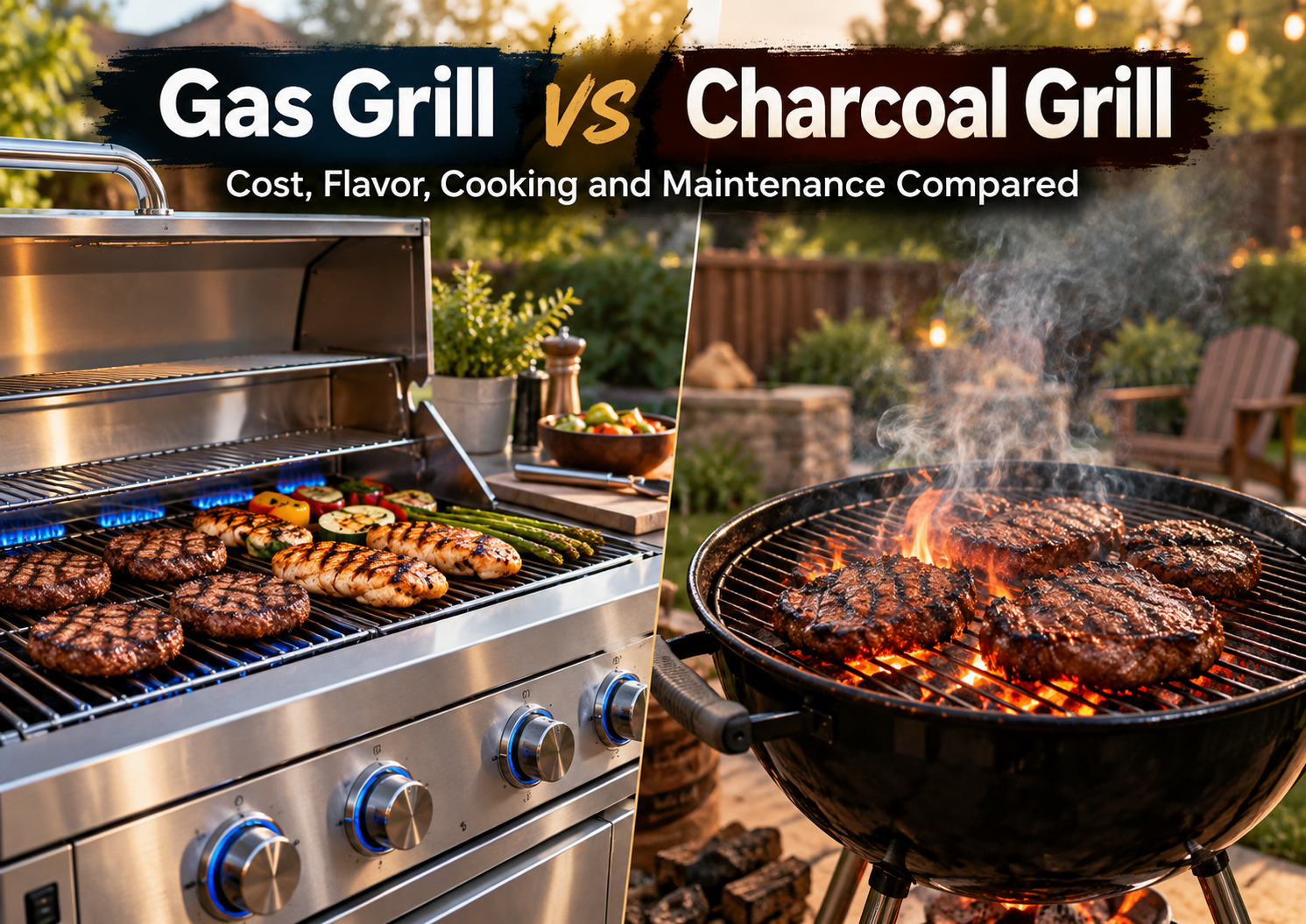
Choosing between a gas grill and a charcoal grill is one of the most important decisions a backyard cook can make. Both types of grills can produce excellent food, but they create very different cooking experiences. Gas grills prioritize convenience, predictable heat and quick weeknight cooking, while charcoal grills offer stronger traditional grilled flavor, extremely high heat potential and greater control over how the fire interacts with the food.
There is no universal winner for every backyard. The better grill depends on what you cook, how often you grill, how much time you want to spend managing the fire, your budget and how important smoky charcoal flavor is to you.
A family that wants to grill chicken breasts and burgers after work may find a gas grill far more useful than charcoal. Someone who treats weekend grilling as a hobby, loves steaks with a deep crust and enjoys experimenting with smoking wood may strongly prefer charcoal.
Cost also requires more consideration than simply comparing the price tags at the store. Charcoal grills are usually less expensive to purchase, but charcoal itself can become a significant ongoing expense. Gas grills generally cost more upfront but can be inexpensive to operate once connected to propane or natural gas.
Maintenance is different as well. Gas grills have burners, ignition systems, heat shields, valves and grease-management components that eventually require cleaning or replacement. Charcoal grills have fewer mechanical parts but create much more ash and soot.
This detailed comparison examines gas grills and charcoal grills across the factors that matter most: purchase price, operating cost, flavor, heat output, temperature control, cooking speed, versatility, maintenance, cleanup, smoking capability, safety and long-term ownership.
By the end, you should have a clear understanding of which grill makes the most sense for your backyard.
Gas Grill vs Charcoal Grill at a Glance
Gas and charcoal grills both cook food primarily through direct radiant heat, hot air and contact with heated cooking grates. The major difference is the source of that heat.
A gas grill burns propane or natural gas through metal burners positioned underneath the cooking surface. Turning control knobs changes the amount of fuel reaching the burners, allowing temperature adjustments that feel similar to controlling a kitchen stove.
A charcoal grill burns charcoal briquettes or lump charcoal. Instead of adjusting a gas valve, you manage temperature by changing the amount of charcoal, arranging the fuel differently and controlling oxygen through the grill’s vents.
That fundamental difference explains most of the advantages and disadvantages of each design.
In general:
Gas grills are better for:
- Fast startup
- Weeknight cooking
- Predictable temperature control
- Large family meals
- Easy cleanup
- Frequent grilling
- Cooking multiple foods simultaneously
- Users who value convenience
Charcoal grills are better for:
- Traditional grilled flavor
- High-temperature steak searing
- Smoking
- Fire management
- Low initial purchase cost
- Portable grilling
- Enthusiasts who enjoy the cooking process
Neither list means that the other grill cannot perform those tasks. Good gas grills can sear excellent steaks, and experienced charcoal cooks can maintain remarkably stable temperatures. The differences are primarily about how easily each grill performs those jobs.
Gas Grill vs Charcoal Grill: Quick Comparison
| Category | Gas Grill | Charcoal Grill |
|---|---|---|
| Initial cost | Usually moderate to high | Usually low to moderate |
| Fuel cost | Generally economical | Can become expensive with frequent use |
| Startup time | Very fast | Slower |
| Temperature control | Easy | Requires practice |
| Maximum heat | High | Potentially extremely high |
| Traditional smoke flavor | Mild | Strong |
| Steak searing | Excellent on powerful models | Excellent |
| Low-and-slow smoking | Possible but limited | Very capable |
| Cleanup | Relatively easy | More ash and soot |
| Maintenance | More mechanical parts | Simpler construction |
| Convenience | Excellent | Moderate |
| Portability | Moderate | Excellent on smaller models |
| Learning curve | Easy | Moderate |
| Fire management | Minimal | Hands-on |
| Best for beginners | Excellent | Good with some practice |
| Best for enthusiasts | Good | Excellent |
The table provides a useful overview, but each category deserves a closer examination.
What Is a Gas Grill?
A gas grill uses propane or natural gas as its primary fuel.
Most residential gas grills contain several burners positioned underneath metal heat shields, flavorizer bars or diffuser plates. These components help distribute heat while protecting the burners from grease and food drippings.
Propane grills commonly use portable refillable propane cylinders. Natural gas grills connect to a permanent household gas supply through an approved gas connection.
When the grill is turned on, fuel flows through the burners and is ignited using an electronic or mechanical ignition system. Flames heat the cooking chamber, cooking grates and heat diffusers.
Gas grills may have two, three, four, five or more independently controlled burners. Multiple burners create cooking zones with different temperatures.
For example, you could operate the left two burners at high heat for steaks while keeping another burner low for vegetables.
More advanced gas grills may include:
- Infrared searing burners
- Side burners
- Rotisserie burners
- Warming racks
- Smoker boxes
- Built-in thermometers
- Electronic temperature monitoring
- Cabinet storage
- Interior lighting
- Side shelves
- Dedicated griddle sections
The defining characteristic of a gas grill is convenience. Turn the gas on, ignite the burners, preheat the grill and start cooking.
What Is a Charcoal Grill?
A charcoal grill burns solid charcoal fuel instead of gas.
The two main charcoal fuels are briquettes and lump charcoal.
Charcoal briquettes are manufactured pieces of compressed charcoal and other ingredients formed into consistent shapes. Because the pieces are relatively uniform, briquettes generally burn predictably and provide dependable heat over long cooking periods.
Lump charcoal consists of carbonized pieces of natural wood. The pieces vary in shape and size and often ignite quickly while producing intense heat.
Charcoal grills can have extremely simple designs. At the most basic level, a charcoal grill requires:
- A firebox
- Charcoal grate
- Cooking grate
- Air vents
- Lid
More sophisticated models may add:
- Adjustable charcoal trays
- Removable ash containers
- Hinged cooking grates
- Built-in thermometers
- Heat deflectors
- Multiple cooking levels
- Insulated walls
- Smoking accessories
Airflow is central to charcoal cooking.
Opening the intake vents allows more oxygen to reach the charcoal, increasing combustion and temperature. Restricting airflow reduces the intensity of the fire.
The exhaust vent controls how hot gases and smoke travel through the grill.
Learning to control those vents is an important part of mastering charcoal grilling.
Gas Grill vs Charcoal Grill Cost
Price is often the first difference shoppers notice.
Charcoal grills generally offer the lower entry cost. Simple charcoal grills can provide excellent cooking performance without complicated burners, valves or ignition systems.
Gas grills usually contain significantly more hardware and therefore tend to cost more.
However, purchase price tells only part of the story.
You should consider:
- Initial grill price
- Fuel
- Accessories
- Replacement parts
- Maintenance
- Expected lifespan
The lowest-priced grill is not necessarily the cheapest grill to own over many years.
Initial Purchase Price
Entry-level charcoal grills are among the most affordable ways to start outdoor cooking.
A simple kettle-style charcoal grill can provide enough cooking capability for burgers, steaks, chicken, ribs and even smoked meats without requiring a large investment.
Gas grills usually begin at a higher price because even inexpensive models require burners, fuel regulators, gas lines, ignition systems and control valves.
As grills become more premium, however, pricing overlaps significantly.
You can find premium charcoal cookers that cost considerably more than basic gas grills. Ceramic kamado grills, insulated charcoal smokers and large competition-style charcoal cookers can become major investments.
Likewise, high-end gas grills with stainless steel construction, powerful burners and built-in outdoor kitchen installations can cost several times more than mainstream models.
Therefore, it is more accurate to say:
Basic charcoal grilling usually has the lowest entry cost, while premium grills of either fuel type can become expensive.
Fuel Cost
Fuel changes the economics considerably.
Gas tends to provide a large amount of cooking time from a single propane cylinder or natural gas connection.
A typical grilling session may use only a fraction of the fuel available in a cylinder.
Charcoal is consumed every time you grill. Once charcoal has burned completely, that fuel is gone.
A long cook can require a significant amount of charcoal, particularly when smoking large cuts such as brisket or pork shoulder for many hours.
For people who grill occasionally, fuel cost may not matter very much.
Someone grilling twice per month may spend relatively little on either fuel.
For someone cooking four or five times every week, however, the difference becomes more noticeable.
Frequent gas grilling can be comparatively economical because you only burn the amount of gas required during the cook.
Charcoal users can reduce fuel waste by extinguishing partially burned charcoal after cooking. Closing the vents on many charcoal grills deprives the fire of oxygen, allowing leftover charcoal to be reused later.
Long-Term Ownership Cost
Long-term cost depends heavily on grill construction.
A simple charcoal grill has relatively few components that can fail.
Eventually you might replace:
- Cooking grates
- Charcoal grates
- Vent hardware
- Thermometers
- Handles
Gas grills contain additional parts.
Potential replacements include:
- Burners
- Igniters
- Heat shields
- Gas regulators
- Hoses
- Valves
- Thermometers
- Cooking grates
- Grease trays
Higher-quality gas grills often make replacement components readily available, which can significantly extend the life of the grill.
Cheap gas grills sometimes become uneconomical to repair after several major components rust or fail.
Therefore, when comparing cost, build quality matters as much as fuel type.
Which Grill Is Cheaper Overall?
For initial purchase price, charcoal usually wins.
For frequent fuel use, gas often wins.
For long-term maintenance, charcoal’s simpler mechanical design can have an advantage.
The overall winner depends on your cooking frequency.
An occasional backyard cook may spend less with charcoal.
A family that grills several nights every week may find gas considerably cheaper and more convenient over time.
Gas Grill vs Charcoal Grill Flavor
Flavor is one of the strongest arguments in favor of charcoal.
Many people associate the classic taste of outdoor grilling with charcoal smoke, burning fat and intense radiant heat.
Charcoal itself contributes combustion aromas to the cooking environment.
Food drippings also fall onto hot charcoal, vaporize and generate flavorful compounds that circulate around the meat.
This creates the distinctive backyard-grilled aroma that is difficult to reproduce perfectly on gas.
Why Charcoal Often Produces Stronger Flavor
Several factors contribute to charcoal flavor.
First, charcoal produces smoke and combustion compounds as it burns.
Second, the charcoal often sits relatively close to the food.
Third, juices and rendered fat can drip directly onto hot coals.
When those drippings vaporize, they produce additional smoke and aromatic compounds.
The smoke then circulates around the food.
Charcoal grills also make it extremely easy to add wood.
Chunks of oak, hickory, cherry, apple or other smoking woods can be placed directly among the charcoal.
This provides a much stronger wood-smoke profile than most standard gas grills.
Does Gas-Grilled Food Have Flavor?
Absolutely.
The idea that gas grills produce flavorless food is incorrect.
A gas grill can create tremendous flavor through:
- Browning
- Caramelization
- Searing
- Seasonings
- Marinades
- Sauces
- Fat vaporization
- Smoke accessories
Gas grills commonly position metal heat diffusers over the burners.
When fat and juices drip onto these extremely hot surfaces, some of the liquid vaporizes, producing aroma that returns to the food.
A powerful gas grill can also create excellent crust development on steaks, burgers and chops.
The primary difference is that gas combustion itself produces less of the characteristic smoky flavor associated with charcoal.
Adding Smoke Flavor to a Gas Grill
Gas grill owners can introduce smoke using wood chips or smoker boxes.
Wood chips placed inside a metal smoker box can smolder when positioned over a burner.
Some cooks also use foil packets containing wood chips.
While this technique can produce noticeable smoke, the result generally does not mimic charcoal perfectly because the overall combustion environment remains different.
Still, for chicken, pork, vegetables and shorter cooks, a little wood smoke combined with strong searing can produce excellent results.
Flavor Winner: Charcoal
If flavor is your highest priority, charcoal has the advantage.
That does not mean every charcoal meal tastes better than every gas-grilled meal.
Cooking skill remains more important than fuel type.
Poorly managed charcoal can produce bitter, dirty smoke. Excessive lighter fluid can introduce unpleasant aromas. Food can burn if the fire becomes too intense.
A skilled gas grill cook will easily outperform someone who does not understand fire management.
But with both grills operated properly, charcoal generally provides greater potential for deep smoke and live-fire flavor.
Gas Grill vs Charcoal Grill for Steak
Steak provides one of the best tests of grilling performance.
A great steak requires intense heat, excellent browning and precise control over internal temperature.
Both gas and charcoal grills can produce outstanding steaks.
Charcoal has one particular advantage: concentrated radiant heat.
A full chimney of hot charcoal piled beneath a small cooking area can generate extremely intense searing conditions.
This makes charcoal excellent for developing a dark crust quickly.
Gas grills can also reach high temperatures, especially models equipped with dedicated infrared searing burners.
The advantage of gas is control.
If the steak begins cooking too quickly, lowering a burner requires only a turn of the control knob.
On charcoal, temperature adjustment is slower.
Two-Zone Steak Cooking
Both grill types benefit from two-zone cooking.
A two-zone fire divides the grill into:
Direct heat zone: Very hot area used for searing.
Indirect heat zone: Cooler area used for gentler cooking.
On a charcoal grill, place most or all charcoal on one side.
On a gas grill, turn burners on one side to high while leaving another burner low or off.
This arrangement allows you to move the steak away from direct heat whenever necessary.
For thick steaks, this technique provides much better control than leaving the meat directly over maximum heat for the entire cook.
Gas Grill vs Charcoal Grill for Burgers
Gas grills are extremely convenient for burgers.
You can preheat the grill quickly, cook a batch of burgers and shut everything down immediately afterward.
Temperature consistency also helps when cooking multiple patties.
Charcoal produces stronger live-fire flavor and can give burgers an exceptional smoky crust.
However, fatty burgers can cause significant flare-ups when grease drips directly onto hot charcoal.
Both systems work extremely well.
For quick family burger nights, gas is arguably more practical.
For maximum grilled flavor, charcoal has the edge.
Gas Grill vs Charcoal Grill for Chicken
Chicken benefits from controlled heat.
Direct high heat can burn chicken skin or sugary marinades before the interior reaches the desired temperature.
Gas grills make temperature management straightforward.
You can create separate temperature zones and make small heat adjustments during cooking.
Charcoal can produce tremendous chicken flavor, but careful fire arrangement becomes more important.
Indirect charcoal grilling works particularly well.
Place the charcoal on one side and cook the chicken on the opposite side with the lid closed.
Finish over direct heat if additional browning or crispness is required.
For ease of cooking, gas has the advantage.
For flavor potential, charcoal wins.
Gas Grill vs Charcoal Grill for Ribs
Ribs require longer cooking than burgers or steaks, which highlights the versatility of charcoal.
A charcoal grill can function almost like a smoker when configured correctly.
Place the charcoal away from the ribs, maintain moderate temperatures and add wood chunks.
The grill becomes a compact barbecue smoker.
Gas grills can cook ribs indirectly as well. Turn on one or two burners and place the ribs over an unlit section.
However, achieving authentic smoke flavor usually requires additional wood chips or a smoker box.
Charcoal is generally better if smoked ribs are an important part of your cooking plans.
Gas Grill vs Charcoal Grill for Brisket and Pork Shoulder
Long barbecue cooks strongly favor charcoal over conventional gas grilling.
Brisket and pork shoulder often benefit from hours of controlled heat and wood smoke.
A charcoal grill with sufficient capacity can maintain low temperatures for surprisingly long periods when properly configured.
Popular techniques involve arranging charcoal so that it burns progressively rather than igniting the entire fuel load at once.
Wood chunks can be distributed through the charcoal to produce smoke throughout the early stages of cooking.
A gas grill can cook brisket or pork shoulder indirectly, but it usually behaves more like an outdoor oven unless wood smoke is added.
For serious barbecue enthusiasts interested in brisket, pork shoulder and ribs, charcoal offers greater versatility.
Temperature Control
Gas wins decisively in ease of temperature adjustment.
Turning a burner knob creates an immediate change in fuel flow.
While the cooking chamber still takes time to respond, the process is intuitive.
Charcoal temperature control involves several variables:
- Amount of lit charcoal
- Charcoal arrangement
- Intake vent position
- Exhaust vent position
- Weather
- Grill insulation
- Food quantity
- Lid position
Learning how these factors interact takes practice.
Once mastered, however, charcoal can be surprisingly stable.
Experienced charcoal cooks can maintain relatively consistent temperatures for hours.
Maximum Cooking Temperature
Charcoal has impressive maximum heat potential.
By concentrating a large quantity of fully lit charcoal underneath a smaller cooking area, you can create very intense radiant heat.
This is excellent for:
- Steak
- Burgers
- Lamb chops
- Skewers
- Thin pork chops
- Certain vegetables
Gas grills vary dramatically in maximum heat output.
A basic gas grill may struggle to create restaurant-style steak crust.
A powerful premium grill with close burner placement and infrared technology may produce extraordinary searing performance.
Therefore, charcoal has the more reliable advantage at lower grill prices.
Low-Temperature Cooking
Gas grills can maintain moderate temperatures easily because burners can be turned down.
However, very low temperature cooking can become difficult on grills with powerful burners and compact cooking chambers.
Charcoal low-and-slow cooking requires more setup but provides excellent results.
The goal is to create controlled combustion rather than lighting a large pile of charcoal all at once.
Ceramic kamado grills are particularly efficient at low-temperature charcoal cooking because their insulated construction limits heat loss and fuel consumption.
Startup Time
Gas provides one of its biggest advantages before cooking even begins.
Starting a gas grill usually requires:
- Open the lid.
- Turn on the gas.
- Ignite the burners.
- Close the lid.
- Preheat.
Depending on the grill and desired cooking temperature, you may be ready to cook within roughly ten to fifteen minutes.
Charcoal requires additional preparation.
The process commonly involves:
- Measure charcoal.
- Ignite charcoal.
- Wait for sufficient ignition.
- Pour or arrange charcoal.
- Install the cooking grate.
- Adjust vents.
- Allow the grill temperature to stabilize.
A chimney starter can make this process much easier and more predictable, but charcoal will still usually require more time.
For spontaneous weeknight grilling, gas wins easily.
Shutdown Time
Gas is equally convenient after cooking.
Turn the burners off and close the gas supply.
Charcoal continues burning until the fuel is consumed or deprived of oxygen.
On grills with effective vents, closing both intake and exhaust vents can extinguish the charcoal.
The grill may remain extremely hot for a considerable period.
This can matter if you grill in a location where the cooker must be moved or stored soon afterward.
Cooking Convenience
Convenience is perhaps the strongest overall reason to choose gas.
Imagine coming home at 6:30 p.m. and wanting grilled chicken, vegetables and sausages for dinner.
A gas grill allows you to begin cooking quickly with very little preparation.
Charcoal turns the same dinner into a larger process.
For some people, that process is part of the enjoyment.
Lighting charcoal, arranging the fire and managing the vents can be relaxing.
For others, it becomes a reason not to grill.
The important question is not whether one approach is objectively better.
The question is whether you enjoy fire management.
If you do, charcoal may feel rewarding rather than inconvenient.
If you simply want excellent grilled food with minimal preparation, gas fits better.
Cooking Capacity
Both grill types are available in many sizes.
However, large gas grills are particularly convenient for entertaining because independently controlled burners create several cooking zones.
You might simultaneously cook:
- Burgers over high heat
- Chicken over medium heat
- Vegetables over lower heat
- Buns on the warming rack
Doing the same thing on charcoal requires more careful fuel placement and food rotation.
Large charcoal grills can certainly handle parties, but the cook needs to understand how heat varies across the cooking surface.
For frequent entertaining, gas often provides easier capacity management.
Gas Grill vs Charcoal Grill Maintenance
Maintenance differs considerably between the two systems.
Charcoal grills create more mess during everyday cooking but have fewer mechanical parts.
Gas grills create less ash but contain more components that need periodic inspection and cleaning.
Neither grill is completely maintenance-free.
Gas Grill Maintenance
A typical gas grill requires attention to:
- Cooking grates
- Burners
- Heat shields
- Grease trays
- Ignition components
- Gas connections
- Exterior surfaces
Cooking grates should be cleaned regularly to remove food residue and carbon buildup.
Heat shields gradually accumulate grease and burned food.
Burner ports can become obstructed by debris, grease or corrosion.
Grease trays need to be emptied to reduce fire risk.
Gas hoses and connections should also be checked periodically for signs of damage.
The ignition system may eventually require new batteries or replacement components.
Charcoal Grill Maintenance
Charcoal maintenance is mechanically simpler.
The main tasks include:
- Cleaning cooking grates
- Emptying ash
- Removing grease buildup
- Cleaning vents
- Inspecting fire grates
- Preventing corrosion
Ash should not be allowed to accumulate for long periods.
Charcoal ash can hold moisture, potentially accelerating corrosion in steel components.
After the grill has cooled completely, excess ash should be removed.
The interior does not need to look perfectly clean. A thin layer of seasoned residue is normal.
However, thick grease deposits, flaky carbon and obstructed vents should be cleaned.
Which Grill Requires More Maintenance?
The answer depends on how you define maintenance.
Charcoal requires more cleanup after many cooking sessions because ash must be handled.
Gas requires more component maintenance over the grill’s lifetime.
If you dislike dealing with ash, gas is easier.
If you dislike replacing burners and ignition components, charcoal’s simplicity is appealing.
Cleaning After Every Cook
Gas grill cleanup can be remarkably quick.
A common routine is:
- Run the grill hot briefly.
- Brush or scrape the grates.
- Shut down the burners.
- Empty the grease tray when necessary.
Charcoal cleanup requires waiting until the fuel and ash are completely cool.
Then the ash must be removed and disposed of appropriately.
Premium charcoal grills often include removable ash catchers, which make the process significantly easier.
Grease Management
Grease is an important consideration on both grills.
Gas grills typically channel grease toward a removable drip tray or grease pan.
If that system is ignored, grease can accumulate and eventually ignite.
Charcoal grills often allow grease to drip toward charcoal or into the bottom of the grill.
Small amounts contribute to grilled flavor.
Large quantities can create intense flare-ups.
Fatty foods such as burgers, chicken thighs and sausages require particular attention.
Flare-Ups
Flare-ups occur when fat contacts extremely hot surfaces or flames.
Charcoal grills can generate dramatic flare-ups because the food may sit directly above burning coals.
A two-zone fire provides a simple solution: move the food temporarily to the indirect side.
Gas grills can also flare, especially when heat shields contain accumulated grease.
Regular cleaning reduces the problem.
Neither grill should be operated with the expectation that visible flames constantly touching the food are desirable.
Short flare-ups can contribute flavor.
Continuous flames can rapidly burn the exterior while producing unpleasant soot.
Weather Performance
Weather affects outdoor cooking more than many people realize.
Wind, cold and rain can alter grill temperature.
Gas grills are generally straightforward in changing conditions because you can increase or decrease burner output.
Charcoal responds more dramatically to airflow.
Strong wind entering the intake vents can accelerate combustion.
Cold weather can increase fuel consumption.
Highly insulated charcoal grills perform much better in winter than thin-walled models.
Gas grills also use more fuel during cold weather because greater heat is required to maintain cooking temperature.
For casual year-round grilling, gas tends to require fewer adjustments.
Wind Sensitivity
Gas flames can potentially be disrupted by strong winds, although well-designed grills protect burners reasonably well.
Charcoal does not blow out easily, but wind can make the charcoal burn much faster.
Positioning matters for both systems.
Never block required ventilation in an attempt to protect a grill from wind.
Outdoor cooking appliances require sufficient airflow for safe operation.
Smoking Capability
If smoking is an important priority, charcoal is the stronger choice.
A charcoal grill can generate both heat and smoke using the same fuel system.
Add hardwood chunks to burning charcoal and the grill becomes a simple smoker.
With indirect cooking, you can smoke:
- Brisket
- Pork shoulder
- Ribs
- Chicken
- Turkey
- Sausage
- Fish
- Cheese under appropriate conditions
- Vegetables
A gas grill can also generate smoke, but additional equipment is usually needed.
Wood chips placed in a smoker box can work well, particularly for shorter cooks.
However, maintaining continuous smoke for an all-day barbecue session is generally more natural on charcoal.
Smoke Quality Matters More Than Smoke Quantity
More smoke is not automatically better.
Good barbecue smoke should generally be relatively clean.
Thick, dirty smoke can create bitter flavors.
Charcoal needs adequate oxygen to burn efficiently.
Closing vents excessively in an attempt to lower temperature can create poor combustion.
A better strategy is often to begin with the correct amount and arrangement of fuel, then use vents for fine control.
Gas grill owners should follow the same principle with wood chips. Excessive smoldering smoke can overpower food.
Fuel Storage
Fuel storage affects convenience.
Propane cylinders are compact and relatively clean but must be stored and handled properly.
Natural gas removes most fuel-storage concerns because the grill is connected directly to the home’s gas supply.
Charcoal bags require dry storage.
Moist charcoal can become difficult to ignite and may burn inconsistently.
People who grill frequently may store several large bags at once.
Charcoal also creates dust, so dedicated outdoor or garage storage is useful.
Propane vs Natural Gas Grills
Not all gas grills use the same fuel.
Propane provides portability.
You can reposition the grill within an appropriate outdoor area as long as the propane cylinder moves with it.
Natural gas grills are connected to a fixed gas line.
The main advantage is essentially continuous fuel availability.
You do not have to discover halfway through cooking that the propane cylinder is empty.
Natural gas can be especially convenient for permanent outdoor kitchens.
However, professional installation may be necessary, and the grill becomes less portable.
Not every propane grill can simply be connected to natural gas. Fuel conversions should only be performed when the manufacturer supports the appropriate conversion components.
Charcoal Briquettes vs Lump Charcoal
Choosing charcoal involves another decision.
Briquettes and lump charcoal behave differently.
Charcoal Briquettes
Briquettes generally offer:
- Uniform size
- Predictable burn
- Long cooking duration
- Easy temperature planning
- Broad availability
They are particularly useful for longer cooking sessions because consistency makes fuel management easier.
Lump Charcoal
Lump charcoal generally offers:
- Faster ignition
- High heat potential
- Natural irregular pieces
- Low ash production
- Responsive temperature changes
Because pieces vary dramatically in size, airflow and burn duration may be less predictable.
Many charcoal enthusiasts keep both fuels available and choose according to the cooking method.
Ease of Use for Beginners
Gas is easier for most beginners.
The controls are familiar.
If the grill becomes too hot, turn the burner down.
If the temperature drops, turn it up.
Charcoal introduces several variables simultaneously.
Beginners must learn:
- How much charcoal to use
- When charcoal is ready
- How vents affect temperature
- Where to position food
- How to create direct and indirect zones
- How to add fuel during long cooks
- How weather affects combustion
Fortunately, charcoal grilling is not particularly difficult once these basic concepts become familiar.
Someone who cooks regularly may become comfortable after only several sessions.
Temperature Monitoring
A reliable thermometer improves cooking on either type of grill.
Built-in lid thermometers are useful for understanding general grill temperature, but they do not always represent the exact temperature at cooking-grate level.
Digital probe thermometers can monitor both food temperature and grill temperature.
This is especially helpful for:
- Brisket
- Pork shoulder
- Whole chicken
- Turkey
- Thick steaks
- Large roasts
Using internal temperature rather than relying exclusively on cooking time produces more predictable results regardless of fuel type.
Direct Cooking
Direct cooking means placing the food directly above the primary heat source.
This technique works well for foods that cook quickly, including:
- Steaks
- Burgers
- Hot dogs
- Thin pork chops
- Shrimp
- Fish fillets
- Vegetables
- Kebabs
Both gas and charcoal perform extremely well for direct grilling.
Gas offers control.
Charcoal offers intense radiant heat and smoke flavor.
Indirect Cooking
Indirect cooking places the food away from the active heat source.
A gas grill may use the outside burners while leaving the burner underneath the food turned off.
A charcoal grill may have all charcoal positioned on one side while the food sits on the opposite side.
Indirect cooking is useful for:
- Whole chicken
- Turkey
- Ribs
- Pork shoulder
- Brisket
- Thick steaks
- Roasts
- Large cuts
Understanding indirect cooking dramatically expands what you can prepare on either grill.
Reverse Searing
Reverse searing is particularly useful for thick steaks.
The meat is cooked gently over indirect heat until it approaches the desired internal temperature.
Then it is moved over extremely high direct heat to create a crust.
Charcoal is excellent for reverse searing because a concentrated charcoal zone can provide intense finishing heat.
Gas also performs well, particularly when the grill includes a dedicated searing burner.
This technique reduces the risk of burning the outside of a thick steak before the center is properly cooked.
Rotisserie Cooking
Gas grills often have an advantage for rotisserie cooking.
Many midrange and premium gas grills are designed to accept rotisserie attachments.
Some models include dedicated rear infrared burners that provide even heat across rotating meat.
Charcoal rotisserie setups also exist and can produce exceptional results.
Charcoal adds an additional layer of wood-fired flavor to rotisserie chicken, pork or lamb.
However, gas provides easier temperature consistency for long rotisserie sessions.
Grilling Vegetables
Vegetables do not necessarily need charcoal smoke to taste excellent.
Gas grills are particularly convenient for:
- Bell peppers
- Zucchini
- Eggplant
- Corn
- Asparagus
- Onions
- Mushrooms
- Potatoes
Precise temperature control can reduce burning.
Charcoal can produce exceptional blistering and smoky flavor, especially on peppers, corn and onions.
For vegetables that cook quickly, both systems are excellent.
Grilling Fish
Fish benefits from controlled heat and clean cooking grates.
Gas makes gentle temperature adjustment easy, reducing the risk of burning delicate fillets.
Charcoal provides additional flavor but may require more attention.
Firm fish such as salmon, tuna and swordfish tolerate direct grilling better than delicate species.
Indirect charcoal cooking can also produce excellent smoked fish.
Family Cooking
Gas is generally the better choice for families that want grilling to function like an extension of the kitchen.
You can cook outside regularly without turning every meal into a fire-management project.
This makes gas particularly convenient for:
- Weeknight dinners
- School nights
- Quick lunches
- Large family meals
- Frequent entertaining
The grill may be used much more frequently simply because starting it requires almost no effort.
A grill that is slightly less exciting but used three times every week may provide more value than a grill that produces incredible food but is only used twice per summer.
Cooking as a Hobby
Charcoal becomes especially appealing when grilling itself is part of the entertainment.
Lighting the fire, arranging charcoal, adjusting vents and watching the food cook become part of the experience.
Charcoal rewards experimentation.
You can test:
- Different charcoal arrangements
- Different wood species
- Direct and indirect setups
- Low-and-slow techniques
- Reverse searing
- Two-level fires
- Rotisserie methods
- Smoking techniques
For enthusiasts, these additional variables are features rather than disadvantages.
Safety Differences
Both grill types require safe outdoor use.
Neither gas nor charcoal grills should be operated inside enclosed structures where dangerous combustion gases can accumulate.
Charcoal produces carbon monoxide and must always have adequate outdoor ventilation.
Gas grills must also be used according to manufacturer clearance and ventilation requirements.
With propane grills, inspect hoses and connections periodically.
Never use damaged fuel components.
For charcoal, hot ash is a major concern.
Ash can remain hot much longer than it appears.
Never place potentially hot charcoal or ash in combustible containers.
Always allow the grill and fuel to cool fully before disposal.
Fire Control
Gas provides instant shutdown capability.
Turn the burners off and the primary flame disappears immediately.
The grill remains hot, but active combustion stops.
Charcoal continues burning until oxygen or fuel is exhausted.
Closing vents usually reduces combustion, but hot coals remain capable of igniting combustible material.
This difference is worth considering for people cooking in smaller outdoor areas.
Apartment and Balcony Considerations
Local rules, property policies and fire codes may restrict outdoor cooking appliances.
Some buildings prohibit charcoal entirely.
Others restrict propane grills or limit cylinder size.
Electric grills may be the only permitted option in certain locations.
Always follow local requirements and property regulations rather than assuming that a grill is allowed simply because outdoor space is available.
Environmental Considerations
Comparing the environmental impact of grilling fuels is complicated.
Gas burns relatively cleanly during use compared with charcoal combustion.
Charcoal production, transportation and combustion can create additional emissions.
However, total environmental impact depends on:
- Fuel source
- Manufacturing methods
- Grill lifespan
- Cooking efficiency
- Transportation
- Frequency of use
Using an efficient grill only as long as necessary reduces unnecessary fuel consumption regardless of type.
Long-lasting equipment can also reduce waste compared with frequently replacing poorly constructed grills.
Durability
Durability depends more on materials and construction than fuel choice.
A well-built charcoal grill may last decades.
A high-quality stainless steel gas grill can also provide many years of service.
Look for construction features such as:
- Stable frame
- Rust-resistant materials
- Thick cooking grates
- Durable lid
- Quality hardware
- Replaceable components
- Good grease or ash management
Cheap thin metal can deteriorate quickly when repeatedly exposed to high temperatures, moisture and outdoor weather.
Rust Prevention
Keeping a grill dry dramatically extends its life.
Use an appropriate grill cover once the cooker has completely cooled.
However, covers should not trap excessive moisture.
Clean grease and food residue periodically.
On charcoal grills, remove ash because moisture combined with ash can accelerate corrosion.
On gas grills, inspect burner areas and grease trays where corrosion may develop unnoticed.
Gas Grill Advantages
Gas grills have several major strengths.
Fast Startup
A gas grill can be cooking-ready quickly.
This encourages frequent use.
Easy Temperature Control
Burner knobs provide simple and intuitive heat adjustment.
Excellent for Weeknight Meals
Gas works extremely well when you want grilled food without a lengthy setup process.
Easy Multi-Zone Cooking
Multiple burners allow different temperature zones across the cooking surface.
Relatively Clean Operation
There are no bags of charcoal, clouds of ash or leftover coals to manage.
Economical for Frequent Use
Gas can provide significant cooking time from a relatively small amount of fuel.
Easy Shutdown
Turn off the burners and fuel supply when cooking is finished.
Gas Grill Disadvantages
Gas is not perfect.
Less Traditional Smoke Flavor
Standard gas grilling produces less smoke character than charcoal.
Higher Initial Cost
A quality gas grill generally costs more than a simple charcoal grill.
More Mechanical Components
Burners, valves and ignition systems eventually require maintenance.
Potential Fuel Supply Problems
Propane users can unexpectedly run out of fuel.
Less Fire Interaction
People who enjoy working directly with live coals may find gas less engaging.
Charcoal Grill Advantages
Charcoal has a different set of strengths.
Excellent Grilled Flavor
Smoke, charcoal combustion and vaporized drippings create classic barbecue character.
Exceptional High-Heat Potential
Concentrated charcoal can create extremely powerful searing zones.
Excellent Smoking Capability
Wood chunks integrate naturally with charcoal cooking.
Lower Entry Cost
Basic charcoal grills can provide impressive performance for relatively little money.
Simple Construction
There are fewer mechanical components to fail.
Highly Versatile
One charcoal grill can sear, roast, smoke and cook indirectly.
Engaging Cooking Experience
Fire management appeals to enthusiasts who enjoy traditional outdoor cooking.
Charcoal Grill Disadvantages
Charcoal also requires compromises.
Longer Startup
Lighting and stabilizing charcoal takes additional time.
More Cleanup
Ash must be removed and disposed of.
Greater Learning Curve
Temperature control requires understanding airflow and fuel management.
Ongoing Fuel Expense
Frequent charcoal use can become costly.
Slower Shutdown
Hot charcoal remains active after cooking.
More Weather Sensitivity
Wind and cold can significantly influence combustion.
Gas Grill vs Charcoal Grill for Beginners
For most beginners, gas is easier.
You can focus on learning food preparation without simultaneously learning fire management.
This is especially useful when developing skills such as:
- Recognizing doneness
- Using meat thermometers
- Creating grill marks
- Managing flare-ups
- Seasoning food
- Building two-zone cooking setups
Charcoal is still perfectly suitable for a beginner who specifically wants to learn traditional grilling.
A simple kettle grill can teach fundamental concepts that apply to many forms of barbecue.
Gas Grill vs Charcoal Grill for Serious BBQ Enthusiasts
Charcoal often appeals more strongly to enthusiasts.
The ability to manipulate fuel, airflow, smoke and heat creates more opportunities for experimentation.
A charcoal cook can use the same grill for high-heat steak one day and low-temperature smoked ribs the next.
However, many serious grill enthusiasts eventually own both.
Gas handles quick meals.
Charcoal handles weekend barbecue.
This combination provides exceptional flexibility.
Should You Own Both?
For people with enough outdoor space, owning one gas grill and one charcoal grill can be an ideal setup.
Use gas when:
- Time is limited
- Cooking lunch
- Grilling vegetables
- Preparing quick family dinners
- Cooking several foods simultaneously
Use charcoal when:
- Smoking ribs
- Cooking brisket
- Searing premium steaks
- Hosting weekend cookouts
- Experimenting with wood smoke
- Enjoying the process of live-fire cooking
The two grills complement rather than replace each other.
Which Grill Is Better for Small Backyards?
Small charcoal grills are extremely space-efficient.
A compact kettle can provide substantial cooking capability while occupying relatively little patio space.
Compact gas grills are also available, although fuel-cylinder storage increases the overall footprint.
If you grill infrequently and want something easy to store, charcoal may make sense.
If you grill frequently in a small backyard, a compact two- or three-burner gas grill can be more practical.
Which Grill Is Better for Large Outdoor Kitchens?
Gas is usually more convenient for permanent outdoor kitchens.
Built-in gas grills integrate neatly into countertops and cabinetry.
A natural gas connection eliminates portable fuel cylinders.
Large cooking surfaces, side burners and rotisserie systems can create an outdoor cooking station that functions almost like a complete second kitchen.
Charcoal can still be incorporated into an outdoor kitchen, particularly for enthusiasts who want both cooking methods.
Premium outdoor kitchens often include several appliances:
- Gas grill
- Charcoal cooker
- Smoker
- Griddle
- Pizza oven
Each performs a different role.
Which Grill Is Better for Parties?
Gas usually has the convenience advantage for large gatherings.
You can quickly adjust cooking zones, handle multiple batches and relight the grill if necessary.
If guests arrive late, restarting a gas grill takes only minutes.
Charcoal parties require more fuel planning.
However, charcoal can create a memorable cooking experience and exceptional flavor.
For slow barbecue parties centered around ribs, pork shoulder or brisket, charcoal may actually be the better choice.
For large quantities of burgers, sausages and chicken, gas is usually easier.
Which Grill Is Better for Camping?
Portable charcoal grills are extremely popular for camping because the cooker itself can be simple and compact.
However, charcoal must be transported, stored dry and disposed of safely.
Some camping areas impose fire restrictions that may prohibit charcoal during dry conditions.
Portable propane grills offer cleaner fuel handling and immediate shutdown.
Always follow regulations at the specific campground or recreation area.
How Much Time Does Each Grill Require?
Time extends beyond the actual cooking period.
Consider the complete process.
Gas Grill
A typical session might involve:
- Several minutes of setup
- Roughly ten to fifteen minutes of preheating
- Cooking
- Brief grate cleaning
- Immediate shutdown
Charcoal Grill
A typical session may involve:
- Preparing charcoal
- Lighting the fuel
- Waiting for ignition
- Arranging coals
- Stabilizing grill temperature
- Cooking
- Waiting for complete cooldown
- Ash disposal
If you cook outdoors frequently, these differences can become significant.
Does Charcoal Really Taste Better?
For many traditional grilled foods, charcoal provides more complex smoke flavor.
However, “better” remains subjective.
Some people prefer clean-tasting gas-grilled food.
Others want pronounced wood and charcoal aroma.
Food quality also depends more heavily on technique than many buyers expect.
Consider steak.
A properly salted steak cooked on a powerful gas grill to the perfect internal temperature will usually taste better than an overcooked steak prepared over premium charcoal.
Fuel influences flavor, but it cannot compensate for poor cooking technique.
Does Gas Grill Food Taste Like Indoor Food?
Not necessarily.
Gas grilling still creates conditions that are difficult to reproduce in most kitchens.
High cooking grate temperatures produce strong browning.
Juices vaporize on hot surfaces.
Food is exposed to an outdoor high-heat cooking environment.
The flavor is distinctly grilled, even when charcoal smoke is absent.
Adding a small amount of wood smoke can increase that outdoor character further.
Which Is Better for Healthier Cooking?
Neither gas nor charcoal automatically makes food healthy or unhealthy.
Cooking technique matters more.
Extremely high heat and heavy charring should not be the goal with either system.
Avoid continuously exposing food to uncontrolled flames.
Trim excessive fat when appropriate, manage flare-ups and avoid intentionally burning food.
Vegetables, lean meats, fish and many other nutritious foods can be prepared successfully using either grill.
Gas Grill vs Charcoal Grill Cost Example
Consider two fictional grill owners.
The first grills three or four evenings every week.
The second grills two weekends each month.
The frequent griller may benefit financially from gas because the cooker starts quickly and fuel consumption is efficient.
The occasional weekend cook may prefer a relatively inexpensive charcoal grill because the higher per-session fuel expense occurs less frequently.
This illustrates why there is no single cost calculation that fits everyone.
Frequency matters enormously.
How to Choose the Right Gas Grill
If you decide gas fits your cooking style, evaluate more than burner count.
Look at:
Cooking Area
Choose enough space for the number of people you normally feed.
Avoid purchasing an enormous grill if most meals serve only two people.
Burner Arrangement
Multiple independently controlled burners improve indirect cooking.
Heat Output
Total burner power matters, but burner design and grill construction are equally important.
Cooking Grates
Cast iron and stainless steel are common choices.
Each has different heat retention and maintenance characteristics.
Grease Management
A removable grease tray makes cleaning much easier.
Replacement Parts
Availability of burners and ignition components can dramatically extend grill lifespan.
Construction Quality
Examine the lid, firebox, cart and hardware.
A stable, well-built grill usually offers better long-term value than a feature-packed but fragile alternative.
How to Choose the Right Charcoal Grill
Important charcoal grill features include:
Ventilation
Good intake and exhaust vents make temperature control much easier.
Lid
A tight-fitting lid is essential for indirect cooking and smoking.
Ash Removal
A removable ash catcher can save considerable cleanup time.
Cooking Grate Access
Hinged sections make adding charcoal or wood easier during long cooks.
Fuel Capacity
Larger charcoal chambers provide better flexibility for smoking.
Adjustable Charcoal Height
Some grills allow the charcoal grate to move closer to or farther from the food.
This is useful for controlling searing intensity.
Construction
Thicker materials generally retain heat better and resist warping.
Gas Grill vs Charcoal Grill Maintenance Schedule
A practical maintenance schedule improves both performance and lifespan.
After Most Gas Grill Sessions
Clean cooking grates and inspect the grease system.
Every Few Gas Grill Sessions
Inspect heat shields and remove excessive grease buildup.
Periodically
Check burner ports, ignition operation and fuel components.
After Most Charcoal Sessions
Allow the charcoal to cool completely and remove excess ash.
Periodically
Clean vents and remove heavy carbon buildup.
Several Times Per Year
Inspect cooking grates, fasteners, handles and structural components on either grill.
The exact schedule depends on how often you cook.
Common Gas Grill Mistakes
Preheating Too Little
A properly heated grill improves browning and grate performance.
Cooking Everything at Maximum Heat
Different foods require different temperatures.
Ignoring Grease
Grease buildup can cause dangerous fires.
Never Cleaning Burners
Blocked burner ports can create uneven heat.
Opening the Lid Constantly
Repeatedly opening the grill releases heat and slows cooking.
Running Out of Propane
Frequent grillers should monitor fuel supply rather than discovering an empty cylinder during dinner.
Common Charcoal Grill Mistakes
Cooking Before the Fire Is Ready
Poorly established charcoal can produce unstable heat.
Using Too Much Charcoal
More fuel is not always better.
Closing Vents Excessively
Starving the fire of oxygen can create poor combustion.
Ignoring Two-Zone Cooking
A safe indirect area gives you somewhere to move food during flare-ups.
Adding Excessive Smoking Wood
Heavy smoke can make food bitter.
Throwing Away Reusable Charcoal
Partially burned charcoal can often be extinguished and used again.
Best Choice by Cooking Style
Your preferred food can simplify the decision.
Mostly Burgers and Hot Dogs
Gas for convenience; charcoal for flavor.
Mostly Steak
Charcoal for intense traditional searing, although powerful gas grills perform extremely well.
Mostly Chicken
Gas for easy temperature control.
Mostly Vegetables
Gas for convenience and precision.
Ribs
Charcoal if smoke flavor is important.
Brisket
Charcoal.
Pork Shoulder
Charcoal.
Weeknight Meals
Gas.
Weekend BBQ Projects
Charcoal.
Large Parties
Gas for grilling; charcoal for barbecue.
Frequent Daily Cooking
Gas.
Recreational Fire Cooking
Charcoal.
Who Should Buy a Gas Grill?
A gas grill is probably the better choice if you:
- Want to cook outdoors several times per week
- Have limited time after work
- Prefer predictable temperature control
- Frequently cook for family
- Host large gatherings
- Dislike handling charcoal and ash
- Primarily grill rather than smoke
- Want quick startup and shutdown
- Prefer a kitchen-like cooking experience
Gas allows grilling to become part of normal everyday meal preparation.
Instead of planning a barbecue session, you simply walk outside and start cooking.
That convenience should not be underestimated.
Who Should Buy a Charcoal Grill?
A charcoal grill is probably better if you:
- Prioritize traditional grilled flavor
- Enjoy managing a live fire
- Want to smoke meat
- Cook ribs, brisket or pork shoulder
- Want extremely high searing heat
- Prefer simple mechanical construction
- Want lower initial equipment cost
- Grill mostly on weekends
- Consider barbecue a hobby
- Enjoy experimenting with wood smoke
Charcoal turns grilling into a more hands-on cooking experience.
For many enthusiasts, that is exactly the appeal.
Frequently Asked Questions
Is a gas grill cheaper than a charcoal grill?
Gas grills usually cost more initially, but gas can be economical for frequent cooking. Charcoal grills are generally cheaper to purchase, while ongoing charcoal purchases can make frequent operation more expensive.
The cheapest long-term option depends on grill price, fuel cost, cooking frequency and how long the equipment lasts.
Does charcoal taste better than gas?
Charcoal generally produces stronger smoke and live-fire flavor.
Fat drippings vaporize over hot charcoal, and wood chunks can be added directly to the fire.
Gas still produces excellent grilled flavor through browning, searing and vaporized drippings, but the smoke profile is usually milder.
Is charcoal hotter than gas?
Charcoal can produce extremely intense concentrated heat, making it excellent for steak searing.
Some premium gas grills can also produce exceptionally high temperatures, particularly models with infrared searing systems.
Is a gas grill easier to use?
Yes, for most people.
Gas grills start quickly and temperature adjustments are made using burner knobs.
Charcoal requires more understanding of fuel quantity, airflow and fire arrangement.
Which grill is easier to clean?
Gas usually creates less everyday mess because there is no charcoal ash.
However, gas grills contain grease trays, heat shields and burners that require periodic cleaning.
Charcoal grills require more frequent ash removal but contain fewer mechanical components.
Can you smoke meat on a gas grill?
Yes.
Use indirect heat and a suitable wood-smoking method.
However, charcoal grills generally provide more natural and flexible smoking capability.
Can you smoke meat on a charcoal grill?
Yes.
Charcoal grills can be excellent smokers when configured for indirect low-temperature cooking.
Adding hardwood chunks creates traditional barbecue smoke.
Which grill lasts longer?
Build quality matters more than fuel type.
A high-quality charcoal grill or gas grill can last many years with proper maintenance.
Cheap materials, corrosion and lack of replacement parts shorten lifespan.
Which grill is better for beginners?
Gas is generally easier because temperature control is simple.
Charcoal is also suitable for motivated beginners who want to learn fire management.
Which grill is better for steaks?
Both are excellent.
Charcoal provides intense radiant heat and strong fire flavor.
Premium gas grills offer powerful searing combined with easier temperature adjustment.
Which grill is better for burgers?
Gas is more convenient for frequent burger cooking.
Charcoal provides stronger smoky flavor.
Which grill is better for BBQ ribs?
Charcoal usually wins because it combines indirect heat and wood smoke easily.
Which grill is better for brisket?
Charcoal is generally better than a conventional gas grill for traditional smoked brisket.
Dedicated smokers can provide even better control for very long barbecue sessions.
Do gas grills create smoke flavor?
Yes, although usually less than charcoal.
Drippings vaporize on hot surfaces, creating grilled aroma.
Wood chips or smoker boxes can increase smoke flavor.
Does charcoal take much longer?
Startup generally takes longer because the charcoal must ignite and reach appropriate cooking conditions.
The difference may only be several additional minutes for simple grilling, but it becomes more noticeable when compared with the push-button convenience of gas.
Can you use charcoal in a gas grill?
No, unless the grill manufacturer specifically designed the equipment to support charcoal.
A standard gas grill should never be filled with charcoal because the heat and ash can damage burners, fireboxes and other components.
Is propane better than charcoal?
Propane is better for convenience and temperature control.
Charcoal is better for traditional smoke flavor and live-fire cooking.
The right choice depends on your priorities.
Does a charcoal grill require electricity?
Most traditional charcoal grills require no electricity.
Certain advanced charcoal cookers may use electronic controllers, fans or ignition systems.
Does a gas grill require electricity?
Many basic gas grills do not require household electricity, although electronic ignition may use batteries.
Advanced gas grills with lighting, rotisserie systems or electronic controls may require electrical power.
Which Grill Is Better Overall?
There is no absolute winner because gas and charcoal solve different problems.
If convenience is the priority, gas wins.
If smoky flavor is the priority, charcoal wins.
If quick weeknight cooking matters most, gas wins.
If smoking brisket and ribs matters most, charcoal wins.
If you want simple temperature adjustment, choose gas.
If you enjoy managing a fire, choose charcoal.
If purchase price is the main constraint, an affordable charcoal grill often provides extraordinary cooking performance for the money.
If you grill constantly and value quick startup, investing in a quality gas grill can be worthwhile.
The difference can be summarized simply.
Gas makes grilling easier. Charcoal makes grilling more interactive.
Gas transforms outdoor grilling into something almost as convenient as cooking on an indoor stove.
Charcoal preserves the traditional relationship between food, fire, smoke and airflow.
Neither philosophy is wrong.
Final Verdict: Gas Grill vs Charcoal Grill
For the average household that wants to grill several times per week, a gas grill is probably the more practical choice.
Its combination of fast startup, easy temperature control, simple cleanup and flexible multi-zone cooking makes it useful for everything from chicken breasts and burgers to vegetables and steaks.
Gas grills remove many of the small inconveniences that can discourage people from grilling regularly.
Turn the burners on, preheat, cook dinner and shut the grill down.
Charcoal is the stronger choice for people who value the experience and flavor of live-fire cooking.
It provides greater smoke potential, exceptional high-temperature searing and outstanding versatility for traditional barbecue.
A charcoal grill can cook burgers at extremely high heat in the afternoon and slowly smoke pork shoulder for hours the following weekend.
The tradeoff is that you must manage the fire.
Charcoal takes longer to start, produces ash and requires a better understanding of airflow.
Those disadvantages may feel frustrating to someone interested only in quick meals.
To an enthusiast, they are part of the craft.
From a cost perspective, charcoal usually requires less money upfront, while gas often becomes economical for frequent use.
From a flavor perspective, charcoal generally wins.
From a convenience perspective, gas wins decisively.
From a maintenance perspective, gas is cleaner during everyday cooking, while charcoal benefits from simpler construction and fewer mechanical components.
For steak, both can be exceptional.
For weeknight chicken and vegetables, gas is easier.
For brisket, ribs and pork shoulder, charcoal provides the stronger traditional barbecue experience.
Ultimately, the best grill is not determined by which fuel looks more impressive or which type professional cooks prefer.
It is the grill that matches how you actually cook.
If you want an appliance that encourages you to grill dinner three or four times every week, choose gas.
If you want an outdoor cooker that turns weekends into opportunities to experiment with smoke, charcoal, airflow and slow barbecue, choose charcoal.
And if grilling is one of your favorite hobbies and outdoor space allows it, owning both may be the best solution of all.
A gas grill provides speed and convenience when time matters.
A charcoal grill provides fire, smoke and traditional barbecue flavor when the cooking experience matters just as much as the meal itself.