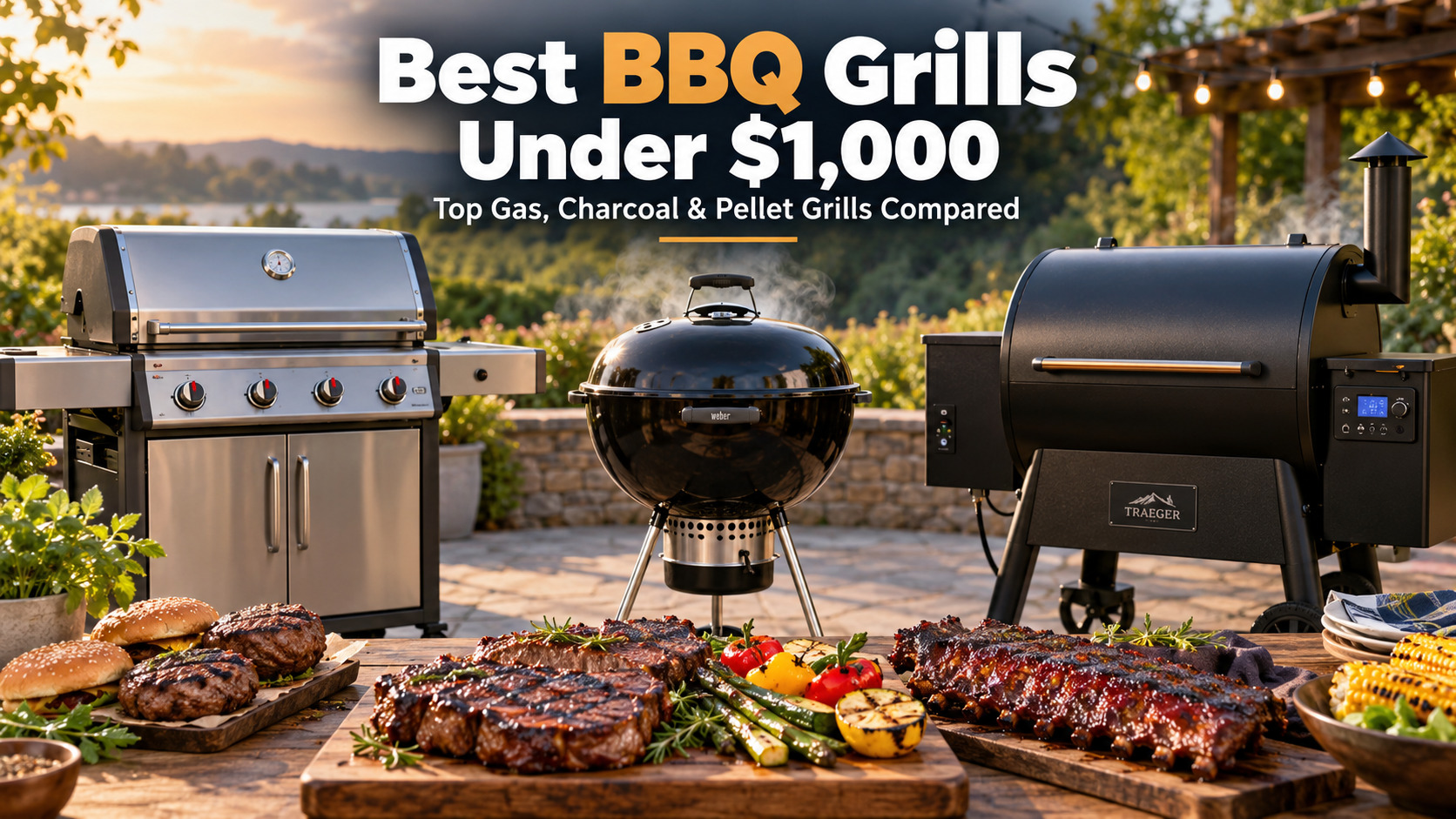
A $1,000 budget puts you in one of the most competitive and interesting parts of the outdoor cooking market. You are no longer restricted to bare-bones entry-level grills, but you also do not need to spend several thousand dollars to get excellent heat control, durable construction, useful cooking space and enough versatility for serious backyard barbecue.
The challenge is deciding where to put that money.
Should you buy a gas grill that can be fired up in minutes for burgers, steaks and weeknight dinners? Should you choose a traditional charcoal grill for maximum smoke and flame flavor? Or does a pellet grill make more sense because you want to smoke brisket, pork shoulder and ribs without constantly adjusting vents and fuel?
There is no universal winner because gas, charcoal and pellet grills approach outdoor cooking differently. Gas grills emphasize convenience and responsive temperature control. Charcoal grills prioritize fire management, high heat and classic BBQ flavor. Pellet grills concentrate on temperature stability and long unattended smoking.
For most buyers, the best BBQ grill under $1,000 is therefore not simply the model with the longest feature list. It is the grill whose strengths match the food you actually plan to cook.
This guide compares some of the strongest gas, charcoal and pellet grill options available around the under-$1,000 price level in 2026. It also explains the differences between fuel types, cooking performance, maintenance, operating costs, durability and versatility so you can choose a grill that makes sense for your backyard rather than simply buying the most expensive model your budget allows.
Prices frequently change because of seasonal promotions, retailer discounts and model updates. Consider the prices discussed here approximate purchasing benchmarks rather than permanent prices, and remember that accessories, covers, fuel and taxes can push the total cost of ownership above the grill’s advertised price.
Best BBQ Grills Under $1,000 at a Glance
| Grill | Fuel Type | Approximate Price | Best For |
|---|---|---|---|
| Weber Spirit E-425 | Gas | About $630–$680 | Best overall gas grill |
| Napoleon Rogue 425 | Gas | About $720–$800 | Premium gas grilling |
| Weber Genesis E-325W | Gas | Around $1,000 | Premium gas option near budget limit |
| Weber Original Kettle Premium 22″ | Charcoal | About $230–$250 | Best charcoal value |
| Weber Performer Premium 22″ | Charcoal | About $650 | Charcoal convenience |
| Masterbuilt Gravity Series 600 | Charcoal | About $800 | Digital charcoal cooking |
| Kamado Joe Classic Joe Series I | Charcoal | About $1,000 | Kamado grilling and smoking |
| Traeger Pro 575 | Pellet | About $800 | Easy pellet smoking |
| Pit Boss Navigator 850 | Pellet | About $700–$800 | Pellet value and cooking space |
| Z Grills 7002C2E WiFi | Pellet | About $780 | Affordable WiFi pellet cooking |
The right choice depends heavily on how you cook. Someone who grills chicken breasts three evenings per week has very different requirements from someone who starts a pork shoulder at midnight and wants it ready for lunch the following day.
Before looking at individual grills, it helps to understand what each fuel type actually gives you.
Gas vs Charcoal vs Pellet Grills: Which Type Is Best Under $1,000?
Spending more money does not eliminate the fundamental differences between grill types.
A $900 pellet grill still behaves differently from a $900 gas grill. Likewise, a premium charcoal grill requires more involvement than most gas grills even when both cost the same amount.
Understanding these differences is more important than comparing individual features.
Gas Grills
Gas grills are usually powered by liquid propane or a permanent natural gas connection.
Their biggest advantage is convenience.
Turn on the gas supply, ignite the burners and the grill can often be ready for cooking within approximately 10 to 15 minutes. Temperature adjustments are made with knobs instead of air vents, and shutting the grill down is equally straightforward.
Gas grills are especially good for:
- Burgers
- Steaks
- Chicken
- Sausages
- Seafood
- Vegetables
- Kebabs
- Weeknight dinners
- Large cookouts requiring repeated batches of food
They also make it easy to establish multiple temperature zones. You might keep one side extremely hot for searing while maintaining a lower temperature on another side for slower cooking.
The tradeoff is flavor.
Gas combustion is relatively clean compared with charcoal or wood. Food can still develop excellent browning, rendered fat and grilled flavor, but you generally do not get the same deep smoke profile produced naturally by burning charcoal or hardwood.
You can add wood chips or smoker accessories, but gas remains primarily a grilling fuel rather than the traditional choice for serious low-and-slow barbecue.
For people who cook outdoors several times per week, however, convenience often matters more than maximum smoke flavor. A grill that takes five minutes of effort to start may get used dramatically more often than one requiring a complicated fire-building process.
Charcoal Grills
Charcoal remains the traditional favorite for cooks who enjoy managing a real fire.
Charcoal grills can generate intense temperatures, making them excellent for steakhouse-style searing. They can also run at moderate or low temperatures when the charcoal and airflow are carefully controlled.
That means a well-designed charcoal grill can handle almost everything from hamburgers to brisket.
Charcoal is particularly good for:
- Steaks
- Burgers
- Chicken
- Ribs
- Pork shoulder
- Brisket
- Whole turkey
- Reverse-seared meat
- Smoke-roasted vegetables
- Traditional barbecue
The biggest advantage is flavor.
Dripping fat hits hot charcoal and creates aromatic smoke that rises back toward the food. Hardwood chunks can also be placed directly on the coals for additional smoke.
The disadvantage is labor.
You need to light the charcoal, wait for the fire to establish itself, arrange the coals appropriately and control heat using airflow. After cooking, you need to deal with ash.
Experienced charcoal users often consider these tasks part of the enjoyment. Someone who simply wants dinner ready quickly may consider them unnecessary work.
The arrival of digitally controlled charcoal grills such as the Masterbuilt Gravity Series has blurred this distinction. These grills use real charcoal but electronically regulate airflow, combining charcoal flavor with some of the convenience normally associated with pellet grills.
Pellet Grills
Pellet grills use compressed hardwood pellets that are automatically delivered from a storage hopper into a small burn pot.
An electric controller manages the process. You choose a target temperature, and the grill attempts to maintain it by adjusting how quickly pellets enter the fire and how combustion airflow is managed.
This makes pellet grills especially attractive for smoking.
Instead of repeatedly opening vents, adding wood and adjusting airflow, you can load the hopper, set the temperature and let the controller handle much of the work.
Pellet grills excel at:
- Brisket
- Pork shoulder
- Ribs
- Whole chicken
- Turkey
- Salmon
- Meatloaf
- Reverse-seared steaks
- Roasting
- Baking
- Long overnight cooks
Pellet grills provide wood-fired flavor, although the smoke profile is generally cleaner and milder than what you might produce with a traditional charcoal or offset smoker.
Their primary limitation is direct high-heat grilling.
Some pellet grills now offer higher maximum temperatures or mechanisms that expose food more directly to flame, but a traditional charcoal grill remains difficult to beat when your main objective is an aggressively charred steak cooked over intense radiant heat.
Pellet grills also require electricity. If the power fails, the feeding system and controller cannot operate normally.
Best Overall Gas Grill Under $1,000: Weber Spirit E-425
The Weber Spirit line has long occupied the middle ground between inexpensive mass-market gas grills and premium outdoor cooking equipment. The modern Spirit E-425 continues that approach while offering enough burner capacity and cooking flexibility for most households.
Current versions use four burners, and Weber incorporates a higher-powered searing area designed to provide additional heat when you want strong browning on steaks, burgers or chops. Current U.S. manufacturer pricing keeps the standard model comfortably below the $1,000 ceiling.
Why the Weber Spirit E-425 Stands Out
The strongest argument for the Spirit is balance.
It is large enough for entertaining without becoming a massive piece of backyard equipment. Four burners allow you to establish meaningful cooking zones, which is considerably more useful than simply having a large single-temperature surface.
For example, you can place steaks over the hottest burners while keeping vegetables at a lower temperature. You can also turn off one or two burners and use indirect heat for thicker pieces of chicken or meat.
That flexibility matters more than extremely high advertised burner output.
Good grilling is about controlling heat rather than simply generating as much heat as possible.
The Spirit also benefits from Weber’s large ecosystem of replacement components and cooking accessories. A grill is a long-term appliance, so being able to replace worn grates, ignition components and other parts can be more valuable than receiving a collection of unnecessary gadgets on the day you purchase it.
Cooking Performance
The Spirit E-425 is particularly well suited to common backyard foods.
Burgers cook quickly, chicken can be moved between direct and indirect zones, and the hotter searing section helps improve crust development on steaks.
Gas also makes repeated batch cooking easy.
If you are feeding a party and need to cook 30 burgers in several rounds, you do not need to worry about a charcoal fire declining halfway through the event. As long as sufficient propane remains in the tank, you can continue cooking.
Who Should Buy It?
The Weber Spirit E-425 is best for someone who wants:
- Fast startup
- Straightforward cleaning
- Enough space for a family or moderate-sized gathering
- Multiple cooking zones
- Strong everyday grilling performance
- A grill that can be used several nights per week
It is less appropriate for someone whose main objective is smoking brisket or producing extremely heavy wood-smoke flavor.
Verdict
For the average household seeking one dependable gas grill below $1,000, the Weber Spirit E-425 is one of the safest choices. It emphasizes the qualities that matter most—heat control, cooking flexibility and ease of use—without forcing buyers into luxury-grill pricing.
Best Premium Gas Grill Under $1,000: Napoleon Rogue 425
The Napoleon Rogue 425 is an attractive alternative for buyers who want something more premium-feeling while remaining below four figures.
Depending on configuration and promotions, Rogue 425 models generally sit in the upper hundreds of dollars. Napoleon’s current U.S. lineup includes Rogue 425 configurations below the $1,000 mark, with some propane versions priced around the low-to-mid $700 range during promotions.
What Makes the Rogue Different?
Napoleon competes directly with Weber in the premium mainstream gas-grill market.
The Rogue focuses heavily on robust construction, strong heat output and grilling performance. The grill is designed for cooks who want the simplicity of gas without feeling as though they purchased an entry-level appliance.
Three main burners give you enough flexibility for both direct and indirect cooking.
Different Rogue versions may also include features such as upgraded grids or side burners, so buyers should pay careful attention to exact model numbers rather than assuming every Rogue 425 has identical equipment.
Excellent Choice for Steak Lovers
Where the Rogue makes considerable sense is for someone who primarily grills meat.
Steaks, chops, sausages and burgers benefit from a grill capable of getting properly hot and recovering temperature reasonably quickly after the lid is opened.
This is important because advertised BTU numbers tell only part of the story.
Grill design, burner placement, distance between the flame and cooking grate, lid construction and heat retention all influence actual cooking performance.
A well-designed gas grill can therefore outperform a cheaper grill with an impressive-looking BTU number.
Build Quality Matters
A $200 gas grill and an $800 gas grill may initially appear to perform the same basic task: both burn propane beneath a grate.
The difference becomes more obvious after several years outdoors.
Burners experience heat cycles. Grease attacks internal components. Weather encourages corrosion. Igniters wear out. Thin metal can distort.
Moving into the middle and upper price range generally gives manufacturers more room to use stronger components and better engineering.
That does not mean an expensive grill will last forever, especially when left uncovered in a harsh climate. But durability becomes an increasingly important reason to spend more once basic cooking performance has been satisfied.
Who Should Buy It?
Choose the Rogue 425 if you want a premium-feeling gas grill for frequent grilling and are willing to spend more than entry-level Weber Spirit money for the construction and cooking experience you prefer.
For someone primarily interested in ribs and brisket, the money would still be better spent on a charcoal or pellet grill.
Premium Gas Option Near the $1,000 Limit: Weber Genesis E-325W
If your budget really does extend all the way to $1,000, selected Weber Genesis configurations can move into consideration.
Current Genesis E-325W and EX-325W configurations can sit around the $999 level depending on finish and fuel type.
The Genesis represents a meaningful move upward from the Spirit family rather than simply adding decorative trim.
You are buying into Weber’s more premium gas-grill platform with a larger overall presence and an emphasis on long-term outdoor cooking.
Should You Spend the Full $1,000 on Gas?
Not necessarily.
For many families, a Spirit will cook burgers, steaks and chicken extremely well while leaving several hundred dollars available for a cover, tools, thermometer, cast-iron cookware and high-quality ingredients.
The Genesis becomes more appealing if grilling is already an important hobby and you know you will use the additional size and premium construction.
A common buying mistake is purchasing the biggest grill possible simply because the budget allows it.
Cooking area that you rarely use still needs to be heated, cleaned and stored.
Buy the grill that matches your actual household and entertaining habits rather than the grill with the largest dimensions.
Best Charcoal Grill for the Money: Weber Original Kettle Premium 22″
Few products demonstrate the law of diminishing returns better than the Weber Original Kettle.
A 22-inch Original Kettle Premium costs only a fraction of the $1,000 budget yet can cook food that competes with grills costing several times more.
Current manufacturer pricing is approximately $230 to $250 depending on color or configuration. The grill provides a 22-inch charcoal cooking surface, adjustable vents, an integrated lid thermometer, hinged grate access and an enclosed ash collection system.
Why a Simple Kettle Works So Well
A kettle grill is essentially a carefully designed metal chamber for controlling fire and airflow.
That simplicity is a strength.
There are no electronic controllers, pellet augers or complicated burner assemblies required to cook.
For direct grilling, spread lit charcoal beneath the cooking grate.
For two-zone cooking, place charcoal on one side and leave the other side without direct heat.
For low-and-slow barbecue, arrange fuel so that charcoal gradually ignites over several hours while controlling airflow through the vents.
The same inexpensive grill can therefore cook a steak at high heat on Saturday evening and smoke pork shoulder on Sunday.
Excellent Searing Capability
Charcoal generates intense radiant heat.
Place a thick steak above a concentrated bed of hot lump charcoal or briquettes and you can create a deeply browned exterior that inexpensive gas grills may struggle to reproduce.
You are also cooking over combustion products from real fuel.
When meat drippings hit the hot charcoal, they vaporize and contribute to the characteristic flavor people associate with backyard grilling.
Smoking on a Kettle
The Weber Kettle is not marketed as a dedicated smoker, but it is remarkably capable when configured correctly.
You can arrange charcoal around one side or around part of the circumference, add hardwood chunks and place the meat away from direct heat.
The lid turns the grill into a compact convection chamber.
Maintaining a stable temperature requires practice, but many accomplished backyard cooks smoke excellent ribs, pork shoulder and even brisket on a kettle.
The Biggest Weakness: Workspace
The classic kettle design provides relatively little built-in preparation space.
A separate table quickly becomes useful for trays, sauces, thermometers and utensils.
That limitation is one reason Weber created the Performer line.
Who Should Buy It?
The Original Kettle Premium is ideal for:
- Beginners who want to learn charcoal grilling
- Experienced cooks who appreciate simplicity
- Steak lovers
- Budget-conscious BBQ enthusiasts
- People with limited patio space
- Anyone wanting maximum performance per dollar
If your goal is simply to cook excellent barbecue, spending the remaining $750 is completely optional.
Best Premium Traditional Charcoal Grill: Weber Performer Premium
The Performer concept takes Weber’s proven kettle cooking system and integrates it into a much more functional cart.
Current Performer models range upward through several configurations, with premium versions remaining below $1,000. Weber currently lists the 22-inch Performer Premium around $649, while smart versions move higher.
Why Pay More Than a Standard Kettle?
You are not necessarily paying for dramatically better flavor.
The underlying kettle cooking concept remains similar.
What you gain is usability.
Charcoal grilling involves handling raw food, cooked food, tools, seasoning, charcoal, thermometers and hot equipment. Having a proper work surface changes the experience significantly.
The Performer also gives the grill a more substantial permanent-station feel.
Instead of rolling a small kettle into the yard and setting up a separate table, you have an integrated backyard cooking center.
Is It Worth the Extra Money?
For occasional grilling, probably not.
A standard Original Kettle Premium delivers extraordinary value.
For someone cooking over charcoal multiple times per week, however, convenience matters.
Small improvements repeated hundreds of times become significant.
A larger work surface, better storage and easier organization can make charcoal grilling feel considerably less cumbersome.
This is especially useful if you want charcoal flavor but dislike the improvised workspace that often surrounds traditional kettle grills.
Best High-Tech Charcoal Grill Under $1,000: Masterbuilt Gravity Series 600
The Masterbuilt Gravity Series 600 is one of the most interesting choices in this entire comparison because it combines two cooking philosophies that were traditionally separate.
You get actual charcoal combustion, but an electronically controlled fan regulates the fire.
The Gravity Series 600 is currently priced around $799.99. Masterbuilt lists approximately 600 square inches of cooking space, temperatures up to about 700°F and a gravity-fed hopper capable of holding a substantial quantity of charcoal for extended cooking.
How the Gravity System Works
Instead of arranging charcoal directly beneath a conventional grill grate, you load charcoal into a vertical hopper.
The fuel gradually feeds downward toward the combustion area.
An electronically controlled fan regulates airflow according to your selected temperature.
This gives you a user experience somewhat similar to a pellet smoker:
- Load fuel.
- Light the fire.
- Select the desired temperature.
- Allow the controller to regulate the cook.
But instead of burning hardwood pellets, the system burns real charcoal.
You can also incorporate wood chunks to modify the smoke profile.
Charcoal Flavor Without Constant Vent Adjustment
This solves one of the major objections people have to traditional charcoal smoking.
A conventional smoker requires you to understand combustion.
Too much airflow can make the fire run hot. Too little can create weak or dirty combustion. Fuel quantity, ambient temperature and weather conditions can all affect the cook.
The Gravity system automates much of that work.
For a busy person who loves charcoal flavor but does not want to babysit a fire for ten hours, that is extremely attractive.
High-Heat Capability
The Masterbuilt is not restricted to low-temperature barbecue.
Its high maximum temperature means it can also handle grilling and searing duties.
That makes it significantly more versatile than a traditional cabinet smoker.
You could smoke a large cut at a low temperature, remove it temporarily, increase the grill temperature and finish with higher heat.
The Tradeoff: Complexity
A Weber Kettle contains very little that can fail.
A digital charcoal grill contains:
- Electronics
- Temperature sensors
- A controller
- A powered fan
- Wiring
- Mechanical switches
- Additional moving or replaceable components
That does not automatically make it unreliable, but complexity always creates additional potential maintenance points.
People who value extreme mechanical simplicity may prefer a kettle or ceramic kamado.
People who value convenience may consider the electronic system well worth the trade.
Best Ceramic Charcoal Grill Under $1,000: Kamado Joe Classic Joe Series I
The Kamado Joe Classic Joe Series I sits almost exactly at the upper edge of this buying guide.
Current manufacturer pricing is approximately $999.99 for the standard Series I model. It uses an 18-inch ceramic kamado design and includes Kamado Joe’s multi-level cooking system and slide-out ash drawer.
What Makes a Kamado Different?
A kamado is a thick, insulated charcoal cooker.
Traditional metal charcoal grills allow heat to escape relatively quickly through their walls. A ceramic kamado stores a significant amount of thermal energy.
Once the ceramic body becomes hot, the cooker can maintain stable temperatures using surprisingly small amounts of airflow.
This creates exceptional fuel efficiency and makes kamados effective for long cooks.
Low-and-Slow Cooking
Close the vents down and a kamado can maintain barbecue temperatures for extended periods with a relatively modest charcoal load.
Add hardwood chunks to the charcoal and you can produce rich smoke flavor for:
- Brisket
- Ribs
- Pork shoulder
- Beef ribs
- Turkey
- Whole chicken
Because airflow can be kept low, food also tends to retain moisture well.
Extremely High Temperatures
The opposite capability is equally important.
Open the vents and provide sufficient fuel, and a kamado can become extremely hot.
That makes it excellent for pizza and steak.
Few grills transition from long-duration low-temperature smoking to extremely high-temperature cooking as naturally as a ceramic kamado.
Why Not Recommend It to Everyone?
The first limitation is size.
An 18-inch circular cooking area is versatile but not enormous. If you regularly cook for a large crowd, rack arrangement becomes important.
The second issue is weight.
Ceramic grills are heavy. Once positioned on a patio, they are not something most owners casually move around every evening.
Ceramic can also crack if severely abused or subjected to certain forms of impact.
Finally, temperature changes are slower.
Because the ceramic body stores so much heat, recovering from an accidental overshoot can take time. If you wanted 250°F but let the cooker climb to 450°F, simply closing the vents will not instantly remove the stored thermal energy.
Kamado cooking rewards patience.
Who Should Buy It?
The Classic Joe Series I is an excellent choice for someone who sees barbecue as a hobby rather than merely a way to prepare dinner.
It is especially compelling for people who want one charcoal cooker capable of smoking, roasting, baking and extremely high-temperature grilling.
Best Overall Pellet Grill Under $1,000: Traeger Pro 575
Traeger helped turn pellet cooking into a mainstream backyard category, and the Pro 575 remains one of the company’s most recognizable midrange grills.
Current manufacturer pricing is about $799.99. The Pro 575 incorporates Traeger’s electronic temperature control and WiFIRE connectivity, allowing compatible app-based monitoring and control.
Why Pellet Grills Are So Popular
Traditional barbecue has a romantic image: a pitmaster tending a fire all night while smoke slowly transforms a large piece of meat.
In reality, many people do not want to manage a fire at 3 a.m.
Pellet grills automate the tedious portion of barbecue.
Fill the hopper with pellets, set a temperature and allow the system to maintain combustion.
You still need to prepare the meat properly, understand when the food is finished and make decisions about wrapping, resting and seasoning, but managing the fire becomes much easier.
Where the Pro 575 Excels
The Pro 575 makes the most sense for someone whose priorities include:
- Smoking
- Roasting
- Set-and-monitor cooking
- Consistent temperatures
- Connected features
- Moderate household cooking capacity
It is particularly attractive for long cooks.
A pork shoulder might remain on the grill for many hours. With a manually controlled charcoal smoker, you would periodically verify fuel and airflow.
With a pellet grill, you can spend much more time focusing on the food rather than the fire.
Smoke Flavor
Pellet grills produce genuine hardwood smoke, but prospective buyers should have realistic expectations.
A pellet grill does not necessarily generate the same aggressive smoke profile as a traditional offset smoker burning full pieces of wood.
Pellet combustion is relatively efficient and controlled.
Many people prefer the cleaner, milder flavor. Others want heavier smoke.
Neither preference is wrong.
Grilling Performance
The Pro 575 can cook burgers and steaks, but someone primarily interested in extreme direct-heat searing may be happier with charcoal or gas.
Pellet grills shine when cooking with the lid closed.
Think of them as wood-fired outdoor convection cookers that can grill rather than as direct replacements for every function of a charcoal kettle.
Who Should Buy It?
Choose the Traeger Pro 575 if you want to learn barbecue without making fire management your second hobby.
It is particularly suitable for beginners who are intimidated by traditional smokers but still want to cook ribs, pork shoulder and brisket at home.
Best Pellet Grill for Cooking Space and Value: Pit Boss Navigator 850
The Pit Boss Navigator 850 makes a strong argument for buyers who want more cooking capacity and features for their money.
The current Navigator 850 Connected Grill provides approximately 932 square inches of cooking space, a 30-pound pellet hopper, WiFi and Bluetooth connectivity and an operating temperature range around 180°F to 500°F. Manufacturer pricing has recently been around $700 to $800 depending on promotions.
Lots of Grill for the Money
The Navigator’s most obvious advantage is size.
Cooking-space specifications can be deceptive because manufacturers sometimes include warming racks in the total number. Even so, the Navigator offers substantial capacity for its price class.
That makes it appealing to families who regularly cook:
- Several racks of ribs
- Multiple pork shoulders
- Whole chickens
- Large batches of wings
- Burgers for a gathering
A small grill can produce excellent barbecue, but capacity becomes important when smoking.
You cannot simply cook a second batch of brisket in 15 minutes.
Large cuts may occupy the cooker for eight, ten or twelve hours, so having enough space from the beginning matters.
Direct-Flame Capability
Pit Boss also emphasizes its Flame Broiler system.
This provides another reason to consider the Navigator if you want a pellet grill but still occasionally cook foods that benefit from more direct heat.
It does not turn the grill into a dedicated charcoal searing machine, but it expands versatility beyond pure indirect smoking.
Large Pellet Hopper
A large hopper is particularly useful during long cooks.
Pellet consumption varies significantly with cooking temperature, weather and grill design, but additional pellet capacity reduces the likelihood that you will need to refill the grill during an overnight session.
This is easy to overlook when shopping.
Smartphone connectivity gets more attention in advertising, but physical hopper capacity can have a bigger effect on day-to-day usability.
Who Should Buy It?
The Navigator 850 is ideal for someone who wants:
- Pellet convenience
- Large cooking capacity
- Connected controls
- Smoking versatility
- Better value per square inch than many premium brands
For families and frequent entertainers, it may make more sense than paying primarily for a more famous brand name.
Best Alternative WiFi Pellet Grill: Z Grills 7002C2E WiFi
Z Grills has become increasingly competitive in the value-focused pellet market.
The updated 7002C2E WiFi has recently been offered around the upper-$700 range and incorporates WiFi capability, a large pellet hopper and modern electronic temperature management.
Why Consider Z Grills?
Competition has been good for pellet-grill buyers.
Features that were once associated primarily with premium models—PID-style temperature management, meat-probe support, hopper cleanout systems and wireless connectivity—have gradually moved into less expensive grills.
The 7002C2E demonstrates that trend.
It is worth considering if you want many of the conveniences associated with mainstream premium pellet grills but would rather maximize features and capacity within a fixed budget.
Where Established Brands Still Have an Advantage
Price and specifications are not the entire story.
When comparing pellet grills, consider:
- Replacement-part availability
- Customer support
- App quality
- Controller reliability
- Warranty
- Accessory availability
- Long-term brand support
A grill might remain on your patio for many years. The ability to obtain an igniter or replacement temperature sensor several seasons later matters.
That is one reason the cheapest grill is not automatically the best value.
Which Grill Is Best for Steaks?
For pure steak performance, charcoal remains extremely difficult to beat.
A concentrated bed of hot charcoal produces intense radiant energy and direct flame interaction.
Among the grills in this guide, the Kamado Joe Classic Joe and Weber Kettle are exceptional steak cookers.
The Kamado can reach very high temperatures while its thick ceramic body retains enormous heat.
The Weber Kettle takes a simpler approach but can still produce spectacular results with charcoal arranged close to the grate.
If you prefer gas, the Napoleon Rogue 425 and Weber Spirit E-425 are excellent alternatives.
Gas is especially attractive if you cook steak frequently because there is almost no fire-building ritual.
For reverse-searing, pellet grills become more competitive.
You can slowly bring a thick steak toward its desired internal temperature in smoke and then finish it over higher heat.
However, if the final crust is your top priority, a separate charcoal or high-output gas searing stage often produces better results.
Which Grill Is Best for Brisket?
Pellet grills are arguably the easiest option for beginners cooking brisket.
A Traeger Pro 575 or Pit Boss Navigator allows you to select a low cooking temperature and maintain it for many hours with relatively little intervention.
That does not make brisket foolproof.
You still need to understand:
- Meat selection
- Trimming
- Seasoning
- Bark development
- Wrapping
- Internal tenderness
- Resting
But stable pit temperature eliminates one major variable.
For maximum charcoal flavor with automated temperature control, the Masterbuilt Gravity Series 600 is especially compelling.
More experienced cooks may prefer a Kamado Joe or Weber Kettle because managing charcoal manually gives them greater involvement in the process.
Which Grill Is Best for Ribs?
Ribs work beautifully on all three fuel types.
Pellet grills are easiest because ribs are typically cooked at relatively low temperatures for several hours.
Charcoal produces a stronger traditional barbecue profile.
Gas requires additional smoke-generating techniques if smoke flavor is important, but indirect gas heat can still cook extremely tender ribs.
If ribs are one of your main reasons for buying a grill, prioritize cooking area.
A rack of ribs consumes a surprising amount of horizontal space.
A Pit Boss Navigator 850 becomes particularly attractive when cooking multiple racks.
Which Grill Is Best for Burgers and Hot Dogs?
Gas wins on convenience.
A Weber Spirit can be started quickly, preheated while you prepare the food and shut down immediately after dinner.
That makes it perfect for hamburgers, hot dogs and sausages.
Charcoal may produce better flavor, but spending 20 or 30 minutes preparing the fire for a few hot dogs does not appeal to everyone.
Pellet grills can cook burgers, but they are usually not the first choice if quick direct grilling represents most of your outdoor cooking.
Which Grill Is Best for Beginners?
The easiest overall grill for a complete beginner is gas.
Controls are familiar and intuitive. Turn the knob higher for more heat and lower for less.
A pellet grill is the easiest choice for someone specifically interested in smoking.
You do not need to learn complex fire-management techniques before successfully cooking ribs or pork shoulder.
Traditional charcoal has the steepest initial learning curve but teaches the most about fire.
Learning to control a kettle helps you understand airflow, fuel arrangement, direct heat and indirect heat—fundamental concepts that transfer to many other forms of barbecue.
How Much Cooking Space Do You Really Need?
Manufacturers love advertising enormous cooking-area numbers because bigger numbers look more impressive.
Do not automatically assume bigger is better.
A couple cooking primarily for themselves does not need a 1,000-square-inch grill.
Large grills have disadvantages:
- They occupy more patio space.
- They can consume more fuel.
- They require more cleaning.
- They are harder to move.
- They usually cost more.
- Large surfaces may be unnecessary for normal meals.
For two to four people, a medium grill is usually sufficient.
For families of four to six, additional room becomes useful, particularly when cooking multiple food types simultaneously.
If you regularly entertain ten or more people, cooking space should become a major purchasing consideration.
Smokers deserve special consideration because smoked meat occupies the grill for long periods.
You cannot rapidly rotate food through a smoker the way you can batch-cook burgers.
How Important Is Maximum Temperature?
Maximum temperature is important, but it is frequently overemphasized.
A grill capable of reaching 700°F is not automatically superior to one that reaches 600°F.
Heat distribution, radiant intensity and grate design matter too.
For most everyday grilling, temperatures between approximately 350°F and 500°F handle an enormous range of foods.
Very high heat becomes most valuable for:
- Steak searing
- Thin burgers
- Pizza
- Certain vegetables
- Rapid browning
For barbecue, the opposite end of the range matters more.
A smoker needs to maintain low temperatures consistently.
A pellet grill that holds 225°F steadily for ten hours may be far more useful for brisket than one with an impressive maximum-temperature specification.
Build Quality: Where Your Money Should Go
When comparing a $300 grill with an $800 grill, look beyond electronic features.
Spend money on the physical cooker first.
Important areas include:
Cooking Grates
Grates should be sufficiently substantial to handle repeated heating and cleaning.
Cast iron stores heat extremely well but requires care against corrosion.
Stainless steel can be easier to maintain and may last a long time when constructed properly.
Firebox Construction
The hottest components live a hard life.
Thin metal exposed repeatedly to grease, salt, moisture and high temperatures can deteriorate.
Inspect the quality of the firebox, burner covers, grease-management components and seams.
Lid
A sturdy lid improves heat retention and contributes to temperature stability.
This is particularly important when roasting and smoking.
Wheels and Cart
A grill may weigh 100 pounds or considerably more.
Cheap wheels and unstable legs become irritating every time you move it.
Shelves
Workspace sounds boring until you begin cooking.
Having enough room for a cutting board, tray, thermometer and seasonings can improve the entire experience.
Smart Features: Worth Paying For?
WiFi and Bluetooth controls are increasingly common, especially on pellet grills.
They can be useful.
Imagine smoking a pork shoulder at 250°F while watching a movie indoors. Being able to verify grill and food temperature without repeatedly walking outside is genuinely convenient.
Connected controls are particularly useful for:
- Overnight cooks
- Cold weather
- Long brisket cooks
- Pork shoulder
- Large turkey
- Monitoring food while entertaining guests
However, connectivity should not compensate for poor grill construction.
A strong grill with a basic controller is better than a cheaply built grill with an impressive smartphone application.
Technology also ages faster than steel.
A grill might remain mechanically useful for 15 years while today’s mobile software becomes outdated much sooner.
Consider smart features a bonus rather than the foundation of your buying decision.
Fuel Costs: Gas vs Charcoal vs Pellets
The purchase price is only the beginning.
Every outdoor cooker requires fuel.
Propane
Propane is clean, convenient and widely available.
A standard tank lasts through multiple grilling sessions depending on burner settings and cooking duration.
For quick meals, gas can be economically attractive because you burn fuel only while the grill is operating.
Natural Gas
If your home already has an appropriate outdoor natural gas connection, a natural-gas grill offers tremendous convenience.
You do not need to refill tanks.
However, propane and natural-gas grills are normally configured specifically for their fuel type. Never assume you can simply connect one fuel to a grill designed for another.
Charcoal
Charcoal cost varies considerably.
Briquettes are generally predictable and convenient for long cooks.
Lump charcoal can burn differently depending on piece size and brand but is popular among kamado users and enthusiasts.
Efficient grills such as kamados can make surprisingly good use of charcoal because unburned fuel can sometimes be saved for future cooks.
Wood Pellets
Pellet consumption depends heavily on temperature.
Smoking at 225°F consumes pellets much more slowly than running a grill near maximum temperature.
Cold or windy conditions can also increase consumption because the grill must burn additional fuel to maintain its set point.
Cleaning and Maintenance
All grills require maintenance.
Marketing sometimes makes modern outdoor cookers appear almost automatic, but grease, smoke and combustion residue have to go somewhere.
Gas Grill Maintenance
Regularly clean:
- Cooking grates
- Grease trays
- Burner covers
- Interior grease buildup
- Burner openings when necessary
Inspect hoses and gas connections according to manufacturer instructions.
Charcoal Grill Maintenance
Remove ash after cooking.
Ash can retain moisture, and allowing large amounts to sit inside a grill unnecessarily is not good long-term practice.
Clean accumulated grease from the bowl and lid periodically.
Pellet Grill Maintenance
Pellet grills require several forms of cleaning:
- Vacuum ash from the burn area.
- Clean grease-management components.
- Scrape cooking grates.
- Keep the temperature sensor reasonably clean.
- Avoid allowing pellets to absorb moisture inside the hopper.
Wet pellets can swell, crumble and create feeding problems.
A pellet grill should therefore be protected carefully from weather.
Do You Need a Grill Cover?
For most grills, yes.
A cover is one of the least exciting but most sensible accessories you can buy.
Rain, snow, dust, pollen and sunlight all contribute to cosmetic and mechanical deterioration.
A cover does not make a grill immortal, and moisture can still become trapped if conditions are poor, but protecting an expensive cooker from direct weather exposure generally makes sense.
If your $1,000 budget is strict, consider buying an $850 grill plus a quality cover rather than spending every dollar on the grill itself.
Accessories Worth Buying
You do not need an enormous collection of BBQ accessories.
A few high-quality tools are enough.
The most useful purchases include:
- Reliable instant-read thermometer
- Leave-in meat thermometer for long cooks
- Long grilling tongs
- Grill brush or appropriate grate-cleaning tool
- Heat-resistant gloves
- Charcoal chimney for kettle users
- Heavy-duty aluminum foil or butcher paper for barbecue
- Grill cover
- Large cutting board
A thermometer deserves special emphasis.
Cooking by time alone is unreliable because meat thickness, starting temperature, weather and grill temperature vary.
Internal temperature and tenderness provide much better information.
Gas Grill Pros and Cons
Advantages
Gas is exceptionally convenient.
Startup is fast, heat is easy to adjust, shutdown is simple and cleanup is relatively manageable.
It is the best choice for many families who primarily cook normal dinners outdoors.
Disadvantages
Gas produces less natural smoke flavor.
Complex burner assemblies may eventually require replacement parts.
Propane users also need to monitor tank level.
Charcoal Grill Pros and Cons
Advantages
Charcoal produces excellent flavor, intense heat and enormous cooking versatility.
Simple charcoal grills can also be extraordinarily affordable.
Disadvantages
Lighting takes longer.
Temperature control requires practice.
Ash cleanup is unavoidable.
Smoke can also be inconvenient in dense neighborhoods.
Pellet Grill Pros and Cons
Advantages
Pellet grills make low-and-slow barbecue accessible to beginners.
Temperature control is straightforward, smoke is generated automatically and long cooks require relatively little fire management.
Disadvantages
They require electricity.
Electronic components increase complexity.
Pellets must remain dry.
High-heat direct grilling is generally not their strongest capability.
Best Grill Under $1,000 for Different Buyers
Best for Everyday Family Cooking: Weber Spirit E-425
Gas convenience wins when the grill needs to become part of normal weekday life.
Best for Serious Steak Lovers: Kamado Joe Classic Joe Series I
The kamado’s ability to retain and generate intense heat makes it a formidable steak cooker while still supporting low-and-slow barbecue.
Best Budget Grill: Weber Original Kettle Premium
Few grills provide as much cooking capability for approximately $250.
Best for Beginners Interested in Smoking: Traeger Pro 575
Straightforward electronic temperature control eliminates much of the intimidation associated with learning barbecue.
Best Pellet Value: Pit Boss Navigator 850
Large cooking capacity and connected controls make the Navigator attractive for buyers focused on features per dollar.
Best Charcoal Grill for Convenience: Masterbuilt Gravity Series 600
It delivers genuine charcoal combustion while electronically managing airflow and temperature.
Best Traditional Charcoal Setup: Weber Performer Premium
It preserves traditional kettle cooking while adding the workspace and organization missing from a basic kettle.
Best Premium Gas Alternative: Napoleon Rogue 425
A strong choice for buyers seeking durable construction and serious gas-grilling performance without breaking the four-figure threshold.
Can One Grill Do Everything?
Not perfectly.
That is one of the most important lessons in outdoor cooking.
The best steak grill is not necessarily the easiest brisket smoker.
The easiest weeknight grill may not create your favorite smoke flavor.
Many BBQ enthusiasts eventually own more than one cooker because specialized grills complement each other.
For example:
Gas grill + pellet smoker: Excellent combination for convenience. Use gas for quick dinners and pellet for barbecue.
Gas grill + charcoal kettle: Affordable and extremely versatile. Gas handles weekdays while charcoal handles steaks and weekend barbecue.
Pellet grill + charcoal kettle: A powerful combination for serious BBQ enthusiasts. Pellet handles long smoking sessions while charcoal provides intense direct heat.
Interestingly, buying two good grills can still fit within a $1,000 budget.
A Weber Original Kettle Premium combined with a midrange pellet grill can provide more total cooking versatility than spending the entire budget on one premium appliance.
Should You Spend the Full $1,000?
Only when the additional money solves a real problem.
Do not automatically spend $999 because your budget is $1,000.
A $250 Weber Kettle might genuinely be the best grill for you.
The remaining money could purchase:
- Quality meat
- Charcoal
- Wood chunks
- Thermometers
- Accessories
- A prep table
- Outdoor lighting
- A cover
Likewise, someone who only grills burgers twice per month probably does not require an expensive connected grill.
Spend according to frequency and cooking style.
The more often you use a grill, the easier it becomes to justify spending money on durability and convenience.
How Long Should a Good Grill Last?
There is no universal lifespan.
Climate, maintenance, construction quality and usage intensity matter enormously.
A grill stored beneath a covered patio in a dry climate experiences a much easier life than one sitting uncovered beside the ocean.
Salt, humidity and rain accelerate corrosion.
Cleaning also matters.
Grease and food residue can trap moisture and contribute to deterioration.
One advantage of established manufacturers is replacement-parts availability.
Burners and ignition components may wear out before the entire grill body does.
Replacing a relatively inexpensive part can extend the grill’s usable life substantially.
Frequently Asked Questions
What is the best BBQ grill under $1,000 overall?
For most people who primarily grill burgers, steaks, chicken and vegetables, the Weber Spirit E-425 is one of the most balanced choices because it combines convenience, multiple burners and strong everyday cooking performance.
For someone primarily interested in barbecue and smoking, a pellet grill such as the Traeger Pro 575 or Pit Boss Navigator 850 may be a better overall purchase.
For charcoal enthusiasts, the Kamado Joe Classic Joe Series I offers exceptional versatility near the top of the budget, while the Weber Original Kettle Premium provides extraordinary value at a much lower price.
Is a $1,000 grill worth it?
A $1,000 grill can be worth the money if you cook outdoors frequently.
Higher-priced grills generally offer some combination of better construction, larger cooking surfaces, stronger carts, more capable temperature control and better convenience features.
However, spending $1,000 is not necessary to produce excellent food.
Cooking technique matters more than price.
Is charcoal better than gas?
Charcoal is generally better for people prioritizing traditional grilled flavor and high radiant heat.
Gas is better for convenience.
Neither is objectively superior.
A charcoal grill that takes extra time to light provides little benefit if that inconvenience causes you to cook outdoors only twice per year.
Are pellet grills better than charcoal smokers?
Pellet grills are easier to control.
Charcoal smokers give the cook greater control over the fire and can produce a stronger traditional smoke profile.
Beginners often achieve more consistent early results using pellets because electronic controllers handle much of the combustion management.
Can a pellet grill replace a gas grill?
For some people, yes.
A pellet grill can cook burgers, chicken, vegetables and many other foods normally prepared on gas.
However, gas generally preheats faster and provides more convenient direct grilling.
If quick weeknight cooking is your priority, gas remains difficult to beat.
Can a gas grill smoke meat?
Yes.
You can cook meat indirectly at relatively low temperatures and use smoker boxes or other methods to introduce wood smoke.
However, gas is usually less convenient for serious smoking than a dedicated pellet, charcoal or wood-burning cooker.
Can you smoke brisket on a Weber Kettle?
Yes.
A 22-inch kettle can be configured for indirect low-temperature cooking using carefully arranged charcoal and wood chunks.
It requires more fire management than a pellet grill but can produce excellent brisket.
Is a kamado worth $1,000?
For an enthusiastic outdoor cook, it can be.
A ceramic kamado can smoke at low temperatures, roast, bake and generate extremely high heat.
Its versatility and fuel efficiency make it more than simply a charcoal grill.
For casual hamburger cooking, however, a much cheaper kettle is sufficient.
Is WiFi necessary on a grill?
No.
WiFi is convenient rather than essential.
It is most useful for long cooks when you want to monitor temperature without standing beside the grill.
Excellent barbecue was produced for generations before connected grills existed.
What grill is easiest to clean?
Gas grills are generally among the easiest for routine use because there is no charcoal ash.
However, grease trays and burner-area components still require cleaning.
Pellet grills create both grease and combustion ash.
Charcoal grills require ash disposal after cooking.
What is the best grill for a small patio?
A 22-inch Weber Kettle offers extraordinary capability in a small footprint.
A smaller gas grill can also work well if open-flame cooking is permitted.
Always follow local building, apartment and fire regulations regarding grill placement.
Which grill is best for a large family?
The Pit Boss Navigator 850 is attractive for a family that wants significant smoking capacity.
For people focused on direct grilling, a four-burner gas grill such as the Weber Spirit E-425 provides convenient space for multiple foods and heat zones.
What is the best first grill?
If you simply want to cook outside, start with gas.
If you want to learn the fundamentals of fire and barbecue, start with a Weber Kettle.
If your main goal is smoking brisket and ribs with minimal fire management, start with a pellet grill.
Final Verdict: The Best BBQ Grills Under $1,000
There has probably never been a better time to shop for an outdoor cooker in the sub-$1,000 category.
Buyers can choose between sophisticated gas grills, digitally controlled charcoal cookers, ceramic kamados, WiFi-connected pellet smokers and remarkably capable traditional kettles.
The key is resisting the temptation to compare them only by price.
A Weber Original Kettle Premium costing roughly one-quarter of the budget can outperform far more expensive grills at certain tasks.
A $1,000 ceramic kamado provides capabilities a basic kettle cannot match as easily.
A pellet smoker provides a level of unattended temperature control traditional charcoal cannot offer without additional equipment.
A four-burner gas grill delivers convenience that neither charcoal nor pellets can completely duplicate.
For the best everyday gas grill, the Weber Spirit E-425 is the most balanced recommendation. It heats quickly, provides useful multi-zone cooking and fits comfortably below the $1,000 ceiling.
For buyers wanting a more premium gas option, the Napoleon Rogue 425 deserves serious consideration, particularly for frequent steak, burger and chicken grilling.
For the best charcoal grill value, the Weber Original Kettle Premium 22-inch remains extremely difficult to beat. Its combination of low price, high-temperature grilling and legitimate smoking capability makes it one of the most versatile outdoor cookers available at any price.
For buyers who want charcoal flavor without constantly managing vents, the Masterbuilt Gravity Series 600 provides one of the most compelling combinations of traditional fuel and modern temperature control.
For charcoal enthusiasts willing to use nearly the entire budget, the Kamado Joe Classic Joe Series I offers remarkable versatility. It can smoke slowly, roast efficiently and reach the temperatures required for aggressive steak searing and pizza.
For easy wood-fired smoking, the Traeger Pro 575 remains one of the strongest mainstream pellet choices.
For buyers seeking more cooking capacity and features for the money, the Pit Boss Navigator 850 provides particularly strong value.
The final decision should come down to how you actually cook.
Choose gas if outdoor cooking needs to be fast and convenient.
Choose charcoal if flavor, fire and high heat matter most.
Choose pellets if your dream is making brisket, pork shoulder and ribs while spending less time tending the fire.
And remember that the best BBQ grill under $1,000 is not necessarily the grill that costs $999.99.
It is the grill you will enjoy using often enough to become a better cook every time you light it.