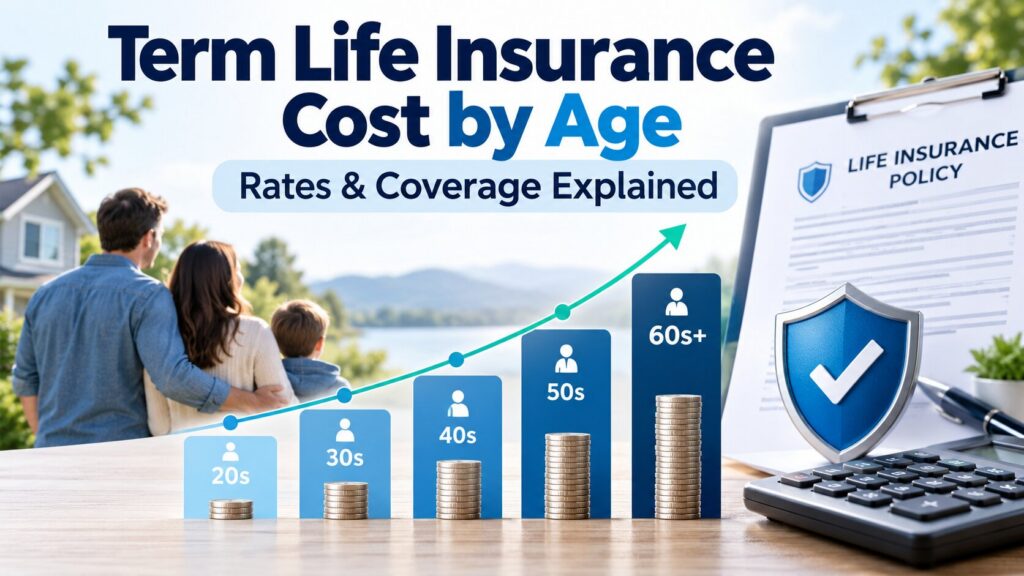
Term life insurance can be one of the most affordable ways to create a substantial financial safety net for your family, but the price you pay depends heavily on one factor you cannot change: your age.
A healthy person who purchases a term life insurance policy in their 20s or early 30s may be able to secure hundreds of thousands of dollars in coverage for a relatively modest monthly premium. Someone applying for the same policy at age 50, 60, or 70 may pay several times more.
That difference exists because life insurance pricing is based largely on mortality risk. As a person gets older, the statistical likelihood that the insurer will need to pay a death benefit during the policy term increases. Insurers compensate for that additional risk by charging higher premiums.
Age is important, but it is far from the only consideration. Your health, tobacco use, family medical history, occupation, driving history, hobbies, coverage amount, term length, and underwriting classification can all affect the final rate.
Understanding how these factors interact can help you determine when to buy term life insurance, how much coverage you may need, and whether a 10-year, 20-year, or 30-year term makes the most financial sense.
This guide explains term life insurance costs by age, provides illustrative 2026 rate examples, and examines how coverage amounts, health classifications, smoking, term lengths, and other underwriting factors influence what you may ultimately pay.
What Is Term Life Insurance?
Term life insurance provides life insurance protection for a specific period rather than permanently.
Common term lengths include:
- 10 years
- 15 years
- 20 years
- 25 years
- 30 years
- 40 years with some insurers
During the policy term, you pay the required premium to keep the policy active. If you die while the coverage is in force, the insurer generally pays the policy’s death benefit to your designated beneficiaries, subject to the policy terms and any applicable exclusions.
For example, suppose you purchase a $500,000 20-year term life insurance policy at age 35.
If you die at age 48 while the policy remains active, your beneficiaries may receive the $500,000 death benefit.
If you remain alive when the policy expires at age 55, the original term coverage generally ends without a payout.
Unlike many permanent life insurance products, ordinary term life insurance generally does not accumulate cash value.
This simplicity is one reason term life insurance is often much less expensive than permanent life insurance.
A term policy may be particularly useful when you have a large temporary financial responsibility, such as:
- Replacing income while children are financially dependent on you
- Paying off a mortgage
- Covering household expenses
- Funding future education expenses
- Paying outstanding debts
- Supporting a spouse who depends on your income
- Protecting a business
- Providing financial security until retirement assets become sufficient
The goal is typically to maintain substantial coverage during the period when your death would create the greatest financial burden.
How Much Does Term Life Insurance Cost?
Term life insurance can range from less than $20 per month for some young, healthy applicants to hundreds or even thousands of dollars per month for older applicants, smokers, or people with significant health risks.
There is therefore no single average premium that accurately describes what everyone will pay.
Consider a healthy nonsmoker purchasing approximately $500,000 of coverage for 20 years.
Illustrative preferred-rate pricing may look roughly like this:
| Age | Female Monthly Premium | Male Monthly Premium |
|---|---|---|
| 20 | About $15 | About $17–$18 |
| 30 | About $15–$18 | About $18–$25 |
| 40 | About $23–$30 | About $27–$35 |
| 50 | About $53–$70 | About $68–$90 |
| 60 | About $135–$160 | About $190–$220 |
| 70 | About $660+ | About $800+ |
These figures are illustrative rather than guaranteed quotes. They generally represent applicants receiving favorable underwriting classifications.
An applicant with average health, tobacco use, significant medical conditions, or other risk factors could pay substantially more.
The table nevertheless demonstrates the fundamental relationship between age and term life insurance premiums.
The difference between buying coverage at age 30 and waiting until age 50 can be substantial.
Waiting until age 60 can increase the cost dramatically.
Why Does Term Life Insurance Get More Expensive With Age?
Life insurance companies are essentially pricing the probability that they will have to pay a death benefit during the insured period.
Suppose two healthy people each apply for a 20-year policy.
One applicant is 30.
The other is 60.
The 30-year-old would be covered until approximately age 50.
The 60-year-old would potentially be covered until approximately age 80.
Statistically, the probability of death during those periods is very different.
The insurer therefore needs to collect substantially more premium from the older applicant to compensate for the increased likelihood of paying a claim.
Insurance companies rely on mortality statistics, actuarial models, medical information, and underwriting data when determining premiums.
Age is especially important because mortality risk generally increases as people get older.
That is why life insurance premiums often rise relatively slowly in your 20s and early 30s but begin accelerating in your 40s, 50s, and 60s.
Term Life Insurance Cost by Age in 2026
The following sections provide a closer look at how term life insurance pricing may change through different stages of life.
The exact rates available to you can differ significantly from these examples, but understanding the general pattern can help with financial planning.
Term Life Insurance Cost in Your 20s
Your 20s are typically one of the least expensive periods in which to purchase term life insurance.
A healthy nonsmoker may qualify for the insurer’s best or near-best underwriting class.
For a 20-year policy providing $500,000 of coverage, monthly premiums may sometimes fall around:
- Female applicant: approximately $15 to $25 per month
- Male applicant: approximately $18 to $30 per month
Higher coverage amounts can still be relatively affordable.
A healthy person in their 20s might potentially obtain $1 million of term coverage for considerably less than an older applicant would pay for half that amount.
Do You Need Life Insurance in Your 20s?
Not everyone needs substantial life insurance at age 20.
If nobody relies financially on you and you have few financial obligations, your need for coverage may be limited.
However, coverage may make sense if you:
- Are married
- Have children
- Support parents or relatives
- Share a mortgage
- Have private debts that another person would become responsible for
- Own a business
- Expect your financial responsibilities to increase soon
There is another potential advantage to buying young.
With a level term policy, your premium generally remains fixed during the guaranteed level-premium period.
A healthy 25-year-old purchasing a 30-year term policy may therefore lock in a low rate until approximately age 55.
Someone who waits until age 40 to purchase the same duration of coverage will usually pay substantially more.
The Trade-Off of Buying Very Early
Buying life insurance earlier does not automatically mean purchasing the largest policy possible.
If you purchase a 20-year term policy at age 22 but do not have children until age 35, the policy could expire when your children are still financially dependent on you.
Term length therefore matters just as much as price.
Young applicants should consider not only what is inexpensive today but also how long their financial responsibilities are likely to last.
Term Life Insurance Cost in Your 30s
Your 30s are often considered an attractive period for purchasing term life insurance because premiums may still be relatively low while financial responsibilities are often increasing.
Many people in their 30s are:
- Getting married
- Buying homes
- Having children
- Taking on mortgages
- Increasing household income
- Building businesses
- Saving for education
- Accumulating long-term financial obligations
For a healthy nonsmoker purchasing a 20-year, $500,000 term policy, favorable premiums might be approximately:
- Female applicant: $15 to $25 per month
- Male applicant: $18 to $30 per month
A $1 million policy might still cost less than some applicants expect, particularly for those who qualify for a preferred underwriting class.
Why Your 30s Can Be an Important Buying Window
The biggest advantage of buying during your 30s is that you may still qualify for relatively inexpensive coverage while obtaining a term long enough to protect your most important earning years.
For example, a 35-year-old parent purchasing a 30-year policy may have coverage until age 65.
That could protect the family throughout:
- Child-raising years
- Mortgage repayment
- College expenses
- Peak earning years
- Retirement accumulation
Waiting another decade could dramatically increase the premium.
Waiting also creates health risk.
A medical condition diagnosed between ages 35 and 45 could affect your future underwriting classification even if the condition is manageable.
Buying earlier can therefore protect not only against increasing age but also against the possibility that your health changes.
Term Life Insurance Cost in Your 40s
Term life insurance remains widely available in your 40s, but premiums typically begin increasing more noticeably.
A healthy 40-year-old seeking $500,000 of coverage for 20 years might see monthly premiums around:
- Female applicant: approximately $25 to $40
- Male applicant: approximately $30 to $50
Applicants who qualify for the very best underwriting classes may pay toward the lower end, while those with average health could pay considerably more.
Why Rates Begin Rising Faster After 40
The actuarial difference between age 30 and 40 is significant because a 20-year policy purchased at 40 potentially covers the insured through age 60.
Mortality risk starts becoming more meaningful during that period.
Health conditions also become more common.
An applicant in their 40s may have developed:
- High blood pressure
- Elevated cholesterol
- Diabetes
- Sleep apnea
- Cardiovascular concerns
- Weight-related health issues
- Prescription medication usage
Having one of these conditions does not automatically prevent someone from obtaining life insurance.
Many people with controlled medical conditions can still qualify.
However, the condition may affect the underwriting classification and therefore the premium.
Coverage Needs in Your 40s
People in their 40s frequently still have substantial insurance needs.
A typical household might have:
- 10 to 20 years remaining on a mortgage
- Children living at home
- Future college expenses
- A spouse depending on income
- Business obligations
- Insufficient retirement assets to replace future earnings
A 20-year or 25-year policy may therefore fit many applicants better than a very short term.
However, the ideal duration should reflect the period during which your family would actually need financial protection.
Term Life Insurance Cost in Your 50s
Term life insurance becomes considerably more expensive in your 50s.
For a healthy 50-year-old nonsmoker seeking approximately $500,000 of coverage for 20 years, favorable monthly pricing might fall around:
- Female applicant: approximately $50 to $80
- Male applicant: approximately $65 to $105
Standard health classifications may result in premiums exceeding these levels substantially.
Smokers may pay several times more.
Why Premiums Increase Sharply During Your 50s
A 20-year policy issued at age 50 covers the policyholder through approximately age 70.
That creates considerably more mortality risk for the insurer than covering someone from age 30 to age 50.
Underwriters may also pay closer attention to medical history.
Possible underwriting considerations include:
- Blood pressure
- Cholesterol levels
- Heart health
- Diabetes
- Cancer history
- Family medical history
- Weight
- Kidney function
- Liver function
- Prescription medications
- Tobacco use
The existence of a health condition is not always as important as how well the condition is controlled.
For example, someone with well-managed hypertension who follows treatment recommendations may receive significantly better underwriting treatment than someone with uncontrolled hypertension.
Does Term Life Insurance Still Make Sense After 50?
It can.
Many people still have meaningful financial obligations at this age.
Coverage may be used to:
- Protect a spouse
- Replace remaining working income
- Pay a mortgage
- Provide for dependent children
- Protect a business
- Cover debts
- Bridge the years until retirement
- Protect retirement savings from being depleted after a spouse’s death
However, applicants in their 50s should carefully evaluate how much coverage they truly need.
You might not require the same death benefit you needed at age 35.
For example, your mortgage may be smaller, your savings larger, and your children closer to financial independence.
Reducing unnecessary coverage can make premiums more manageable.
Term Life Insurance Cost in Your 60s
Life insurance costs commonly rise substantially after age 60.
For a healthy nonsmoker seeking a $500,000 policy, premiums may exceed:
- Female applicant: roughly $130 to $200 per month
- Male applicant: roughly $190 to $300 per month
Actual availability also becomes more restricted.
Some companies may limit:
- Maximum coverage amount
- Maximum term length
- Available riders
- Issue ages
A 60-year-old might be eligible for a 10-year or 20-year policy with one company while another insurer may restrict longer terms.
Why Someone in Their 60s Might Need Term Insurance
Term coverage can still serve legitimate financial purposes.
Examples include:
- Continuing to work and providing household income
- Having a mortgage
- Supporting a younger spouse
- Supporting dependent children
- Covering business obligations
- Protecting against outstanding debts
- Providing temporary estate liquidity
However, the decision becomes increasingly sensitive to cost.
Someone approaching retirement should compare the premium with the actual financial loss the household would experience if the insured person died.
If retirement savings are already sufficient to support the surviving spouse, purchasing a very large term policy may be unnecessary.
Term Life Insurance Cost in Your 70s
Term life insurance can become extremely expensive in your 70s, and options may be limited.
A healthy applicant seeking $500,000 of coverage could potentially face premiums of several hundred dollars per month or more.
Illustrative preferred-rate averages for some 70-year-old applicants can exceed:
- $650 per month for women
- $800 per month for men
Applicants with less favorable health classifications could pay considerably more.
Some companies may not offer a 20-year policy at this age.
Instead, available terms might be limited to 10 years or another shorter period.
Is Term Insurance Worth Buying in Your 70s?
The answer depends primarily on the financial obligation being protected.
Someone in their 70s might consider coverage for:
- A remaining mortgage
- Business obligations
- Financial support for a spouse
- Estate planning needs
- Debts
- Temporary financial commitments
However, permanent insurance or other financial strategies may sometimes be more appropriate, depending on the purpose.
The key question is not simply whether coverage is available.
It is whether the financial benefit justifies the premium.
Sample 2026 Term Life Insurance Rates by Age
The following table illustrates the approximate annual cost of a $500,000, 20-year term policy for healthy nonsmokers receiving a highly favorable underwriting classification.
| Age | Female Annual Premium | Male Annual Premium |
|---|---|---|
| 20 | About $175 | About $210 |
| 30 | About $180 | About $215 |
| 40 | About $280 | About $320 |
| 50 | About $635 | About $810 |
| 60 | About $1,640 | About $2,330 |
| 70 | About $7,900+ | About $9,700+ |
These are market examples, not guaranteed prices.
The most important pattern is the rate of increase.
Between age 20 and age 30, premiums may change very little for healthy applicants.
Between age 40 and age 50, the increase becomes much more noticeable.
Between age 50 and age 60, costs may more than double.
By age 70, long-term coverage can become dramatically more expensive.
How Much Does $250,000 of Term Life Insurance Cost?
A smaller death benefit generally results in a lower premium.
For a healthy younger applicant, $250,000 of coverage may sometimes cost approximately $10 to $25 per month.
Pricing increases with age.
Illustrative ranges might look like:
| Age | Approximate Monthly Range for $250,000 |
|---|---|
| 20 | $10–$20 |
| 30 | $12–$25 |
| 40 | $15–$35 |
| 50 | $30–$65 |
| 60 | $70–$180+ |
These ranges can vary significantly based on sex, health, insurer, term length, and underwriting class.
A $250,000 policy may be appropriate for someone whose primary goal is paying off a moderate mortgage, replacing a few years of income, or providing supplemental family protection.
However, households depending heavily on one person’s income may need substantially more.
How Much Does $500,000 of Term Life Insurance Cost?
A $500,000 death benefit is a common example because it can provide meaningful family protection without reaching the cost of a $1 million policy.
For healthy applicants, a 20-year policy could approximately range from:
| Age | Approximate Monthly Cost |
|---|---|
| 20 | $15–$30 |
| 30 | $15–$35 |
| 40 | $25–$50 |
| 50 | $50–$110 |
| 60 | $130–$300+ |
| 70 | $650–$1,000+ |
The actual premium can fall outside these ranges.
Someone receiving a Standard underwriting classification may pay considerably more than someone receiving Preferred Plus.
Tobacco use can increase premiums dramatically.
How Much Does $1 Million of Term Life Insurance Cost?
Many people assume $1 million of life insurance must be extremely expensive.
For younger healthy applicants, that is not necessarily true.
A healthy applicant in their 20s or 30s may sometimes find $1 million of 20-year coverage for roughly $30 to $60 per month, depending on underwriting characteristics.
By age 40, premiums could move toward roughly $50 to $100 or more.
At age 50, the same coverage could cost approximately $110 to $200 or substantially more.
At older ages, pricing can rise sharply.
One useful principle is that doubling the death benefit does not necessarily double the premium.
For example, if $500,000 costs $30 per month, $1 million might cost $50 rather than $60.
That occurs partly because insurers have fixed administrative expenses that do not increase proportionately with the death benefit.
Applicants should therefore compare multiple coverage amounts rather than assuming the larger policy is unaffordable.
How Term Length Affects Life Insurance Cost
Age is only one component of pricing.
Term length also matters significantly.
Consider a 40-year-old applicant.
A 10-year policy covers the insurer only until approximately age 50.
A 30-year policy potentially covers the same person until approximately age 70.
The probability of paying a death claim is much higher under the 30-year policy.
The insurer therefore generally charges more.
Typical pricing relationships are:
- 10-year term: lowest premium
- 15-year term: slightly higher
- 20-year term: moderate
- 25-year term: higher
- 30-year term: higher still
- 40-year term: often significantly higher where available
Choosing the shortest possible policy purely to minimize the premium can be a mistake.
Suppose a 35-year-old parent needs protection until their youngest child becomes financially independent around age 25.
A 10-year term could expire long before that responsibility ends.
If the parent attempts to purchase a new policy at age 45, coverage will probably cost more.
A new medical condition could make replacement insurance even more expensive or potentially unavailable.
The appropriate term should therefore correspond to the duration of the financial risk you are trying to insure.
10-Year vs. 20-Year vs. 30-Year Term Life Insurance
10-Year Term Life Insurance
A 10-year policy may work well for:
- Older applicants with temporary obligations
- People with approximately 10 years remaining on a mortgage
- Parents whose children are nearly independent
- Workers approaching retirement
- Business owners covering a short-term obligation
The main advantage is lower cost.
The main disadvantage is that coverage ends sooner.
20-Year Term Life Insurance
A 20-year term is frequently suitable for:
- New parents
- Homeowners
- People in their 30s or 40s
- Families needing income replacement
- Borrowers with long-term debts
Twenty years provides substantial protection without the higher premiums associated with some 30-year policies.
30-Year Term Life Insurance
A 30-year policy can be attractive for:
- Younger parents
- Newly married couples
- Homeowners with 30-year mortgages
- People wanting coverage through most of their working career
A 30-year policy usually costs more than 20-year coverage, but it may eliminate the need to reapply later.
For someone purchasing coverage at age 30, a 30-year term potentially provides protection until age 60.
How Health Affects Term Life Insurance Rates
Two people of exactly the same age can receive dramatically different quotes.
Health classification is one of the biggest reasons.
Insurers commonly divide applicants into categories that may resemble:
- Preferred Plus
- Preferred
- Standard Plus
- Standard
- Table-rated or substandard classifications
The exact terminology varies by company.
Preferred Plus
This is generally reserved for applicants with excellent health and favorable risk characteristics.
These applicants typically receive the lowest rates.
Preferred
Applicants are generally healthy but may have minor issues preventing qualification for the absolute best class.
Premiums remain relatively competitive.
Standard
A Standard applicant may have average health characteristics or manageable risk factors.
The premium can be noticeably higher than Preferred pricing.
Substandard or Table-Rated
Applicants with significant medical conditions or other risks may receive higher premiums based on an insurer’s table-rating system.
In severe cases, an insurer may postpone or decline an application.
Importantly, underwriting standards vary.
One insurer might classify a particular medical condition as Preferred, while another assigns Standard rates.
That is why comparing insurers can be especially valuable for applicants with health conditions.
How Smoking Affects Term Life Insurance Cost
Tobacco use can have one of the largest effects on life insurance premiums.
Smokers frequently pay several times the rate of comparable nonsmokers.
For example, a healthy 40-year-old nonsmoker purchasing $500,000 of 20-year coverage might pay roughly $25 to $50 per month.
A smoker of the same age could potentially pay $100 to $170 or more.
At age 50, the difference becomes even more dramatic.
Illustrative annual 2026 premiums for a $500,000, 20-year policy show healthy smokers potentially paying several thousand dollars annually by age 50 or 60.
Insurers may consider many nicotine products when determining tobacco classifications, potentially including:
- Cigarettes
- Cigars
- Pipes
- Chewing tobacco
- Nicotine products
- Some vaping activity
Underwriting rules differ by company, so occasional use may be handled differently from regular smoking.
Applicants should answer tobacco questions accurately.
Misrepresenting tobacco usage can create serious problems with coverage and claims.
Can You Get Lower Rates After Quitting Smoking?
Potentially.
Many insurers require a person to remain tobacco-free for a specified period before qualifying for nonsmoker rates.
The required duration varies.
Someone who recently quit may initially receive tobacco rates but potentially become eligible for reconsideration later.
Longer periods without tobacco can sometimes improve the available underwriting class.
Other health improvements may also help, including:
- Lower blood pressure
- Improved cholesterol
- Better diabetes control
- Sustained weight loss
- Improved medical follow-up
However, delaying insurance solely to improve health creates a different risk.
You become older while waiting, and unexpected medical conditions could develop.
Applicants should consider both factors rather than assuming postponement will necessarily result in a lower overall premium.
Does Gender Affect Term Life Insurance Rates?
Life insurance pricing has historically differed between men and women because mortality statistics differ.
Women commonly receive lower premiums than men of the same age and similar health.
For example, illustrative preferred-rate pricing for a $500,000, 20-year policy at age 50 may be around:
- Woman: approximately $50 to $65 per month at highly favorable rates
- Man: approximately $65 to $85 per month at highly favorable rates
At older ages, the dollar difference can become considerably larger.
Gender is only one underwriting factor, however.
A healthy male applicant may still pay less than a female applicant with significant medical conditions or tobacco use.
Other Factors That Affect Term Life Insurance Premiums
Age and health receive the most attention, but insurers evaluate many characteristics.
Coverage Amount
Higher death benefits generally cost more.
A $1 million policy will normally cost more than a $500,000 policy.
Term Length
Longer terms generally cost more because the insurer is exposed to mortality risk for a longer period.
Medical History
Conditions such as cardiovascular disease, diabetes, cancer, kidney disease, and other health problems may affect underwriting.
Family Medical History
Certain insurers consider serious illnesses or premature deaths among close family members.
Body Weight
Insurers typically use height-and-weight guidelines.
Being outside an insurer’s preferred range may affect the available rate class.
Blood Pressure
Controlled hypertension may have a smaller effect than uncontrolled hypertension.
Cholesterol
Underwriters may evaluate total cholesterol and related ratios.
Driving Record
Serious traffic violations, reckless driving, or repeated offenses may increase underwriting concerns.
Occupation
High-risk jobs can affect pricing or eligibility.
Examples may include certain aviation, mining, offshore, military, or hazardous industrial occupations.
Hobbies
Higher-risk activities can sometimes result in additional premiums or exclusions.
Examples may include:
- Private aviation
- Skydiving
- Technical climbing
- Certain types of scuba diving
- Motorsport
Alcohol or Drug History
A documented history of substance misuse may affect eligibility and pricing.
Criminal History
Some criminal records may affect underwriting.
Foreign Travel or Residency
Certain international travel patterns or residency situations can influence underwriting, depending on the insurer and applicable laws.
Medical Exam vs. No-Exam Term Life Insurance
Traditional term life insurance underwriting may involve:
- A health questionnaire
- Medical history review
- Prescription database review
- Medical records
- Blood testing
- Urine testing
- Height and weight measurements
- Blood pressure readings
However, accelerated underwriting has become increasingly common.
Some applicants can obtain substantial coverage without completing a traditional medical examination.
The insurer may instead evaluate electronic records, prescription information, application data, and other permitted underwriting sources.
Is No-Exam Life Insurance More Expensive?
Not necessarily.
Modern accelerated-underwriting policies may offer rates similar to traditionally underwritten coverage for qualified applicants.
However, products vary.
Simplified-issue products that collect limited health information may sometimes charge more because the insurer has less information with which to evaluate risk.
Guaranteed-issue coverage generally costs significantly more per dollar of coverage and usually offers much smaller death benefits.
The important distinction is therefore not merely “exam” versus “no exam.”
Applicants should examine the type of underwriting and policy being offered.
How Much Term Life Insurance Do You Need?
The lowest premium is not necessarily the best policy.
The goal should be purchasing enough coverage to address the financial consequences of your death without paying for unnecessary protection.
Several methods can help estimate coverage.
Income Replacement Method
A simple approach is multiplying annual income by a certain number of years.
For example, someone earning $100,000 might initially consider:
- 5 years of income = $500,000
- 10 years = $1 million
- 15 years = $1.5 million
This method is easy but incomplete.
It does not account for debts, education expenses, existing savings, or a spouse’s income.
DIME Method
Another common framework considers:
D — Debt
Include major debts your family might need to repay.
I — Income
Estimate how many years of income should be replaced.
M — Mortgage
Consider the remaining mortgage balance.
E — Education
Estimate future education expenses for children.
Suppose someone has:
- $50,000 in non-mortgage debt
- $800,000 needed for income replacement
- $300,000 mortgage balance
- $150,000 estimated education need
The total need would be approximately $1.3 million.
If the household already has $300,000 in assets specifically available for survivors, the insurance need might be closer to $1 million.
This is only a planning framework, but it demonstrates why coverage should be based on household needs rather than choosing an arbitrary policy amount.
Should You Buy Term Life Insurance as Early as Possible?
There is a strong argument for purchasing coverage once you have a genuine need.
Buying younger offers two major advantages.
First, age-based premiums are lower.
Second, you may qualify while your health is favorable.
Imagine two healthy individuals who eventually need a 30-year policy.
One purchases it at age 30.
The other waits until age 40.
The 30-year-old generally locks in substantially lower premiums.
The person waiting until 40 also faces ten additional years during which a health problem could develop.
However, purchasing insurance before any meaningful financial need exists can result in paying premiums unnecessarily.
The better principle is:
Purchase life insurance when someone would suffer financially from your death, then choose a term that corresponds to how long that risk is expected to continue.
Is It Better to Buy More Coverage While You Are Young?
Potentially, particularly if you reasonably expect your financial responsibilities to grow.
For example, a married 28-year-old who plans to have children and purchase a home soon might consider future responsibilities when selecting coverage.
Buying sufficient protection early could avoid having to purchase much more expensive additional coverage later.
However, excessively large policies may not be approved without financial justification.
Life insurers often evaluate whether the requested amount is reasonable relative to income, assets, age, and financial obligations.
Life insurance is designed to protect against financial loss rather than create unlimited speculative payouts.
What Happens When a Term Life Insurance Policy Expires?
When the level term period ends, several possibilities may exist.
Let the Policy Expire
If you no longer need insurance, you may simply allow the coverage to end.
This is often the intended outcome.
Ideally, by the time the policy expires:
- Children are financially independent
- The mortgage is largely repaid
- Retirement savings are substantial
- Debts are lower
- Your spouse has sufficient assets
- Your need for income replacement has declined
Renew the Policy
Some term policies allow annual renewal after the original level term ends.
However, premiums can become dramatically higher.
The original premium may have been based on your age when the policy began.
Renewal pricing reflects your much older attained age.
Someone paying $40 per month during the original term could potentially face a dramatically larger premium after expiration.
Purchase a New Policy
If you remain healthy enough, you might apply for a new term policy.
The premium will be based on your current age and health.
Convert the Policy
Some term policies include a conversion feature allowing the policyholder to convert some or all of the coverage into permanent life insurance without undergoing new medical underwriting.
Conversion rules vary.
Policies may impose:
- Conversion deadlines
- Maximum conversion ages
- Limits on available permanent products
A conversion option can become valuable if your health deteriorates during the term and you still require lifelong coverage.
Can You Lower Your Term Life Insurance Cost?
Several strategies can help.
Buy Coverage Before You Are Older
Age generally works against you.
If you already need coverage, unnecessary delays can increase premiums.
Compare Multiple Insurers
Underwriting guidelines differ.
The least expensive insurer for one applicant may not be the least expensive for another.
This becomes especially important if you have:
- Diabetes
- High blood pressure
- Sleep apnea
- High cholesterol
- A cancer history
- Certain occupations
- Risky hobbies
Improve Your Health
Better control of medical conditions may improve underwriting.
Potentially helpful changes include:
- Maintaining a healthier weight
- Managing blood pressure
- Controlling cholesterol
- Following diabetes treatment
- Attending recommended medical appointments
- Avoiding tobacco
Choose the Appropriate Term
Do not automatically purchase 30 years if your need only lasts 10 years.
A shorter term can reduce the premium.
However, avoid choosing an unrealistically short policy simply to save money.
Choose an Appropriate Death Benefit
Calculate your actual financial need.
If $750,000 provides adequate protection, purchasing $2 million may create unnecessary premium expense.
Pay Annually When Beneficial
Some insurers offer modest savings for annual payments compared with monthly billing.
The savings vary.
Review Riders Carefully
Optional riders may add benefits but can increase cost.
Purchase riders because they address a real need rather than simply because they are available.
Common Term Life Insurance Riders
A rider modifies or adds benefits to a life insurance policy.
Common examples can include:
Accelerated Death Benefit Rider
This may allow the insured to access part of the death benefit while alive after meeting requirements for a qualifying terminal illness or other covered condition.
Waiver of Premium Rider
This may waive premiums if the insured becomes disabled under the rider’s definition.
Child Rider
This can provide limited life insurance coverage for eligible children.
Conversion Feature
Although not always technically marketed as a rider, conversion provisions may allow term coverage to be converted to permanent insurance.
Return of Premium
Return-of-premium term insurance may refund eligible premiums if the insured survives the policy term.
However, these policies usually cost substantially more than ordinary term insurance.
Before purchasing additional features, compare the extra premium with the benefit they provide.
Term Life Insurance vs. Whole Life Insurance Cost
Term insurance is generally much less expensive than whole life insurance for the same initial death benefit.
The reason is straightforward.
Term insurance provides temporary death-benefit protection.
Whole life insurance is designed to remain in force permanently when policy requirements are met and generally includes a cash-value component.
Because permanent coverage creates a much higher likelihood that the insurer will eventually pay a death claim, premiums are substantially higher.
A healthy 30-year-old might be able to obtain hundreds of thousands of dollars in term coverage for a relatively modest monthly premium.
A comparable whole life death benefit could cost many times more.
This does not automatically make one product better.
They serve different purposes.
Term insurance is often suited to temporary needs such as income replacement and mortgage protection.
Permanent insurance may be considered for certain lifelong needs, estate planning situations, business planning, or other objectives.
When Is Term Life Insurance Cheapest?
Term life insurance is generally cheapest when you are:
- Young
- Healthy
- A nonsmoker
- Applying for a relatively short term
- Purchasing a moderate coverage amount
- Eligible for a Preferred or Preferred Plus classification
For many adults, their 20s and early 30s offer particularly favorable pricing.
However, the cheapest time to buy is not necessarily the correct time.
Someone with no dependents or financial obligations may have little need for life insurance at age 20.
The better objective is securing affordable coverage once meaningful financial responsibilities exist.
At What Age Does Term Life Insurance Become Expensive?
There is no single age at which insurance suddenly becomes expensive.
The increase is gradual, but it tends to accelerate.
In broad terms:
20s: Usually very inexpensive for healthy applicants.
30s: Still relatively inexpensive.
40s: Premium increases become more noticeable.
50s: Costs rise substantially.
60s: Long-term coverage becomes much more expensive.
70s: Large policies and long terms may become extremely expensive or unavailable from some insurers.
The exact pattern depends on health, sex, tobacco use, term length, and insurer.
Is 40 Too Late to Buy Term Life Insurance?
No.
Age 40 is still a common time to purchase coverage.
Many 40-year-olds have some of their largest financial responsibilities at this stage.
They may have:
- Young children
- Significant mortgages
- High household expenses
- College funding goals
- Business responsibilities
- Decades of income remaining before retirement
A healthy 40-year-old may still qualify for competitive rates.
The important issue is avoiding unnecessary delays if coverage is already needed.
Is 50 Too Late to Buy Term Life Insurance?
No.
Term insurance remains widely available at age 50.
However, premiums are significantly higher than they would have been at 30 or 40.
Applicants should carefully select the term.
For example, a 50-year-old expecting to retire at 65 might determine that a 15-year policy provides sufficient income-replacement protection.
Someone with a mortgage lasting until age 70 might prefer a 20-year policy.
Matching the coverage period to the actual financial need can help control cost.
Is 60 Too Late to Buy Term Life Insurance?
Not necessarily.
Many insurers still offer coverage to applicants in their 60s.
However:
- Premiums are higher
- Maximum terms may be shorter
- Medical underwriting may become more important
- Some coverage amounts may be restricted
A person purchasing term life insurance at this age should have a clear reason for the coverage.
Paying hundreds of dollars every month may be reasonable to protect a major financial obligation, but less sensible if the household already has enough assets to self-insure.
Can Seniors Get Affordable Term Life Insurance?
Affordable is relative.
A healthy senior may obtain significantly better pricing than a senior with serious medical conditions.
Choosing a lower death benefit or shorter term can also reduce premiums.
For example, someone who only needs $100,000 for 10 years may face a much more manageable premium than someone seeking $1 million for 20 years.
The appropriate policy should match the actual liability being protected.
Frequently Asked Questions About Term Life Insurance Cost by Age
How much is term life insurance for a 25-year-old?
Healthy applicants in their mid-20s may be able to purchase substantial coverage for relatively modest premiums. A $500,000 policy can sometimes cost roughly $15 to $30 per month, depending on sex, health, term length, and insurer.
How much is term life insurance for a 30-year-old?
A healthy 30-year-old nonsmoker may pay approximately $15 to $30 per month for $500,000 of 20-year coverage at favorable underwriting rates. A $1 million policy may cost roughly $30 to $60 per month for qualified applicants.
How much is term life insurance for a 35-year-old?
Pricing typically remains relatively affordable at age 35. A healthy applicant might see $500,000 of coverage starting around the low-$20s to $30s monthly, although actual quotes can vary considerably.
How much is term life insurance for a 40-year-old?
A healthy 40-year-old may pay roughly $25 to $50 per month for a $500,000 20-year term policy. Standard health classifications or tobacco use can increase the cost substantially.
How much is term life insurance for a 45-year-old?
At age 45, pricing generally begins rising more quickly. Healthy applicants may encounter premiums around $40 to $70 or more per month for $500,000 of 20-year coverage, depending on underwriting.
How much is term life insurance for a 50-year-old?
A healthy 50-year-old might pay roughly $50 to $105 per month for $500,000 of 20-year coverage. Rates for smokers or applicants with medical conditions can be several times higher.
How much is term life insurance for a 55-year-old?
A healthy 55-year-old may pay approximately $90 to $150 or more per month for $500,000 of coverage, depending heavily on sex, term length, and underwriting classification.
How much is term life insurance for a 60-year-old?
Healthy applicants may see premiums of roughly $130 to $300 or more per month for $500,000 of term coverage. Longer policy terms may be limited or more expensive.
How much is term life insurance for a 65-year-old?
At 65, premiums become significantly higher. A shorter term such as 10 years may be more practical than a 20-year policy. Costs vary widely based on health and the coverage amount.
How much is term life insurance for a 70-year-old?
A large 20-year term policy can potentially cost several hundred dollars per month or more, assuming it is available. Preferred-rate examples for $500,000 of coverage can exceed $600 to $800 monthly.
Does term life insurance increase every year?
A level term policy generally keeps the premium fixed during the guaranteed level-premium period.
For example, if you purchase a 20-year level term policy at $40 per month, the scheduled premium normally remains $40 throughout those 20 years as long as the policy remains in force according to its terms.
After the level term ends, renewal premiums can increase sharply.
Does life insurance get more expensive every birthday?
New coverage generally becomes more expensive as you age.
However, an existing level term policy normally does not increase simply because you have another birthday.
Once the policy is issued, the premium is typically locked for the level term.
Is it better to buy life insurance before your birthday?
Potentially.
Insurers determine insurance age differently.
Some use your actual age.
Others may use an “age nearest birthday” method, meaning your insurance age could increase approximately six months before your actual birthday.
Because underwriting methods vary, buying earlier can occasionally produce a lower age-based rate.
Does a medical condition automatically make term insurance expensive?
No.
The severity, treatment, stability, and insurer’s underwriting guidelines matter.
A well-controlled medical condition may still qualify for favorable rates.
Comparing companies becomes particularly important when health conditions are involved.
Will losing weight reduce life insurance rates?
It can, particularly if weight reduction moves the applicant into a more favorable underwriting range and improves related health measurements.
However, insurers may want weight loss to be maintained rather than extremely recent or unexplained.
Is no-exam term insurance always more expensive?
No.
Accelerated underwriting allows some qualified applicants to obtain competitive rates without completing a traditional medical exam.
Simplified or guaranteed-issue products may be more expensive, but no-exam coverage is not automatically a high-cost product.
Can you have more than one term life insurance policy?
Yes, subject to insurer underwriting and financial justification.
Some people use multiple policies with different expiration dates, sometimes called a laddering strategy.
For example:
- $500,000 for 10 years
- Another $500,000 for 20 years
- Another $500,000 for 30 years
This creates $1.5 million of initial coverage.
After 10 years, the first policy expires and coverage falls to $1 million.
After another 10 years, coverage falls to $500,000.
This can align insurance with declining financial obligations and may cost less than maintaining the full $1.5 million for 30 years.
How to Choose the Right Term Life Insurance Policy
Price matters, but purchasing the cheapest policy without evaluating anything else can be shortsighted.
Consider several factors.
Financial Strength
The insurer needs to remain financially capable of paying claims decades into the future.
Financial strength should therefore be considered along with price.
Term Length
Choose a term that covers the years when your death would create the greatest financial hardship.
Coverage Amount
Calculate household needs instead of simply choosing a round number.
Conversion Options
A strong conversion provision may become valuable if your health deteriorates.
Riders
Consider whether additional benefits justify their cost.
Underwriting Fit
Different insurers may be more favorable toward specific health conditions, occupations, hobbies, or family histories.
Premium Structure
Confirm whether premiums remain level for the entire period you expect.
Policy Details
Understand renewal provisions, conversion deadlines, exclusions, and other contractual terms before purchasing.
The Real Cost of Waiting to Buy Term Life Insurance
Waiting one year does not necessarily produce a dramatic change in premiums.
Waiting ten years often does.
Consider the broad preferred-rate pattern for $500,000 of 20-year term coverage.
A healthy man might pay around:
- Age 30: approximately $18 to $30 per month
- Age 40: approximately $27 to $45
- Age 50: approximately $68 to $105
- Age 60: approximately $190 to $300
The increase is not linear.
Costs accelerate as mortality risk rises.
More importantly, waiting introduces medical uncertainty.
A healthy 35-year-old may assume they can purchase insurance at age 45.
But between those ages they could develop:
- Diabetes
- Cardiovascular disease
- Cancer
- Kidney disease
- Significant hypertension
- Other conditions affecting insurability
Life insurance can protect against an unexpected death.
Buying it while healthy also protects against the possibility that obtaining affordable coverage becomes more difficult later.
Bottom Line: Term Life Insurance Costs Rise Significantly With Age
Age is one of the most powerful factors affecting term life insurance premiums.
Healthy applicants in their 20s and 30s can often obtain substantial death benefits at relatively low cost.
Pricing begins increasing more noticeably during the 40s.
By the 50s and 60s, premiums can rise substantially.
In the 70s, long-duration policies with large death benefits may become extremely expensive or unavailable from certain insurers.
However, age alone does not determine your premium.
Your final rate may depend on:
- Health
- Tobacco use
- Sex
- Coverage amount
- Policy term
- Underwriting classification
- Family medical history
- Occupation
- Driving history
- Lifestyle
- Hobbies
- Insurer-specific guidelines
The most effective approach is to determine why you need life insurance, calculate how much financial protection your beneficiaries would require, and select a term that covers the years when the financial risk is greatest.
Someone with young children and a new mortgage may reasonably need 20 or 30 years of substantial protection.
Someone approaching retirement may require only a smaller 10-year policy.
The objective is not simply to find the lowest premium.
It is to purchase enough protection for the appropriate period at a price that fits comfortably within your long-term budget.
For people who already have significant financial responsibilities, purchasing term insurance while relatively young and healthy can offer an important advantage: the ability to lock in coverage before age and potential health changes make the same protection considerably more expensive.
Editorial Note: The rates and examples in this article are illustrative 2026 market estimates intended for educational comparison. They are not insurance quotes or guarantees. Actual premiums and eligibility vary by insurer, location, age, health, tobacco status, underwriting classification, coverage amount, policy duration, and other individual factors. Policy terms, exclusions, limitations, and availability should be reviewed before purchasing coverage.