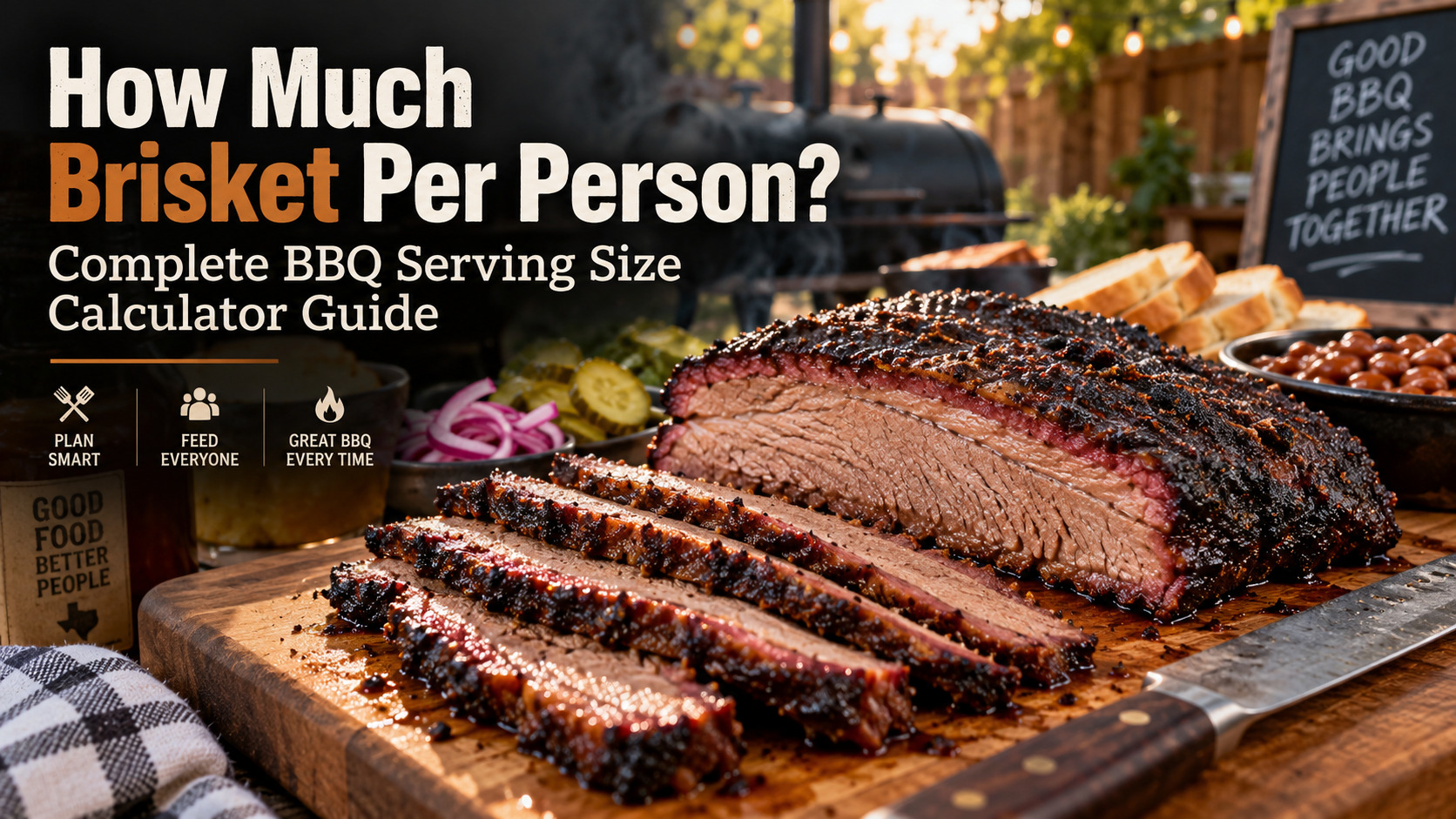
Few things can ruin a backyard barbecue faster than running out of brisket while hungry guests are still standing in line. On the other hand, buying far too much brisket can become expensive, especially when a large whole packer brisket may weigh well over 10 pounds before trimming and cooking.
That is why understanding how much brisket per person you actually need is one of the most useful skills when planning a BBQ.
For most gatherings, a good starting point is about 1/2 pound of cooked brisket per adult. Because brisket loses a significant amount of weight during trimming and smoking, you will normally need approximately 1 pound of raw brisket per adult to end up with that serving amount.
However, the perfect quantity depends on much more than one simple number.
Are you serving brisket as the main attraction?
Will there also be ribs, sausage, chicken, pulled pork, or other meats?
Are guests eating brisket sandwiches or thick slices?
Are there several filling side dishes?
Are you feeding adults, children, teenagers, or serious barbecue enthusiasts?
Do you intentionally want leftovers?
The answers can change the amount of brisket you need considerably.
This complete guide explains how to calculate brisket portions for almost any BBQ, including small family dinners, backyard parties, holiday meals, catering events, large gatherings, sandwiches, mixed-meat BBQ menus, and events where you want extra brisket left over.
By the end, you should be able to estimate both the raw brisket weight to purchase and the cooked brisket quantity your guests are likely to eat.
Quick Answer: How Much Brisket Per Person?
A practical rule for most BBQ gatherings is:
1/2 pound of cooked brisket per adult
Since raw brisket may lose roughly 40% to 50% of its original weight through trimming and cooking, plan on buying:
Approximately 1 pound of raw brisket per adult
For children, approximately:
1/4 pound of cooked brisket per child
or roughly:
1/2 pound of raw brisket per child
These numbers provide a comfortable starting point rather than an absolute rule.
For lighter meals with several meats and side dishes, adults may only eat around 1/3 pound of cooked brisket.
For brisket-focused meals with hungry guests, portions can approach 3/4 pound per adult.
A simple serving range looks like this:
- Light serving: 1/3 pound cooked brisket per adult
- Standard serving: 1/2 pound cooked brisket per adult
- Generous serving: 2/3 pound cooked brisket per adult
- Large serving: 3/4 pound cooked brisket per adult
When estimating raw brisket, approximately double the expected cooked serving weight.
That means:
- 1/3 pound cooked requires roughly 2/3 pound raw
- 1/2 pound cooked requires roughly 1 pound raw
- 2/3 pound cooked requires roughly 1.3 pounds raw
- 3/4 pound cooked requires roughly 1.5 pounds raw
Using these numbers gives you a useful safety margin because brisket yield can vary considerably from one piece of meat to another.
Brisket Serving Size Calculator Formula
The easiest formula for calculating brisket is:
Number of adults × cooked brisket portion = cooked brisket needed
For a standard serving:
Number of adults × 0.5 pound = cooked brisket required
Then estimate raw brisket using approximately a 50% finished yield:
Cooked brisket required × 2 = raw brisket required
For example, imagine you are feeding 20 adults.
20 × 0.5 pound = 10 pounds cooked brisket.
If the brisket finishes at approximately half its original raw weight:
10 × 2 = 20 pounds raw brisket.
Therefore, approximately 20 pounds of raw brisket would be a sensible purchase for 20 adults when brisket is the main meat.
This does not mean every brisket will lose exactly 50% of its original weight. Some briskets produce better yields, while heavily trimmed or very fatty briskets may lose more.
Using approximately 50% yield makes event planning easier while providing a reasonable buffer.
Raw Brisket vs Cooked Brisket: Why the Difference Matters
One of the most common BBQ planning mistakes is calculating portions based only on the raw weight shown on the brisket package.
A 15-pound raw brisket does not produce 15 pounds of food.
Brisket loses weight at multiple stages.
First comes trimming.
A whole packer brisket often contains thick exterior fat, hard fat deposits, thin edges, and other sections that may be removed before smoking.
Depending on how aggressively you trim the brisket, you could remove several pounds.
After trimming, the brisket loses additional weight during cooking.
Water evaporates from the meat, fat renders, and juices leave the brisket.
A brisket that originally weighs 15 pounds could potentially finish with only around 7 to 9 pounds of edible cooked meat.
The precise number depends on:
- Initial fat content
- Trimming style
- Brisket grade
- Cooking temperature
- Cooking duration
- Amount of rendered fat
- Moisture loss
- Flat-to-point ratio
- Whether burnt ends are separated
- Whether small scraps are discarded
- Resting and slicing losses
This is why calculating brisket based on cooked portions is more reliable.
Start with how much cooked meat guests need and then work backward to determine how much raw brisket to purchase.
How Much Weight Does Brisket Lose During Cooking?
Brisket frequently loses approximately 40% to 50% of its raw packaged weight between trimming and cooking.
Some briskets may lose less, while particularly fatty briskets may lose more.
Consider a 14-pound whole packer brisket.
You might trim away approximately 2 pounds of fat and scraps.
That leaves 12 pounds before cooking.
During smoking, the brisket might lose another 4 to 5 pounds of moisture and rendered fat.
Your final cooked brisket could weigh around 7 to 8 pounds.
That means the finished yield could be around 50% to 57% of the original packaged weight.
For event planning, assuming roughly 50% finished yield is simple and conservative.
If you consistently cook brisket and know your typical yield, you can eventually use your own numbers.
For example, if your records show that your briskets usually retain 55% of their packaged weight, you can calculate purchases more precisely.
Until then, the 50% rule is easier and safer.
How Much Cooked Brisket Per Adult?
For most BBQ meals, plan approximately 1/2 pound of cooked brisket per adult.
This amount generally works well when brisket is the primary protein and several traditional sides are served.
A half-pound portion equals approximately 8 ounces of cooked meat.
That is a substantial serving once you add foods such as:
- Potato salad
- Macaroni and cheese
- Coleslaw
- Beans
- Cornbread
- Bread
- Pickles
- Onions
- Corn
- Salad
- Desserts
Some guests will eat less than eight ounces. Others may eat considerably more.
Across a group, those differences often balance each other.
However, guest demographics matter.
A group of hungry adults at an evening BBQ may consume significantly more brisket than a mixed family gathering during lunch.
If you expect especially large appetites, increasing the calculation to 2/3 or 3/4 pound cooked per person is reasonable.
How Much Raw Brisket Per Adult?
If you want approximately 1/2 pound of cooked brisket for each adult, plan roughly:
1 pound of raw brisket per adult
This calculation assumes the brisket retains approximately half its packaged weight after trimming and cooking.
Therefore:
10 adults = approximately 10 pounds raw brisket.
20 adults = approximately 20 pounds raw brisket.
30 adults = approximately 30 pounds raw brisket.
50 adults = approximately 50 pounds raw brisket.
100 adults = approximately 100 pounds raw brisket.
This rule is intentionally simple.
If you purchase slightly more than necessary, properly stored leftover brisket is usually preferable to telling the last few guests that there is no meat remaining.
How Much Brisket Per Child?
Children normally eat much smaller portions than adults.
For children roughly 5 to 12 years old, approximately 1/4 pound of cooked brisket per child is generally sufficient.
That means around:
1/2 pound of raw brisket per child
Toddlers may eat considerably less.
Teenagers, however, should often be counted as adults.
In fact, active teenagers may sometimes eat more than the average adult.
When planning a mixed gathering, a useful approach is:
- Young child: count as 0.5 adult serving
- Older child: count as 0.5 to 0.75 adult serving
- Teenager: count as 1 adult serving
- Very hungry teenager: consider 1.25 adult servings
For example, suppose your BBQ includes:
20 adults
10 children
Count the 10 children as approximately five adults.
You now have the equivalent of:
25 adult servings.
Using one pound of raw brisket per adult-equivalent serving means approximately:
25 pounds of raw brisket.
How Much Brisket for 5 People?
For five adults eating brisket as the main meat:
Cooked brisket needed:
5 × 0.5 = 2.5 pounds.
Raw brisket needed:
Approximately 5 pounds.
However, whole packer briskets are normally much larger than five pounds.
For a small gathering, you might purchase a brisket flat instead of an entire packer brisket.
If you smoke a whole brisket anyway, expect leftovers.
A small group is actually a great excuse to cook extra brisket because leftover brisket can be used in sandwiches, tacos, breakfast dishes, chili, nachos, pizza, baked potatoes, and many other meals.
How Much Brisket for 10 People?
For 10 adults:
Cooked brisket:
10 × 0.5 = 5 pounds.
Raw brisket:
Approximately 10 pounds.
A single smaller whole packer brisket might be sufficient.
However, if your brisket is particularly fatty or requires aggressive trimming, a 10-pound raw brisket could finish with less than five pounds of usable meat.
For greater security, choosing something around 11 to 12 pounds may be more comfortable.
If you want generous leftovers, consider a 13- to 15-pound brisket.
How Much Brisket for 15 People?
For 15 adults:
Cooked brisket:
15 × 0.5 = 7.5 pounds.
Raw brisket:
Approximately 15 pounds.
One large whole packer brisket can often handle this group.
However, brisket sizes vary significantly.
A 15-pound brisket with heavy exterior fat may produce less edible meat than a well-shaped 15-pound brisket with better meat-to-fat proportions.
If everyone loves brisket and it is the only meat being served, purchasing slightly more than 15 pounds is sensible.
How Much Brisket for 20 People?
For 20 adults:
Cooked brisket:
20 × 0.5 = 10 pounds.
Raw brisket:
Approximately 20 pounds.
This may mean smoking two smaller briskets rather than one enormous brisket.
Cooking two briskets can actually offer several advantages.
You gain more bark.
You reduce your dependence on one piece of meat.
You can potentially finish the briskets at slightly different times.
You may also get a better balance of point and flat meat.
For 20 people with large appetites, around 22 to 25 pounds of raw brisket provides a safer margin.
How Much Brisket for 25 People?
For 25 adults:
Cooked brisket required:
25 × 0.5 = 12.5 pounds.
Raw brisket required:
Approximately 25 pounds.
Two briskets weighing around 12 to 14 pounds each would usually provide a comfortable quantity.
If several other meats are being served, you may need considerably less.
For example, if brisket is served alongside ribs and sausage, approximately 8 to 10 pounds of cooked brisket may be enough instead of 12.5 pounds.
How Much Brisket for 30 People?
For 30 adults:
Cooked brisket:
30 × 0.5 = 15 pounds.
Raw brisket:
Approximately 30 pounds.
This might mean two large briskets or three smaller briskets.
Whenever smoking multiple briskets, remember that total cooker capacity becomes important.
Briskets need adequate airflow around them.
Do not assume that because your smoker physically holds three briskets, they will cook exactly like one brisket.
A heavily loaded smoker can require more fuel, recover heat more slowly after opening, and create different temperature zones.
Leave enough room for airflow and rotate briskets if your cooker has noticeable hot spots.
How Much Brisket for 40 People?
For 40 adults:
Cooked brisket:
40 × 0.5 = 20 pounds.
Raw brisket:
Approximately 40 pounds.
For a standard event, around three large briskets may work depending on their individual weights.
If brisket is only one of several proteins, your requirement may fall closer to 25 to 30 pounds raw.
If brisket is the centerpiece and the crowd has large appetites, 40 to 45 pounds raw would be safer.
How Much Brisket for 50 People?
For 50 adults:
Cooked brisket:
50 × 0.5 = 25 pounds.
Raw brisket:
Approximately 50 pounds.
This is a meaningful amount of meat and requires more careful planning.
Instead of thinking only about total weight, consider:
- Smoker capacity
- Cooking time
- Resting space
- Holding temperature
- Slicing station
- Serving speed
- Refrigeration
- Food safety
- Number of cutting boards
- Number of knives
- Serving trays
For fifty people, you may need approximately four briskets weighing around 12 to 14 pounds each.
Buying a little extra can protect against unexpectedly poor yield from one brisket.
How Much Brisket for 75 People?
For 75 adults:
Cooked brisket:
75 × 0.5 = 37.5 pounds.
Raw brisket:
Approximately 75 pounds.
At this point, you are essentially planning a small catering operation.
Depending on brisket size, you could need five to seven whole packer briskets.
It becomes important to calculate everything by total weight rather than simply counting briskets.
Seven 10-pound briskets provide considerably less raw meat than seven 16-pound briskets.
Always calculate the total packaged weight.
For a group this large, adding approximately 5% to 10% extra meat is often wise.
How Much Brisket for 100 People?
For 100 adults:
Cooked brisket:
100 × 0.5 = 50 pounds.
Raw brisket:
Approximately 100 pounds.
This could require seven or eight large briskets, depending on individual size.
A hundred-person BBQ should include an intentional safety margin.
Running out of brisket with two people remaining is annoying.
Running out with twenty people remaining is a serious event-planning failure.
For large groups, consider purchasing around 105 to 110 pounds raw unless other proteins significantly reduce expected brisket consumption.
Brisket Serving Calculator Table
The following table uses the standard estimate of 1/2 pound cooked brisket per adult and approximately 50% finished yield.
| Number of Adults | Cooked Brisket Needed | Approximate Raw Brisket |
|---|---|---|
| 5 | 2.5 lb | 5 lb |
| 10 | 5 lb | 10 lb |
| 15 | 7.5 lb | 15 lb |
| 20 | 10 lb | 20 lb |
| 25 | 12.5 lb | 25 lb |
| 30 | 15 lb | 30 lb |
| 35 | 17.5 lb | 35 lb |
| 40 | 20 lb | 40 lb |
| 50 | 25 lb | 50 lb |
| 60 | 30 lb | 60 lb |
| 75 | 37.5 lb | 75 lb |
| 100 | 50 lb | 100 lb |
| 125 | 62.5 lb | 125 lb |
| 150 | 75 lb | 150 lb |
| 200 | 100 lb | 200 lb |
These numbers should be adjusted according to your menu and guests.
How Many People Does One Brisket Feed?
The answer depends heavily on the starting weight of the brisket.
Suppose you purchase a 14-pound whole packer brisket.
If approximately half remains after trimming and cooking, you might finish with around seven pounds of cooked brisket.
At half a pound per adult:
7 ÷ 0.5 = 14 servings.
Therefore, a 14-pound raw brisket may feed approximately 14 adults.
This leads to a simple shortcut:
A whole packer brisket often feeds roughly one adult per pound of raw packaged weight.
A 12-pound brisket may feed about 12 adults.
A 15-pound brisket may feed about 15 adults.
An 18-pound brisket may feed about 18 adults.
Again, these are approximate numbers.
A very fatty brisket may produce fewer servings.
A well-trimmed brisket with excellent yield may produce more.
How Many People Will a 10-Pound Brisket Feed?
A 10-pound raw brisket may produce approximately five pounds of cooked meat.
At eight ounces per person:
Five pounds can feed approximately 10 adults.
If serving smaller portions of around one-third pound each:
Five pounds could feed approximately 15 people.
If portions are very large at three-quarters of a pound:
Five pounds would serve only six or seven people comfortably.
Therefore, a 10-pound raw brisket will typically serve around 8 to 12 adults, depending on the menu and appetite.
How Many People Will a 12-Pound Brisket Feed?
A 12-pound raw brisket may produce approximately six pounds cooked.
At half a pound each:
Six pounds serves about 12 adults.
With plenty of other meats and sides, it might serve 15 to 18 people.
For a brisket-heavy meal, around 10 to 12 people is safer.
How Many People Will a 15-Pound Brisket Feed?
A 15-pound raw brisket may finish around 7.5 pounds cooked.
At standard portions:
7.5 ÷ 0.5 = 15 adults.
With smaller servings, it could feed around 20 guests.
For large appetites, it may feed closer to 10 to 12 people.
How Many People Will an 18-Pound Brisket Feed?
An 18-pound brisket might finish with around nine pounds cooked.
At half-pound portions:
9 ÷ 0.5 = 18 adults.
With abundant sides and additional proteins, the same brisket might stretch to 24 or more guests.
Because very large briskets often contain substantial fat, however, do not automatically assume an 18-pound brisket will provide exactly nine pounds finished.
Inspect the brisket’s shape and fat distribution when purchasing.
Should You Calculate Brisket Based on Raw or Cooked Weight?
For serving calculations, think in terms of cooked weight.
For purchasing calculations, think in terms of raw weight.
The process should therefore be:
First, calculate how much cooked brisket your guests need.
Second, estimate your expected cooking yield.
Third, calculate how much raw brisket you must purchase.
For example:
40 adults × 0.5 pound cooked = 20 pounds cooked.
If expected yield is 50%:
20 ÷ 0.50 = 40 pounds raw.
If your personal cooking records show a 55% yield:
20 ÷ 0.55 = approximately 36.4 pounds raw.
This illustrates why experienced pitmasters can become more accurate over time.
Brisket Yield Calculator
You can calculate your personal brisket yield using:
Cooked weight ÷ raw packaged weight × 100 = finished yield percentage
Example:
Raw brisket = 16 pounds.
Cooked brisket = 8.4 pounds.
8.4 ÷ 16 = 0.525.
0.525 × 100 = 52.5%.
Your finished yield was 52.5%.
If you track several briskets and consistently average around 52%, you can use that number for future event planning.
Professional caterers benefit tremendously from recording these numbers because even a few percentage points affect purchasing costs across hundreds of pounds of meat.
How Much Brisket If Other Meat Is Being Served?
When brisket is one of several proteins, guests normally eat less of it.
Instead of 1/2 pound cooked brisket per adult, consider approximately:
1/4 to 1/3 pound cooked brisket per adult
For example, imagine you’re feeding 30 adults and serving:
Brisket
Pork ribs
Sausage
Chicken
Because guests will sample multiple meats, you may only need around one-third pound of brisket each.
30 × 0.33 = approximately 10 pounds cooked brisket.
At 50% yield:
Approximately 20 pounds raw brisket.
Without the additional meats, you might have purchased around 30 pounds.
That difference can substantially reduce food costs.
Brisket With Ribs
Brisket and ribs are a classic BBQ combination.
Because ribs contain bones, however, portion calculations differ.
Guests may eat several ribs plus a few brisket slices.
For a menu where brisket and ribs are equal attractions, approximately 1/4 to 1/3 pound cooked brisket per adult is usually reasonable.
Serve larger brisket portions if the ribs are intended more as a secondary item.
Serve smaller portions if everyone receives a large rack portion.
Brisket With Pulled Pork
Brisket and pulled pork are both filling proteins.
When serving equal portions of both, approximately 1/4 pound cooked brisket plus 1/4 pound cooked pulled pork per adult produces a combined half-pound meat serving.
For especially hungry groups, increase the combined amount toward 2/3 pound.
Because pulled pork often costs less than brisket, using both can also reduce the overall meat budget for a large gathering.
Brisket With Sausage
Sausage is rich, filling, and easy to portion.
If every guest gets a sausage link plus brisket, approximately 1/3 pound of cooked brisket per person may be enough.
If sausage is offered only as an optional extra, remain closer to the normal half-pound brisket calculation.
Brisket With Chicken
Chicken can dramatically reduce brisket consumption, especially if guests receive a substantial piece such as a quarter chicken.
For brisket and chicken meals, approximately 1/4 to 1/3 pound cooked brisket per adult is typically sufficient.
This combination works especially well for large events because chicken provides a less expensive alternative while brisket remains the premium BBQ centerpiece.
How Much Brisket for Sandwiches?
Brisket sandwiches normally require less meat than a plated brisket meal.
A standard brisket sandwich might contain approximately 1/4 pound of cooked brisket, or four ounces.
A larger sandwich may contain approximately 1/3 pound, or around five to six ounces.
An oversized BBQ sandwich could contain half a pound or more.
For standard sandwiches, use:
4 ounces cooked brisket per sandwich
This means one pound of cooked brisket produces roughly four sandwiches.
Therefore:
10 pounds cooked = approximately 40 sandwiches.
20 pounds cooked = approximately 80 sandwiches.
25 pounds cooked = approximately 100 sandwiches.
Using a 50% finished yield, 100 standard brisket sandwiches might require around 50 pounds of raw brisket.
However, buffet-style sandwiches often encourage guests to pile on more meat than preassembled sandwiches.
If guests build their own sandwiches, consider calculating five ounces of meat per sandwich instead of four.
How Much Brisket for Sliders?
Brisket sliders require considerably less meat.
A typical slider may contain approximately 1.5 to 2 ounces of cooked brisket.
One pound contains 16 ounces.
Therefore, one pound of cooked brisket could make approximately:
Eight sliders at two ounces each.
Ten sliders at about 1.6 ounces each.
If sliders are appetizers and guests will eat two each, calculate around three to four ounces of brisket per person.
If sliders are the main meal, expect guests to eat three or four depending on size.
How Much Brisket for Tacos?
Brisket tacos usually contain around two to three ounces of meat each.
A guest may eat two to four tacos depending on tortilla size and side dishes.
For a normal meal, calculate approximately 1/3 pound of cooked brisket per adult.
For hungry guests making generously filled tacos, move closer to half a pound.
Taco toppings such as onions, cilantro, salsa, cheese, avocado, cabbage, beans, rice, and sauces can substantially increase the overall meal volume and reduce meat consumption.
How Much Brisket for Nachos?
Brisket nachos typically use less meat because chips, cheese, beans, toppings, and sauces provide much of the volume.
Approximately two to four ounces cooked brisket per person may be enough.
If brisket nachos are an appetizer, two ounces can be sufficient.
If they are the main meal, calculate around four ounces or slightly more.
How Much Brisket When Serving Heavy Side Dishes?
Side dishes significantly influence how much meat guests consume.
Heavy sides include:
Macaroni and cheese
Potato salad
Baked beans
Cornbread
Mashed potatoes
Loaded baked potatoes
Pasta salad
Rice
Creamed corn
Bread
When several rich sides are available, brisket consumption may fall from half a pound to around one-third pound per adult.
For example, suppose you feed 40 adults.
At half a pound each, you need 20 pounds cooked brisket.
At one-third pound each, you need only about 13.3 pounds.
That difference translates into roughly 13 additional pounds of raw brisket at a 50% yield.
Side dishes therefore have a major impact on food cost.
How Much Brisket When Serving Light Sides?
If your sides consist mostly of lighter foods such as:
Green salad
Pickles
Onions
Grilled vegetables
Fruit
Slaw
Guests may consume more meat.
In this situation, staying near half a pound cooked brisket per adult is safer.
If guests are particularly hungry, consider 2/3 pound.
Lunch vs Dinner Brisket Portions
Meal timing affects appetite.
People often eat slightly smaller portions at lunch than at dinner.
For a lunchtime BBQ with several sides:
Approximately 1/3 to 1/2 pound cooked brisket per adult may be sufficient.
For an evening BBQ:
Approximately 1/2 pound is a stronger starting point.
For late-night events involving alcohol or extended socializing, guests may return for additional food later, so a larger safety margin can be worthwhile.
Buffet vs Plated Brisket Service
Buffet service tends to increase meat consumption.
Guests serving themselves often take larger portions than necessary.
Some may select several thick slices before realizing how filling brisket is.
For buffet service, consider increasing your calculated quantity by approximately 5% to 10%.
Plated service gives you better portion control.
If each guest receives a fixed amount of brisket, your calculations can be much more precise.
For example, a plated meal with exactly six ounces of brisket per person requires substantially less uncertainty than an unrestricted buffet.
Sliced Brisket vs Chopped Brisket
Sliced brisket makes portion size easier to see.
Guests recognize that they have taken several substantial slices.
Chopped brisket can be deceptive.
A large spoonful may contain more meat than expected, especially when piled onto sandwiches.
Pre-portioning chopped brisket or using smaller serving utensils can help control consumption at large events.
Point vs Flat Portions
A whole packer brisket contains two major muscles:
The flat.
The point.
The flat is leaner and commonly sliced.
The point contains more intramuscular fat and is often richer, juicier, and used for thick slices, chopped brisket, or burnt ends.
Guests may have preferences.
Some want lean flat slices.
Others prefer fatty point meat.
At large gatherings, separating and clearly identifying lean and fatty portions can improve the serving experience.
Remember that a whole brisket does not provide equal amounts of point and flat.
If your guests overwhelmingly prefer one style, you may need additional briskets even when the total meat weight appears sufficient.
Does Making Burnt Ends Change the Calculation?
Yes.
Traditional burnt ends are often made from the brisket point.
The point may be separated, cubed, seasoned, sauced, and cooked again.
During this additional cooking, more fat can render and more moisture may be lost.
If you plan to serve both sliced brisket and burnt ends, consider purchasing slightly more brisket.
Burnt ends are extremely popular and can disappear quickly.
They also encourage guests to sample both burnt ends and sliced meat, increasing overall consumption.
For brisket-focused events featuring burnt ends, adding around 10% extra raw brisket can provide useful insurance.
Should You Trim Brisket Before Calculating Weight?
When purchasing packaged whole briskets, use the package weight for your initial calculation.
Your 50% yield assumption already accounts for trimming and cooking losses.
If you purchase professionally trimmed briskets, your finished yield may be higher.
For example, a butcher-trimmed brisket weighing 12 pounds may contain less waste than a 12-pound heavily untrimmed packer.
This is another reason serious BBQ cooks should track their own yields.
How Aggressive Trimming Changes Brisket Yield
Brisket trimming style can dramatically affect final yield.
Some cooks remove only obvious hard fat and shape the edges lightly.
Others perform competition-style trimming that removes significant material.
If you remove four pounds from a 16-pound brisket before it even reaches the smoker, your potential food yield has already dropped substantially.
For home BBQ, moderate trimming usually provides a good balance.
Remove:
Hard fat that will not render effectively.
Very thin edges likely to burn.
Loose pieces.
Excessively thick exterior fat.
Leave enough fat and meat to protect moisture and produce an attractive final brisket.
From a serving-calculation perspective, aggressive trimming means you should purchase more raw weight.
How Brisket Grade Affects Yield
Different briskets contain different amounts of marbling and fat.
A highly marbled brisket may produce exceptionally juicy slices but can also render a considerable amount of fat.
A leaner brisket may retain slightly more weight but could be less forgiving during a long cook.
Grade alone does not determine yield because individual briskets vary.
Shape, fat distribution, thickness, and trimming are all important.
When shopping for briskets for a large event, select pieces with good shape rather than simply choosing the heaviest packages.
A thick, evenly shaped flat generally cooks more predictably than an extremely thin, irregular brisket.
How Much Extra Brisket Should You Buy?
For normal family gatherings, buying about 5% to 10% extra is reasonable.
For important events such as:
Weddings
Graduations
Corporate parties
Large birthdays
Family reunions
Community events
Consider a larger safety margin.
Around 10% extra meat can protect against:
Unexpected guests
Larger appetites
Low brisket yield
Serving mistakes
Burnt or dry sections
Extra trimming
Dropped food
Guests returning for seconds
Suppose you calculate that you need 50 pounds raw.
Adding 10% means:
50 × 1.10 = 55 pounds.
That extra five pounds could prevent a serious shortage.
How Much Brisket If You Want Leftovers?
If you intentionally want leftover brisket, add the desired leftover amount after calculating normal servings.
For example:
20 adults need approximately 10 pounds cooked brisket.
Suppose you want five pounds cooked left over.
You now need:
15 pounds cooked total.
At 50% yield:
30 pounds raw brisket.
This is better than simply guessing.
Determine how much cooked leftover meat you want, then convert it into additional raw weight.
Why Leftover Brisket Is Often Worth Planning For
Brisket takes many hours to prepare.
Once you have already committed to firing the smoker, managing temperatures, wrapping, resting, and slicing, cooking an additional brisket can be worthwhile.
Leftover brisket is extremely versatile.
It can be used for:
Brisket sandwiches
Breakfast hash
Eggs and brisket
Tacos
Quesadillas
Burritos
Nachos
Chili
Macaroni and cheese
Loaded fries
Loaded baked potatoes
Pizza
Pasta
Rice bowls
Grilled cheese sandwiches
Soups
Stews
Bean dishes
Because brisket reheats well when stored properly, intentional leftovers are rarely wasted in households that enjoy BBQ.
How Much Brisket for a Backyard BBQ?
For a typical backyard BBQ with adults and children, start with approximately:
1/2 pound cooked per adult.
1/4 pound cooked per child.
If you also serve sausage, ribs, or chicken, reduce brisket portions to around one-third pound per adult.
For example:
16 adults
8 children
The children count as approximately four adults.
Total equivalent servings:
20 adults.
At half a pound cooked:
10 pounds cooked brisket.
At 50% yield:
20 pounds raw brisket.
If serving ribs and sausage too, you could potentially reduce that to around 14 to 16 pounds raw.
How Much Brisket for a Birthday Party?
Birthday parties often include significant amounts of other food.
There may be appetizers, chips, dips, sides, cake, desserts, and beverages.
Because guests are not relying entirely on brisket, approximately one-third to half a pound cooked per adult is usually sufficient.
For children’s birthday parties, calculate the adult and child portions separately.
Do not forget that parents attending with children may eat full adult portions even when the event is primarily for kids.
How Much Brisket for a Wedding?
Wedding catering requires a larger safety margin because running out of food is unacceptable.
If brisket is the primary entrée, plan approximately half a pound cooked per adult, then add around 10%.
If there are multiple entrée choices, brisket consumption may be lower.
However, guest preference becomes important.
If brisket is dramatically more appealing than the alternative entrée, a large percentage of guests may choose it.
Catering events should therefore be based on expected selection percentages, not simply dividing every meat equally.
How Much Brisket for a Tailgate?
Tailgate parties frequently involve hungry guests, snacks, alcohol, and long periods of eating.
Brisket sandwiches are particularly practical.
Calculate around one-third pound cooked brisket per adult for sandwiches.
If brisket is served sliced as the main meal, move toward half a pound.
Because people may continue eating throughout the event, adding 10% extra can be worthwhile.
How Much Brisket for a Holiday Meal?
Holiday meals usually include numerous substantial sides.
For Thanksgiving-style or Christmas-style gatherings where brisket accompanies many side dishes, approximately one-third to half a pound cooked per adult may be sufficient.
If brisket replaces traditional centerpiece meats and is clearly the main attraction, use half a pound.
If turkey, ham, or other proteins are also served, brisket portions can drop toward one-quarter pound per adult.
How Much Brisket for a Football Party?
Football parties often resemble buffets.
Guests eat intermittently over several hours rather than during one formal meal.
Sandwiches, sliders, nachos, wings, dips, and snacks are common.
If sliced brisket is part of a broad game-day spread, approximately one-quarter to one-third pound cooked per adult may be enough.
If brisket sandwiches are the main food, plan one-third pound.
For serious BBQ crowds, increase the amount accordingly.
How Appetite Changes Brisket Calculations
Not every group eats the same amount.
A gathering of construction workers after a long workday may consume more food than a light corporate luncheon.
An athletic team may consume more than a mixed-age family reunion.
A group of barbecue enthusiasts may take larger brisket portions because they came specifically for smoked meat.
Consider your audience.
Use approximately 1/3 pound cooked for light eaters.
Use 1/2 pound for average eaters.
Use 2/3 pound for hungry groups.
Use 3/4 pound when brisket is the main event and you expect very large appetites.
Portion Calculator for Hungry Guests
For generous two-thirds-pound cooked portions:
10 adults require about 6.7 pounds cooked.
20 adults require about 13.3 pounds cooked.
30 adults require about 20 pounds cooked.
50 adults require about 33.3 pounds cooked.
100 adults require about 66.7 pounds cooked.
At 50% yield, raw weight is roughly double those numbers.
Therefore, 50 very hungry adults could require approximately 67 pounds of raw brisket rather than the standard 50 pounds.
This illustrates why understanding your guests matters.
How Many Brisket Slices Per Person?
Slice count is less reliable than weight because brisket slices vary dramatically in thickness and size.
A large slice from the flat may weigh several ounces.
A smaller slice may weigh less than one ounce.
Still, a normal eight-ounce serving might equal approximately:
Three to five substantial slices.
For precise catering, weighing portions is more reliable than counting slices.
If serving buffet-style, slice brisket as needed rather than cutting every brisket in advance.
This helps retain moisture and gives you better control over portioning.
How Thick Should Brisket Be Sliced?
The flat is commonly sliced approximately pencil-thick.
The point can generally be sliced slightly thicker because its higher fat content keeps it tender.
If brisket is extremely tender, slightly thicker slices may prevent it from falling apart.
If the meat requires unusually thin slices to seem tender, it may be slightly undercooked.
Slice across the grain for tenderness.
Because the grain direction changes between the flat and point, rotate the meat as necessary after separating or reaching the transition area.
Why You Should Not Slice All the Brisket Immediately
Sliced brisket loses moisture faster than an intact brisket.
For a party, slicing everything before guests arrive may result in dry meat.
Instead, keep briskets whole or in large sections during holding.
Slice enough for the initial serving line.
Continue slicing as needed.
This also helps control portions because you can observe how quickly guests are consuming the brisket.
Resting and Holding Brisket for Large Events
Brisket planning is not only about quantity.
Timing matters just as much.
Brisket should normally finish before guests are ready to eat.
Trying to schedule the brisket to finish exactly at serving time creates unnecessary risk.
Briskets vary in cooking duration.
One may become tender hours earlier than another even when they weigh approximately the same.
A long heated rest or hold can improve tenderness while giving you schedule flexibility.
For large gatherings, finishing several hours early is usually preferable to serving late.
Your holding method must maintain safe temperatures while avoiding excessive cooking or drying.
Why Brisket Cooking Time Should Not Be Calculated Too Precisely by Weight
You may hear estimates such as one hour per pound or 90 minutes per pound.
These can help establish a rough schedule, but brisket should not be treated like a stopwatch recipe.
Cooking duration depends on:
Smoker temperature
Meat thickness
Starting temperature
Weather
Humidity
Airflow
Wrapping
Brisket shape
Fat content
Stall duration
Individual muscle characteristics
Two briskets of identical weight may finish at different times.
When cooking for guests, build extra time into the schedule.
A brisket that finishes early can be held.
A brisket that finishes late cannot magically be rushed without potentially sacrificing quality.
How to Avoid Running Out of Brisket
Several simple strategies reduce your risk.
First, calculate based on cooked meat rather than raw package weight.
Second, assume realistic trimming and cooking loss.
Third, buy a modest safety margin.
Fourth, serve filling side dishes.
Fifth, control serving portions during the first trip through the buffet.
Sixth, slice brisket gradually.
Seventh, avoid putting every brisket on the serving table simultaneously.
Keep some meat in reserve.
If consumption is faster than expected, adjust portions or encourage guests to enjoy additional sides.
For large events, having sausage, chicken, pulled pork, or another backup protein also provides useful insurance.
How to Prevent Buying Too Much Brisket
While shortages are undesirable, excessive overbuying wastes money.
Avoid simply adding random extra briskets.
Calculate carefully.
If 30 adults require around 15 pounds cooked, do not purchase 60 pounds raw unless you intentionally want large leftovers.
Adjust the calculation based on:
Children
Vegetarians
Guests who may not eat beef
Other meats
Heavy side dishes
Desserts
Meal timing
Guest appetite
Sandwiches versus plated meals
Accurate planning can substantially reduce unnecessary food expenses.
Should Vegetarians Be Included in the Brisket Count?
No.
If you know some guests will not eat beef, remove them from the brisket calculation.
For example:
50 guests total.
Five vegetarians.
Three guests who do not eat beef.
Brisket-consuming guests:
At half a pound cooked each:
21 pounds cooked brisket.
Approximately 42 pounds raw.
If you had automatically planned for all 50 guests, you might have purchased about eight unnecessary pounds of raw brisket.
Should No-Shows Be Included?
For informal events, attendance can be uncertain.
If 100 people were invited but historically only 80% attend, purchasing food for all 100 may create large leftovers.
However, predicting attendance carries risk.
For important events with confirmed RSVPs, use the confirmed guest count plus a modest contingency.
For informal open-house gatherings, build a realistic expected attendance range and prepare flexible backup foods.
How to Calculate Brisket for Mixed Adults and Children
Use adult-equivalent servings.
Consider this example:
30 adults.
12 children.
Four teenagers.
Count:
30 adults = 30 servings.
12 children × 0.5 = six servings.
Four teenagers = four servings.
Total adult-equivalent servings:
At one pound raw per adult equivalent:
Approximately 40 pounds raw brisket.
If the meal includes several proteins, reduce the brisket allocation accordingly.
Complete Brisket Calculator Example
Imagine you are planning a backyard BBQ for:
36 adults
10 children
Brisket is the primary protein.
You also have substantial sides.
You want around 10% extra.
Step one is converting children into adult equivalents.
10 children × 0.5 = five adult portions.
Total equivalent guests:
36 + 5 = 41.
Step two is calculating cooked brisket.
41 × 0.5 pound = 20.5 pounds cooked.
Step three is adding the 10% safety margin.
20.5 × 1.10 = 22.55 pounds cooked.
Step four is converting cooked weight into raw weight.
At 50% yield:
22.55 ÷ 0.50 = 45.1 pounds raw.
Therefore, approximately 45 to 47 pounds of raw whole brisket would be a sensible purchase.
Depending on available brisket sizes, that might mean:
Three 15-pound briskets.
Four 12-pound briskets.
Or another combination totaling roughly the same weight.
Example With Multiple Meats
Suppose you have:
50 adults.
Brisket.
Pulled pork.
Sausage.
Macaroni and cheese.
Beans.
Coleslaw.
Bread.
Because brisket is only one part of the meal, calculate one-third pound cooked brisket per adult.
50 × 0.33 = approximately 16.5 pounds cooked.
At 50% yield:
16.5 × 2 = 33 pounds raw.
Add roughly 10%:
Around 36 pounds raw brisket.
Instead of purchasing 50 to 55 pounds raw, you may only need approximately 35 to 37 pounds because other meats carry part of the meal.
Example for Brisket Sandwiches
Suppose you want to serve 80 brisket sandwiches.
Each sandwich receives four ounces of cooked meat.
Four ounces equals 0.25 pound.
80 × 0.25 = 20 pounds cooked brisket.
At 50% yield:
20 × 2 = 40 pounds raw brisket.
Add 10% for generous sandwiches:
Approximately 44 pounds raw.
If guests assemble their own sandwiches, you may want more because self-service portions are harder to control.
Example for 100-Person Catering Event
Suppose you are serving 100 adults.
The menu includes:
Brisket.
Sausage.
Potato salad.
Beans.
Coleslaw.
Bread.
Dessert.
Because sausage is another significant protein, calculate approximately one-third pound cooked brisket per person.
100 × 0.33 = 33 pounds cooked brisket.
Add a 10% margin:
Approximately 36.3 pounds cooked.
At 50% yield:
Approximately 72.6 pounds raw.
Rounding up, around 73 to 75 pounds of raw brisket would provide a comfortable quantity.
What Size Briskets Should You Buy for a Large Group?
When buying several briskets, similar sizes can make cooking easier.
For example, four briskets between 12 and 14 pounds may be easier to manage than one 8-pound brisket, two 15-pound briskets, and one 20-pound brisket.
Similar thickness and weight generally mean more predictable cooking, though each brisket will still finish individually.
Moderately sized briskets can also provide a good balance of bark and interior meat.
Extremely large briskets require more cooking space and may contain considerable fat.
Choose briskets with:
A thick flat.
Good flexibility.
Reasonably even shape.
Healthy marbling.
Minimal excessively hard exterior fat.
Avoid focusing on weight alone.
Is It Better to Buy One Large Brisket or Two Smaller Briskets?
For many gatherings, two moderately sized briskets are better than one enormous brisket.
Advantages include:
More bark.
More burnt ends.
More point meat options.
Potentially easier handling.
Reduced risk if one brisket cooks poorly.
Better flexibility during serving.
Two briskets may also fit some smokers more efficiently.
However, every additional brisket requires cooking space.
Choose the configuration that fits your smoker without restricting airflow.
How Much Brisket Should You Serve on a Plate?
A standard plated BBQ serving might contain:
Six to eight ounces brisket.
One or two substantial sides.
Bread.
Pickles and onions.
Six ounces is enough for many guests.
Eight ounces is more generous.
For formal catering where portions must be controlled, six ounces may significantly reduce meat requirements compared with an unrestricted half-pound buffet serving.
For 100 people:
Six ounces each equals 600 ounces.
600 ÷ 16 = 37.5 pounds cooked.
Eight ounces each equals 50 pounds cooked.
That 12.5-pound difference in cooked meat could require roughly 25 additional pounds of raw brisket.
Small changes in portion size matter enormously at scale.
Brisket Portion Sizes in Ounces
Understanding ounces can make calculations easier.
One pound equals 16 ounces.
Therefore:
4 ounces = 1/4 pound.
5.3 ounces = approximately 1/3 pound.
6 ounces = 3/8 pound.
8 ounces = 1/2 pound.
10.7 ounces = approximately 2/3 pound.
12 ounces = 3/4 pound.
For sandwiches, four to six ounces is common.
For plated BBQ, six to eight ounces works well.
For large eaters, eight to twelve ounces may be appropriate.
How Sides Affect Your Brisket Budget
Brisket is usually one of the most expensive items on a BBQ menu.
Strategically chosen sides can reduce the amount of brisket required without making guests feel shortchanged.
Filling sides such as beans, potato salad, pasta, macaroni and cheese, cornbread, and potatoes cost less per serving than smoked brisket.
A well-balanced plate containing six ounces of brisket plus several satisfying sides can feel more substantial than eight ounces of brisket with minimal accompaniments.
For large events, menu design is therefore part of portion planning.
Should You Put Sauce on Brisket Before Serving?
That depends on your style of BBQ.
Serving sauce separately generally gives guests more control and preserves the bark.
From a portion perspective, sauce does not dramatically reduce brisket consumption, although sandwiches with sauce, slaw, pickles, and other toppings may feel more filling.
Avoid relying on sauce as a way to stretch insufficient meat.
Accurate portion planning remains more important.
What If Guests Want Seconds?
Your standard half-pound calculation already assumes some variation.
Some guests will eat less.
Some will return for seconds.
However, if your event culture encourages unlimited second servings, adding 10% extra is wise.
Another strategy is to encourage everyone to complete the first serving before announcing seconds.
This ensures every guest has access to brisket before the largest eaters return to the line.
How to Portion Brisket Without Making Guests Feel Restricted
Portion control does not need to feel stingy.
Serve attractive slices.
Arrange the plate neatly.
Provide generous sides.
Keep additional meat available for seconds.
A six-ounce brisket serving presented with beans, slaw, bread, pickles, and macaroni and cheese can look abundant.
Presentation often matters as much as raw quantity.
Brisket Storage After the Party
Leftovers should be handled promptly and safely.
Avoid leaving cooked brisket sitting at unsafe temperatures for extended periods.
Store leftover brisket in manageable portions.
Keeping some rendered juices or cooking liquid with the meat can help preserve moisture.
Large pieces often retain moisture better than meat sliced into very thin portions.
For future meals, divide brisket according to how much your household is likely to use at once.
This avoids repeatedly reheating the entire batch.
Should Brisket Be Stored Sliced or Whole?
For short-term storage, larger pieces generally retain moisture better.
If possible, store brisket in chunks or larger sections and slice after reheating.
However, pre-sliced brisket can be convenient.
If storing slices, pack them tightly with some reserved juices or rendered fat to reduce drying.
The best choice depends on how you plan to use the leftovers.
Best Ways to Use Extra Brisket
Extra brisket should not be viewed as a failure in planning.
When properly stored, it becomes an ingredient for additional meals.
Chopped brisket works beautifully in chili because the smoky beef adds depth.
Thin slices make excellent sandwiches.
Cubed pieces can top macaroni and cheese.
Brisket pairs well with eggs and potatoes for breakfast.
It can become taco filling.
It can be added to beans.
It can be folded into quesadillas.
It can top baked potatoes.
It can become a pizza topping.
This versatility is one reason buying a modest amount of extra brisket is often preferable to cutting quantities too close.
Common Mistakes When Calculating Brisket Per Person
The first major mistake is forgetting cooking loss.
Buying 20 pounds of raw brisket does not mean you will serve 20 pounds.
The second mistake is treating every guest equally.
Children, teenagers, and adults have different appetites.
The third mistake is ignoring other meats.
If guests are eating ribs, sausage, chicken, and pork, they probably do not need half a pound of brisket each.
The fourth mistake is ignoring sides.
A plate filled with macaroni and cheese, beans, bread, and potatoes requires less brisket than a meat-heavy plate.
The fifth mistake is failing to add a safety margin for important events.
The sixth mistake is buying briskets based entirely on count instead of total weight.
Four briskets can mean 40 pounds or 70 pounds depending on size.
The seventh mistake is slicing everything before serving.
This can dry the brisket and make portion control more difficult.
The Safest Brisket Rule for Beginners
If you do not know your guests’ exact appetites and brisket is the main protein, use this simple rule:
Buy approximately one pound of raw whole brisket per adult.
For children, buy approximately half a pound raw each.
Then adjust downward when you have several additional meats.
Adjust upward if:
Guests are big eaters.
You want leftovers.
Brisket is the only protein.
You expect people to return for seconds.
You are serving an important event where running out would be unacceptable.
This simple rule works because it accounts for both trimming and cooking losses while producing approximately an eight-ounce cooked adult serving.
Quick Brisket Planning Cheat Sheet
For brisket as the main meat:
Adult: approximately 1 pound raw or 1/2 pound cooked.
Child: approximately 1/2 pound raw or 1/4 pound cooked.
For brisket alongside several other meats:
Adult: approximately 1/2 to 2/3 pound raw or 1/4 to 1/3 pound cooked.
For standard brisket sandwiches:
Approximately 1/4 pound cooked brisket per sandwich.
For hungry BBQ crowds:
Approximately 1.25 to 1.5 pounds raw brisket per adult.
For important events:
Add approximately 5% to 10% extra.
For intentional leftovers:
Add the amount of cooked leftovers you want, then approximately double that weight when calculating how much additional raw brisket to purchase.
Frequently Asked Questions About Brisket Serving Sizes
Is half a pound of brisket per person enough?
For most adults, half a pound of cooked brisket is a generous standard serving, especially when several side dishes are included.
Some guests will eat less, while large eaters may consume more.
For mixed groups, half a pound provides a reliable average.
How much raw brisket should I buy per person?
Approximately one pound of raw whole brisket per adult is a good general rule when brisket is the primary meat.
This assumes around 50% of the packaged brisket weight remains after trimming and cooking.
How much brisket should I buy for children?
Approximately half a pound raw per child or one-quarter pound cooked is usually enough for school-age children.
Teenagers should generally be counted as adults.
How much brisket do I need if I am also serving ribs?
Approximately one-quarter to one-third pound of cooked brisket per adult is usually sufficient when ribs are also a major part of the meal.
How much brisket do I need if I am serving pulled pork?
If brisket and pulled pork are served in similar quantities, approximately one-quarter pound cooked brisket per adult plus one-quarter pound cooked pork creates a generous combined meat serving.
How much brisket for sandwiches?
Plan around four to six ounces of cooked brisket per sandwich.
Four ounces is appropriate for a standard sandwich.
Six ounces produces a larger BBQ-style sandwich.
How many sandwiches can I make from one pound of brisket?
At four ounces each, one pound of cooked brisket makes approximately four sandwiches.
At five ounces each, it makes slightly more than three sandwiches.
How much brisket do I need for 20 adults?
Approximately 10 pounds cooked or around 20 pounds raw is a good starting point when brisket is the primary meat.
How much brisket do I need for 50 adults?
Approximately 25 pounds cooked or around 50 pounds raw.
For important events, consider increasing the raw amount to approximately 53 to 55 pounds.
How much brisket do I need for 100 adults?
Approximately 50 pounds cooked or around 100 pounds raw if brisket is the main protein.
If several meats are served, the amount can be significantly lower.
Does brisket really lose half its weight?
It can.
The combined effect of trimming, rendered fat, evaporated moisture, and cooking losses can reduce a whole brisket’s packaged weight by roughly 40% to 50%, sometimes more.
Actual yield varies.
Is it better to have too much brisket than too little?
For most gatherings, modest leftovers are preferable to running out.
However, buying excessively more than necessary wastes money.
A 5% to 10% safety margin is usually sufficient for normal planning.
Should I count teenagers as adults?
Yes.
Teenagers frequently eat adult-sized portions and can sometimes eat considerably more.
For athletic or particularly hungry teenagers, consider slightly larger servings.
What if half my guests are children?
Convert children into adult-equivalent portions.
Two younger children can generally be counted as approximately one adult serving.
Does buffet service require more brisket?
Usually yes.
Self-service buffets encourage larger first portions.
Adding around 5% to 10% compared with controlled plated portions is sensible.
Can sides reduce how much brisket I need?
Absolutely.
Heavy sides such as beans, potatoes, macaroni and cheese, pasta salad, bread, and cornbread can significantly reduce average meat consumption.
How many briskets do I need for 30 people?
At approximately one pound raw per adult, you need around 30 pounds of raw brisket.
That may mean two large briskets or three smaller briskets depending on individual weights.
How many briskets do I need for 50 people?
You need around 50 pounds raw if brisket is the main meat.
Depending on brisket size, this could mean approximately four large packer briskets.
How many briskets do I need for 100 people?
You need approximately 100 pounds raw using the standard rule.
That could mean seven to nine briskets depending on their individual sizes.
Always calculate total weight rather than relying only on brisket count.
Final Brisket Serving Size Formula
If you remember only one calculation from this guide, use this:
Adults × 0.5 pound = cooked brisket needed
Then:
Cooked brisket × 2 = approximate raw brisket to purchase
Therefore:
Adults × approximately 1 pound = raw whole brisket needed
For children:
Children × 0.25 pound = cooked brisket needed
or:
Children × approximately 0.5 pound = raw brisket needed
For mixed-meat BBQ menus, reduce brisket to approximately one-quarter to one-third pound cooked per adult.
For big eaters, increase servings toward two-thirds or three-quarters of a pound cooked.
For important gatherings, add roughly 5% to 10% extra.
Final Thoughts
Determining how much brisket per person becomes much easier once you understand the difference between raw weight and finished cooked weight.
The most dependable starting point is approximately half a pound of cooked brisket per adult, which generally requires around one pound of raw whole brisket per adult after allowing for trimming and cooking losses.
Children usually require about half the adult amount.
If brisket shares the menu with ribs, pulled pork, sausage, chicken, or other meats, reduce the brisket portion to approximately one-quarter to one-third pound cooked per person.
For sandwiches, approximately four to six ounces of cooked brisket is generally appropriate.
For big eaters, brisket-focused parties, or events where leftovers are desirable, increase the amount.
Most importantly, calculate portions based on your actual menu rather than relying on a single universal number.
Consider guest ages, appetite, other proteins, side dishes, buffet style, meal timing, planned leftovers, and the importance of the occasion.
A casual family dinner can tolerate a little improvisation.
A wedding or 100-person BBQ needs a deliberate margin of safety.
When in doubt, the simplest rule remains one of the most useful:
Plan approximately one pound of raw whole brisket per adult when brisket is the main meat.
That amount generally produces around half a pound of finished brisket per guest, gives average eaters a satisfying portion, allows hungry guests some flexibility, and greatly reduces the risk of watching your final slices disappear while people are still waiting in line.