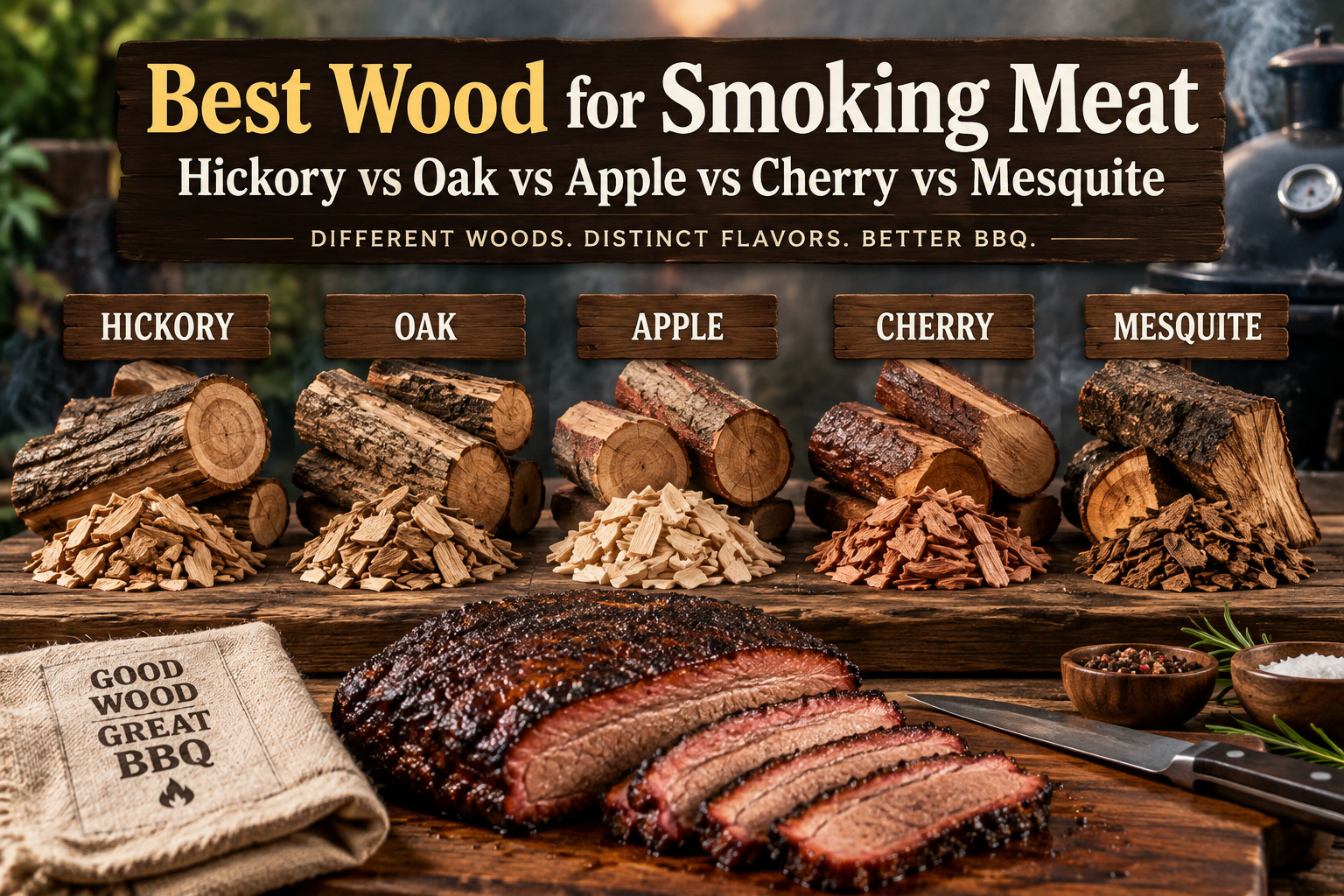
Choosing the best wood for smoking meat can make as much difference to the finished barbecue as the seasoning, cooking temperature, and quality of the meat itself. Smoke is not simply something that makes barbecue taste smoky. Different woods create noticeably different aromas, levels of intensity, colors, sweetness, bitterness, and savory characteristics.
Hickory may give pork ribs the deep barbecue flavor many people expect from classic American BBQ. Oak can create a balanced smoke profile that complements brisket without overwhelming the beef. Apple provides a mild, slightly sweet character that works beautifully with pork and poultry. Cherry can produce an attractive reddish exterior while adding gentle fruitwood flavor. Mesquite delivers an aggressive, earthy smoke that can be excellent with beef when carefully controlled but overpowering when used excessively.
There is therefore no single smoking wood that is automatically best for every piece of meat.
The better question is: which wood creates the flavor you want for the meat you are cooking?
Understanding how wood behaves also helps prevent one of the biggest smoking mistakes beginners make: assuming that more smoke automatically means better barbecue. Great smoked meat usually comes from clean combustion and controlled smoke rather than filling the smoker with thick white clouds for hours.
This guide examines hickory vs oak vs apple vs cherry vs mesquite in detail. It explains their flavor profiles, ideal meat pairings, strengths, disadvantages, blending possibilities, wood preparation, smoke management, and practical techniques for producing better barbecue.
Whether you are smoking brisket overnight, preparing pork ribs for a weekend cookout, smoking chicken for dinner, or experimenting with different wood combinations, understanding these five woods gives you an excellent foundation for choosing smoke flavors intelligently.
Why Wood Choice Matters When Smoking Meat
Wood performs two different jobs inside many smokers.
First, it may provide heat.
Second, it produces smoke containing compounds that interact with the surface of the meat.
In traditional offset smokers and some charcoal smokers, wood can contribute substantially to the heat required for cooking. In pellet smokers, electricity controls much of the system while compressed wood pellets provide heat and smoke. In charcoal smokers and grills, charcoal may provide most of the heat while wood chunks are added primarily for flavor.
Regardless of smoker type, the species of wood affects the character of the smoke.
Different hardwoods contain different concentrations of lignin, cellulose, hemicellulose, sugars, minerals, and aromatic compounds. When properly heated, these materials break down and release gases and microscopic particles.
Some compounds contribute desirable smoky aromas.
Others contribute sweetness, spice, toasted notes, color, or deeper savory flavors.
Poor combustion, however, can generate heavy deposits of soot, creosote-like compounds, and harsh flavors.
This means successful smoking involves more than selecting a wood species. You must also burn that wood properly.
A perfectly selected piece of hickory burned poorly may produce worse barbecue than ordinary oak burned efficiently.
The best results usually come from combining three factors:
- Appropriate wood species
- Clean combustion
- Correct smoke intensity
Once those fundamentals are understood, wood selection becomes a powerful flavor-control tool rather than guesswork.
Quick Comparison: Hickory vs Oak vs Apple vs Cherry vs Mesquite
The following overview gives you a general idea of how these popular smoking woods compare.
| Smoking Wood | Smoke Strength | General Flavor | Best With |
|---|---|---|---|
| Oak | Medium | Clean, balanced, traditional | Beef, brisket, pork, sausages |
| Hickory | Medium to strong | Rich, savory, bacon-like | Pork, ribs, brisket, poultry |
| Apple | Mild | Sweet, delicate, fruity | Pork, chicken, turkey, fish |
| Cherry | Mild to medium | Sweet, fruity, slightly rich | Pork, poultry, ribs, beef |
| Mesquite | Very strong | Earthy, bold, intense | Beef, steaks, short cooks |
These descriptions are useful starting points rather than rigid rules.
For example, apple can absolutely be used with beef. Oak can be used with chicken. Cherry can be mixed with mesquite. Hickory can be blended with apple.
The key is understanding what each wood contributes.
Oak: The Most Versatile Wood for Smoking Meat
If you could choose only one wood for smoking a wide variety of meats, oak would be one of the safest choices.
Oak creates a medium-strength smoke that sits between delicate fruitwoods and stronger woods such as hickory or mesquite.
Its greatest strength is balance.
Oak smoke is noticeable enough to create traditional barbecue flavor, but it usually does not dominate the natural flavor of the meat when burned correctly.
That makes it especially valuable for long smoking sessions.
A brisket may remain in a smoker for ten hours or considerably longer. A very aggressive wood could become overwhelming during such a long cook. Oak provides enough character to complement the beef while remaining relatively forgiving.
What Does Oak Smoke Taste Like?
Oak is generally described as:
- Clean
- Woody
- Savory
- Moderately smoky
- Slightly earthy
- Neutral compared with stronger smoking woods
Some varieties of oak may create subtle differences, but oak generally lacks the obvious fruity sweetness associated with apple or cherry.
It also tends to be less sharp than mesquite.
This neutrality makes oak a useful foundation for wood blends.
You could use mostly oak and add smaller amounts of another wood to modify the flavor.
For example:
Oak plus cherry can create balanced smoke with additional sweetness and color.
Oak plus hickory can produce a stronger traditional barbecue flavor.
Oak plus apple can soften the smoke profile for pork.
Oak plus a small quantity of mesquite can add extra intensity to beef without allowing mesquite to dominate the entire cook.
Best Meats for Oak
Oak works particularly well with:
- Brisket
- Beef ribs
- Chuck roast
- Pork shoulder
- Pork ribs
- Sausages
- Lamb
- Game meats
- Turkey
Its versatility means it can also be used with chicken, although many cooks prefer lighter fruitwoods for poultry.
Oak for Brisket
Oak is one of the best woods for smoking brisket.
Beef brisket has a rich flavor and significant fat content, so it can handle a moderate amount of smoke.
At the same time, brisket usually requires a long cooking period. Using an extremely strong wood throughout the cook may create excessive smoke flavor.
Oak provides an excellent middle ground.
It reinforces the beef’s savory character without covering it with aggressive smoke.
For someone smoking brisket for the first time, oak is therefore an excellent starting wood.
Advantages of Oak
Oak has several important advantages.
It is versatile.
It burns steadily.
It creates recognizable barbecue flavor.
It works for both long and moderately short cooking sessions.
It combines well with other woods.
It is forgiving compared with mesquite.
This makes oak especially useful for people who do not want to maintain five or six different varieties of smoking wood.
Potential Disadvantages of Oak
Oak’s biggest strength can also be viewed as its weakness.
Because it is balanced, it may not produce the distinctive character some pitmasters want.
If you want aggressive Texas-style smoke, oak alone might seem too restrained.
If you want a noticeably sweet fruitwood profile, apple or cherry may be more appropriate.
But for reliable all-purpose smoking, oak is difficult to beat.
Hickory: The Classic Strong American BBQ Wood
Hickory is one of the most recognizable barbecue woods in the United States.
Its smoke is stronger than oak and substantially stronger than apple.
When used correctly, hickory creates deep, rich barbecue flavor that pairs exceptionally well with pork.
The familiar combination of pork, smoke, salt, sweetness, and hickory has helped define many traditional barbecue dishes.
What Does Hickory Smoke Taste Like?
Hickory is commonly described as having flavors that are:
- Rich
- Strong
- Savory
- Slightly sweet
- Nutty
- Bacon-like
- Traditional barbecue-like
That bacon-like description does not mean hickory literally tastes like bacon. Rather, the combination of cured or seasoned meat with hickory smoke creates a profile strongly associated with smoked pork and bacon.
Hickory is considerably more assertive than most fruitwoods.
Used correctly, this produces deep flavor.
Used excessively, it can make meat taste harsh, bitter, or overly smoky.
Best Meats for Hickory
Hickory is especially well suited to:
- Pork shoulder
- Pork ribs
- Spare ribs
- Baby back ribs
- Beef brisket
- Beef ribs
- Chicken
- Turkey
- Sausages
- Ham
It can also work with game meats and other strongly flavored proteins.
Hickory for Pork Ribs
Hickory and pork ribs are one of the classic barbecue combinations.
Pork has enough richness to handle a stronger smoke, particularly when combined with spice rubs containing salt, pepper, paprika, sugar, or chili.
Hickory adds depth beneath the seasoning and bark.
However, ribs have considerably less mass than a large pork shoulder or brisket. This means they can become oversmoked more quickly.
You do not necessarily need heavy hickory smoke for the entire cook.
A controlled amount of clean hickory smoke early in the cooking process can provide plenty of flavor.
Hickory for Pulled Pork
Pork shoulder is another excellent candidate for hickory.
A large pork shoulder can smoke for many hours, giving the meat plenty of opportunity to develop a deep bark.
Because pulled pork is usually shredded before serving, smoky exterior pieces become mixed with the milder interior meat. This distributes the smoke flavor throughout the finished dish.
The result can be exceptionally balanced even when the bark has a relatively strong hickory character.
Hickory for Brisket
Hickory can also be excellent with brisket, particularly if you prefer a stronger smoke profile.
Compared with oak, hickory produces a more obvious smoke presence.
Some cooks use pure hickory, while others prefer combining it with oak.
An oak-heavy blend with a smaller amount of hickory is especially useful when you want deeper smoke without overwhelming a long brisket cook.
Advantages of Hickory
Hickory offers:
- Strong traditional barbecue character
- Excellent pairing with pork
- Enough intensity for beef
- Good bark-building potential
- Strong aroma
- Excellent compatibility with fruitwoods
It is also one of the easiest smoking woods for beginners to identify by flavor.
Potential Disadvantages of Hickory
The primary risk with hickory is oversmoking.
Because hickory is more assertive than oak, using too much can create bitterness.
This is especially likely when combined with poor airflow and smoldering wood.
Hickory works best when it burns cleanly.
If your smoker constantly produces thick, dirty white smoke, reducing the amount of wood may improve your barbecue more than changing wood species.
Apple Wood: Mild, Sweet Smoke for Pork and Poultry
Apple is one of the most popular fruitwoods for barbecue.
Compared with oak and hickory, apple produces gentler smoke with a subtle sweetness.
This makes it particularly attractive for foods that can easily be overwhelmed by strong smoke.
Chicken is a perfect example.
Chicken has much less intense natural flavor than brisket. Heavy smoke can quickly dominate the meat.
Apple adds smoky character while allowing the chicken itself, along with the seasoning, to remain noticeable.
What Does Apple Wood Smoke Taste Like?
Apple smoke is commonly described as:
- Mild
- Sweet
- Fruity
- Delicate
- Smooth
- Slightly floral
Do not expect smoked meat to taste strongly like eating an apple.
The fruit character is much more subtle.
Apple smoke is better understood as adding a gentle sweetness and pleasant aroma rather than an obvious apple flavor.
Best Meats for Apple Wood
Apple works particularly well with:
- Pork ribs
- Pork loin
- Pork chops
- Pork shoulder
- Chicken
- Turkey
- Duck
- Fish
- Seafood
- Cheese
It can also work with beef when used as part of a blend.
Apple Wood for Pork
Pork naturally works well with sweet flavors.
Think about the common use of brown sugar, honey, maple, fruit sauces, and sweet barbecue sauces with pork.
Apple smoke fits naturally into this flavor family.
Pork ribs smoked with apple can develop a more delicate profile than ribs smoked entirely with hickory.
That may be preferable if your rub or sauce already has strong flavors.
Apple is also excellent for pork loin because pork loin is leaner and milder than pork shoulder.
Apple Wood for Chicken
Apple is one of the safest woods for smoked chicken.
Chicken absorbs smoke quickly, particularly when the skin and meat are exposed directly to the cooking chamber.
Strong smoke can become unpleasant before the chicken finishes cooking.
Apple provides enough smoke to create barbecue flavor without easily overwhelming the meat.
It pairs especially well with seasoning containing:
- Garlic
- Herbs
- Pepper
- Paprika
- Honey
- Brown sugar
- Citrus
- Mild chili
Apple Wood for Turkey
Turkey can also benefit from apple smoke.
A whole turkey has a large surface area, and the relatively delicate meat can pick up smoke effectively.
Apple helps create smoky aroma without giving the turkey an excessively heavy barbecue character.
For additional depth, apple can be mixed with oak or cherry.
Apple Wood for Fish
Fish generally requires careful smoke management.
Many fish cook quickly and can absorb strong smoke rapidly.
Mild woods such as apple are often better choices than hickory or mesquite.
Apple can provide gentle smoke while allowing the natural flavor of the fish to remain prominent.
Advantages of Apple Wood
Apple’s advantages include:
- Mild smoke
- Low risk of overpowering food
- Excellent compatibility with pork and poultry
- Pleasant sweet aroma
- Useful for shorter cooks
- Excellent blending wood
Apple is particularly useful for people who find traditional barbecue smoke too heavy.
Potential Disadvantages of Apple Wood
Apple can sometimes be too subtle.
If you are smoking a large brisket and want a powerful barbecue profile, apple alone may not provide enough intensity.
Its mild smoke can also encourage beginners to add excessive wood in an attempt to create more flavor.
Instead of producing stronger apple flavor, this can result in dirty combustion.
If you want stronger smoke, mixing apple with oak or hickory is generally better than intentionally creating heavier smoke.
Cherry Wood: Sweet Smoke, Rich Aroma, and Excellent Color
Cherry is another fruitwood frequently used for smoking meat.
It is often compared with apple because both create relatively mild, sweet smoke.
Cherry, however, is commonly perceived as slightly richer and somewhat stronger.
One of cherry’s most attractive characteristics is the beautiful color it can help produce on smoked meat.
Pork, poultry, and ribs smoked with cherry can develop deep reddish or mahogany tones.
What Does Cherry Smoke Taste Like?
Cherry is usually described as:
- Mild to medium
- Sweet
- Fruity
- Smooth
- Slightly rich
- Aromatic
Like apple, the fruit flavor is subtle rather than literal.
Cherry will not make brisket taste like cherries.
Instead, it contributes gentle sweetness and aromatic complexity.
Best Meats for Cherry Wood
Cherry works very well with:
- Pork ribs
- Pork shoulder
- Ham
- Chicken
- Turkey
- Duck
- Beef
- Brisket
- Sausages
- Lamb
It is also extremely useful as a blending wood.
Cherry Wood for Pork Ribs
Cherry is excellent for ribs because of both flavor and appearance.
Ribs often benefit from a slightly sweet smoke profile.
Cherry complements sweet or spicy barbecue rubs without becoming overwhelming.
At the same time, the color produced during the cook can make ribs visually impressive.
Combining cherry with hickory is particularly popular.
Hickory contributes deep smoke.
Cherry adds sweetness and color.
Together they create a more layered profile than either wood alone.
Cherry Wood for Chicken
Cherry is also excellent for poultry.
It produces more noticeable smoke than some very mild fruitwoods while remaining gentler than hickory.
The reddish color can be especially attractive on smoked chicken skin.
Be careful not to confuse dark smoke deposits with desirable color. Properly smoked chicken should develop color from clean smoke and browning rather than being coated in black soot.
Cherry Wood for Brisket
Although fruitwoods are often associated with pork and poultry, cherry can work surprisingly well with beef.
For brisket, it is often best used in combination with oak.
Oak provides the traditional savory foundation.
Cherry contributes subtle sweetness and color.
An oak-and-cherry blend can therefore be an excellent choice for cooks who want a balanced brisket rather than aggressively smoky beef.
Advantages of Cherry Wood
Cherry offers:
- Mild to moderate smoke
- Attractive meat color
- Gentle sweetness
- Broad versatility
- Excellent blending characteristics
- Lower risk of overpowering poultry than hickory or mesquite
It is arguably one of the most flexible fruitwoods.
Potential Disadvantages of Cherry Wood
Cherry may be too mild for people looking for intense smoke.
It can also be easy to attribute too much of a meat’s exterior color to the wood itself. Rub ingredients, temperature, humidity, airflow, cooking time, and meat chemistry all contribute to bark and skin color.
Cherry can help, but it is not a replacement for good smoking technique.
Mesquite: The Strongest and Most Aggressive Option
Mesquite is very different from apple, cherry, oak, and even hickory.
It produces powerful smoke with an earthy and sometimes sharp flavor.
Used correctly, mesquite can create exceptional beef.
Used carelessly, it can quickly overpower the meat.
This is why mesquite has both passionate fans and people who avoid it entirely.
The problem usually is not that mesquite is inherently bad.
The problem is using too much.
What Does Mesquite Smoke Taste Like?
Mesquite is commonly described as:
- Strong
- Earthy
- Intense
- Bold
- Spicy
- Rustic
- Sharp
- Distinctive
Its smoke profile is immediately noticeable.
Where apple may gently support the meat, mesquite announces itself.
Best Meats for Mesquite
Mesquite works best with foods capable of handling substantial smoke flavor, including:
- Beef steaks
- Beef ribs
- Brisket
- Burgers
- Lamb
- Venison
- Game meats
It can technically be used with pork and poultry, but considerable restraint is required.
Mesquite for Steak
Mesquite is especially effective when grilling or smoking food for relatively short periods.
A steak cooked over mesquite can pick up strong smoke character during a short cook without having enough time to become excessively smoky.
This is one reason mesquite works extremely well with grilled beef.
The strong flavor complements the browned crust created by high-temperature cooking.
Mesquite for Brisket
Mesquite can be used for brisket, but long cooks require careful control.
Brisket may remain exposed to smoke for many hours.
Using aggressive mesquite smoke continuously can result in a harsh exterior.
One solution is to use mesquite only during part of the cook.
Another is blending a relatively small amount of mesquite with oak.
Oak becomes the base smoke while mesquite adds additional depth.
Why Mesquite Can Become Bitter
Any wood can create unpleasant flavor when burned poorly, but mesquite’s strong character makes mistakes particularly obvious.
Heavy smoldering can generate dense smoke containing compounds that deposit aggressively on meat.
The result may taste:
- Bitter
- Ashy
- Acrid
- Chemical
- Burnt
- Numbing
This is not the desirable version of mesquite flavor.
Proper mesquite smoke should be bold but still pleasant.
Advantages of Mesquite
Mesquite provides:
- Extremely strong smoke flavor
- Excellent pairing with beef
- Distinctive Southwestern character
- Strong performance for short cooks
- Useful intensity when blended with milder woods
A relatively small quantity can dramatically change the flavor of a cook.
Potential Disadvantages of Mesquite
Mesquite is less forgiving than oak or apple.
The major disadvantages include:
- Easy to overpower meat
- Greater risk of harsh flavor
- Poor choice for delicate foods when used heavily
- Requires careful fire management
- Can dominate seasoning and natural meat flavor
Beginners should generally use less mesquite than they initially think they need.
Hickory vs Oak: Which Is Better?
Hickory and oak are both excellent general-purpose barbecue woods.
The main difference is intensity.
Oak is more balanced and neutral.
Hickory is stronger and more distinctive.
Choose oak when you want:
- Medium smoke
- Long smoking sessions
- Beef-focused barbecue
- A forgiving wood
- A neutral base for blends
Choose hickory when you want:
- Stronger smoke
- Traditional pork barbecue flavor
- Deep savory character
- More noticeable wood flavor
For brisket, either can be excellent.
Oak is usually the safer option.
Hickory is better if you specifically want stronger smoke.
For pork ribs and pork shoulder, many people favor hickory because pork handles its rich character particularly well.
Apple vs Cherry: Which Fruitwood Is Better?
Apple and cherry are both mild fruitwoods, but they are not identical.
Apple is generally softer and more delicate.
Cherry tends to provide slightly richer smoke and can help produce beautiful exterior color.
Choose apple for:
- Mild chicken
- Turkey
- Pork loin
- Fish
- Delicate smoke profiles
Choose cherry for:
- Ribs
- Chicken
- Turkey
- Pork shoulder
- Beef blends
- Enhanced color
If you cannot decide, mixing them is perfectly reasonable.
Apple and cherry together create smooth, slightly sweet smoke without becoming overly aggressive.
Hickory vs Mesquite: Which Is Stronger?
Mesquite is generally considered stronger than hickory.
Hickory is certainly assertive, but it remains easier to use during extended cooks.
Mesquite can become overwhelming much faster.
For pork, hickory is usually the more natural choice.
For beef, either can work.
For steaks and short high-heat cooks, mesquite can be excellent.
For long brisket cooks, hickory tends to be more forgiving.
Oak vs Mesquite for Brisket
If you are smoking your first brisket, choose oak.
Oak provides plenty of smoke while giving you a larger margin for error.
If you already understand fire management and want a more aggressive flavor, you can add some mesquite.
You do not necessarily need to choose one or the other.
For example, you could burn primarily oak and occasionally add mesquite.
This provides the clean foundation of oak with some of mesquite’s earthy intensity.
Best Wood for Smoking Brisket
The best all-around wood for brisket is arguably oak.
Its moderate smoke strength and long-burning characteristics make it excellent for extended cooking periods.
Other excellent choices include:
- Hickory for stronger smoke
- Cherry for subtle sweetness and color
- Mesquite for bold flavor
- Apple for a milder profile
A particularly effective combination is oak and cherry.
Another is oak and hickory.
If using mesquite, consider combining it with oak instead of relying entirely on mesquite for a long cook.
Best Wood for Smoking Pork Ribs
Pork ribs work with an exceptionally wide variety of woods.
Excellent choices include:
- Hickory
- Apple
- Cherry
- Oak
Hickory creates classic BBQ flavor.
Apple produces milder sweetness.
Cherry adds sweetness and attractive color.
Oak creates balanced smoke.
One of the best approaches is blending a stronger wood with a fruitwood.
Examples include:
- Hickory and apple
- Hickory and cherry
- Oak and cherry
- Oak and apple
This creates complexity without overwhelming the ribs.
Best Wood for Pulled Pork
For pork shoulder or Boston butt, hickory is one of the strongest choices.
The large cut can handle significant smoke.
Oak is another excellent option.
For sweeter pulled pork, blend hickory with apple or cherry.
A combination such as hickory plus apple gives you both traditional smoke depth and gentle fruitwood sweetness.
Best Wood for Chicken
Chicken benefits from relatively mild smoke.
The best choices include:
- Apple
- Cherry
- Oak
Hickory can work if used carefully.
Mesquite should generally be used very lightly.
Apple is especially good if you want a delicate flavor.
Cherry is excellent when you also want rich exterior color.
A blend of apple and cherry can produce an especially smooth poultry smoke profile.
Best Wood for Turkey
Turkey pairs well with:
- Apple
- Cherry
- Oak
- Hickory
Apple creates gentle sweetness.
Cherry provides deeper color.
Oak creates traditional smoky flavor without excessive intensity.
Hickory works well for people who prefer stronger barbecue flavor.
A cherry-and-apple blend is a particularly good option for holiday turkey because it provides enough smoke to be noticeable without overpowering the bird.
Best Wood for Beef Ribs
Beef ribs have strong natural flavor and enough fat to tolerate assertive smoke.
Excellent choices include:
- Oak
- Hickory
- Mesquite
- Cherry
Oak is the most balanced.
Hickory creates deeper smoke.
Mesquite produces the most aggressive flavor.
Cherry can be added to any of these for sweetness and color.
Best Wood for Steak
Because steaks cook relatively quickly, stronger woods become more practical.
Mesquite is excellent.
Hickory also works very well.
Oak provides a somewhat more restrained flavor.
For steak, you are often trying to introduce smoke quickly while simultaneously producing intense browning.
That makes mesquite particularly suitable.
Best Wood for Fish
Fish generally requires lighter smoke.
Apple is the best of these five woods for many fish preparations.
Cherry can also work.
Oak may be suitable when used lightly.
Hickory and mesquite are usually more challenging because their flavors can overwhelm delicate fish.
Fatty fish can tolerate stronger smoke better than very lean, mild fish.
Regardless of species, clean combustion is especially important.
Best Wood for Sausages
Sausages can work with nearly every wood in this comparison.
Hickory is excellent for traditional smoked sausage flavor.
Oak provides balanced smoke.
Cherry creates good color and slight sweetness.
Apple works well with poultry or pork sausages.
Mesquite may be useful for strongly seasoned beef sausage.
The seasoning inside the sausage should influence your choice.
A heavily seasoned beef sausage can tolerate much stronger smoke than a mild chicken sausage.
Best Wood for Lamb
Lamb has a distinctive flavor that can handle medium or strong smoke.
Oak is a reliable option.
Hickory adds additional depth.
Mesquite can be excellent with lamb when carefully controlled.
Cherry can provide a slightly sweeter contrast.
Can You Mix Different Smoking Woods?
Yes.
In fact, blending woods is one of the easiest ways to customize barbecue flavor.
You can think of your smoking wood in two categories.
The first is the base wood.
The second is the accent wood.
The base wood usually provides most of the heat and smoke.
Oak is excellent for this role because of its balanced character.
The accent wood modifies the flavor.
For example:
Oak and Cherry
Excellent for brisket, beef ribs, pork, and turkey.
Oak supplies balanced smoke while cherry adds sweetness and color.
Hickory and Apple
Excellent for pork ribs and pulled pork.
Hickory provides deep savory smoke while apple softens the profile with mild sweetness.
Hickory and Cherry
Excellent for ribs.
This produces traditional smoke intensity plus attractive color.
Oak and Hickory
Excellent for beef.
This creates stronger smoke than oak alone without being as aggressive as pure mesquite.
Oak and Mesquite
Excellent for people who want bold brisket or beef ribs.
Use oak as the majority wood and mesquite as an accent if you are concerned about oversmoking.
Apple and Cherry
Excellent for poultry and pork.
This creates a mild, sweet smoke profile.
How Much Smoking Wood Should You Use?
There is no universal number because smokers behave differently.
An offset smoker burning wood splits continuously is completely different from a charcoal smoker using a few wood chunks.
A pellet smoker uses wood differently again.
However, one principle applies everywhere:
You usually need less smoke than you think.
Beginners frequently associate visible smoke with flavor and therefore try to maintain thick smoke throughout the cook.
That is usually unnecessary.
Good barbecue can develop substantial smoke flavor from a relatively clean fire producing thin, almost transparent smoke.
The goal is not to make the smoker look like a smoke machine.
The goal is controlled combustion.
What Color Should Smoke Be?
Pitmasters often talk about “thin blue smoke.”
This term describes clean smoke that may appear faint blue, gray, or almost invisible depending on lighting.
You do not literally need to see blue smoke at all times.
The important point is that clean combustion generally produces lighter, less dense exhaust.
Large clouds of heavy white or gray smoke often indicate incomplete combustion.
Possible causes include:
- Insufficient airflow
- Wood that has not ignited properly
- Overloading the firebox
- Wet wood
- Low fire temperature
- Restricting exhaust excessively
Some white smoke when adding fresh wood is normal.
The problem is maintaining thick, dirty smoke continuously.
Why Clean Smoke Tastes Better
Wood combustion happens through several complex stages.
As wood heats, moisture evaporates.
The wood then begins releasing combustible gases.
At sufficient temperature and with enough oxygen, these gases burn efficiently.
When oxygen or heat is insufficient, combustion becomes incomplete.
Incomplete combustion creates more soot and undesirable compounds.
These substances can coat the meat.
That heavy residue is responsible for many complaints about barbecue tasting bitter or “too smoky.”
Often, the real problem is not too much desirable smoke flavor.
It is too much dirty smoke.
Should Smoking Wood Be Soaked in Water?
In most situations, soaking wood chunks or chips is unnecessary.
Wet wood does not magically produce better smoke.
It initially needs energy to heat and evaporate the absorbed surface moisture.
During this period, the wood may steam and smolder rather than burn cleanly.
For many smokers, dry seasoned wood provides better control.
There may be specialized setups where people deliberately use damp chips, but soaking should not be considered a general requirement for good barbecue.
Should You Remove Bark From Smoking Wood?
Bark is not automatically harmful.
Clean bark attached to properly seasoned hardwood can be burned.
However, bark may contain dirt, fungus, insects, moss, contaminants, or other unwanted material depending on how the wood was stored.
If the bark is dirty or questionable, removing it is sensible.
The condition of the wood matters more than following an absolute rule that all bark must remain or all bark must be removed.
Seasoned Wood vs Green Wood
Seasoned wood has been dried for an appropriate period before burning.
Green wood contains much more moisture.
Excessively wet wood can be difficult to burn cleanly.
It may smolder and generate heavy smoke.
Very dry wood, on the other hand, can burn extremely quickly.
For offset smoking, properly seasoned splits with an appropriate moisture level typically provide much more predictable fire management.
Wood Chunks vs Chips vs Splits vs Pellets
The best form of smoking wood depends on the smoker.
Wood Splits
Splits are commonly used in offset smokers.
They provide both heat and smoke.
Split size should match the smoker’s firebox and desired fire size.
A small backyard offset generally performs better with appropriately sized splits than oversized logs.
Wood Chunks
Chunks are excellent for charcoal smokers, kamado grills, and kettles.
They burn longer than chips.
You can bury some chunks in charcoal or place them where they ignite gradually.
Wood Chips
Chips burn quickly because of their high surface area.
They can work for short smoking periods or certain gas and electric smoker setups.
However, they require more frequent replenishment than chunks.
Wood Pellets
Pellets are made from compressed sawdust and are designed for pellet grills and smokers.
Different pellet blends may contain one wood species or mixtures of woods.
Because pellet smoker combustion is automated, the flavor intensity may feel different from burning traditional splits in an offset smoker.
Does the Type of Smoker Change Wood Flavor?
Absolutely.
The same wood can produce different results depending on how it is burned.
An offset smoker burns relatively large pieces of wood with substantial airflow.
A charcoal smoker may allow wood chunks to smolder gradually among charcoal.
A pellet smoker continuously feeds small compressed pellets into a controlled burn pot.
A gas smoker may use wood chips mainly as a smoke source rather than a heat source.
Therefore, a statement such as “hickory is too strong” may be true in one setup but not another.
Your smoker’s combustion characteristics influence how much smoke actually reaches the food.
Offset Smoker Wood Selection
Offset smokers provide some of the strongest opportunities to control wood flavor.
For long cooks, oak is an exceptional base fuel.
Hickory can be used alone or mixed with oak.
Fruitwoods can be added for flavor.
Mesquite should be handled carefully unless you already understand how your smoker drafts and burns.
A small hot fire with good airflow is generally preferable to a large smoldering pile of wood.
Pellet Smoker Wood Selection
Pellet smokers make wood management easier because the grill controls pellet feeding automatically.
You can purchase pellets based on:
- Oak
- Hickory
- Apple
- Cherry
- Mesquite
- Mixed blends
Because pellet grills often generate relatively clean combustion, some users find the smoke flavor milder than traditional offsets.
Using stronger pellets such as hickory or mesquite can increase perceived smoke intensity.
Fruitwood pellets work well for poultry and pork.
Blends are particularly convenient when you want balanced flavor without manually mixing individual pieces of wood.
Charcoal Smoker Wood Selection
Charcoal smokers allow you to use charcoal as the main fuel while adding wood chunks for flavor.
This makes it easy to control smoke intensity.
You do not need to cover the entire charcoal bed with wood.
A few strategically positioned chunks can create smoke gradually during the cook.
Oak and hickory are excellent general choices.
Apple and cherry work beautifully with ribs and poultry.
Mesquite chunks should be used more conservatively.
Kamado Grill Wood Selection
Kamado grills are extremely efficient and retain heat well.
Because airflow may be relatively restricted compared with an offset smoker, wood can smolder for long periods.
This makes wood quantity particularly important.
Use a modest quantity of chunks.
Placing chunks at different depths in the charcoal allows smoke to develop gradually as the fire moves through the fuel.
Apple and cherry are excellent for chicken.
Hickory is excellent for pork.
Oak works with almost everything.
Can You Use Any Hardwood for Smoking?
No.
You should not assume that every hardwood is automatically suitable for cooking.
Use wood species known to be appropriate for smoking food.
Avoid unknown wood.
You should also avoid wood contaminated by:
- Paint
- Preservatives
- Glue
- Chemicals
- Oil
- Stain
- Pressure treatment
Never burn construction scraps, furniture, flooring, plywood, particle board, pallets of uncertain origin, or treated lumber in a smoker.
Why Softwoods Should Usually Be Avoided
Resinous softwoods such as pine are generally unsuitable for smoking meat.
They may produce unpleasant flavors and heavy soot.
Traditional barbecue smoking overwhelmingly relies on suitable hardwoods and fruitwoods.
If you cannot positively identify a piece of wood, do not use it for cooking.
Does Smoke Penetrate All the Way Into Meat?
Smoke primarily affects the exterior of meat.
It does not travel deeply through a large brisket in the way liquid might soak into a sponge.
The interior flavor of pulled pork, brisket, or ribs primarily comes from the meat itself, seasoning, rendered fat, and juices.
Smoke deposits on and interacts with the surface.
This is why bark is usually much smokier than the center of a brisket.
When pulled pork is shredded, smoked bark gets mixed throughout the meat, distributing smoke flavor.
Does Meat Stop Absorbing Smoke at a Certain Temperature?
You may hear claims that meat stops absorbing smoke once it reaches a specific internal temperature.
That is an oversimplification.
Smoke can continue depositing on the surface as long as the surface remains exposed.
However, smoke adhesion and flavor development change as the surface dries, bark forms, and cooking progresses.
The earliest portion of the cook is extremely important because the meat surface is cool and moist.
That does not mean smoke becomes completely useless later.
It means you do not necessarily need aggressive smoke for the entire cooking period.
Does Spritzing Help Smoke Stick to Meat?
A moist surface can encourage smoke particles to adhere.
This is one reason some pitmasters occasionally spritz meat during long cooks.
Common spritz liquids include water, diluted juice, vinegar mixtures, or broth.
However, excessive spritzing can create problems.
Opening the smoker repeatedly loses heat.
Too much liquid can interfere with bark formation.
A good approach is to leave the meat alone until the bark has begun developing and then spritz only when the surface appears excessively dry.
How Smoke Affects Bark
Bark develops through a combination of:
- Seasoning
- Smoke
- Heat
- Dehydration
- Rendered fat
- Browning reactions
- Time
Wood selection contributes to bark flavor and appearance.
Hickory may create deeper smoky character.
Cherry can help create rich reddish color.
Oak provides a classic dark barbecue exterior.
But wood alone cannot create great bark.
Temperature control, seasoning, surface moisture, airflow, and wrapping strategy all matter.
Should You Wrap Meat When Smoking?
Wrapping is not directly a wood-selection decision, but it influences smoke exposure.
Once meat is wrapped tightly in foil, very little additional smoke reaches its surface.
Wrapping in butcher paper generally allows slightly more airflow than foil but still substantially reduces direct smoke exposure.
This means most of the wood flavor should already be established before wrapping.
For brisket, that usually aligns naturally with bark development.
Once the bark looks right, wrapping can help manage the remainder of the cook.
How to Avoid Oversmoked Meat
Oversmoked meat is one of the most common beginner problems.
Follow these principles:
Start With Less Wood
You can increase smoke next time.
You cannot remove bitter smoke once it is deposited on the meat.
Maintain Airflow
Do not choke the exhaust trying to trap smoke.
Fresh airflow helps the fire burn cleanly.
Avoid Constant Thick White Smoke
Heavy smoke throughout a long cook is usually a warning sign.
Use Mild Woods for Delicate Meat
Apple and cherry provide more margin for error with chicken and fish.
Be Conservative With Mesquite
Mesquite is powerful.
Use it intentionally rather than automatically.
Judge Flavor, Not Smoke Visibility
A barely visible exhaust can still contain plenty of smoke compounds.
Choosing Smoking Wood Based on Cook Duration
Cook duration is another useful way to select wood.
Short Cooks
Examples:
- Steaks
- Burgers
- Fish
- Chicken pieces
Because the meat is exposed to smoke for less time, stronger woods can sometimes be used successfully.
Mesquite is especially useful with fast-cooked beef.
Medium Cooks
Examples:
- Whole chicken
- Turkey breast
- Pork ribs
- Sausages
Medium-strength or fruitwoods are ideal.
Hickory, oak, apple, and cherry all work depending on the meat.
Long Cooks
Examples:
- Brisket
- Pork shoulder
- Beef ribs
Balanced woods become valuable.
Oak is particularly effective.
Hickory also works well.
Mesquite requires more restraint.
Fruitwoods can be blended with oak or hickory.
Choosing Wood Based on Meat Flavor Strength
Another simple rule is to match wood intensity with meat intensity.
Delicate meats generally pair better with delicate smoke.
Strong meats can handle stronger smoke.
A rough progression looks like this:
Fish → chicken → turkey → pork loin → pork ribs → pork shoulder → beef → game meats.
This is not an absolute ranking, but it illustrates why apple works naturally with chicken while mesquite works naturally with beef.
Recommended Wood Pairings at a Glance
Brisket
Best overall: Oak
Also excellent: Hickory, cherry, mesquite
Suggested blend: Oak and cherry
Pork Shoulder
Best overall: Hickory
Also excellent: Oak, apple, cherry
Suggested blend: Hickory and apple
Pork Ribs
Best overall: Hickory or cherry
Also excellent: Apple, oak
Suggested blend: Hickory and cherry
Chicken
Best overall: Apple
Also excellent: Cherry, oak
Suggested blend: Apple and cherry
Turkey
Best overall: Cherry or apple
Also excellent: Oak, hickory
Suggested blend: Cherry and oak
Beef Ribs
Best overall: Oak
Also excellent: Hickory, mesquite, cherry
Suggested blend: Oak and hickory
Steak
Best overall: Mesquite
Also excellent: Hickory, oak
Suggested blend: Oak and mesquite
Fish
Best overall: Apple
Also excellent: Cherry
Suggested blend: Apple with a small amount of cherry
Which Smoking Wood Is Best for Beginners?
Oak is arguably the best smoking wood for beginners.
It is strong enough to create recognizable smoke flavor but mild enough to be forgiving.
It works with:
- Beef
- Pork
- Poultry
- Lamb
- Sausage
If you want to purchase two woods, choose oak and apple or oak and cherry.
This gives you one versatile medium-strength wood and one mild fruitwood.
A third excellent addition would be hickory.
Mesquite is useful, but beginners generally benefit from mastering fire control before using large quantities of such a strong wood.
Which Wood Creates the Strongest Smoke Flavor?
Of the five woods compared here, mesquite produces the strongest and most aggressive flavor.
Hickory comes next.
Oak is medium strength.
Cherry is mild to medium.
Apple is generally the mildest.
A simple intensity scale could therefore be represented as:
Apple → Cherry → Oak → Hickory → Mesquite
Actual intensity varies based on smoker design, wood quantity, airflow, moisture, combustion quality, cooking duration, and personal taste.
Which Wood Produces the Sweetest Flavor?
Apple and cherry are the most obviously sweet and fruity woods in this comparison.
Apple tends to be delicate and subtle.
Cherry may feel slightly richer.
Hickory can also have a mild sweetness beneath its stronger savory character.
Oak is relatively neutral.
Mesquite is primarily earthy and intense rather than sweet.
Which Wood Is Best for Traditional BBQ Flavor?
Hickory is one of the strongest candidates for classic American barbecue flavor, particularly with pork.
Oak is equally important, especially in beef barbecue traditions.
If your idea of barbecue centers on pulled pork and ribs, hickory may taste more immediately familiar.
If your idea of barbecue centers on smoked brisket, oak may feel more natural.
Is More Expensive Smoking Wood Better?
Not necessarily.
Wood quality matters, but price does not automatically indicate better flavor.
The wood should be:
- Correctly identified
- Clean
- Untreated
- Properly seasoned
- Free of mold and contaminants
- Appropriate in size for your smoker
A clean piece of ordinary oak burned correctly can produce outstanding barbecue.
Expensive specialty wood burned poorly will not.
How to Store Smoking Wood
Proper storage helps maintain wood quality.
Keep wood:
- Off the ground
- Protected from prolonged rain
- Exposed to enough airflow to remain dry
- Away from chemicals
- Away from treated lumber
- In a location where mold is unlikely to develop
Do not completely seal freshly cut wood inside an airtight container because trapped moisture can encourage mold.
Seasoning requires airflow.
Once wood is appropriately dried, keeping it protected from weather makes fire management easier.
Common Mistakes When Choosing Smoking Wood
Mistake 1: Using Too Much Mesquite
Mesquite should be treated as a powerful ingredient.
A small amount can transform beef.
Too much can dominate everything.
Mistake 2: Assuming Fruitwood Is Always Too Mild
Fruitwoods can create excellent barbecue, especially during long cooks or when blended with stronger wood.
Subtle does not mean flavorless.
Mistake 3: Choosing Wood Without Considering Meat
A wood that is excellent for brisket may be excessive for fish.
Match smoke strength to the food.
Mistake 4: Blaming the Wood for Dirty Smoke
Bitter hickory does not necessarily mean hickory is bad.
The real issue may be poor combustion.
Mistake 5: Chasing Maximum Smoke
The goal is delicious meat, not maximum visible smoke.
Mistake 6: Using Unknown Scrap Wood
Never treat random lumber as cooking fuel.
Mistake 7: Soaking Every Piece of Wood
Dry seasoned wood generally offers better combustion control.
Mistake 8: Ignoring the Smoker
Your smoker design changes how aggressively wood flavor reaches the food.
Frequently Asked Questions About the Best Wood for Smoking Meat
What is the single best wood for smoking meat?
Oak is probably the best all-purpose wood because it provides medium smoke intensity and works with beef, pork, poultry, lamb, and sausages. However, the best wood ultimately depends on the meat and desired flavor.
What is the best wood for smoking beef?
Oak is an excellent overall choice for beef. Hickory provides stronger smoke, while mesquite creates the boldest flavor. Cherry can be blended with oak to add sweetness and color.
What wood is best for brisket?
Oak is one of the best brisket woods because it provides balanced smoke suitable for long cooks. Hickory, mesquite, and cherry are also excellent depending on how strong you want the smoke flavor.
Is hickory or oak better for brisket?
Oak is generally milder and more forgiving. Hickory creates stronger smoke. Oak is better for people who want the beef flavor to remain dominant, while hickory is excellent for a more pronounced barbecue character.
Is apple wood good for brisket?
Yes. Apple can be used for brisket, although it produces relatively mild smoke. It is particularly useful when blended with oak or hickory.
Is cherry wood good for brisket?
Yes. Cherry is excellent as an accent wood for brisket. It adds subtle sweetness and can help produce attractive color. Oak and cherry make an especially good combination.
Is mesquite too strong for brisket?
Not necessarily, but it can be. Mesquite has extremely strong smoke, and brisket cooks for many hours. Using mesquite moderately or blending it with oak can reduce the risk of overpowering the meat.
What is the best wood for smoking ribs?
Hickory, cherry, apple, and oak are all excellent. Hickory creates deeper traditional smoke, while fruitwoods add sweetness. Hickory and cherry are a particularly effective combination.
What wood is best for pulled pork?
Hickory is one of the best choices for pulled pork. Oak is also excellent. Apple or cherry can be added to provide sweetness.
What is the best wood for smoking chicken?
Apple is one of the best choices because its mild smoke complements chicken without overwhelming it. Cherry is another excellent option.
What is the best wood for smoked turkey?
Apple, cherry, and oak are excellent turkey woods. Hickory is suitable if you prefer stronger smoke.
Can I mix apple and hickory?
Yes. Apple and hickory are an excellent combination for pork. Hickory contributes strong savory smoke while apple adds delicate sweetness.
Can I mix cherry and oak?
Yes. Oak and cherry work extremely well together, particularly for brisket, beef ribs, pork, and turkey.
Can I mix hickory and mesquite?
Yes, but the combination can become extremely strong. Use mesquite carefully and maintain clean combustion.
Is mesquite stronger than hickory?
Generally, yes. Mesquite has a more aggressive, earthy flavor and can overpower meat faster than hickory.
Is cherry stronger than apple?
Cherry is often perceived as slightly stronger and richer than apple, although both are relatively mild fruitwoods.
Can you smoke meat with only fruitwood?
Yes. Apple or cherry can be used alone. They are particularly effective for poultry and pork. For large beef cuts, some cooks prefer blending fruitwood with oak or hickory for greater depth.
Do you need wood smoke for the entire cook?
No. Meat can develop significant smoke flavor during the earlier portion of the cook. Continuing to burn heavy smoke throughout the entire cooking period is not necessary.
Is white smoke bad when smoking meat?
Some white smoke is normal when fresh wood ignites. Continuous thick white or gray smoke, however, can indicate inefficient combustion and may create bitter flavors.
Should I close the smoker exhaust to keep smoke inside?
Generally, no. Restricting exhaust excessively can produce stagnant, dirty smoke. Good airflow helps combustion and allows clean smoke to pass over the meat.
Do I need to soak wood chunks?
Usually not. Dry seasoned wood is generally easier to burn cleanly and predictably.
Can I smoke food with wood from my yard?
Only if you can positively identify the species, know that it is suitable for cooking, and know that it has not been contaminated by chemicals, pesticides, paint, preservatives, fungus, or other unsafe materials.
Final Verdict: Hickory vs Oak vs Apple vs Cherry vs Mesquite
There is no universal winner because each smoking wood has a different purpose.
Oak is the best all-purpose smoking wood.
It is balanced, versatile, and forgiving. If you primarily smoke brisket, beef ribs, pork shoulder, sausages, and other traditional barbecue meats, oak can handle almost everything.
Hickory is one of the best woods for strong traditional barbecue flavor.
It is particularly good with pork ribs and pulled pork. It also works extremely well with beef when you want more smoke intensity than oak provides.
Apple is the best choice when you want mild, sweet smoke.
It is ideal for chicken, turkey, pork loin, ribs, and fish. Apple is also an excellent blending wood for cooks who want to soften stronger hickory smoke.
Cherry offers one of the best combinations of flavor, versatility, and color.
It works with poultry, pork, beef, and many other meats. Cherry is particularly useful when combined with oak or hickory.
Mesquite is the best choice for maximum smoke intensity.
It shines with steaks, beef, game meats, and other strongly flavored foods. However, its power demands careful fire management and moderation.
For someone building a basic smoking wood collection, a practical starting lineup would be oak, hickory, and either apple or cherry.
Oak provides your versatile base.
Hickory provides stronger traditional smoke.
Apple or cherry gives you a mild fruitwood.
Mesquite can then be added when you want an aggressive smoke profile for beef.
Ultimately, the best wood for smoking meat is not simply the species with the strongest aroma. The best wood is the one that complements the meat without overpowering it, burns cleanly in your smoker, and creates the flavor profile you actually enjoy.
Perfect barbecue comes from balance.
Choose the wood intentionally, maintain a clean-burning fire, use smoke as a seasoning rather than a competition, and allow the natural flavor of the meat to remain part of the final dish. Once you understand the differences between oak, hickory, apple, cherry, and mesquite, wood selection becomes one of the most enjoyable ways to fine-tune your barbecue and develop a smoking style that is uniquely your own.